



Table of contents

No published study measures organic versus paid cost per lead for real estate, so this page sets side by side the two named datasets that do exist: agents' own lead-source ranking and paid search benchmarks. The answer they give is narrower than the title suggests, and we say where it stops.
Key Takeaways
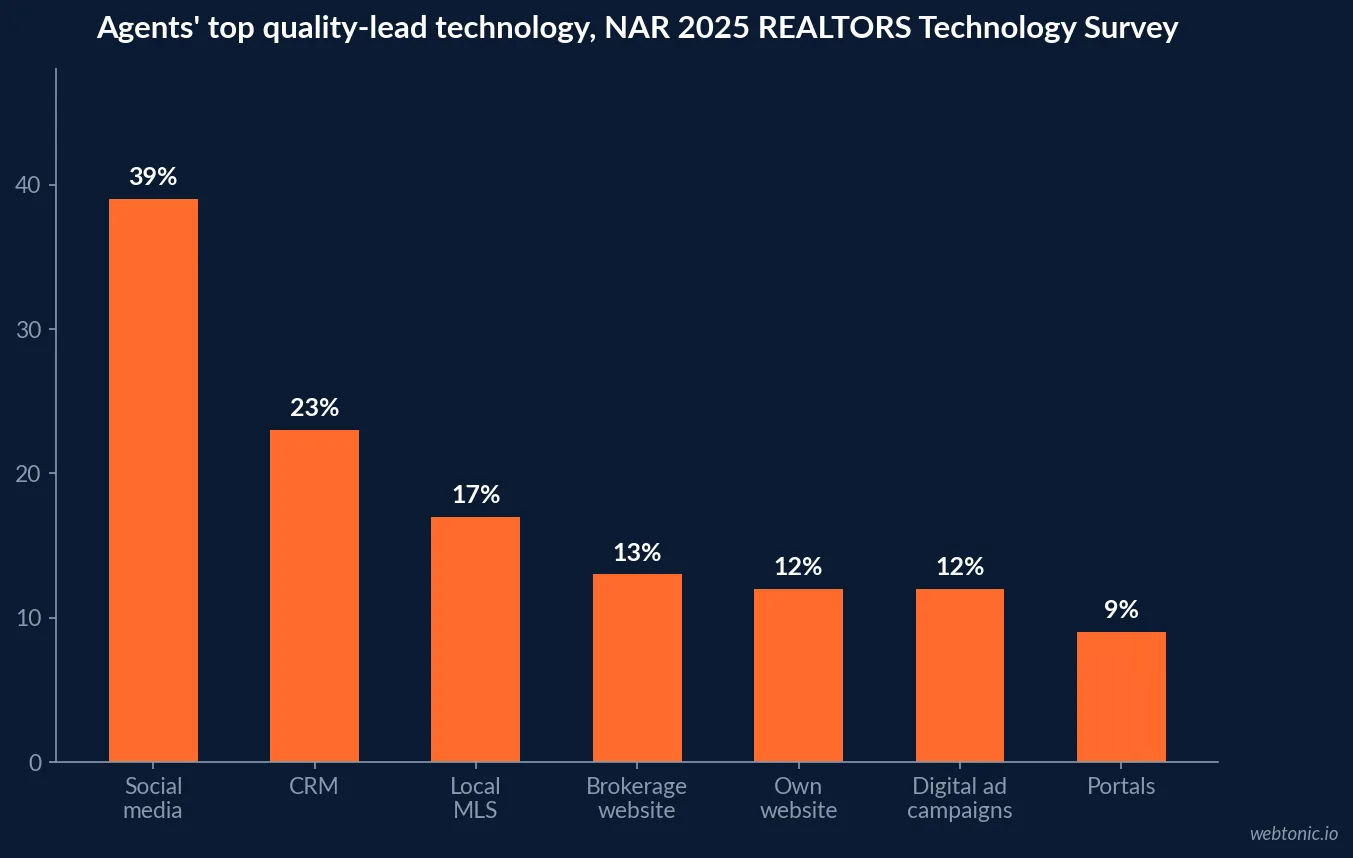
- 12% of agents name their own website their best lead technology; 12% name digital ads.
- Brokerage websites are named by 13%, listing portals by 9%.
- Social media leads agent lead sources at 39%.
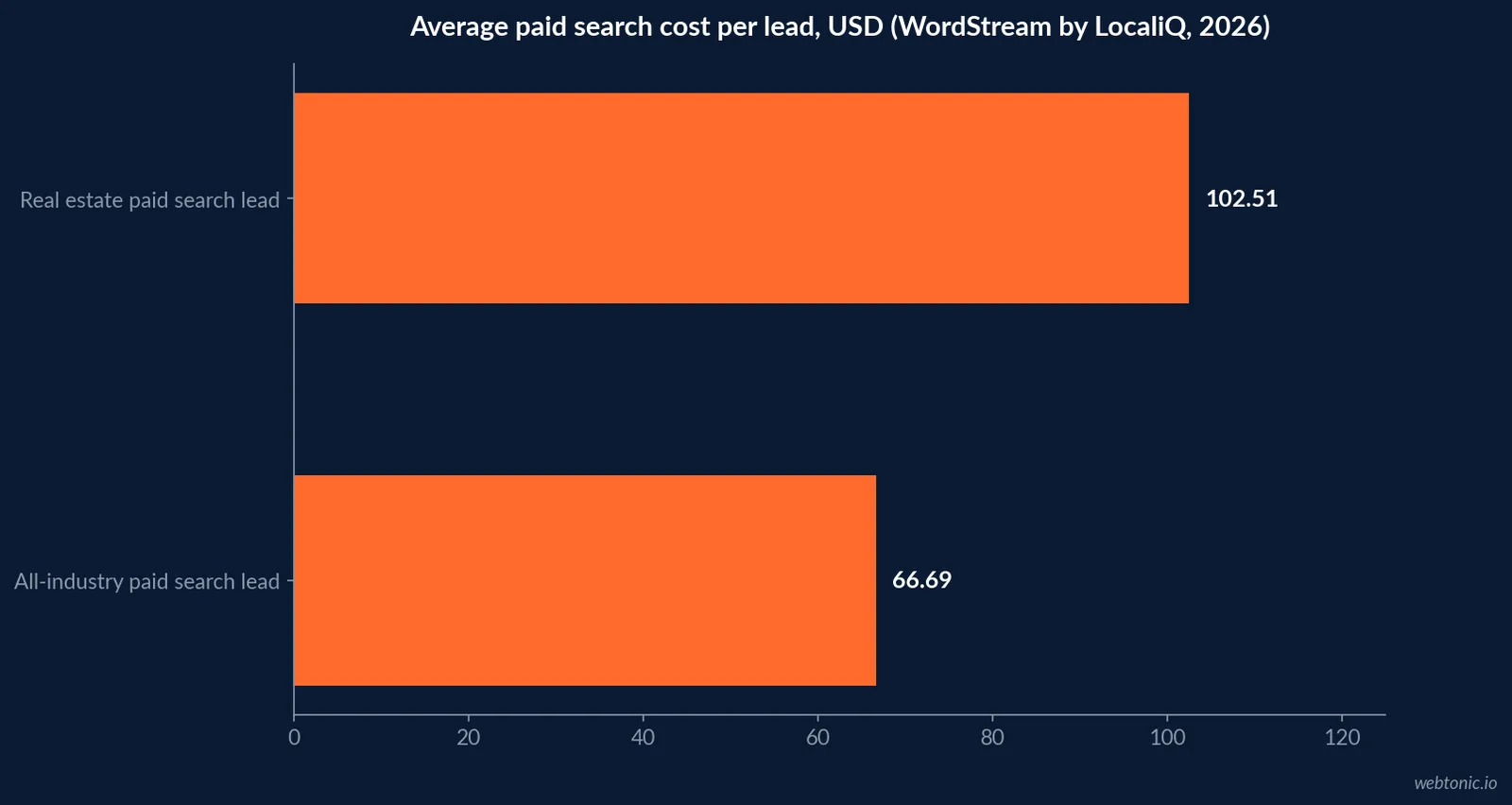
- Real estate paid search averages USD 102.51 per lead in 2026, against USD 66.69 for all industries.
- Real estate clicks average USD 3.22 with a 7.61% click-through rate.
- Organic drove 53.3% of trackable traffic across industries in 2019; paid drove 15.0%.
- 58.5% of US Google searches ended without a click in 2024.
- 88% of buyers purchased through an agent or broker.
Who "enterprise" means in real estate
Most real estate businesses are individual agents working under a broker, which is why enterprise SEO here means brokerages with many offices, franchise networks, large teams and portals. NAR's 2026 Member Profile finds 62% of members hold sales agent licenses, 24% are brokers and 16% are broker associates, and 73% work in real estate as their sole occupation. The typical member earned 28% of business from repeat clients and 22% from referrals in 2025.
That last pair matters for search: half of a typical agent's business arrives through relationships, so a brokerage's organic program is competing for the other half, where buyers and sellers start cold.
| NAR member measure (2026 profile) | Figure | What it means for enterprise SEO |
|---|---|---|
| Sales agent licenses | 62% | Most search demand is captured at brokerage level |
| Brokers | 24% | The owners who fund multi-office SEO |
| Real estate as sole occupation | 73% | Full-time agents can maintain profile pages |
| Business from repeat clients | 28% | Not search-dependent |
| Business from past-client referrals | 22% | Brand searches follow referrals |
The one named organic-vs-paid comparison: agents' best lead source
NAR's 2025 REALTORS Technology Survey, fielded in July 2025, asked members which technology provided the highest number of quality leads. Social media led at 39%, CRM followed at 23% and the local MLS at 17%. The owned-versus-paid rows sit close together: 13% named their brokerage's website, 12% their own business website, 12% a digital ad campaign such as Google or Facebook ads, 11% email marketing, 9% listing syndication or portals, and 1% a personal blog.
Combine the two website rows and owned sites edge ahead of paid campaigns in how often agents name them, but these are answers about perceived lead quality, not measured cost or volume.
| Lead technology (NAR 2025) | Share of agents naming it | Owned, paid or third-party |
|---|---|---|
| Social media | 39% | Mostly owned and organic |
| Brokerage's website | 13% | Owned, organic and direct |
| Own business website | 12% | Owned, organic and direct |
| Digital ad campaign (Google, Facebook, display) | 12% | Paid |
| Listing syndication or portal | 9% | Third-party |
What the paid side costs in 2026
WordStream's 2026 Google Ads benchmarks, a LocaliQ vendor dataset covering Google and Microsoft Ads, put the real estate average at USD 102.51 per lead, one of the highest of its categories, alongside a low USD 3.22 cost per click and a 7.61% click-through rate. Across all industries the averages were USD 66.69 per lead, USD 5.42 per click and 6.64% click-through, with an 8.18% conversion rate.
Cheap clicks and expensive leads is the signature of a category where many searchers are browsing listings rather than ready to contact an agent. That is also the traffic portals win organically.
| Paid search metric (2026) | Real estate | All industries | Source |
|---|---|---|---|
| Average cost per lead | USD 102.51 | USD 66.69 | WordStream (LocaliQ) 2026 |
| Average cost per click | USD 3.22 | USD 5.42 | WordStream (LocaliQ) 2026 |
| Average click-through rate | 7.61% | 6.64% | WordStream (LocaliQ) 2026 |
| Average conversion rate, all industries | Not isolated here | 8.18% | WordStream (LocaliQ) 2026 |
| Organic equivalent | Not published | Not published | No issuer dataset |
The cross-industry traffic split, and its date
For a traffic-share comparison the most cited issuer figure is BrightEdge's 2019 channel report: organic search at 53.3% of trackable traffic, paid search at 15.0%, other channels 27.0% and social 4.7%, measured in May 2019 across thousands of domains with direct traffic excluded. Organic also carried 44.6% of revenue against 27.6% for paid. BrightEdge did not publish a real estate vertical, so the split tells a brokerage what a typical site looked like seven years ago, not what a property site looks like today.
Why "organic" is shrinking before it reaches the site
SparkToro's 2024 zero-click study with Datos panel data found 58.5% of US Google searches ended without a click, and that for every 1,000 US searches only 360 clicks reached the open web. Pew Research Center found users clicked a result in 8% of visits when an AI summary appeared versus 15% without one. Neither study isolates property searches, but both describe the environment a brokerage's organic traffic now has to come through.
Which search engine a brokerage is really optimising for
Statcounter puts Google at 86.1% of US search engine market share in August 2026, Bing at 8.92%, Yahoo at 2.74% and DuckDuckGo at 1.7%. For a brokerage that makes the organic question mostly a Google question, and a Google question in property search is shaped by three surfaces at once: the local map results for "real estate agent near me" style queries, the portal listings that dominate address and "homes for sale" queries, and the AI summaries that now answer many market and process questions directly.
A multi-office brokerage cannot realistically outrank national portals on listing-intent terms, and none of the named datasets suggest it should try. The surfaces it can win are the ones tied to its own entities: office profiles, agent pages, and local market commentary that a portal does not write. Paid search then fills the listing-intent gap at a known cost.
| Search surface | Who usually wins it | Brokerage lever | Related figure |
|---|---|---|---|
| Map results for agent queries | Local offices with complete profiles | Profile management at scale | Bulk verify from 10+ locations |
| Listing and address queries | National portals | Paid search on listing terms | USD 102.51 average paid lead |
| Market and process questions | AI summaries and publishers | Original market data pages | 8% vs 15% click rate |
| Brand name searches | The brokerage itself | Consistent office and agent pages | 22% of business from referrals |
| Search engine mix | Bing check for AI assistants | Google 86.1%, Bing 8.92% |
Office and market pages versus doorway pages
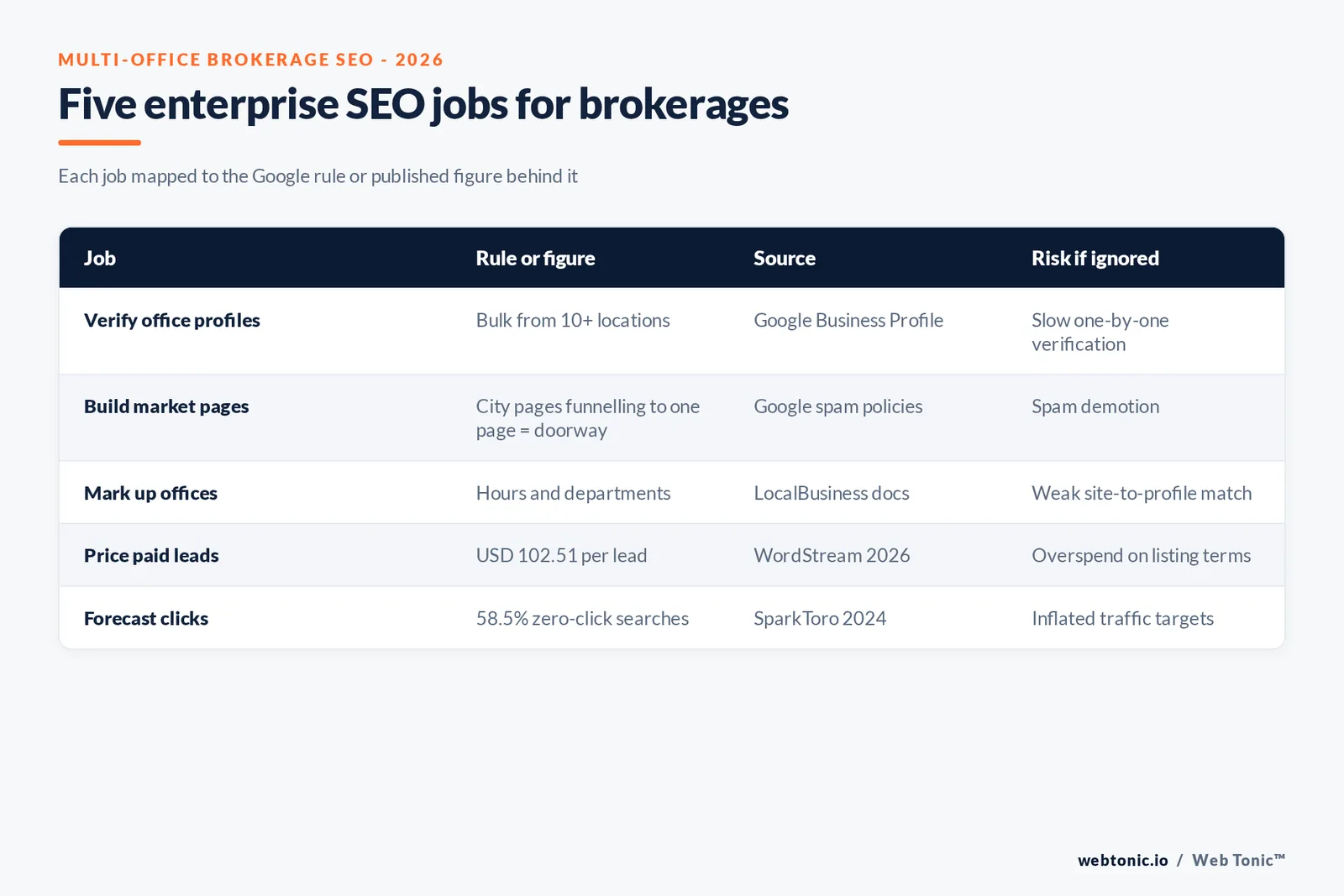
Google's spam policies list, as an example of doorway abuse, "having multiple domain names or pages targeted at specific regions or cities that funnel users to one page". A brokerage with 40 office pages is not a doorway network if each page carries that office's agents, active listings, address and market data. Forty near-identical "homes for sale in [city]" templates that all end at one lead form fit Google's description much more closely.
Running Google Business Profiles across offices
Google Business Profile allows bulk verification once a business has 10 or more locations of the same business. Duplicate, suspended and disabled profiles do not count toward the 10, and agencies that hold several businesses in one account cannot bulk verify. Google's LocalBusiness structured data documentation also lets each office page declare its hours and departments, which ties the site to the profiles.
| Enterprise task | Governing rule or figure | Source |
|---|---|---|
| Bulk profile verification | 10+ locations of the same business | Google Business Profile Help |
| City and market pages | Region pages that funnel to one page are doorway abuse | Google spam policies |
| Office page markup | Hours and departments via LocalBusiness | Google Search Central |
| Measuring organic demand | 58.5% of US searches end with no click | SparkToro / Datos 2024 |
| AI summary exposure | 8% vs 15% click rate | Pew Research 2025 |
Where buyers actually need a brokerage
NAR's 2025 Profile of Home Buyers and Sellers (6,103 responses) finds 88% of buyers purchased through an agent or broker, and 91% of sellers sold with one. Buyers searched for a median 10 weeks, first-time buyers fell to a record-low 21%, and 50% of buyers said they wanted help finding the right home. That need for help is the demand organic content can answer without competing head-on with portals for listing searches.
It also explains why the brokerage, not the individual agent, is the natural owner of enterprise SEO. An agent can maintain a profile page, but only the brokerage can fund market reports, keep office data consistent across dozens of profiles, and hold the technical standards that stop agent pages from duplicating each other. That division of labour is the real organisational question behind organic versus paid.
What the data does not show
There is no issuer-published organic cost per lead, organic conversion rate or organic share of traffic for real estate sites, and we have not estimated one. The NAR data measures which sources agents believe produce quality leads; the WordStream data measures paid costs; BrightEdge measured cross-industry traffic in 2019. An honest organic-versus-paid verdict for a specific brokerage needs its own CRM data joined to Search Console and ad platforms.
Two cautions when you build that. Brand searches for your brokerage name are organic, but most of them exist because of referrals and signage, so separate branded from non-branded queries before crediting SEO. And paid campaigns often capture the same person later in the journey, so a last-click report will overstate one channel and understate the other.
A practical split for multi-office brokerages
- Use paid search for listing-intent terms where a lead averages USD 102.51 and speed matters.
- Put organic effort into office, agent and neighbourhood pages that portals cannot replicate.
- Bulk-manage profiles once you pass 10 offices, and keep NAP identical to office pages.
- Treat social, named by 39% of agents, as part of the same content system.
- Report branded and non-branded organic separately, since 50% of business arrives via repeat and referral.
See the cross-industry view in our enterprise SEO statistics, compare streaming TV options in real estate CTV advertising data, explore growth marketing, or contact us.
Frequently Asked Questions
Is organic or paid search better for real estate leads?
No published study compares organic and paid cost per lead for real estate. The closest named comparison is NAR's 2025 REALTORS Technology Survey, where 12% of agents named their own business website as the technology producing the most quality leads, 13% named their brokerage's website and 12% named digital ad campaigns such as Google or Facebook ads. Social media led at 39%.
What does a paid search lead cost in real estate?
WordStream's 2026 Google Ads benchmarks, a vendor dataset from LocaliQ, put the real estate average cost per lead at USD 102.51 with a USD 3.22 cost per click and a 7.61% click-through rate. The all-industry averages were USD 66.69, USD 5.42 and 6.64%. There is no organic equivalent to set beside those numbers.
What share of website traffic comes from organic search?
BrightEdge's 2019 channel study put organic search at 53.3% of trackable traffic on average and paid search at 15.0%, across thousands of domains with direct traffic excluded. It did not publish a real estate vertical, and the data predates AI Overviews, so treat it as a dated cross-industry baseline.
Are city pages for every market a doorway-page risk?
They can be. Google's spam policies list 'having multiple domain names or pages targeted at specific regions or cities that funnel users to one page' as doorway abuse. Office and market pages that carry real local listings, agents and market data are different from near-identical city templates that all point to one contact form.
Can a brokerage manage many Google Business Profiles at once?
Yes. Google Business Profile allows bulk verification when a business has 10 or more locations of the same business; duplicate, suspended or disabled profiles do not count toward that minimum, and agencies holding several businesses in one account cannot bulk verify.
Sources
NAR - 2025 REALTORS Technology Survey
NAR - 2025 Profile of Home Buyers and Sellers highlights
NAR - 2026 Member Profile feature sheet
WordStream by LocaliQ - 2026 Google Ads benchmarks
BrightEdge - Channel Report 2019
SparkToro - 2024 Zero-Click Search Study
Pew Research Center - AI summaries and clicks, 2025
Google - Spam policies for Google web search
Google Business Profile Help - Verify profiles in bulk
Google - LocalBusiness structured data
Statcounter - US search engine market share


