Table of contents

73% of graded real estate agent websites are missing basic local business schema, and only 26% of REALTORS run a personal website on IDX at all. This page lines up that 2026 site-grading data against the industry's published paid-search benchmarks, so the CTR and cost-per-lead numbers most searches for this topic expect sit next to the organic reality behind them.
Key Takeaways
- 73% of graded real estate agent sites lack local business schema.
- 40.5% are missing a visible Google Maps, reviews or directions element.
- 27% have no home-valuation lead magnet on the homepage.
- Local SEO scores a mean of just 59.6 out of 100 in that same study.
- Only 26% of REALTORS use a personal IDX website.
- Only 21% use a dedicated lead-generation technology.
- Social media is still the top lead-generating tech, named by 39%.
- CRM trails at 23%, local MLS at 17%.
- 13 billion real estate search queries run on Google every year.
- 97% of real estate purchases start with a search engine.
- Real estate's average paid search CTR is 7.61%.
- Average real estate cost per lead sits at USD 102.51.
- Real estate's paid CPC rose 27.27% year over year, the biggest jump measured.
- Residential Real Estate Agent campaigns post an 8.00% click-through rate.
- 18.9% of graded agent sites scored an A grade overall.
- 8.1% scored a D or F.
Why this data pairs a site-grading study with paid benchmarks
Searches for real estate SEO data usually expect CTR and cost-per-lead numbers, but those figures come almost entirely from paid-search benchmark reports, not organic studies - no comparable large-sample organic CTR study exists for real estate specifically. So this page uses the closest real organic evidence available, a 2026 site-grading study of actual agent websites, alongside the published paid benchmarks, and is explicit about which number is which.
What real estate agent websites are actually missing
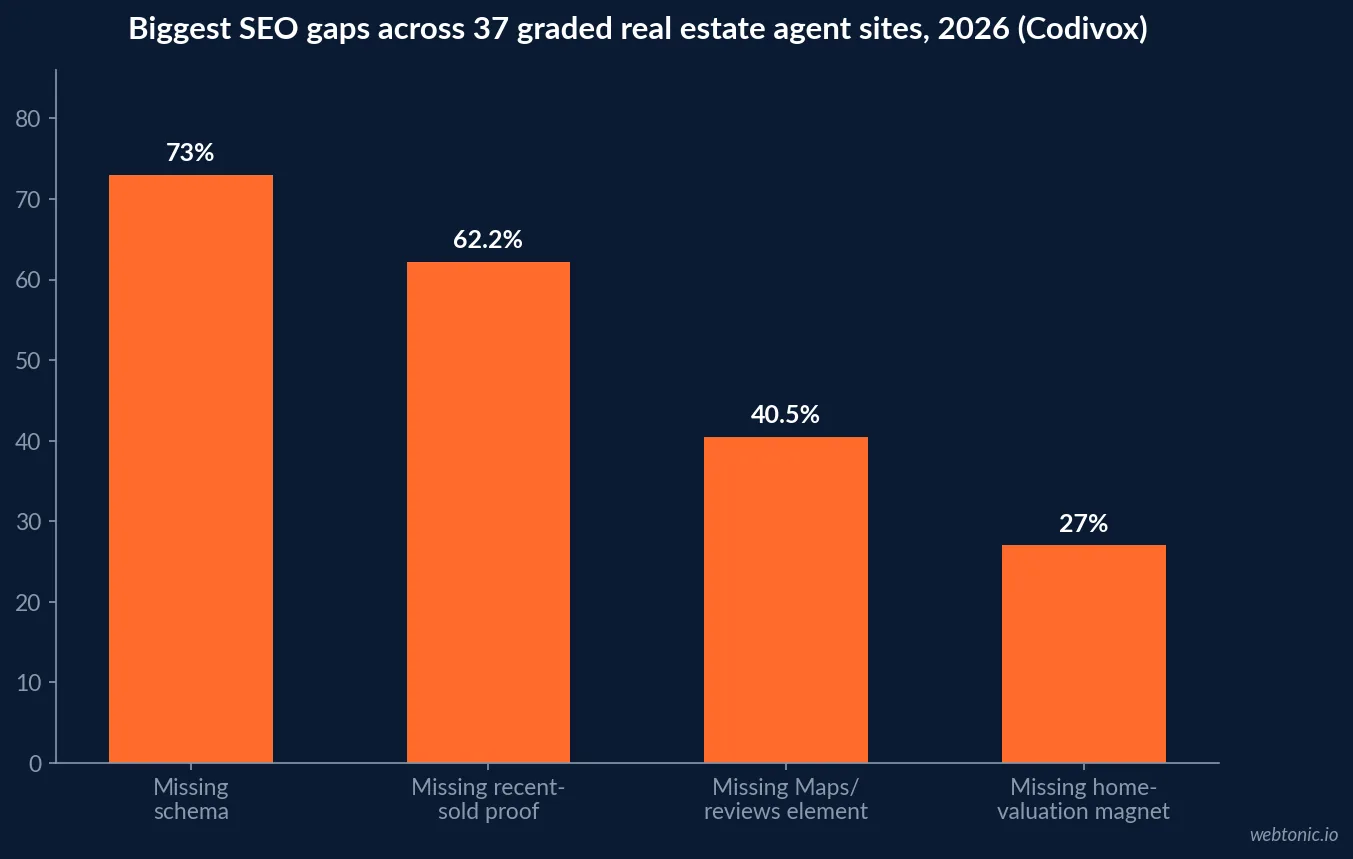
Codivox's 2026 State of Real Estate Websites study sourced 47 U.S. real estate agent and team websites from organic search across roughly 10 metros, excluding portals like Zillow and Realtor.com, and successfully graded 37 of them. 73% were missing RealEstateAgent or LocalBusiness schema markup, 62.2% had no recent-sold or stats-based trust proof, and 40.5% had no visible Google Maps, reviews or directions element on the homepage - all signals that feed directly into local search visibility, not design polish.
On lead capture specifically, 27% had no home-valuation lead magnet and 21.6% lacked a clear primary call to action. Local SEO and Discovery was the weakest-scoring category overall, at a mean of 59.6 out of 100, trailing mobile performance (97.3), content and compliance (97.3), and property search and IDX functionality (91).
| SEO/local signal (Codivox, 37 graded agent sites, 2026) | Present | Missing |
|---|---|---|
| RealEstateAgent / LocalBusiness schema | 27% | 73% |
| Recent sold / stats proof | 37.8% | 62.2% |
| Google Maps / reviews / directions | 59.5% | 40.5% |
| Home-valuation lead magnet | 73% | 27% |
| Primary CTA (search/valuation) | 78.4% | 21.6% |
| Neighborhood / market pages | 91.9% | 8.1% |
Grade distribution: how the sample actually scored
Most graded sites clustered in the middle, not at the extremes. 18.9% scored an A (90-100), 54.1% a B (80-89), 18.9% a C (65-79), and a combined 8.1% scored a D or F. Read plainly: the median real estate agent site is functional but mediocre on the exact local-SEO signals that separate page-one from page-two rankings, which matches why so much of the industry still leans on paid channels instead.
| Grade band | Score range | Share of the 37 graded sites |
|---|---|---|
| A | 90-100 | 18.9% |
| B | 80-89 | 54.1% |
| C | 65-79 | 18.9% |
| D | 50-64 | 2.7% |
| F | Below 50 | 5.4% |
Why agents lean on rented visibility instead of owned SEO
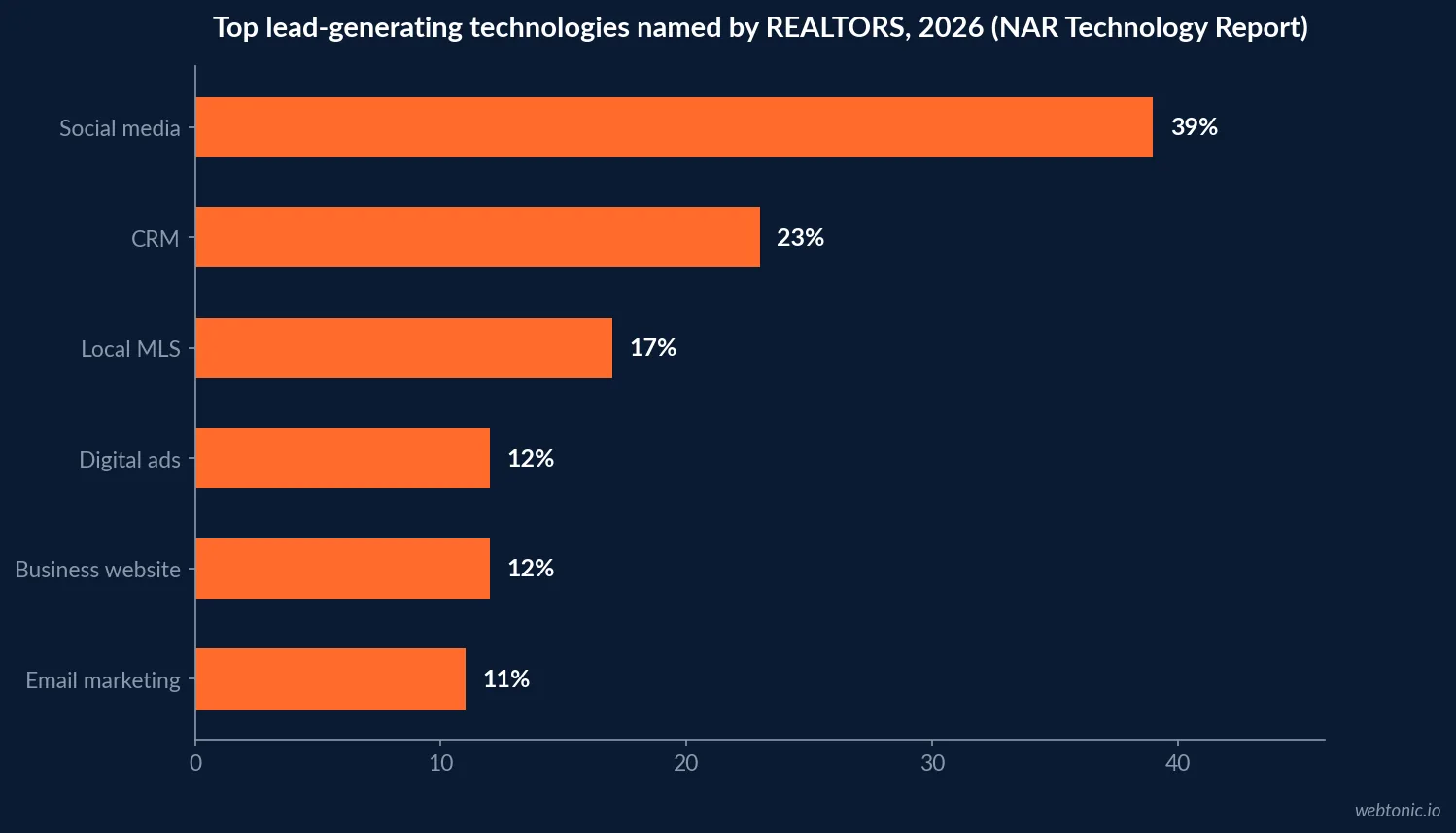
The National Association of REALTORS' 2026 Technology Report, based on roughly 1,200 agent responses, found only 26% of REALTORS use a personal website built on IDX and just 21% use a dedicated lead-generation technology. Social media remains the top lead-generating technology at 39%, ahead of CRM (23%) and the local MLS (17%). That ordering means most agents are renting their visibility from platforms they do not control rather than compounding it through their own site.
That gap is exactly what the Codivox site-grading data reflects on the technical side: schema, trust signals and local content are the parts of SEO an agent has to build once and then own, and they are also the parts most sites skip.
| Lead-generating technology (NAR 2026 Technology Report) | Share of REALTORS naming it top source |
|---|---|
| Social media | 39% |
| Customer relationship management (CRM) | 23% |
| Local MLS | 17% |
| Digital ads | 12% |
| Business website | 12% |
| Email marketing | 11% |
The paid-search numbers this keyword usually means
Because most published real estate benchmarks are paid-search studies, here is that data clearly labeled as such. LocalIQ's 2026 real estate benchmarks, based on nearly 900 real estate search advertising campaigns, report an overall click-through rate of 7.61%, ranging from 5.87% for Homes for Sale by Agent campaigns to 8.00% for Residential Real Estate Agent campaigns, alongside a 3.70% conversion rate. WordStream's parallel 2026 study of over 13,000 campaigns puts real estate's average cost per lead at USD 102.51 - the second highest of the 22 industries tracked - with cost per click up 27.27% year over year, the single biggest increase in the entire report.
The category's underlying search demand explains why that cost keeps climbing: LocalIQ reports 13 billion real estate search queries run on Google every year, and 97% of real estate purchases start with a search engine. Every point of organic ranking an agent's own site earns is one less click that has to be bought at a rising CPC.
| Paid search metric, real estate (2026) | Figure | Source |
|---|---|---|
| Overall click-through rate | 7.61% | LocalIQ |
| CTR, Homes for Sale by Agent | 5.87% | LocalIQ |
| CTR, Residential Real Estate Agent | 8.00% | LocalIQ |
| Overall conversion rate | 3.70% | LocalIQ |
| Average cost per click | USD 3.22 | WordStream |
| Cost per click, year-over-year change | +27.27% | WordStream |
| Average cost per lead | USD 102.51 | WordStream |
What agents actually spend on the technology behind SEO
Budget explains part of the gap. NAR's 2025 REALTORS Technology Survey found 34% of respondents spend only USD 50 to 250 a month on individual technology, and just 38% agree their brokerage provides all the tools they need, with another 29% strongly agreeing. At that budget level, ongoing local SEO work - schema maintenance, neighborhood content, review management - competes directly with CRM and transaction software for the same limited monthly spend, which is a plausible reason schema and trust signals are the parts of the Codivox study most often skipped: they take sustained budget, not a one-time purchase.
| Real estate technology spending signal (NAR 2025 Technology Survey) | Figure |
|---|---|
| Agents spending USD 50-250/month on individual technology | 34% |
| Agents who agree their brokerage provides all tools needed | 38% |
| Agents who strongly agree with that statement | 29% |
| Agents embracing new technology mainly to save time | 66% |
How consumers actually search before they reach an agent
Real estate SEO strategy has to match how local search actually behaves, not how it behaved five years ago. BrightLocal's 2026 Consumer Search Behavior survey, covering 1,227 U.S. consumers, found 73% of local business searches start on mobile, and 52% start specifically on Google Search with a further 9% starting on Google Maps - meaning 61% of the category's search behavior funnels through a single platform before a buyer ever reaches an agent's own site. Across the full search journey, 71% use Google Search at some point, which is the number a real estate SEO strategy should be built to capture, not the smaller slice that starts there.
That same survey found 84% of consumers searched for a local business online in the last three months at all - the baseline demand a real estate agent's SEO has to compete for against portals, brokerages and every other agent in the same market.
| Local search behavior signal (BrightLocal, 2026, n=1,227) | Figure |
|---|---|
| Searches starting on mobile | 73% |
| Searches starting on Google Search | 52% |
| Searches starting on Google Maps | 9% |
| Searches using Google Search at some point in the journey | 71% |
| Consumers who searched for a local business online in 3 months | 84% |
What actually moves a real estate site's rankings
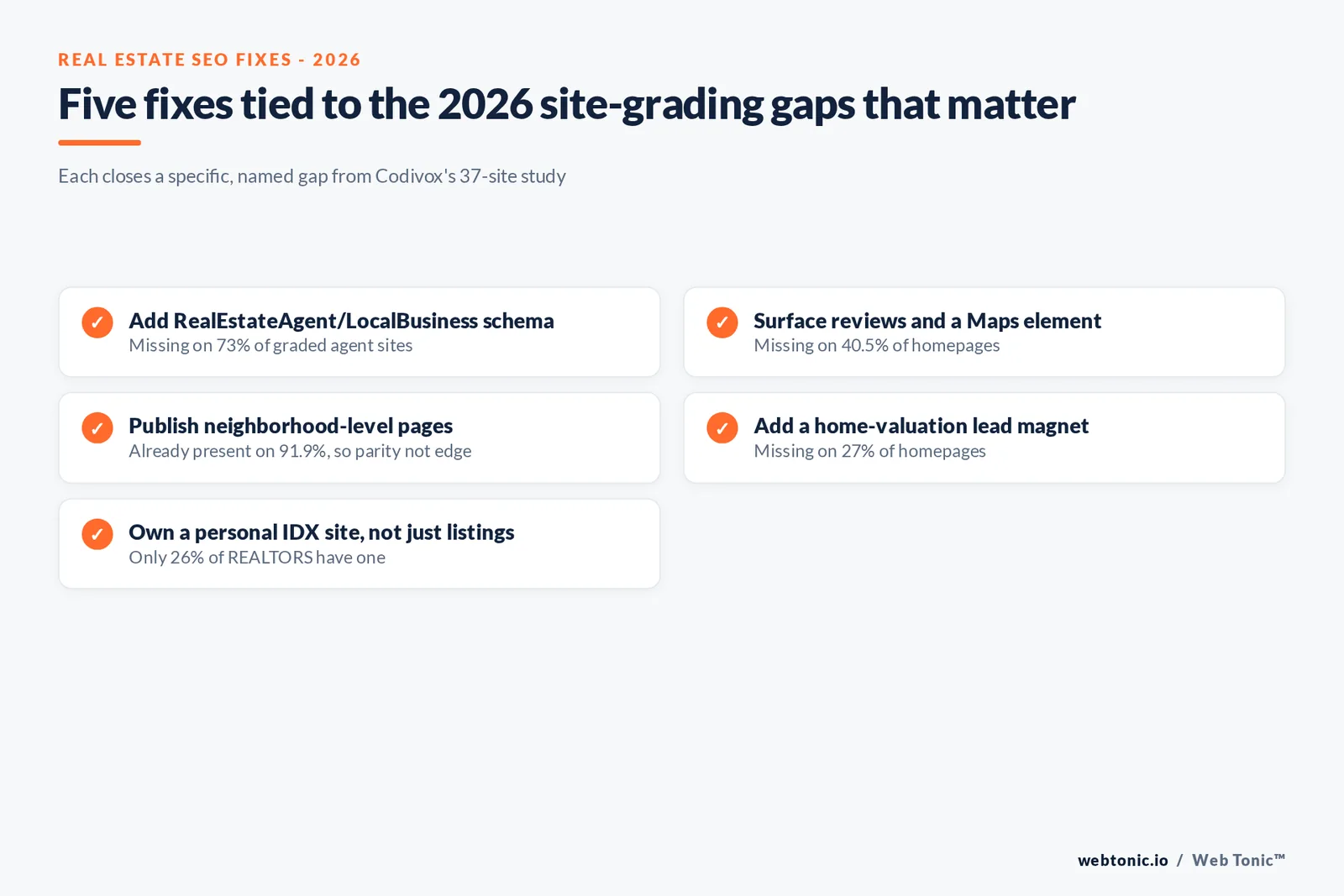
The data points to a short, specific list rather than a generic content calendar: add RealEstateAgent/LocalBusiness schema (the single most commonly missing signal at 73%), surface reviews and a Google Maps element on the homepage (missing on 40.5% of sites), publish neighborhood-level pages (already present on 91.9% of graded sites, so this is closer to parity than differentiation), and add a visible lead-capture element like a home-valuation tool (missing on 27%). None of these require a full rebuild - each is a scoped fix against a documented, named gap.
Our growth marketing practice builds this exact local-SEO layer for real estate clients rather than a generic blog calendar. For the paid side of the same account, see our guide to what Google Ads actually costs, or talk to us about grading your own site against these same signals.
Frequently Asked Questions
What percentage of real estate agent websites have basic SEO in place?
Fewer than you would expect for an industry this competitive. Codivox's 2026 grading study of 37 graded U.S. real estate agent and team websites found 73% missing RealEstateAgent or LocalBusiness schema markup, 40.5% missing a visible Google Maps, reviews or directions element, and 27% missing a home-valuation lead magnet entirely - all gaps that directly touch local search visibility, not cosmetic issues.
What is a good click-through rate for real estate on Google?
For paid search, LocalIQ's 2026 benchmarks put the real estate industry average at 7.61%, ranging from 5.87% for Homes for Sale by Agent up to 8.00% for Residential Real Estate Agent campaigns. There is no equivalent published organic CTR benchmark specific to real estate, but the category's overall search volume - 13 billion real estate queries a year on Google, per LocalIQ - means even a modest organic ranking captures meaningful volume that a 7-8% paid CTR never touches at scale.
How much does a real estate lead cost through paid search versus SEO?
WordStream's 2026 Google Ads benchmarks put real estate's average cost per lead at USD 102.51, the second-highest of the 22 industries it tracks, with cost per click up 27.27% year over year - the biggest single-industry increase in the report. SEO has no equivalent per-lead price tag because the traffic is not bought per click, but the NAR's 2026 Technology Report found only 21% of agents currently use a dedicated lead-generation technology at all, which suggests most of the industry has not built the organic funnel that would make that comparison fair.
Do real estate agents actually invest in their own website and SEO?
Less than in social media. NAR's 2026 Technology Report found only 26% of REALTORS use a personal website built on IDX, and only 21% use a dedicated lead-generation technology, while social media remains the top lead-generating technology at 39%, ahead of CRM at 23% and the local MLS at 17%. Most agents are renting visibility from platforms and social feeds rather than owning it through their own site.
What SEO fix would move the needle fastest for a real estate agent's site?
Local SEO signals score the worst in the 2026 Codivox site-grading study, at a mean of 59.6 out of 100 across the 20% of the grading weight assigned to that category - well behind mobile performance (97.3) and property search UX (91). Adding structured data, a visible Google Business Profile connection and neighborhood-level content closes the specific gap the data shows, rather than a generic content refresh.
Sources
Codivox - State of Real Estate Websites 2026
National Association of REALTORS - The Tech Real Estate Agents Rely on Most in 2026
LocalIQ - 2026 Real Estate Search Advertising Benchmarks
WordStream - Google Ads Benchmarks 2026
BrightLocal - Where Are Your Customers Really Searching? (2026)
National Association of REALTORS - 2025 REALTORS Technology Survey