Table of contents
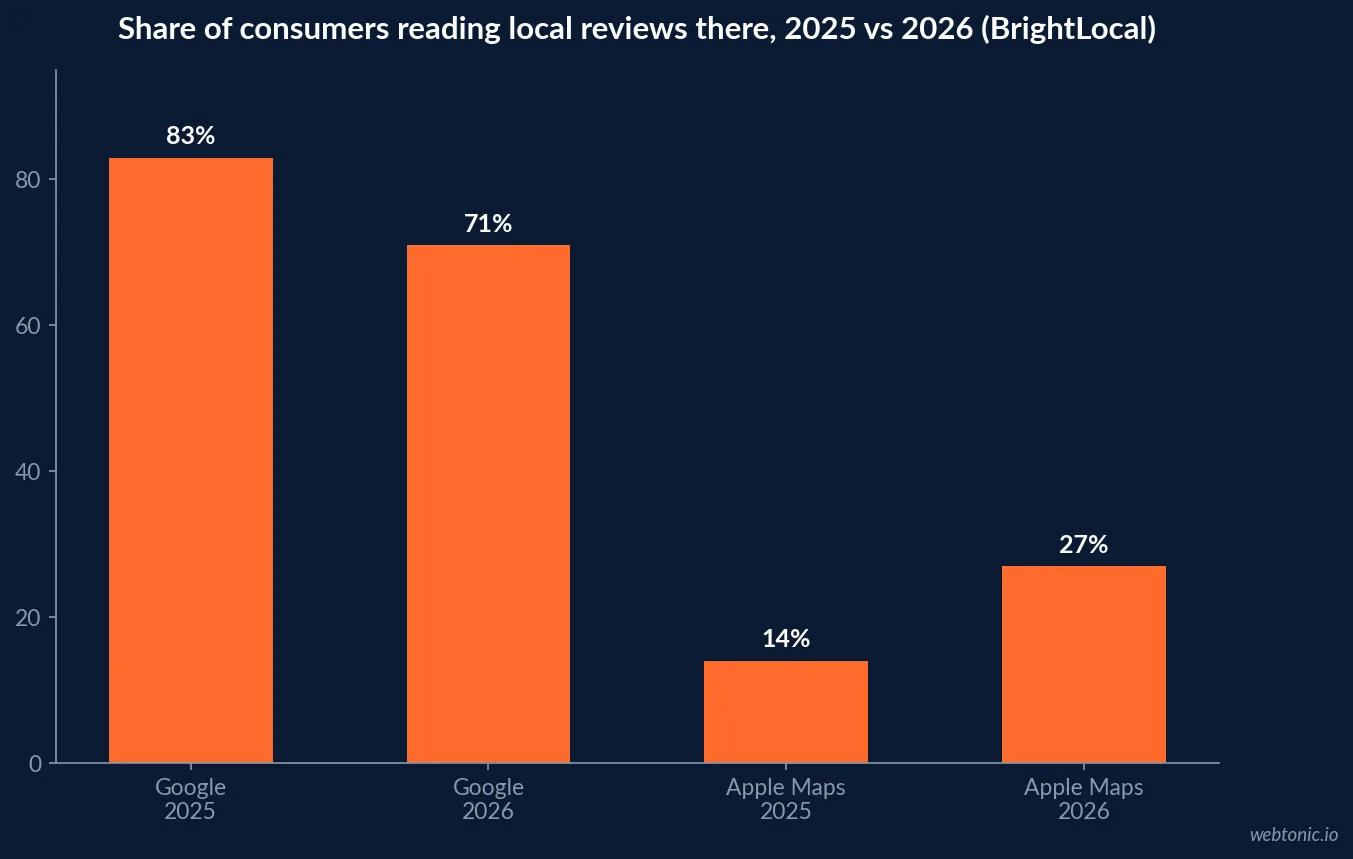
Google's share of local review reading fell from 83% to 71% between 2025 and 2026 while Apple Maps usage for the same behavior nearly doubled, from 14% to 27%. Neither platform has real-estate-specific review-share data published, so the unit of analysis here pairs that cross-industry shift with real estate-specific buyer behavior from the National Association of REALTORS to show what it means for a listing's local presence.
Key Takeaways
- Google's share of local review reads fell from 83% to 71% year over year (BrightLocal 2026).
- Apple Maps usage for reading reviews nearly doubled, from 14% to 27%.
- Only 35% of small and midsize businesses have a Google Business Profile at all.
- Google still carries 79.4% of reviews per location for enterprise brands (Birdeye 2026).
- That Google review share slipped from 80.3% the year before.
- Total review volume per location grew 30.7% year over year.
- 46% of home buyers say their first step was searching online (NAR 2025).
- 88% of buyers and 91% of sellers used an agent or broker for their transaction.
- 97% of consumers now read reviews before choosing a local business.
- 41% of consumers "always" read reviews, up from 29% a year earlier.
- AI tools like ChatGPT grew from 6% to 45% usage for local business recommendations.
- Google is written to by 45% of reviewers, ahead of Facebook (34%) and Apple Maps (17%).
- Apple Maps ranks 4th for writing reviews but 6th for reading them.
- 13 billion real estate search queries happen on Google every year (LocaliQ).
- 97% of real estate purchases start with a search engine.
- 96% of agents still rely on the MLS as their core listing infrastructure.
- Only 26% of agents run a personal IDX website beyond their MLS and portal listings.
The platform shift, in one table
BrightLocal's 2026 Local Consumer Review Survey, based on roughly 1,002 US consumers, tracks where people go to read and write local business reviews. Google remains the clear leader, but its lead is shrinking while Apple's grew faster than any other tracked platform.
| Platform | Share reading reviews, 2025 | Share reading reviews, 2026 | Change |
|---|---|---|---|
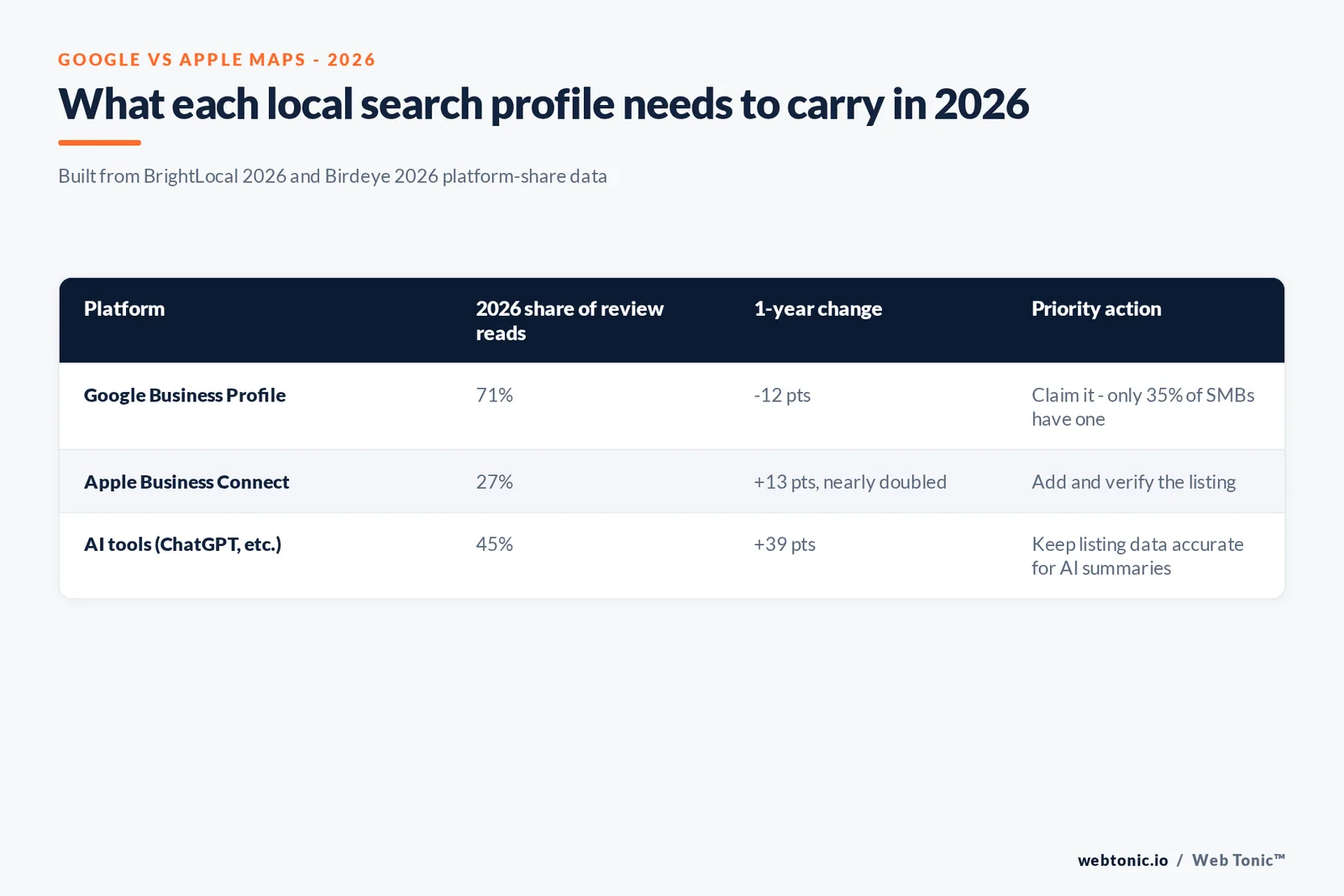
| 83% | 71% | -12 pts | |
| Apple Maps | 14% | 27% | +13 pts, nearly doubled |
| AI tools (ChatGPT, etc.) | 6% | 45% | +39 pts |
Why Google's number is still the one to protect
A shrinking share of a still-dominant platform is not the same as losing. Only 35% of small and midsize businesses have claimed a Google Business Profile at all, per BrightLocal's research cited in the same report - meaning a real estate business without one is invisible to the 71% of consumers still reading Google reviews, before Apple Maps or AI tools even enter the conversation. Fixing that gap outranks chasing the newer platforms for most agents.
What writing reviews looks like, platform by platform
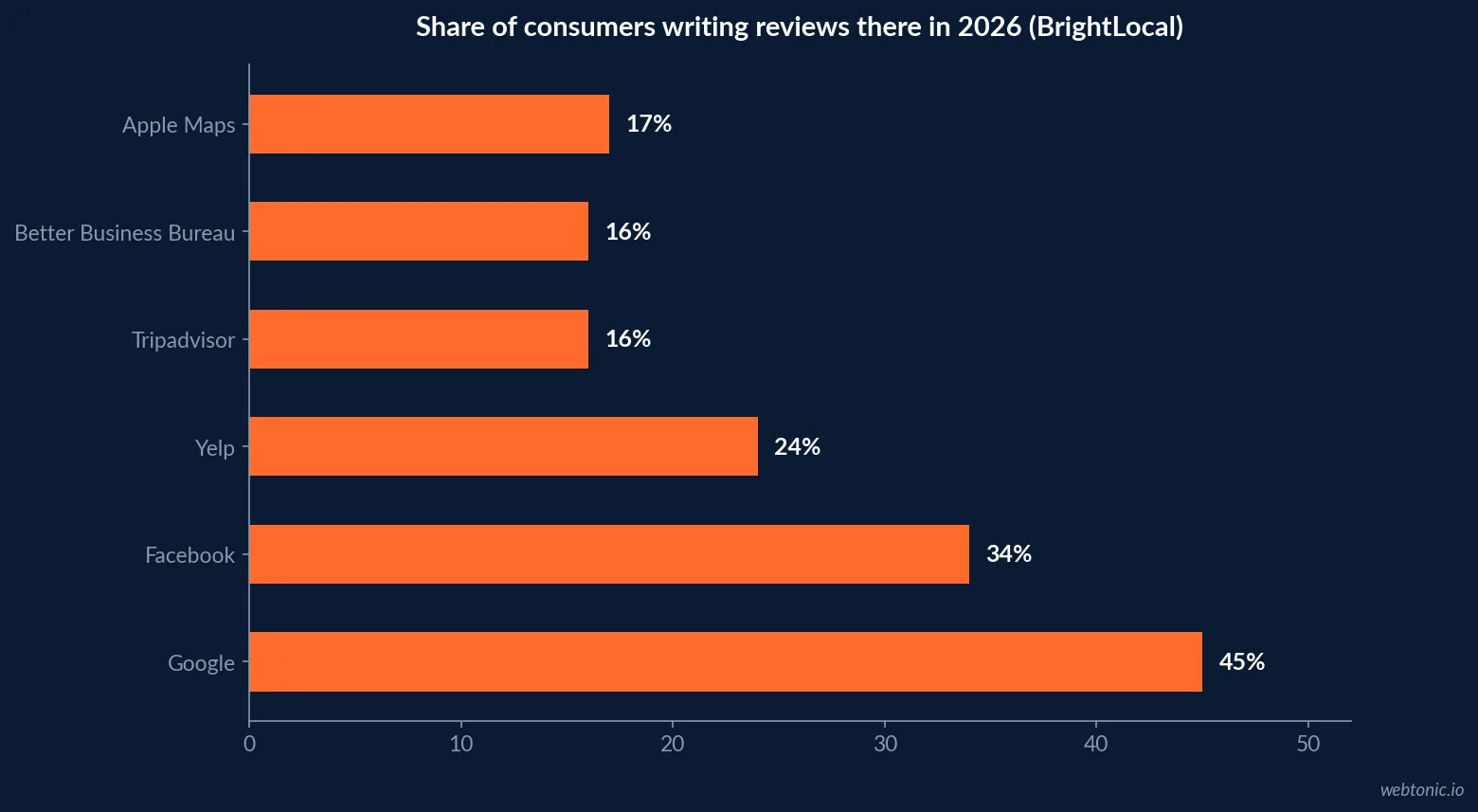
The write side of the ledger runs differently than the read side. Google leads for writing too, but Apple Maps jumps from sixth place on reading to fourth place on writing - it only lets users rate with a star score rather than leave text, which BrightLocal notes changes how and where consumers choose to leave that feedback.
| Platform | Share of consumers who wrote a review there in 2026 |
|---|---|
| 45% | |
| 34% | |
| Yelp | 24% |
| Apple Maps | 17% |
| Tripadvisor | 16% |
| Better Business Bureau | 16% |
Google still dominates volume, even as its share slips
Birdeye's State of Online Reviews 2026 report, which studies enterprise multi-location brands broadly rather than real estate specifically, found Google still carries 79.4% of reviews per location, only a slight dip from 80.3% the year before, while total review volume per location grew 30.7% year over year - the fastest growth rate since 2021. Read together with BrightLocal's consumer-behavior numbers, the picture is one platform still winning on raw review volume while losing ground on where consumers say they go to read.
| Metric (Birdeye 2026, enterprise multi-location brands) | Value | Prior year |
|---|---|---|
| Google share of reviews per location | 79.4% | 80.3% |
| Review volume growth per location | +30.7% YoY | Fastest since 2021 |
What this means for a real estate listing specifically
Real estate is not in BrightLocal's or Birdeye's samples as its own line item, so the honest framing is: these are cross-industry local-discovery shifts, applied to a category where LocaliQ counts 13 billion real estate search queries on Google every year and 97% of real estate purchases start with a search engine. A platform-share shift of 12 points on Google, even a cross-industry one, is not a rounding error against that volume.
What real estate buyers actually do before contacting an agent
The National Association of REALTORS' 2025 Profile of Home Buyers and Sellers, covering transactions that closed between July 2024 and June 2025, found 46% of buyers say their first step was searching for properties online, and 88% of buyers plus 91% of sellers still completed their transaction through an agent or broker. Local search is not replacing the agent relationship - it is the front door buyers walk through before they call one.
| NAR 2025 Profile of Home Buyers and Sellers | Share |
|---|---|
| Buyers whose first step was an online property search | 46% |
| Buyers who purchased through an agent or broker | 88% |
| Sellers who sold through an agent or broker | 91% |
The listing infrastructure behind the review layer
Reviews and maps sit on top of a listing infrastructure most agents have not modernized. NAR's 2026 Technology Report, referenced elsewhere in this series, found 96% of agents still rely on the MLS as their core system and only 26% run a personal website on IDX - meaning most agents' local search footprint is whatever their brokerage or portal profile shows, not a page they control. Claiming and completing a Google Business Profile and an Apple Business Connect listing is one of the few local-SEO moves an individual agent can make without touching that infrastructure at all. Web Tonic's growth marketing team builds that layer for clients who need it done properly.
How the trade press framed the same technology shift
RISMedia's write-up of NAR's 2026 Technology Report frames AI and new tooling as "resetting the client experience," which is the more optimistic half of the story. The less-covered half is that most agents are managing this shift with a thin technology budget - about half spend $50 to $500 a month on everything, not just local search tools - so a Google Business Profile and an Apple Business Connect listing have to be free or near-free wins, not another paid subscription competing for that same modest budget.
A two-platform local SEO checklist for a listing presence
Given the review-platform shift and the buyer-behavior data above, the minimum local presence for an individual agent or small brokerage in 2026 covers both ecosystems, not just the historically dominant one.
| Action | Platform | Why it is on this list |
|---|---|---|
| Claim and fully complete the business profile | Google Business Profile | Only 35% of SMBs have done this at all |
| Add and verify the listing on Apple Business Connect | Apple Maps | Usage nearly doubled year over year |
| Keep NAP data identical across MLS, portal and both profiles | Both | Buyers cross-reference multiple sources before contacting an agent |
| Respond to reviews on both platforms, not just Google | Both | Apple Maps is now the 4th platform consumers write reviews on |
| Monitor AI-generated summaries that reference the listing | Cross-platform | AI tools grew from 6% to 45% usage for local recommendations |
Agencies building this out for clients can benchmark delivery against a documented agency comparison and route new local SEO requests through a scoped conversation rather than treating Google Business Profile and Apple Business Connect as a one-time setup task with no ongoing maintenance.
Why "which platform wins" is the wrong question for most agents
Framed as a single winner, the answer is still Google, comfortably. But the data set behind that answer is moving fast enough that a "set it once and forget it" local SEO plan is already out of date. Apple Maps grew its share of review reads by 13 percentage points in a single year, AI tools grew by 39 points, and Google still lost 12 points even while holding the largest single share of any platform measured. A real estate business optimizing only for the platform that won last year's survey is optimizing for where consumers were, not where they are headed.
The practical takeaway is a maintenance cadence, not a one-time audit: review both profiles monthly, watch for AI-generated summaries that misstate a listing's details, and treat the platform mix as something to re-check against next year's version of this same survey rather than something decided once and left alone.
Frequently Asked Questions
Is Google or Apple Maps more important for real estate local SEO in 2026?
Google, by a wide margin, but the margin is narrowing. BrightLocal's 2026 survey has Google's share of local review reading at 71%, still far ahead of Apple Maps' 27%, but Google's share fell from 83% a year earlier while Apple Maps nearly doubled from 14%. A real estate presence built only on a Google Business Profile is ignoring a fast-growing second surface.
What share of home buyers still start their search online?
46%, according to the National Association of REALTORS' 2025 Profile of Home Buyers and Sellers, which tracked buyers and sellers who closed between July 2024 and June 2025. That is the single most common first step in the home-buying process the survey measures.
How much of a real estate agent's local review footprint sits on Google specifically?
Birdeye's State of Online Reviews 2026 report, covering enterprise multi-location brands broadly rather than real estate alone, found Google carries 79.4% of reviews per location, down slightly from 80.3% the year before - even as Google's overall share slips, it remains the dominant single platform by far.
Do most home buyers still use a real estate agent instead of searching alone?
Yes. NAR's 2025 Profile of Home Buyers and Sellers found 88% of buyers and 91% of sellers completed their transaction through an agent or broker, meaning local search visibility is a lead-routing problem for agents to win, not a sign that buyers are cutting agents out.
Should a real estate business set up Apple Business Connect if it already has a Google Business Profile?
The trend data argues for it. BrightLocal's 2026 survey shows Apple Maps usage for reading local reviews nearly doubled year over year, and it already ranks fourth among platforms consumers use to write reviews. Skipping it means being invisible on a surface that grew faster than almost any other measured in 2026.
Sources
BrightLocal - Local Consumer Review Survey 2026
Birdeye - State of Online Reviews 2026
National Association of REALTORS - 2025 Profile of Home Buyers and Sellers (PDF)
LocaliQ - 2026 Real Estate Search Advertising Benchmarks
National Association of REALTORS - 2026 Technology Report coverage
RISMedia - Report: AI, new tech resetting the client experience
Web Tonic - Growth Marketing services
Web Tonic - About
Web Tonic - Best Google Ads agencies