Table of contents
A procurement manager needs a supplier who can hold a tolerance on a CNC part. An engineer needs a material spec sheet before a design review is even scheduled. Neither one picks up the phone first. They open Google, type in a process or material, and start building a shortlist from whatever shows up on page one.
SEO for manufacturers means structuring a manufacturing company's website and content so it shows up in that shortlist, for the specific processes, materials, and certifications procurement teams and engineers actually search for. It looks different from consumer SEO or even most B2B SEO, because manufacturing buyers search in technical, process-specific language, take months to decide, and often route through a formal RFQ before any sales conversation starts. This playbook covers what makes manufacturing SEO different, what it costs, and where most manufacturers leave leads on the table.
Key Takeaways
- Industrial buyers do their research before ever contacting a supplier: surveys of B2B and industrial buyers have found a majority pay close attention to a supplier's website before submitting an RFI, and 71% start with a generic search, not a branded one — so showing up before a buyer knows your company name matters more than showing up for your own name. (Thomasnet, SEO Sherpa)
- Manufacturing SEO retainers typically range from $3,000 to $10,000 a month for a small manufacturer, up to $10,000 to $30,000 a month for enterprise, multi-facility operations. (Manufacturing SEO Agency)
- Manufacturing SEO has delivered an average 813% return on investment over three years, based on proprietary campaign data First Page Sage has published and multiple independent sources have since cited. (First Page Sage)
- Manufacturing demand concentrates geographically: Texas, California, and Ohio alone account for over $1.8 trillion in annual manufacturing shipments — regional and local SEO is genuinely worthwhile even for industrial sellers, not just local businesses. (U.S. Census Bureau)
- Only 20% of manufacturing marketers rate their own content strategy as very effective, and 67% call it only moderately effective. Most competitors, in other words, are easier to out-rank on technical content than manufacturers assume. (Content Marketing Institute, via Manufacturing SEO Agency)
- A large majority of B2B buyers now use AI tools like ChatGPT, Perplexity, or Google AI Overviews somewhere in their research process — estimates vary by survey, from roughly 73% to as high as 94% — which makes structured, citable technical content a growing part of manufacturing SEO, not just classic rankings. (Mersel AI, SEO Sherpa)
What Makes SEO for Manufacturers Different
Manufacturing SEO starts from a different buyer than most SEO strategies are built for. The searcher is often an engineer or procurement professional typing a process, material, or certification into Google long before they're ready to talk to a salesperson. This isn't an ecommerce SEO problem: unlike ecommerce SEO, which mostly optimizes product pages toward a direct online checkout, manufacturing SEO strategies mostly aim to generate a qualified RFQ. How search engines evaluate technical, industry-specific content hasn't fundamentally changed, but building industry specific pages that actually satisfy an engineer's question is where most generalist digital marketing agencies fall short.
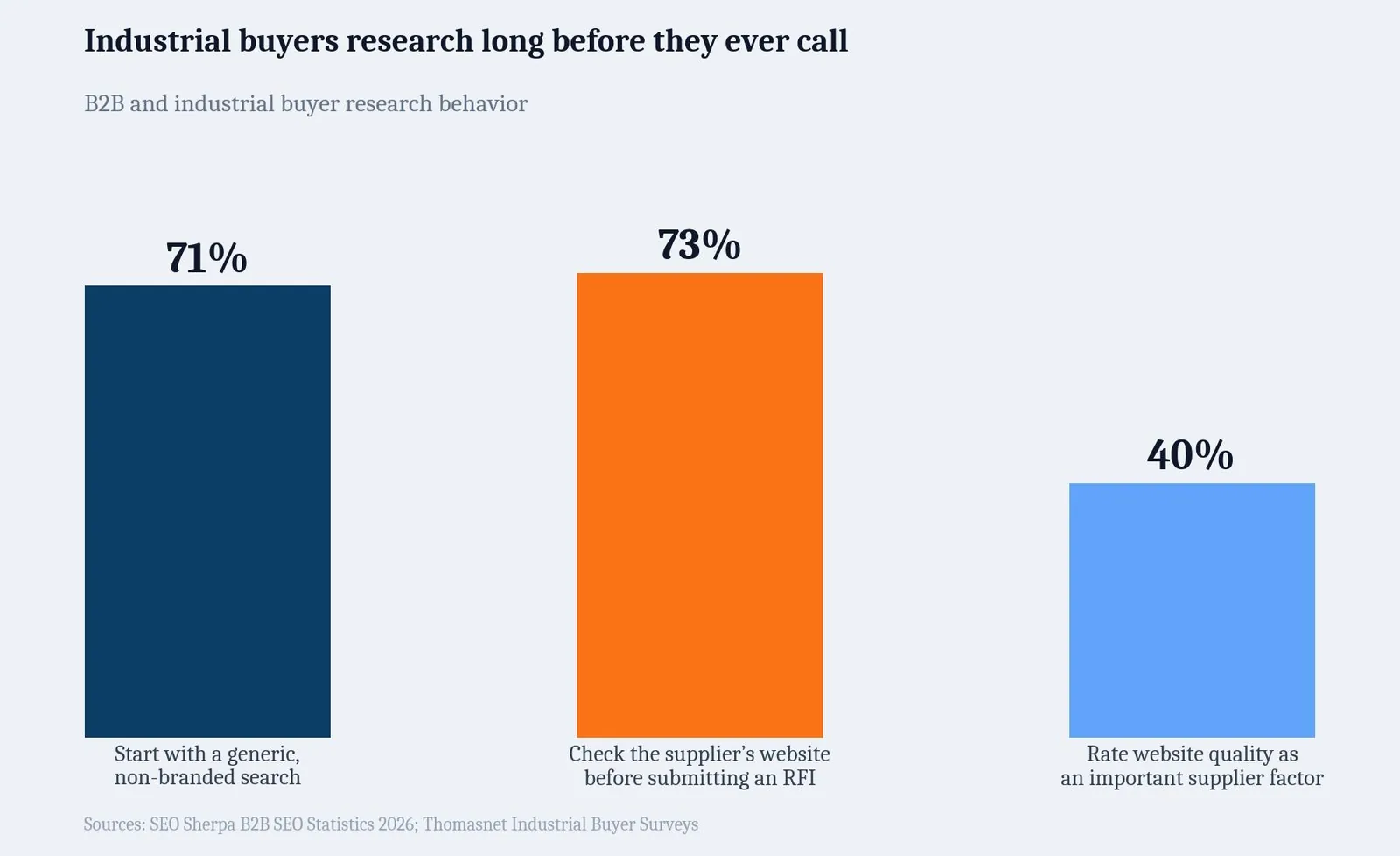
The numbers back this up. 71% of B2B buyers begin their journey with a generic search rather than a branded one, and the average B2B buyer runs somewhere between 8 and 12 searches before ever visiting a specific seller's website. For manufacturers specifically, industrial buyer surveys have found that a large share pay attention to a supplier's website when deciding whether to submit an RFI, and a meaningful share rate website quality itself as an important factor in choosing a supplier (Thomasnet). A manufacturer that only optimizes for its own company name is invisible for the entire research phase where the shortlist actually gets built.
Long sales cycles compound the opportunity. Manufacturing and industrial purchases can take 6 to 18 months and involve a buying committee of up to a dozen people: engineers checking specs, procurement comparing bids, operations confirming capacity. Content that answers a specific technical question can influence that decision long before anyone on the buying committee reaches out, which is exactly the gap most manufacturers' websites leave open.
How Manufacturing SEO Strategies Differ From General SEO
| Factor | General SEO strategies | Manufacturing SEO strategies |
|---|---|---|
| Keyword focus | Broad commercial and informational keywords | Process, material, and certification-specific keywords ("CNC machining tolerances," "IATF 16949 stamping") |
| Buyer | Consumer or generalist B2B buyer | Engineers and procurement professionals with technical vocabulary |
| Content depth | General audience content | Spec sheets, tolerances, and certification detail that require subject-matter accuracy |
| Sales cycle | Days to weeks | 6 to 18 months, often a multi-person buying committee |
| Local SEO relevance | Foot traffic and service areas | Facility locations, regional sourcing, and multi-plant Google Business Profile management |
A generalist SEO company can technically optimize a manufacturer's site, but content that misuses a tolerance callout or a certification name is easy for an engineer to spot, and it quietly costs credibility with the exact audience the content is trying to win. Many manufacturing companies still hire generalist SEO companies whose SEO efforts get measured in traffic volume rather than lead generation, which is the wrong scoreboard for a manufacturer to optimize against. A real content marketing program, paired with marketing strategies built around earning high quality backlinks from trade publications and industry associations, tends to outperform a traffic-only mandate. Trade-focused social media, LinkedIn in particular, reinforces the same technical credibility even though it rarely drives an RFQ directly.
Building a Manufacturing SEO Content Strategy That Works
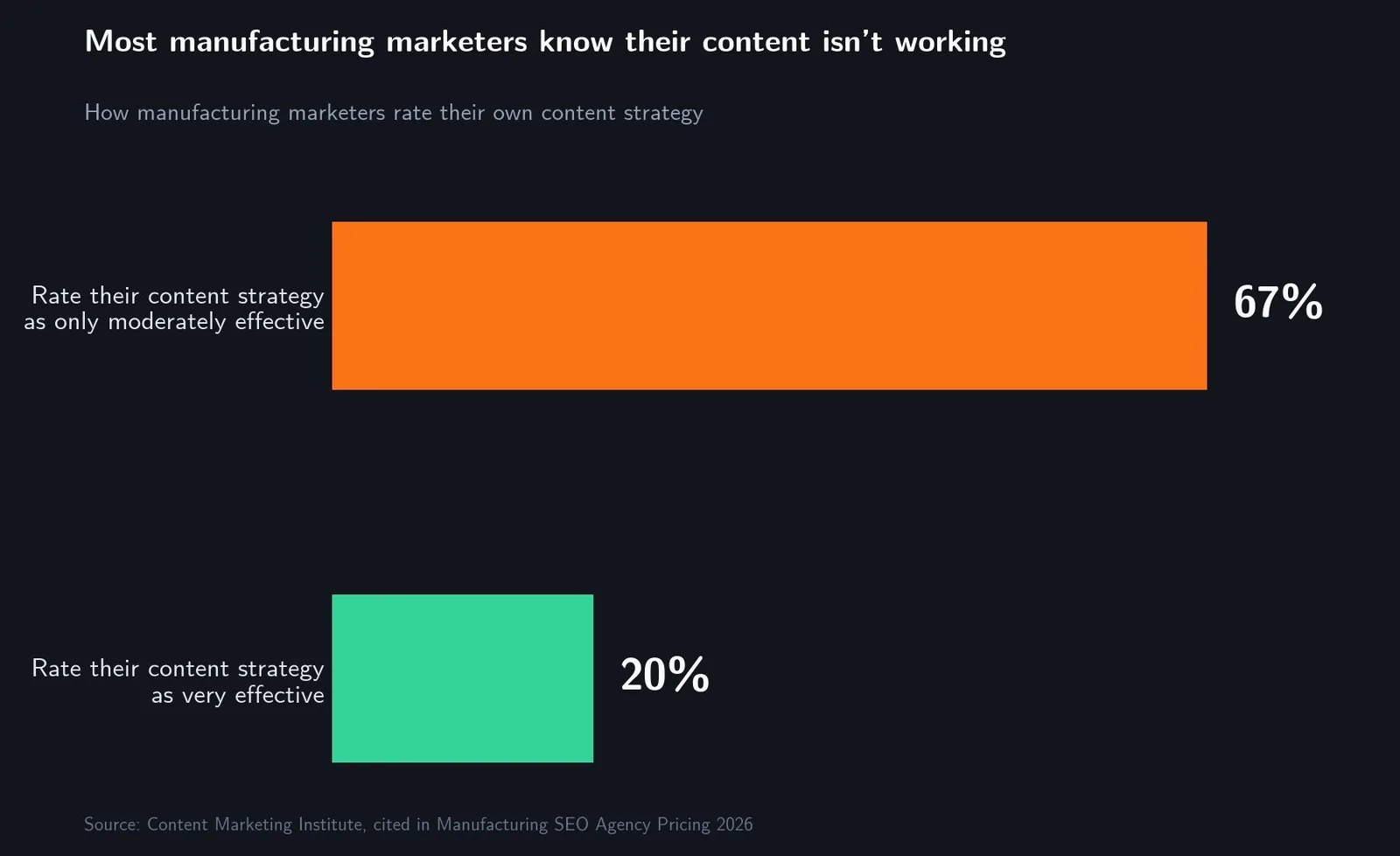
Most manufacturers are already underperforming on content, which is an opportunity as much as a problem: just 20% of manufacturing marketers rate their own content strategy as very effective, while 67% call it only moderately effective. Generic blog posts about "the benefits of quality manufacturing" don't rank and don't convert, because they don't match the specific, technical language buyers actually search.
What works instead is content organized around real procurement-intent keywords: dedicated pages for each process (CNC machining, injection molding, sheet metal fabrication), each material grade, and each certification the company holds. Case studies that walk through a real production challenge and how it was solved tend to perform particularly well with engineers, since they answer the exact "can this company actually do this" question a buyer is trying to resolve. Long-tail keywords, the specific four-plus word phrases buyers actually type, make up the large majority of B2B search queries, which means a page built around "5-axis CNC machining aerospace tolerances" will often out-convert a page chasing "CNC machining company" outright. (The SEO Works)
Local and Multi-Facility SEO for Manufacturers
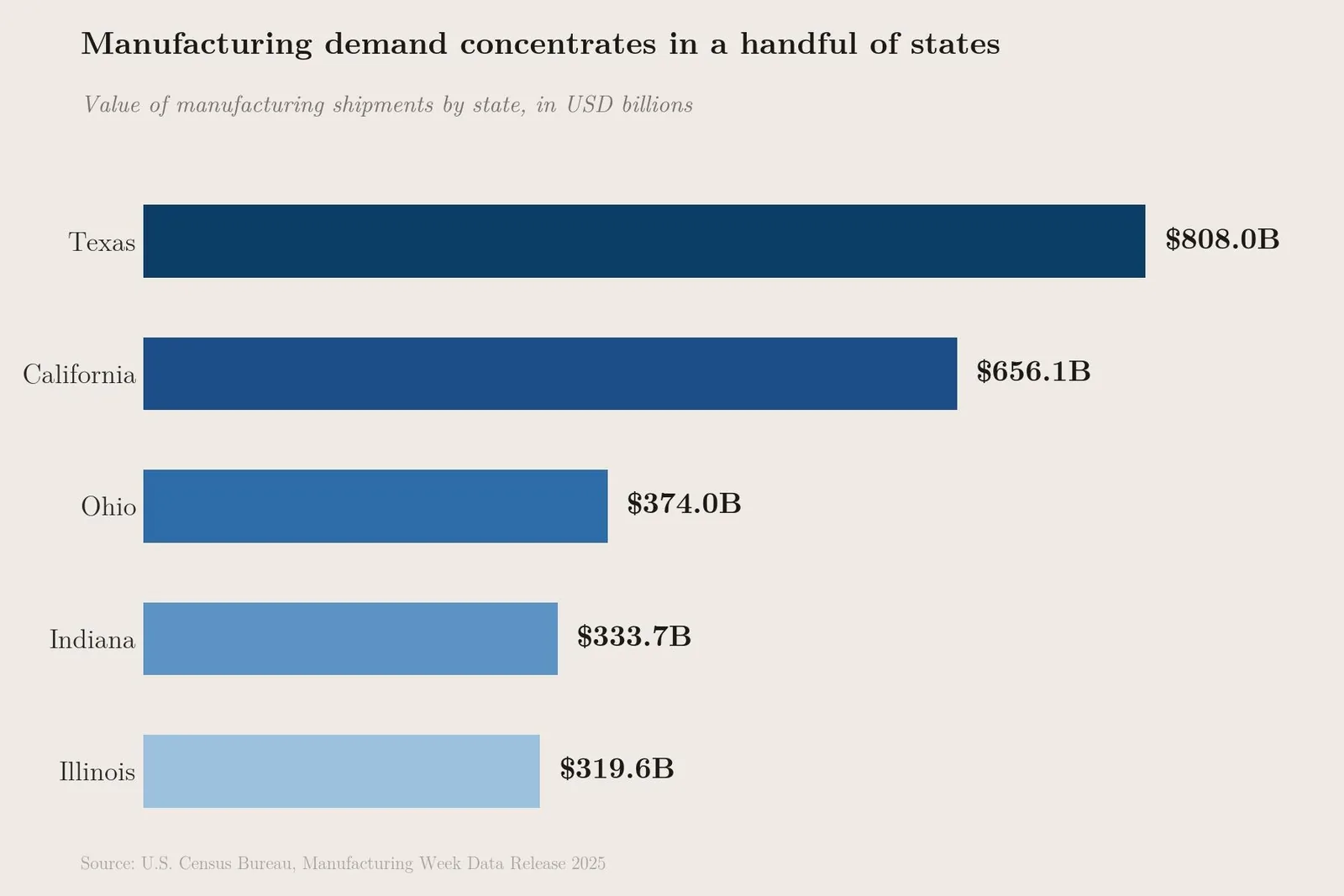
Manufacturing demand isn't evenly spread across the country. Texas alone accounts for roughly $808 billion in annual manufacturing shipments, followed by California at $656 billion, Ohio at $374 billion, Indiana at $334 billion, and Illinois at $320 billion (U.S. Census Bureau). A manufacturer with plants in Ohio and Texas is effectively competing in two very different regional markets, each with its own local SEO behavior.
That's where a properly configured Google Business Profile for every facility, not just headquarters, starts to matter. Consistent NAP (name, address, phone) data across every listing, location-specific service pages, and region-relevant case studies all feed into local search visibility, and B2B companies with optimized Google Business Profiles see meaningfully more clicks to their website as a result (The SEO Works). For a multi-plant manufacturer, this is one of the highest-leverage, lowest-cost parts of the entire SEO strategies list.
Manufacturer SEO tool
Is your website RFQ-ready?
Check off what's already true for your site. Your score updates as you go.
0 of 6
Check off items above to see how RFQ-ready your site is.
What Manufacturing SEO Costs
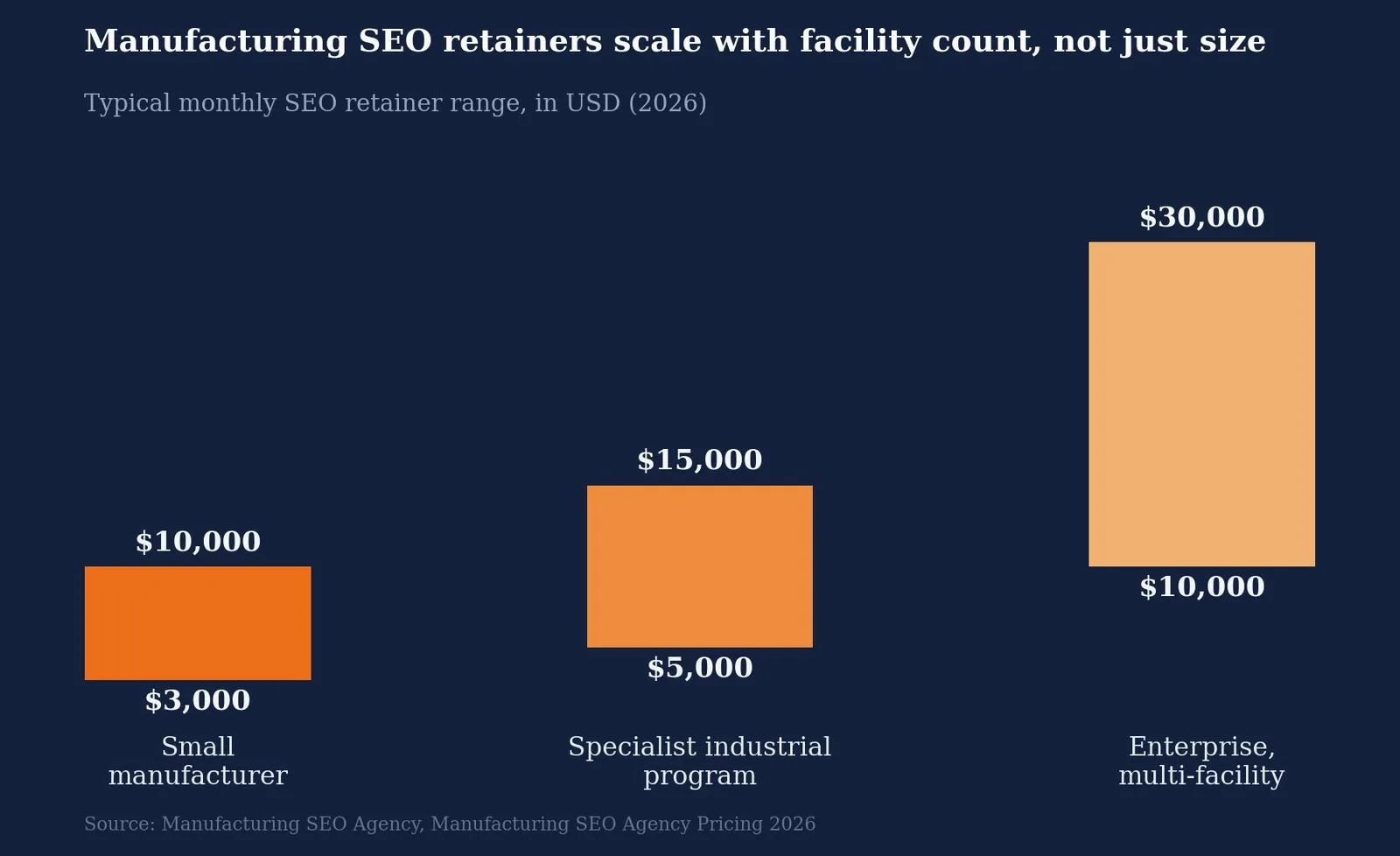
| Company size | Typical monthly retainer (USD) | What it usually includes |
|---|---|---|
| Small manufacturer, single facility | $3,000 – $10,000 | Core technical SEO, process/material pages, basic local SEO |
| Specialist industrial program | $5,000 – $15,000 | Certification-aware content, technical link building, multi-process topical coverage |
| Enterprise, multi-facility | $10,000 – $30,000 | Full-spectrum SEO across every facility, process line, and regional subsidiary |
Full-service industrial marketing programs that bundle SEO with broader demand generation run considerably higher, often $150,000 to $300,000 a year (Manufacturing SEO Agency). Whatever the tier, most manufacturing SEO programs need 4 to 6 months before meaningful ranking movement shows up, with real ROI typically arriving between months 7 and 12. Tracking RFQ-attributed traffic in Google Analytics and watching for crawl or indexing issues in Google Search Console matters more than a vanity ranking report, and many manufacturers still split budget between SEO and PPC without ever measuring which channel actually produces quoted jobs. Manufacturing SEO compounds from there: year two commonly delivers 3 to 5 times the results of year one, which is part of why manufacturing SEO's average 813% three-year ROI looks the way it does. (Mersel AI)
Common Mistakes Manufacturers Make With SEO
Treating the website like a digital brochure is the single biggest mistake manufacturers make. A site built to look professional but not to answer specific process or material questions leaves the entire research phase of the buyer journey to competitors.
Certifications and technical detail get skipped almost as often. Procurement teams filter suppliers by certification before anything else, and a certification that exists but isn't clearly documented on the website might as well not exist to that buyer.
AI search is a newer blind spot, and SEO manufacturers can no longer treat it as optional. With a majority of B2B buyers now using AI tools somewhere in their research, structured content that clearly states capabilities, tolerances, and certifications is what AI systems cite, and unstructured, vague content simply doesn't get pulled into those answers.
Multi-plant manufacturers have their own version of this problem: treating every facility as an afterthought to headquarters. Each facility that lacks its own Google Business Profile and local content is invisible in that facility's regional search results, regardless of how strong the corporate site is.
Frequently Asked Questions
How is SEO for manufacturers different from regular B2B SEO? Manufacturing SEO strategies center on process, material, and certification-specific keywords that match how engineers and procurement professionals actually search, rather than the broader commercial keywords general B2B SEO often targets. Content also needs subject-matter accuracy that a technical buyer will notice if it's wrong.
How much should a manufacturer budget for SEO? Typical ranges run $3,000 to $10,000 a month for a small manufacturer, $5,000 to $15,000 for a specialist industrial program, and $10,000 to $30,000 a month for enterprise, multi-facility operations. Full-service industrial marketing programs can run $150,000 to $300,000 a year.
Does local SEO matter for manufacturers who sell nationally? Yes, particularly for multi-facility companies. Manufacturing demand concentrates in specific states and regions, and a properly optimized Google Business Profile for every facility captures regional searches that a single corporate listing misses entirely.
How long does manufacturing SEO take to show results? Most programs need 4 to 6 months before meaningful ranking movement, with real ROI typically arriving between months 7 and 12. Results compound after that, with year two commonly delivering several times the results of year one.
Do manufacturers need to worry about AI search tools like ChatGPT? Increasingly, yes. With a majority of B2B buyers using AI tools somewhere in their research process, structured, specific content about capabilities and certifications is what gets cited in AI-generated answers, while vague content gets skipped over entirely.
Where Manufacturers Should Focus First
SEO for manufacturers rewards specificity over polish: process-specific pages, documented certifications, and technical content built for engineers and procurement professionals will out-perform a generic, brochure-style website every time. Local SEO deserves more attention than most manufacturers give it, especially for multi-facility operations, and AI search readiness is quickly becoming as important as classic rankings.
A realistic starting point: pick the three or four processes or materials that drive the most revenue, build genuinely deep, accurate pages for each one, and make sure every facility has its own claimed, optimized Google Business Profile before expanding further.
Manufacturing SEO rewards technical depth and patience, but it doesn't have to be built alone. Web Tonic's SEO - GEO - LLMs service line covers technical SEO, industry-specific content, local optimization for multi-facility operations, and AI-search visibility, for manufacturers who'd rather plug into a team that already knows how to build this than staff it from scratch.
More from Web Tonic: growth marketing services, data & analytics.
Sources: blog.thomasnet.com · seosherpa.com · manufacturing-seo.agency · firstpagesage.com · census.gov · mersel.ai · seoworks.co.uk