



Table of contents
Key Takeaways
- Fewer than 30% of franchise location pages rank in the top-3 local pack for their primary service term, according to a 41-brand multi-location study (Source: AuthoritySpecialist).
- 76% of franchise marketing professionals rate Google Business Profile management as their most valuable local SEO service (Source: SOCi).
- There are approximately 1.5 billion "near me" searches per month — about 50 million per day — creating massive high-intent search volume for local franchise businesses (Source: SEOCircular).
- Franchise locations using AI-driven local SEO automation significantly outperform manually managed locations in GBP rankings, review response rates, and citation consistency (Source: SOCi).
- Review velocity matters more than total review count — a location with 30 reviews receiving 2–3 new reviews monthly can outrank a location with 80 reviews and no recent activity (Source: AuthoritySpecialist).
- Franchise brands using subdirectory location pages consolidate 2–3× more domain authority than those deploying individual microsites or subdomains per location (Source: AuthoritySpecialist).
Franchise Local SEO Benchmarks at a Glance
The table below summarizes the critical local SEO performance benchmarks for franchise and multi-location businesses in 2026. These figures are drawn from cross-industry studies, platform data, and franchise marketing surveys.
| Metric | Benchmark | Source |
|---|---|---|
| Top-3 Local Pack Rate | <30% of franchise locations | AuthoritySpecialist (41 brands) |
| GBP as Most Valuable SEO Service | 76% of franchise marketers | SOCi / Local Marketing Survey |
| "Near Me" Monthly Search Volume | ~1.5 billion searches/month | SEOCircular |
| "Near Me" Visitor Conversion | 76% visit within 24 hours | SEOCircular |
| Subdirectory DA Consolidation | 2–3× vs microsites | AuthoritySpecialist |
| Review Velocity Threshold | 2–3 new reviews per month | AuthoritySpecialist |
| Management Time Reduction (AI) | 67% with multi-store dashboards | SOCi |
| Local SEO Budget Allocation | 72% allocate 40%+ to local SEO | MarketingLTB |
Why Local SEO Is the Highest-ROI Channel for Franchises
Local search engine optimization consistently delivers the strongest return on investment for franchise networks. With approximately 1.5 billion "near me" searches happening every month — roughly 50 million per day — the volume of high-intent local queries represents a pipeline that no other channel matches at the individual location level (Source: SEOCircular).
According to MarketingLTB, 72% of franchise systems allocate at least 40% of their marketing budgets to local SEO, making it the single largest line item ahead of paid search and social advertising. The reason is straightforward: local SEO delivers among the highest ROI of any digital channel for franchise businesses, consistently outperforming paid ads when measured at the per-location level (Source: MarketingLTB). However, local SEO operates at the location level, meaning the cumulative ROI across a 100+ unit network compounds rapidly.
Franchise brands that invest in local visibility consistently report shorter sales cycles and lower cost-per-lead compared to national campaigns. A well-managed local search strategy reduces dependency on paid media and creates an owned-traffic asset that appreciates over time rather than requiring continuous ad spend to maintain.
Google Business Profile Performance for Franchise Networks
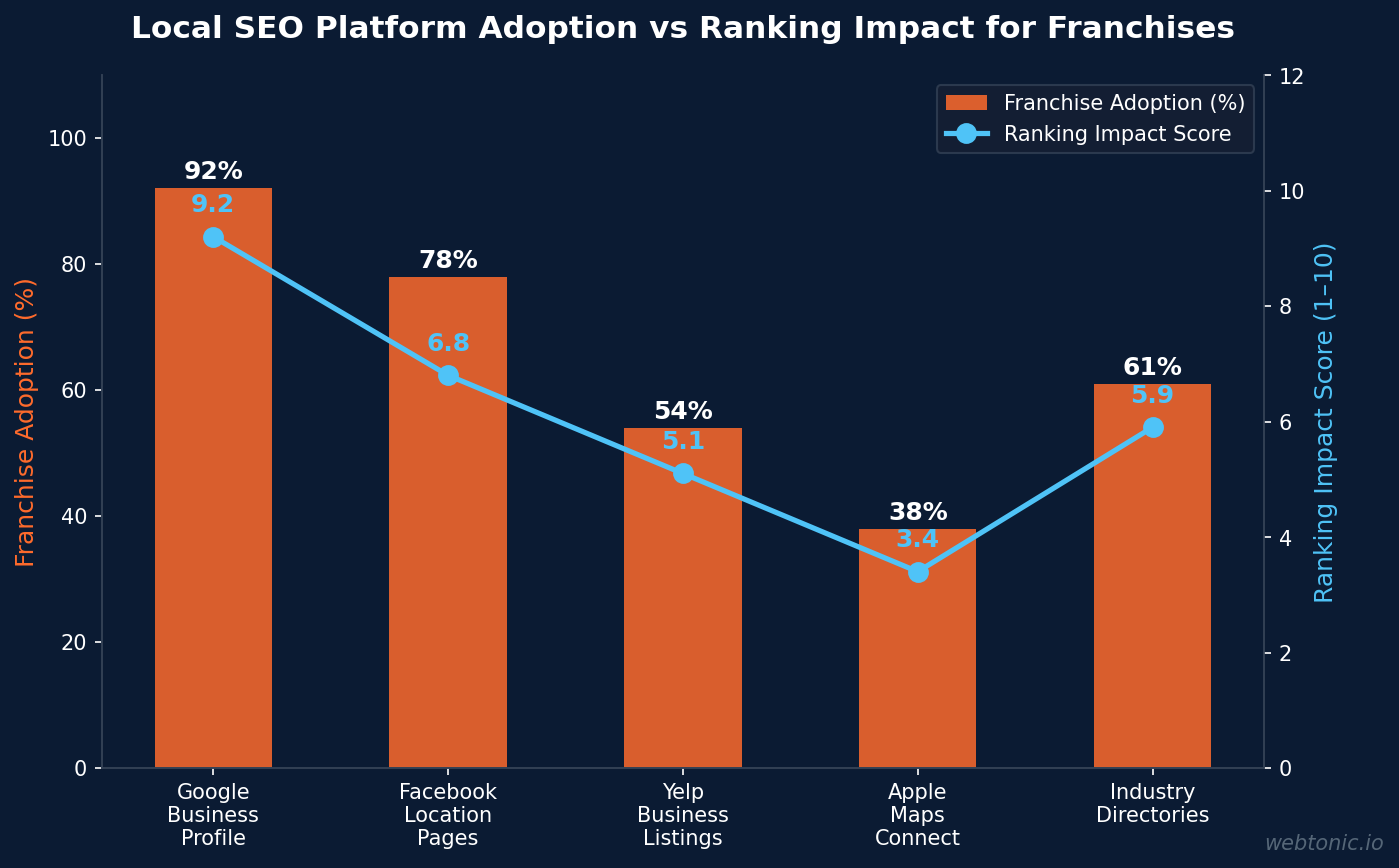
Google Business Profile management is rated the most valuable local SEO service by 76% of franchise marketing professionals (Source: SOCi). The data explains the prioritization: GBP is the primary surface through which consumers discover, evaluate, and contact local businesses directly from search results.
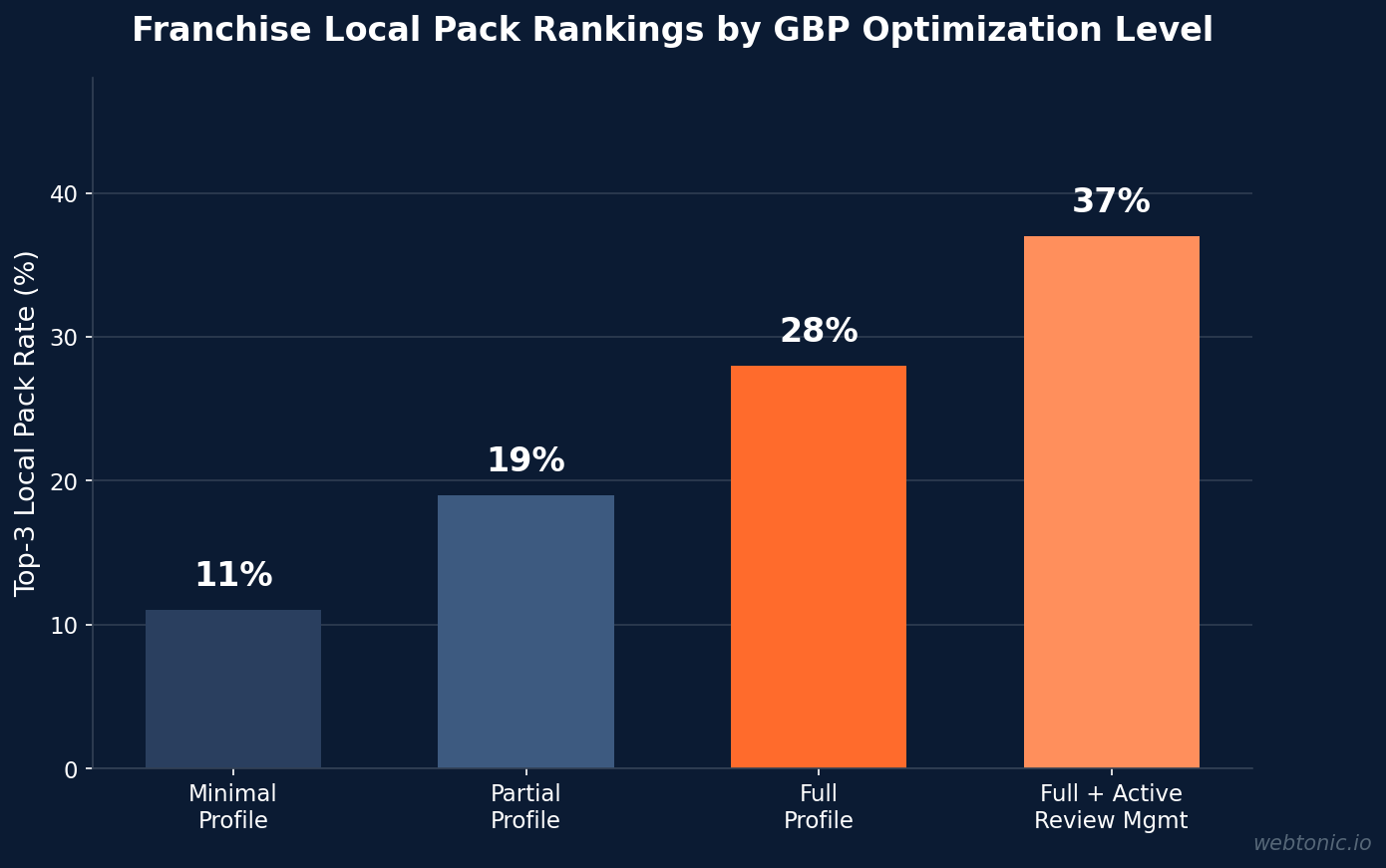
According to the AuthoritySpecialist 41-brand franchise study, franchisees with fully completed Google Business Profiles — including categories, services, hours, and photo content — rank in the local pack at higher rates than those with minimal profiles. The data shows that locations with full profile optimization achieve roughly 37% top-3 local pack placement, compared to just 11% for locations with minimal profiles (Source: AuthoritySpecialist).
For multi-location brands, managing GBP at scale presents operational challenges. SOCi's 2026 Local Visibility Index found that brands using AI-driven automation for GBP management — including automated posting, attribute updates, and category optimization — significantly outperform those relying on manual processes. The gap widens as network size increases, making automated local marketing infrastructure a competitive necessity for franchises with 50+ locations.
Local Pack Rankings: What the Data Shows
The competitive reality for franchise local SEO is sobering. Across the 41 multi-location franchise brands analyzed by AuthoritySpecialist, fewer than 30% of individual location pages rank in the top-3 local pack results for their primary service term in their own territory (Source: AuthoritySpecialist).
This means that the majority of franchise locations are invisible in the most valuable local search real estate. The franchise model creates a paradox: the brand name provides recognition, but Google ranks each physical location almost independently. A flagship store may dominate its local pack while newer or less-optimized locations languish on page two or beyond.
The Search Engine Journal reports that multi-location SEO challenges include rebrands, franchise ownership changes, duplicate listings, and inconsistent updates — all factors that suppress local pack visibility. According to PromoRepublic, the top local SEO ranking factors for multi-location brands remain GBP signals, review signals, on-page signals, and citation consistency — with GBP signals carrying the heaviest weight.
Review Management and Its Impact on Local Rankings
Review signals have become one of the most critical ranking factors for franchise local SEO. The AuthoritySpecialist study reveals a key insight: review velocity matters more than total review count. A location with 80 reviews but no new reviews in six months may underperform a location with just 30 reviews that receives 2–3 new reviews per month consistently (Source: AuthoritySpecialist).
According to Vendasta, consumers read online reviews before making purchase decisions, and franchise brands with unmanaged reviews risk losing customers to competitors who respond faster. The data shows that a location with a 4.6-star rating consistently captures local leads from competitors with higher review counts but lower ratings — proving that recency and response quality outweigh sheer volume.
For franchise networks, review management consistency is the core challenge. Vendasta recommends that multi-location brands must standardize how reviews are requested, monitored, and responded to without requiring corporate to manage each location individually. AI-powered platforms now automate review requests, generate brand-compliant responses, and provide network-wide reporting — enabling franchise marketing teams to enforce standards across hundreds of locations without adding headcount.
Citation Consistency and NAP Data Across Franchise Networks
Citation accuracy remains a foundational element of franchise local SEO. The AuthoritySpecialist study found that multi-location brands with consistent NAP (Name, Address, Phone) data across directories see measurably stronger local authority than those with citation inconsistencies (Source: AuthoritySpecialist).
The challenge for franchises is scale. A 200-location network must maintain accurate listings across potentially 50+ directories per location — creating 10,000+ data points that must remain synchronized. According to Search Engine Journal, common issues include duplicate listings from franchise ownership changes, inconsistent hours after rebrands, and outdated phone numbers from previous operators.
| Citation Factor | Impact on Local Rankings | Franchise Challenge Level |
|---|---|---|
| NAP Consistency | High — measurably stronger local authority | Critical (ownership changes) |
| Directory Coverage | Moderate — 50+ directories per location | High (scale management) |
| Duplicate Listing Cleanup | High — suppresses local pack visibility | High (rebrands, mergers) |
| Hours and Attribute Updates | Moderate — affects user trust signals | Medium (seasonal changes) |
| Photo and Media Content | Moderate — increases profile engagement | Medium (brand compliance) |
Location Page Strategy: Subdirectory vs Microsite Performance
The architectural decision for franchise location pages has significant SEO implications. The AuthoritySpecialist data is clear: franchise brands using subdirectory location pages (e.g., brand.com/locations/city) consolidate 2–3× more domain authority than those deploying individual microsites or subdomains per location (Source: AuthoritySpecialist).
The study across 41 franchise brands found that subdirectory pages typically generate 200–600 organic sessions within 6–12 months of launch, compared to significantly lower traffic for isolated microsites that must build authority from scratch. This consolidation advantage compounds: every new location page added to a strong domain benefits from the existing backlink profile and topical authority of the parent site.
According to SEOCircular, the most effective multi-location SEO framework involves creating dedicated location landing pages with unique content, local schema markup, location-specific testimonials, and embedded Google Maps. The technical setup includes LocalBusiness structured data, hreflang tags for multi-language markets, and canonical tags to prevent duplicate content issues across similar service areas.
AI and Automation in Franchise Local SEO
The scale challenge of managing local SEO across hundreds of franchise locations has driven rapid adoption of AI-powered automation platforms. SOCi's 2026 Local Visibility Index shows that brands managing GBP optimization as an integrated, automated workflow rather than a periodic manual task consistently achieve better rankings and faster response times (Source: SOCi).
Franchise marketing automation now spans several operational domains: local listings management for NAP consistency, GBP optimization with automated posting, review management with AI-generated responses, local content publishing at scale, and performance monitoring across the entire network. According to SOCi, the most effective systems operate at the individual location level rather than applying a one-size-fits-all national template.
The data intelligence infrastructure required for franchise local SEO has matured significantly. Platforms now offer real-time dashboards that track local search visibility alongside review metrics, citation accuracy, and GBP engagement — enabling franchise marketing teams to identify underperforming locations and deploy targeted interventions before rankings deteriorate.
Best Practices for Franchise Local SEO in 2026
- Complete every Google Business Profile field — including primary and secondary categories, services, business description, hours, and at least 10 high-quality photos per location.
- Implement a systematic review generation program — target 2–3 new reviews per location per month to maintain review velocity as a ranking signal.
- Use subdirectory location pages on the main brand domain to consolidate domain authority rather than building separate microsites.
- Audit NAP consistency quarterly — across all directories, paying special attention to locations that recently changed ownership or underwent rebranding.
- Deploy local schema markup (LocalBusiness, Service, and Review structured data) on every location page to enhance search result presentation.
- Invest in AI-powered automation for GBP management, review response, and citation monitoring — manual management does not scale beyond 20–30 locations.
- Publish location-specific content — local event coverage, community involvement, and service-area-specific information that differentiates each page from a template.
- Track location-level metrics — GBP impressions, direction requests, phone calls, and website clicks per location, not just aggregate brand data.
Frequently Asked Questions
What percentage of franchise locations rank in the top-3 local pack?
According to a 41-brand multi-location study by AuthoritySpecialist, fewer than 30% of individual franchise location pages rank in the top-3 local pack results for their primary service term in their own territory. The rate varies significantly based on Google Business Profile optimization level, review velocity, and citation consistency.
How important is Google Business Profile for franchise local SEO?
76% of franchise and multi-location marketing professionals rate GBP management as their most valuable local SEO service. Fully completed GBP profiles — with categories, services, hours, and photo content — rank in the local pack at roughly 3× the rate of minimal profiles (37% vs 11%).
Does review velocity matter more than total review count?
Yes. Research shows that Google's local algorithm weights recency heavily. A franchise location with 30 reviews receiving 2–3 new reviews per month can outperform a location with 80 reviews that has no new activity in six months. Consistent review generation is more valuable than accumulating a large historical count.
Should franchise brands use subdomains or subdirectories for location pages?
Subdirectories consistently outperform subdomains and microsites for franchise SEO. Data shows that subdirectory location pages consolidate 2–3× more domain authority and typically generate 200–600 organic sessions within 6–12 months, compared to significantly less for standalone microsites.
How can franchises scale local SEO across hundreds of locations?
AI-powered franchise marketing automation platforms handle GBP optimization, review monitoring and response, citation management, and local content publishing at scale. Manual management typically becomes unsustainable beyond 20–30 locations, making automated workflows essential for larger networks.
Sources
authorityspecialist.com/industry/professional/consultant/franchise-seo-statistics
seocircular.com/blogs/guide/local-seo-for-multiple-locations
soci.ai/blog/what-is-franchise-marketing-automation
vendasta.com/blog/franchise-review-management
marketingltb.com/blog/statistics/franchise-marketing-statistics
searchenginejournal.com/multi-location-search-visibility-winning-in-google-ai
promorepublic.com/en/blog/local-seo-ranking-factors-that-matter-most


