Table of contents

When someone's water heater floods the basement or their teenager just got a driver's license, the search that follows is immediate: "insurance agent near me" or "auto insurance quote [city]." Google answers with a map and three listings. Those three slots get the calls. Everything else, including the agent with 20 years of experience and a spotless Better Business Bureau rating, becomes an afterthought if they aren't one of the three.
SEO for insurance agents is how an independent agency earns that spot without matching Allstate or Geico's national ad budgets, and how it ranks for the local keywords that actually convert instead of the broad, expensive terms carriers already own. Whether you call it insurance agent SEO, insurance agency SEO, or just local marketing, the fundamentals are the same: a properly optimized Google Business Profile (GBP), location-specific content, consistent trust signals, and a review system that keeps compounding. This complete guide for agents covers what actually works in 2026, what it costs, and how independent agents compete against carriers with far deeper pockets.
Key Takeaways
- 46% of all Google searches carry local intent, and 76% of people who run a "near me" search visit a business within 24 hours, making local SEO the highest-intent, lowest-cost lead channel available to an agency.
- Your Google Business Profile's primary category should be "Insurance Agency," with a secondary category added for each line sold (auto, home, life, Medicare), not a single generic listing.
- NAP consistency (name, address, phone number) across the agency's website, GBP, and directories like the Better Business Bureau is foundational; mismatches quietly suppress local rankings.
- 69% of insurance customers search online before scheduling an appointment with an agent, so a firm invisible in search is invisible to most of its potential book of business.
- Typical SEO investment for a competitive insurance agency runs from $100 to $250 USD per hour, $3,000 to $7,500 USD per month for a retainer, or $5,000 to $50,000 USD for project-based work, with most agents seeing local ranking movement within 3 to 6 months.
- Reviews are one of the strongest local ranking signals available, and agencies that request them systematically after every enrollment or renewal tend to outperform agencies that treat reviews as an afterthought.
What is SEO for insurance agents?
SEO for insurance agents is the practice of optimizing an agency's Google Business Profile, website, and content so it ranks when potential clients search for insurance products in their area. It draws on the same core disciplines search engines reward for any local business, technical SEO, on-page content, and local citations, but insurance carries its own competitive dynamic: independent agents aren't just competing with each other, they're competing with national insurance companies that dominate paid search and brand recognition.
That's exactly where local SEO creates an opening. The same playbook applies whether you're doing SEO for insurance agencies with a single office or SEO for insurance companies operating across many states, but this guide is built for the independent agent's reality: national carriers optimize for broad, expensive keywords, while an independent agent who builds out dedicated content for their specific city, county, or service area, paired with a fully optimized Google Business Profile, can out-rank a national brand for the searches that actually convert.
How people search for insurance locally
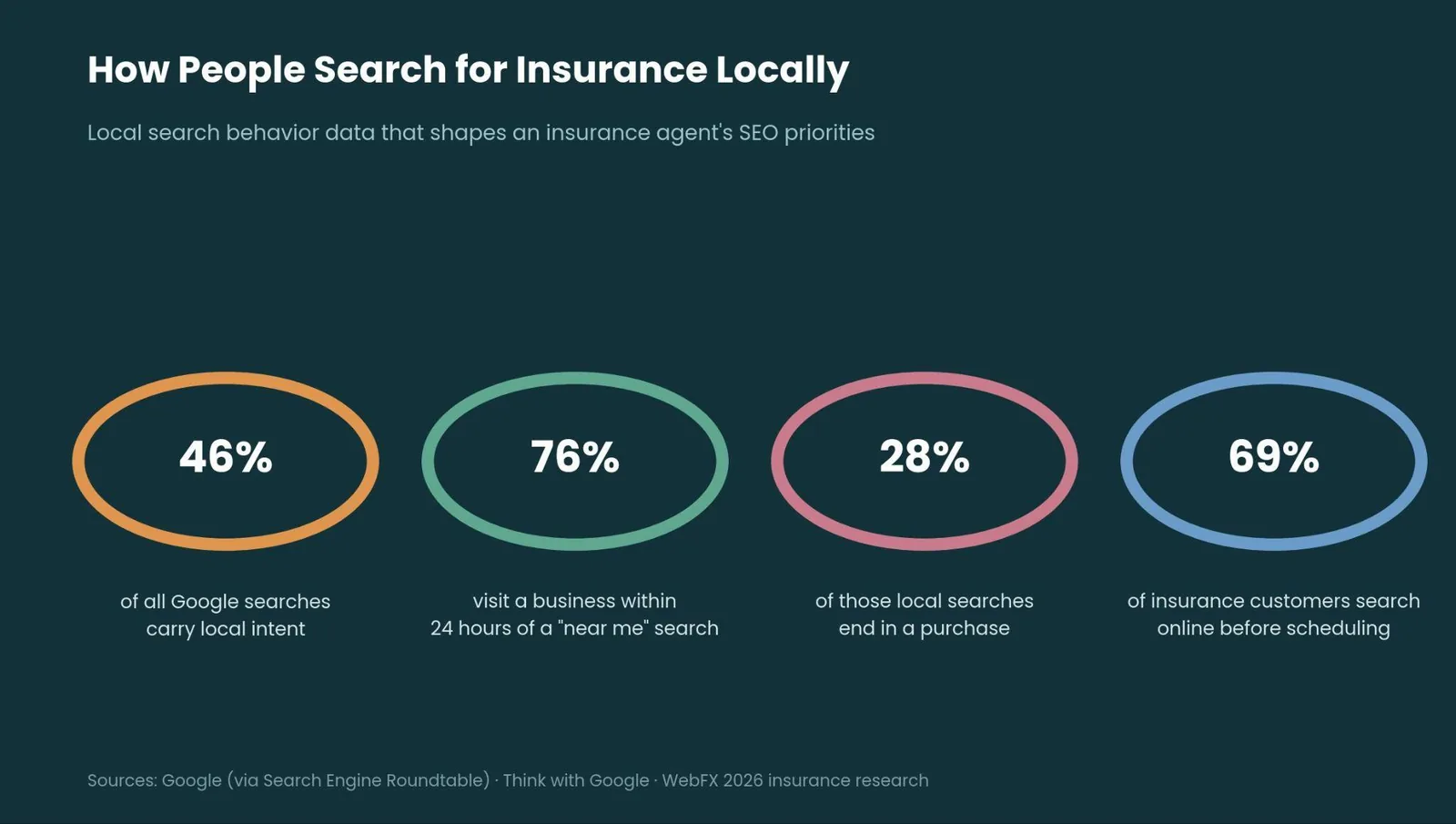
The behavioral data explains why local search matters so much for insurance agencies. Google reports that 46% of all Google searches carry local intent, a figure compiled in local SEO research built specifically for insurance agents. Think with Google separately found that 76% of people who run a "near me" search on a smartphone visit a related business within a day, with 28% of those local searches ending in a purchase, not idle browsing, a buyer on a deadline. One more data point rounds this out: Sonant AI, citing WebFX research, found that 69% of insurance customers conduct an online search before ever scheduling an appointment with an agent or broker.
SEO vs. PPC for insurance agents
Most agencies buy SEO services in one of two ways, an hourly or retainer relationship with an agency, or a bundled package alongside paid media. Either way, it helps to know how SEO and PPC actually compare:
| Factor | SEO (organic) | PPC (paid ads) |
|---|---|---|
| Cost model | Time and investment in GBP, content, and reviews | Ongoing cost per click |
| Time to results | Typically 3-6 months | Immediate |
| Long-term value | Compounds, keeps generating leads after the work is done | Stops the moment spend stops |
| Competitive position | Lets independent agents out-rank national carriers locally | National carriers can outbid independents on broad terms |
| Primary channel | Google Business Profile, location pages, reviews | Google Ads, paid search |
| Typical monthly cost | $3,000 to $7,500 USD (retainer) | Insurance is one of the most expensive PPC verticals online |
Most competitive agencies run both as part of one broader marketing strategy, since insurance is famously one of the priciest verticals for paid clicks. PPC buys immediate visibility while local SEO compounds in the background, and agencies with a strong organic foundation typically reduce paid spend over time as the Local Pack does more of the work for free.
The insurance agent SEO roadmap
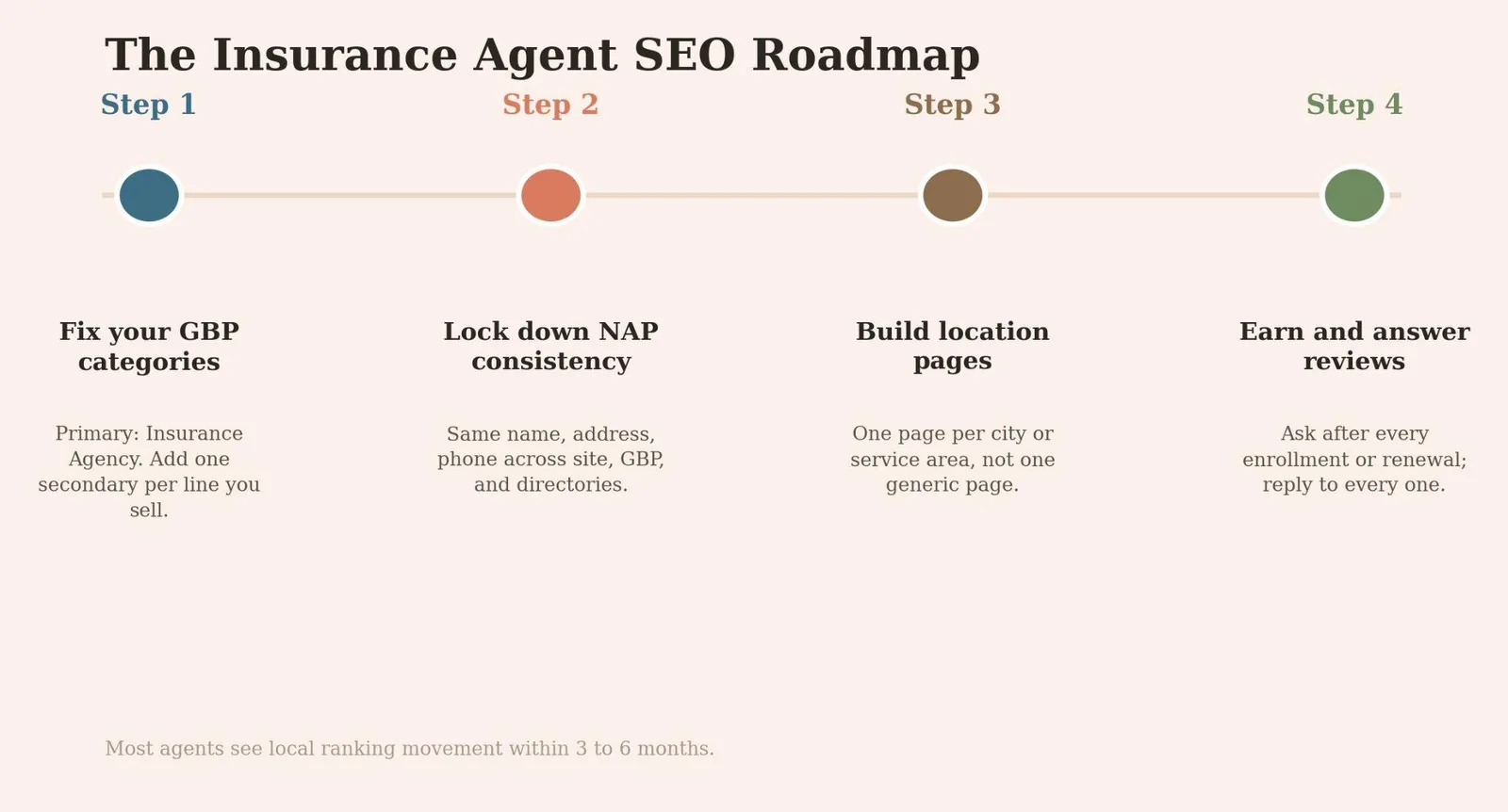
Step 1: Fix your Google Business Profile categories
The primary category should be "Insurance Agency," not a vague catch-all. Add a secondary category for every line actually sold, auto, home, life, Medicare, so the profile surfaces for each specific search rather than just the broadest one. Agents with multiple office locations should audit every one of their Google Business Profiles individually rather than assuming one clean listing means they all are. This is usually the single fastest fix available for GBP visibility.
Step 2: Lock down NAP consistency
Name, address, and phone number need to match exactly across the agency's website, Google Business Profile, and every directory it's listed on, including the Better Business Bureau and insurance-specific directories. Independent agents who work under an IMO (Independent Marketing Organization, a company that connects independent agents with carrier partnerships and shared marketing resources) should double check that any IMO-provided listings use the exact same NAP details as the agency's own site.
Step 3: Build dedicated location pages
One generic "insurance services" page cannot rank for every city or service area an agency covers, or for more than one or two keywords at a time. Each page should target one clear keyword and one location, not several at once. Location-specific blog posts, "Medicare plans available in [county]," for instance, reportedly face far less competition than a national carrier's broad content, according to unLocked CRM's 2026 insurance SEO guide, though that specific "ranks within weeks" timeline comes from a single source and is worth treating as directional rather than guaranteed.
Try it yourself: the tool below scores your agency's local SEO foundation across the six checks that matter most.
Insurance SEO tool
Is your agency's local SEO ready to compete?
Check off what's already true for your agency. Your score updates as you go.
0 of 6
Check off items above to see how your agency's local SEO foundation stacks up.
Step 4: Earn and answer reviews systematically
Reviews are one of the strongest local ranking signals an agency controls directly. Ask for a review right after a policy is written or renewed, when satisfaction is highest, and reply to every review, positive or negative, since Google's local ranking systems weigh both review volume and an agency's engagement with them.
What insurance agents pay for SEO
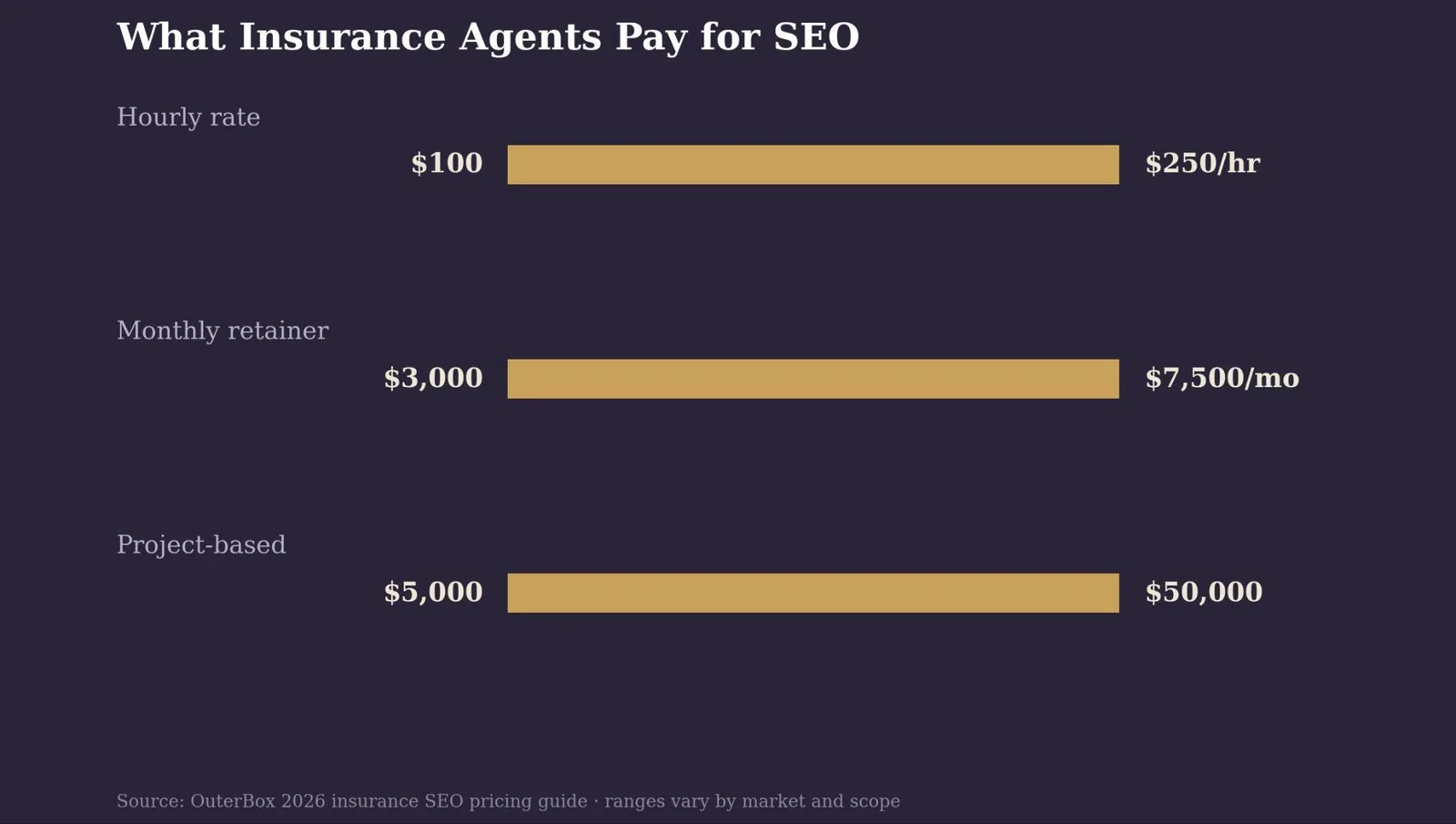
Pricing varies by model. Hourly engagements typically run $100 to $250 USD, monthly retainers run $3,000 to $7,500 USD, and project-based work can range from $5,000 to $50,000 USD depending on scope, per OuterBox's 2026 insurance SEO pricing breakdown. These figures come from a single industry source rather than a broad market survey, so they're worth treating as a planning benchmark and confirming against quotes specific to your market before committing budget.
Trust signals and content that matter
Insurance is a category where trust decides the click. A page that mentions a firm's Better Business Bureau rating, claims satisfaction record, or years serving a specific community sends trust signals that both prospective clients and Google's helpful content algorithm reward over thin, generic pages. Google's helpful content systems increasingly favor pages written to genuinely help a specific searcher, "what does full coverage auto insurance actually cover in [state]," over pages written only to rank, a pattern Quotit's local SEO and AEO guide covers in more depth. A slow or cluttered site loses that trust instantly, no matter how good the content is underneath it.
Content marketing built around real client questions, policy comparison guides, coverage explainers, first-time buyer checklists, does double duty: it builds the kind of content marketing strategy that supports frequently asked questions sections Google can pull into rich results, and it gives an agency's own Google Search Console data a clearer picture of which topics actually drive qualified inquiries rather than just traffic. Every insurance agency website benefits from a clear CTA on each page pointing toward a quote request, since trust signals only convert if the next step is obvious.
Common insurance SEO mistakes
Treating the Google Business Profile as a one-time setup rather than an ongoing channel is the most common mistake. Profiles that go months without a new post or photo lose ground to competitors who stay active.
Inconsistent NAP data is a close second, particularly for agents who list their business through an IMO, a franchise brand, or multiple directories that were never cross-checked against each other.
Writing one generic services page instead of dedicated location and product pages is a quieter mistake; it caps how many distinct searches an agency's site can ever rank for.
And treating reviews passively, waiting for them to trickle in instead of asking systematically, leaves one of the most controllable local ranking levers unused.
Frequently asked questions
How much does SEO cost for an insurance agent?
It depends on the market and whether the work is handled in-house or outsourced. As a planning frame, expect $100 to $250 USD per hour, $3,000 to $7,500 USD per month for a retainer, or $5,000 to $50,000 USD for project-based work. Get a quote specific to your market before committing budget.
How long does local SEO take to work for insurance agents?
Most agents see measurable improvements within 3 to 6 months. Google Business Profile changes can influence rankings within weeks, while review accumulation and content authority take longer to compound.
Can independent agents really compete with Allstate or Geico in search?
Yes, at the local level. National carriers like Allstate and Geico dominate broad, expensive keywords and brand searches, but independent agents who build out hyperlocal content and a fully optimized Google Business Profile routinely out-rank national brands for searches like "insurance agent in [city]," which are exactly the searches that convert.
Does working with an IMO help or hurt SEO?
It depends on execution. An IMO can provide marketing resources and templates, but agents should verify that any IMO-provided website or listing doesn't create duplicate, inconsistent, or thin content that competes with the agent's own site rather than supporting it.
Should insurance agents use PPC as well as SEO?
Many do, since insurance is one of the most expensive PPC verticals online, and pairing the two is usually part of a broader marketing strategy rather than an either-or choice. PPC provides immediate visibility while SEO builds a durable pipeline that keeps generating leads without ongoing ad spend. Agencies with a strong organic foundation often reduce paid spend over time.
The bottom line on SEO for insurance agents
SEO for insurance agents rewards the same things that make a good agent: consistency, responsiveness, and specificity. Fix the Google Business Profile category, lock down NAP across every directory, build a page for every location and product line actually sold, and treat reviews as a system rather than an afterthought.
The agencies pulling ahead right now aren't spending more, they're just not skipping steps. Fix the GBP category this week. Confirm every product line sold is listed as a secondary category. That one check takes fifteen minutes and is usually the highest-leverage thing on this entire list.
Ready to grow your insurance agency online?
Fixing GBP categories, building location pages for every market served, and keeping a review system running consistently is a lot to manage alongside actually serving clients. Web Tonic is a digital marketing agency with a dedicated finance and insurance practice that builds SEO, content, and local visibility strategies specifically for insurance professionals, so the pipeline keeps compounding without pulling agents away from their book of business.
More from Web Tonic: growth marketing services, data & analytics.
Sources: insurancesnapshotforghl.com · sonant.ai · unlockedcrm.ai · outerboxdesign.com · hub.quotit.com