Table of contents
The Google Map Pack captures 42–44% of clicks for local HVAC queries and appears on over 93% of mobile searches for heating and cooling services (PipelineOn). Here are the local SEO benchmarks.
Key Takeaways
- The Google Map Pack receives 42–44% of clicks for local intent queries and appears for over 93% of HVAC service searches on mobile (PipelineOn).
- Proximity to the searcher accounts for roughly 55% of Map Pack ranking decisions, explaining why a contractor with fewer reviews can outrank one with 5× more (PipelineOn/BrightLocal).
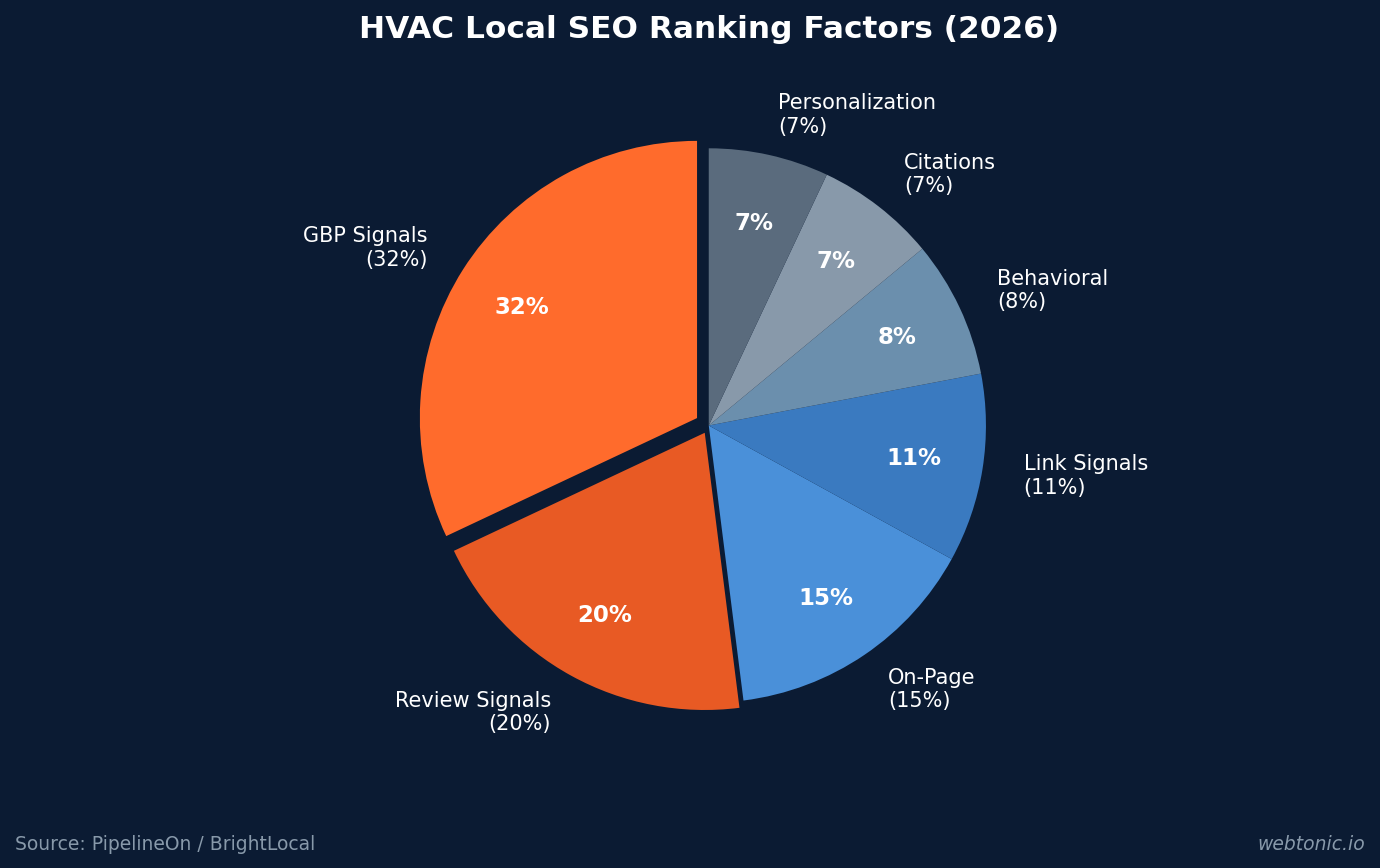
- Google Business Profile signals represent 32% of local ranking factors, followed by review signals at 20%, on-page at 15%, and link signals at 11% (PipelineOn).
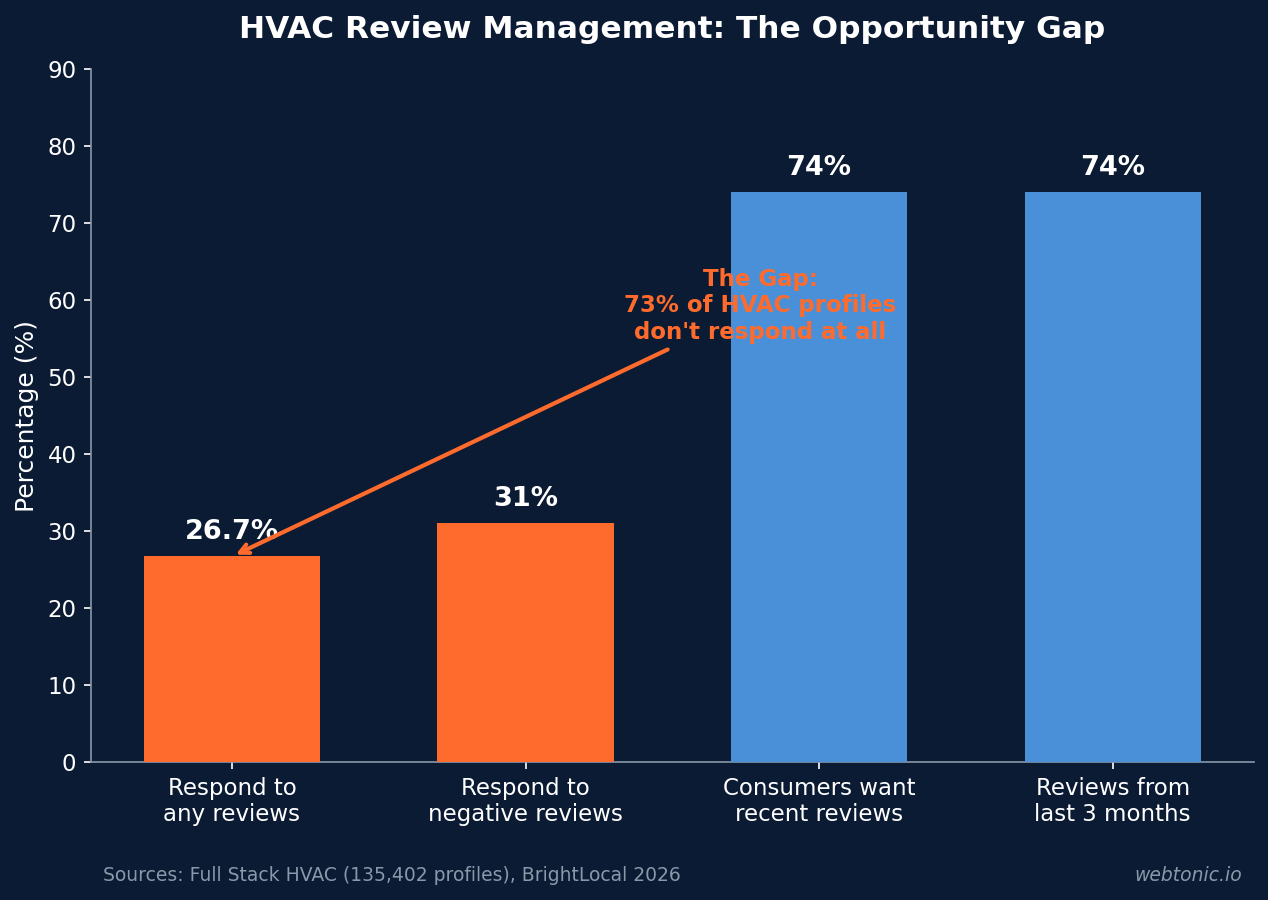
- Only 26.7% of 135,402 HVAC profiles respond to any reviews, and among responders the median reply lands 23 days later (Full Stack HVAC).
- Profiles with 100+ real photos get 520% more calls and 2,717% more direction requests than the GBP average (PipelineOn).
- Switching primary GBP category to "HVAC contractor" lifts Map Pack visibility by 31% on average (PipelineOn/Sterling Sky).
- One HVAC company went from 13 phone calls to 450+ monthly leads through local SEO alone, eliminating $30K/month in Google Ads spend (Orlando SEO Agency).
- 74% of consumers seek reviews written in the last three months, making review recency more valuable than raw count (Full Stack HVAC/BrightLocal).
Local Ranking Factor Breakdown for HVAC
Google's local algorithm weighs multiple signals, but the distribution is not equal. PipelineOn's analysis of HVAC-specific local search behavior reveals the current weight of each factor category.
| Ranking Factor | Weight | Key Signals | Actionability |
|---|---|---|---|
| GBP signals | 32% | Primary category, services, business name, hours | High |
| Review signals | 20% | Volume, velocity, recency, owner response rate | High |
| On-page signals | 15% | NAP consistency, local content, service pages | High |
| Link signals | 11% | Local backlinks, domain authority, anchor text | Medium |
| Behavioral signals | 8% | Click-through rate, dwell time, mobile engagement | Low (indirect) |
| Citation signals | 7% | Directory accuracy, listing completeness, consistency | High |
| Personalization | 7% | Search history, location, device | None |
The single highest-weight actionable change is GBP primary category. Switching from generic "Contractor" to "HVAC contractor" lifts Map Pack visibility by an average of 31% in Sterling Sky testing (PipelineOn).
Review Statistics for HVAC Contractors
Reviews are the second-largest ranking factor at 20%, but most HVAC contractors leave this signal almost entirely unmanaged. Full Stack HVAC's dataset of 135,402 U.S. and Canadian HVAC profiles reveals how poorly the industry performs on review management.
| Review Metric | Industry Data | Source |
|---|---|---|
| Profiles responding to any reviews | Only 26.7% of 135,402 profiles | Full Stack HVAC |
| Negative review response rate | Only 31% receive owner response | Full Stack HVAC |
| Median response time | 23 days after review posted | Full Stack HVAC |
| Consumers seeking recent reviews | 74% look for reviews from last 3 months | BrightLocal 2026 |
| Ideal review velocity | 4–5 new reviews per month | PipelineOn |
| Minimum competitive review count | 75+ reviews for consistent Map Pack ranking | Authority Specialist |
| Average star rating threshold | 4.5+ stars for top 3 placement | PipelineOn |
The opportunity is enormous: with 73.3% of HVAC profiles not responding to any reviews, simply adopting a 48-hour response habit separates a contractor from three-quarters of the market. Review recency matters more than raw count once a listing has a meaningful sample — a profile adding 4–5 reviews per month beats a stale profile with 5× the lifetime count (PipelineOn).
Google Business Profile Optimization Data
Beyond reviews, GBP profile completeness drives significant differences in call volume and customer engagement metrics.
Profiles with 100+ real on-the-job photos get roughly 520% more calls and 2,717% more direction requests than the GBP average (PipelineOn). This means an HVAC contractor who uploads weekly photos of completed installations, equipment, and team members can generate 5× more inbound calls from the same GBP listing.
PipelineOn recommends a minimum GBP setup of primary category as "HVAC contractor" with 5–10 secondary categories, weekly photo uploads of real job photos, and service area pages backing the profile. Single-location HVAC shops can dominate a 5–7 mile radius on this work alone; multi-suburb coverage requires either physical satellite offices or service-area pages that compound over 6–12 months (PipelineOn).
HVAC Local SEO Case Studies
Real-world case studies demonstrate that local SEO investment produces measurable, compounding returns for HVAC contractors across different market sizes and competitive landscapes.
| Case Study | Before | After | Strategy | Timeline |
|---|---|---|---|---|
| HVAC and Direct, Miami (Orlando SEO Agency) | 13 phone calls/mo, $30K/mo on Google Ads | 450+ monthly leads, organic only | Full local SEO infrastructure build | ~8 months |
| First Rate HVAC/Plumbing (Building Blocks Digital) | Stagnant call volume | 1,042 new calls in one year | Multi-location GBP, service-area pages, internal linking | 12 months |
| Houston HVAC (BadassBacklinks) | $3K/mo ads, $180–$220 CPL | 290% organic growth, #2 map pack, 3.8× leads | Local SEO + 41 backlinks + 54 new reviews | 5 months |
The Miami case is particularly compelling. HVAC and Direct had zero local SEO infrastructure despite being in business since 1997, relying entirely on $30,000/month in Google Ads for leads. After an organic-first strategy was implemented, the company went from 13 phone calls and 114 site clicks in November 2024 to 450+ inbound leads per month — entirely from organic search (Orlando SEO Agency).
Mobile Search Dominance in HVAC Local Queries
Mobile devices account for the majority of HVAC emergency and same-day service searches (Authority Specialist). When the AC breaks on a 100-degree afternoon, homeowners reach for their phones — not their laptops. This mobile-first reality has direct implications for local SEO strategy and conversion optimization.
Page speed and mobile usability directly correlate with local ranking stability in competitive HVAC markets. BaaDigi documented one case where rebuilding a Southern Maryland HVAC site cut load time from 4.2s to 1.4s, resulting in +45% phone leads within 5 months and +38% organic traffic growth. The faster site also helped secure Google 3-Pack placement across the broader DMV region (BaaDigi).
For local SEO specifically, click-to-call functionality becomes critical on mobile. With HVAC phone leads converting at 46% compared to roughly 8% for web forms, ensuring one-tap calling from both the GBP listing and the mobile landing page is the single highest-leverage technical optimization for local HVAC visibility (BaaDigi).
Zero-Click Searches and GBP Answer Boxes
Zero-click searches — where Google answers the query without requiring a click to any website — are rising across HVAC queries. This makes featured snippet optimization and GBP completeness more important than ever (Authority Specialist).
For HVAC contractors, zero-click answers most commonly appear for informational queries like "what temperature should I set my thermostat" or "how often should HVAC be serviced." While these queries don't generate direct leads, owning the featured snippet builds brand awareness that feeds into later service-intent searches. Contractors whose GBP listings are fully optimized — with accurate hours, service descriptions, and Q&A responses — capture engagement even when the user never clicks through to the website (Authority Specialist).
The Proximity Problem and How to Solve It
Proximity is the dominant local ranking factor, but it creates a structural problem for HVAC contractors. A contractor with 1,047 reviews and a 4.9-star average can still lose the Map Pack to a competitor with 200 reviews whose office is 3 miles closer to the searcher (Full Stack HVAC).
For HVAC businesses, this mismatch is particularly acute. The contractor's listed address is an office, shop, or warehouse the homeowner will never visit — the service area is a 20–40 mile driveable radius, and the technician is on the road 90% of the time. Google's local algorithm has not yet caught up to this distinction for service-area businesses (Full Stack HVAC).
The solution is service-area pages with real local content. These pages are the structural lever Google uses to assign a contractor to a geography they do not physically occupy. Combined with a multi-location GBP strategy, service-area pages can extend effective Map Pack reach across an entire metro (Full Stack HVAC).
Seasonal Search Patterns in HVAC Local SEO
HVAC search demand follows extreme seasonal patterns that create both opportunity and risk. AC-related queries can increase 3–5× from off-season to peak summer months in most U.S. markets (Authority Specialist).
Contractors who build their local SEO foundation 60–90 days before peak demand consistently outperform those who optimize reactively. This means publishing winter heating content by early October and summer AC content by late March — before the seasonal surge overwhelms the search results with competitors' paid ads (Authority Specialist).
Seasonal search volume spikes in HVAC are among the steepest of any home services vertical, making pre-season content publishing a measurable competitive advantage. Contractors who pair organic local SEO with seasonal PPC campaigns see the highest overall lead volume during peak months (Authority Specialist).
Frequently Asked Questions
What percentage of HVAC searches trigger the Google Map Pack?
The Map Pack appears for over 93% of HVAC service searches on mobile and captures 42–44% of all clicks for local intent queries. The top three results in the Map Pack capture more attention than every paid ad, organic result, and "People Also Ask" box combined (PipelineOn).
How many Google reviews does an HVAC company need to rank locally?
Authority Specialist's audits show that HVAC contractors with fewer than 50 Google reviews rank in the local pack at significantly lower rates than those with 75 or more (Authority Specialist). However, review velocity of 4–5 new reviews per month matters more than total count once you have a baseline (PipelineOn).
What is the most important Google Business Profile setting for HVAC?
Primary category selection is the single highest-weight field. Switching from generic "Contractor" to "HVAC contractor" lifts Map Pack visibility by an average of 31% in Sterling Sky testing. Set 5–10 secondary categories covering specific services like "Air conditioning repair" and "Heating contractor" (PipelineOn).
How does proximity affect HVAC local search rankings?
Proximity accounts for roughly 55% of Map Pack ranking decisions. A competitor with fewer reviews but a closer office will often outrank you. The workaround is building service-area pages with real local content and, where possible, establishing satellite locations to extend your ranking radius (PipelineOn, Full Stack HVAC).
Can local SEO replace Google Ads for HVAC contractors?
Yes, as multiple case studies demonstrate. HVAC and Direct in Miami went from $30K/month in ad spend to 450+ organic leads per month (Orlando SEO Agency). A Houston HVAC company replaced $3,000/month in ads with organic leads after 5 months of SEO (BadassBacklinks). The timeline is typically 3–6 months before organic outperforms paid on cost-per-lead.
Sources
PipelineOn — HVAC Google Maps Optimization (2026)
Full Stack HVAC — Map Pack Ranking for HVAC Contractors
Orlando SEO Agency — HVAC and Direct Case Study
Building Blocks Digital — HVAC and Plumbing Local SEO Case Study
Authority Specialist — HVAC SEO Statistics 2026
Authority Specialist — HVAC Contractor SEO Benchmarks 2026
BadassBacklinks — HVAC SEO Case Study
SerpReach — Link Building for HVAC Contractors (2026)