Table of contents
Insurance is a national-brand category with a local closing motion: 35% of new policies still close through an agent, per J.D. Power's 2026 data, and BrightLocal's 2026 consumer research shows proximity and star rating outrank almost everything else people check before clicking a local listing. This page separates where a local agency still wins the search - the map pack, reviews, listing completeness - from where the national carriers' budget advantage takes over, using 2026 BrightLocal and J.D. Power data plus III's market concentration figures.
Key Takeaways
- 44% of consumers check a business's address or proximity before clicking.
- 38% check the star rating, and 37% check review count.
- 34% check for complete listing information, 30% for visible pricing.
- Only 6% just click the top-ranked result without weighing anything else.
- 72% of consumers look at three or fewer businesses before deciding.
- 75% use more than one channel during a single local search.
- 97% of consumers read reviews for local businesses at all.
- 31% will only use a business with 4.5 stars or more, up from 17% a year ago.
- 68% require at least 4 stars; just 10% require a perfect 5.
- 35% of new insurance policies still close through an agent.
- 47% now close through a digital channel, 17% through a call center.
- 57% of consumers shopped for auto insurance in 2025, a record share.
- 29% switched insurers in 2025 - a retention and win-back opportunity for local agents.
- The top 10 P/C insurers write roughly half the US market between them.
What actually decides a click, before ranking even matters
BrightLocal's 2026 consumer search behavior research asked people what they weigh before clicking a local business listing. Proximity or address led at 44%, followed by star rating (38%), review count (37%), whether the listing had complete information (34%) and whether pricing or an offer was visible (30%). Only 6% said they just click the first result. For an insurance agency, that means ranking position alone is a weak lever; a complete, current, well-reviewed Business Profile beats a slightly-higher rank with a thin listing.
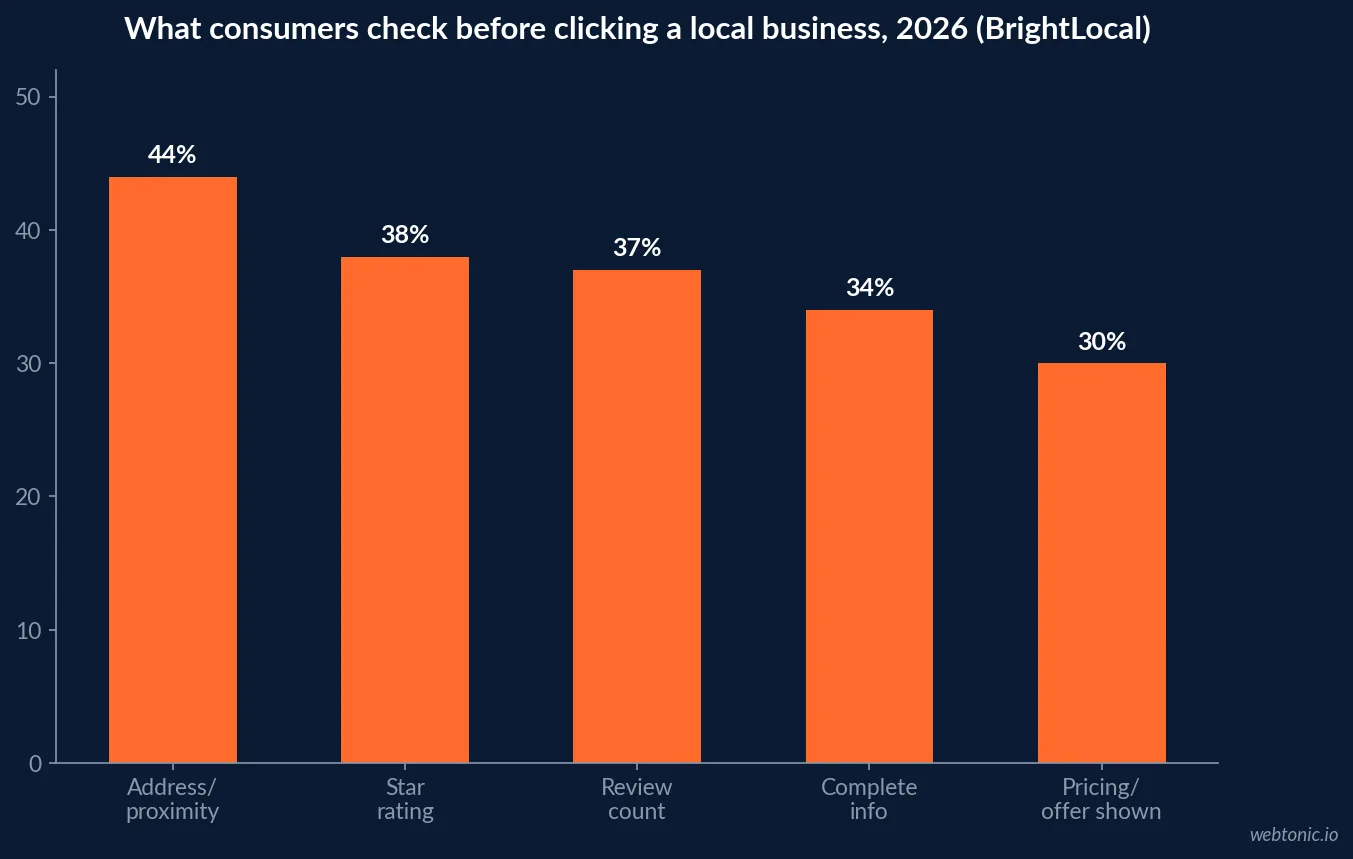
| What consumers check before clicking (2026) | Share | Agent's lever |
|---|---|---|
| Address / proximity | 44% | Accurate GBP address, service-area settings |
| Star rating | 38% | Ongoing review generation |
| Number of reviews | 37% | Review volume, not just score |
| Complete listing information | 34% | Hours, categories, services filled in |
| Visible pricing or an offer | 30% | Rate ranges, quote CTAs on the profile |
| Just clicked the top result | 6% | Not a strategy to rely on |
The bar for star ratings keeps rising
BrightLocal's 2026 Local Consumer Review Survey, a panel of 1,002 US adults run in February 2026, found 97% of consumers still read reviews for local businesses. The threshold for "good enough" moved fast: 31% of consumers will now only use a business rated 4.5 stars or higher, nearly double the 17% who said the same the year before. 68% require at least 4 stars, and only 10% insist on a perfect 5 - so an agency does not need flawless reviews, but it does need to clear 4.5 and keep clearing it as expectations keep climbing.
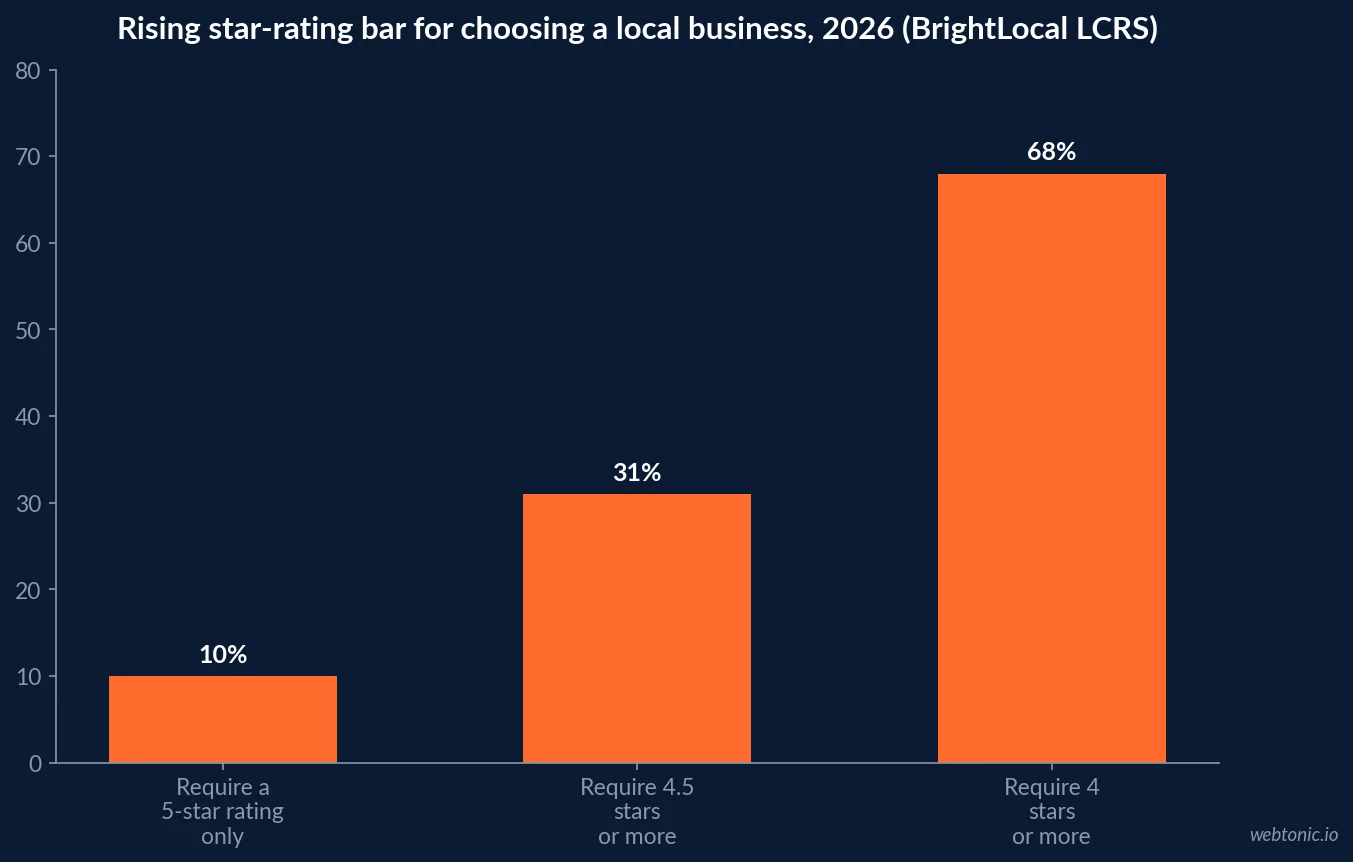
| Star-rating requirement (2026) | Share of consumers | Change vs. 2025 |
|---|---|---|
| Only 5 stars accepted | 10% | Stable |
| 4.5 stars or more required | 31% | Up from 17% |
| 4 stars or more required | 68% | Rising |
| Consumers who care about ratings at all | 92% | Stable |
Where the agent channel still closes business
J.D. Power's 2026 data puts the agent channel at 35% of new policy purchases, against 47% through a digital channel and 17% through a call center. That 35% is exactly the segment where a local agency's map-pack presence and reviews compete directly for the click - a national carrier's own site captures much of the 47% digital share, but a local, independent agent capturing local search traffic is fighting for a real share of that agent-channel third. With 57% of consumers shopping for auto insurance in 2025 (a record share per J.D. Power) and 29% actually switching carriers, the local search channel is also where a switcher looking for a human, not just a quote form, ends up.
| How new insurance policies are bought (2026) | Share | Where local search competes |
|---|---|---|
| Digital channel (carrier site/app) | 47% | Limited - mostly national brand's own funnel |
| Insurance agent | 35% | Direct - map pack, reviews, agent site |
| Call center | 17% | Indirect - often reached via a search click first |
Consumers rarely use one channel or one shortlist
The same BrightLocal research found 75% of consumers use more than one channel during a single local business search, and 72% narrow their decision to three or fewer businesses before choosing. That combination - multi-channel research, then a very short shortlist - means an agency needs consistent NAP data, reviews and pricing signals across Google, its own site and at least one review platform, because a prospect comparing three local agents is very likely checking more than one surface for each.
Where national carrier budgets still win
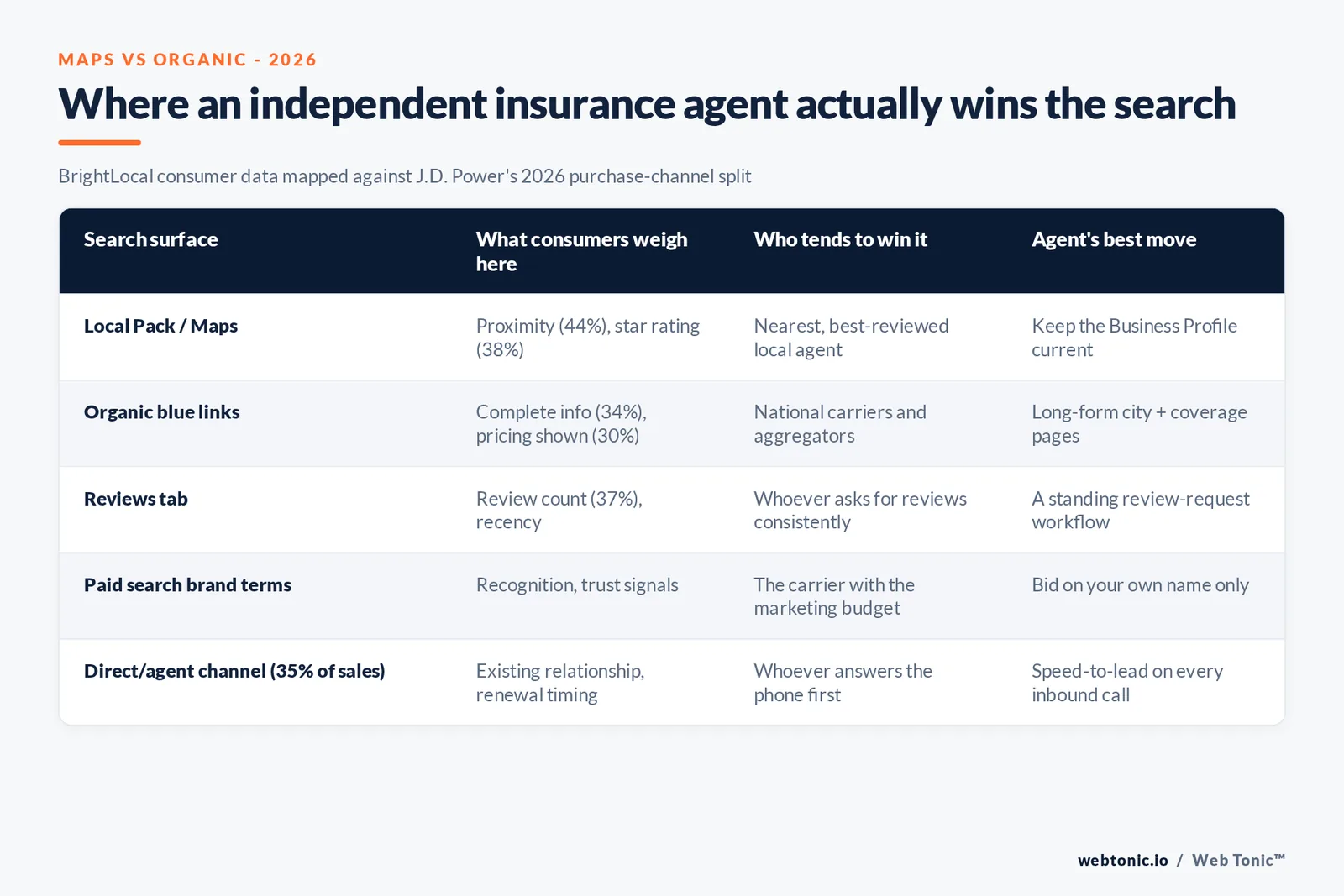
Organic blue-link results and branded paid search are where scale wins. The Insurance Information Institute's 2024 data shows the top 10 property/casualty writers controlling roughly half the US market by direct premiums written - State Farm alone at 10.4% and Progressive at 7.3%. That scale funds the complete-information and visible-pricing content (34% and 30% of consumer decision weight, respectively) that a single-location agency cannot always match content-page for content-page. The realistic strategy is not to outrank a national carrier's homepage; it is to out-execute them on the map pack, reviews and city-level pages where proximity, not budget, decides the winner.
| Search surface | What decides it | Who tends to win | Local agent's move |
|---|---|---|---|
| Local Pack / Google Maps | Proximity (44%), star rating (38%) | Nearest well-reviewed agent | Accurate GBP, active review requests |
| Organic blue links (non-brand) | Complete info (34%), depth | National carrier content teams | City + coverage-type landing pages |
| Paid brand search | Recognition, budget | The carrier with the ad spend | Bid only on the agency's own name |
| Reviews platforms | Review count (37%), recency | Whoever asks consistently | A standing review-request workflow |
Responding to reviews matters as much as collecting them
The same 2026 BrightLocal survey found 80% of consumers say they're likely to use a business that responds to all of its reviews, while 42% say they are unlikely to use one that ignores reviews entirely. 89% of consumers expect a business owner to respond at all, and expectations on speed are tight: 19% expect a same-day reply, and 81% expect one within a week. Generic, templated replies backfire almost as badly as silence - 50% of consumers say a templated response makes them unlikely to choose a business. For a local insurance office, a review-reply workflow is not optional polish; it is a ranking and conversion lever documented at nearly the same weight as the review score itself.
| Review-response behavior (BrightLocal, 2026) | Share of consumers |
|---|---|
| Likely to use a business that responds to all reviews | 80% |
| Unlikely to use a business that ignores reviews entirely | 42% |
| Expect a business owner to respond to reviews at all | 89% |
| Expect a same-day response | 19% |
| Expect a response within a week | 81% |
| Unlikely to choose a business after a generic/templated reply | 50% |
AI answers are entering the local research mix
BrightLocal's 2026 research also flags a shift in how people research before ever reaching a map pack: AI tools like ChatGPT have moved into third place for local business recommendations, behind Google Search and Google Maps but ahead of several traditional review platforms. For insurance specifically, that means the same complete, consistent listing and review data that wins the map pack - accurate hours, services, and a strong review base - is increasingly what an AI answer engine surfaces when a prospect asks it for a nearby agent, rather than typing the query into Google directly.
Compliance still applies to local content
A Google Business Profile post, a review reply, or a city landing page describing coverage is still an advertisement under state insurance law. The NAIC's Unfair Trade Practices Act (Model #880) defines misrepresentation and false advertising of insurance policies as a violation regardless of the medium used, and most states enforce the Advertisements of Life Insurance and Annuities Model Regulation (#570) for how coverage terms can be worded in any public-facing material - a rule that applies just as much to a listing description as to a billboard.
| Local content type | Compliance risk | Safer practice |
|---|---|---|
| GBP post about a coverage type | Overstating what a policy covers | Link to a licensed-agent quote conversation |
| Review reply | Confirming private policy details publicly | Move specifics to a private channel |
| City landing page copy | Implying a guaranteed rate or approval | Use ranges, cite the source, avoid promises |
What a local insurance SEO program should prioritize
Given the data above, the highest-leverage work is unglamorous: keep the Google Business Profile complete and accurate, run a consistent review-request cadence to clear and hold 4.5 stars, and build city- or coverage-specific pages that show pricing ranges rather than hiding them, since 30% of consumers weigh visible pricing before they click at all. Our growth marketing team builds that local content and review cadence around an agency's actual coverage lines, not a generic template. For the paid-search side of the same budget conversation, see what Google Ads really costs, or talk to us about a local SEO plan built on 2026 consumer data, not guesswork.
| Priority | Why it matters here | What it fixes |
|---|---|---|
| Complete, accurate Google Business Profile | 44% weigh proximity, 34% weigh completeness | Missed clicks in the shortlist stage |
| Standing review-request workflow | 31% now require 4.5+ stars, up from 17% | Rating decay below the new threshold |
| City / coverage-type landing pages with visible pricing | 30% weigh visible pricing | Losing comparison-stage traffic to carriers |
| Consistent NAP across every listing | 75% use more than one channel per search | Trust loss from inconsistent info |
Frequently Asked Questions
Does local SEO still matter for insurance agents if most shopping happens online?
Yes, because 'online' does not mean 'carrier website.' J.D. Power's 2026 U.S. Insurance Shopping Study found 35% of new policies still close through an agent, and BrightLocal's 2026 research shows 44% of consumers weigh proximity and 38% weigh star rating before they even click a listing - both are local-search signals an independent agent controls directly, unlike a national ad budget.
What actually gets an insurance agency into the local map pack?
BrightLocal's 2026 consumer-behavior research ranks the factors people check before clicking: address/proximity (44%), star rating (38%), review count (37%), complete listing information (34%) and visible pricing or an offer (30%). None of those are paid-media levers; all five are Google Business Profile and review-management work a local office can do without a national ad budget.
How high does an agency's star rating actually need to be in 2026?
Higher than it used to. BrightLocal's 2026 Local Consumer Review Survey found 31% of consumers will now only use a business with 4.5 stars or more, up from just 17% a year earlier - a near doubling in one year. Sixty-eight percent still require at least 4 stars, and only 10% demand a perfect 5, so the realistic target is a rating that holds above 4.5, not perfection.
Where do national carriers still win over local agents?
Organic blue-link results and paid brand-term search, where consumers weigh complete information (34%) and visible pricing (30%) - content depth and comparison tools that require a national content and product team to build at scale. The Insurance Information Institute's 2024 data shows the top 10 P/C writers controlling roughly half the US market, which is exactly the budget advantage that shows up in organic and paid brand-term competition.
What insurance advertising rules apply to local content, not just paid ads?
State advertising rules do not stop at paid media. The NAIC's Unfair Trade Practices Act (Model #880) defines misrepresentation and false advertising of insurance policies as a violation regardless of medium, which covers a Google Business Profile post, a city landing page, or a review response promising coverage terms the agency cannot guarantee.
Sources
BrightLocal - What Makes Consumers Choose Your Business? (2026)
BrightLocal - Local Consumer Review Survey 2026
Insurance Business America, reporting J.D. Power's 2026 U.S. Insurance Shopping/Digital Experience Studies
Insurance Information Institute - Facts + Statistics: Industry Overview
NAIC - Unfair Trade Practices Act, Model #880
NAIC - Advertisements of Life Insurance and Annuities Model Regulation, Model #570