Table of contents
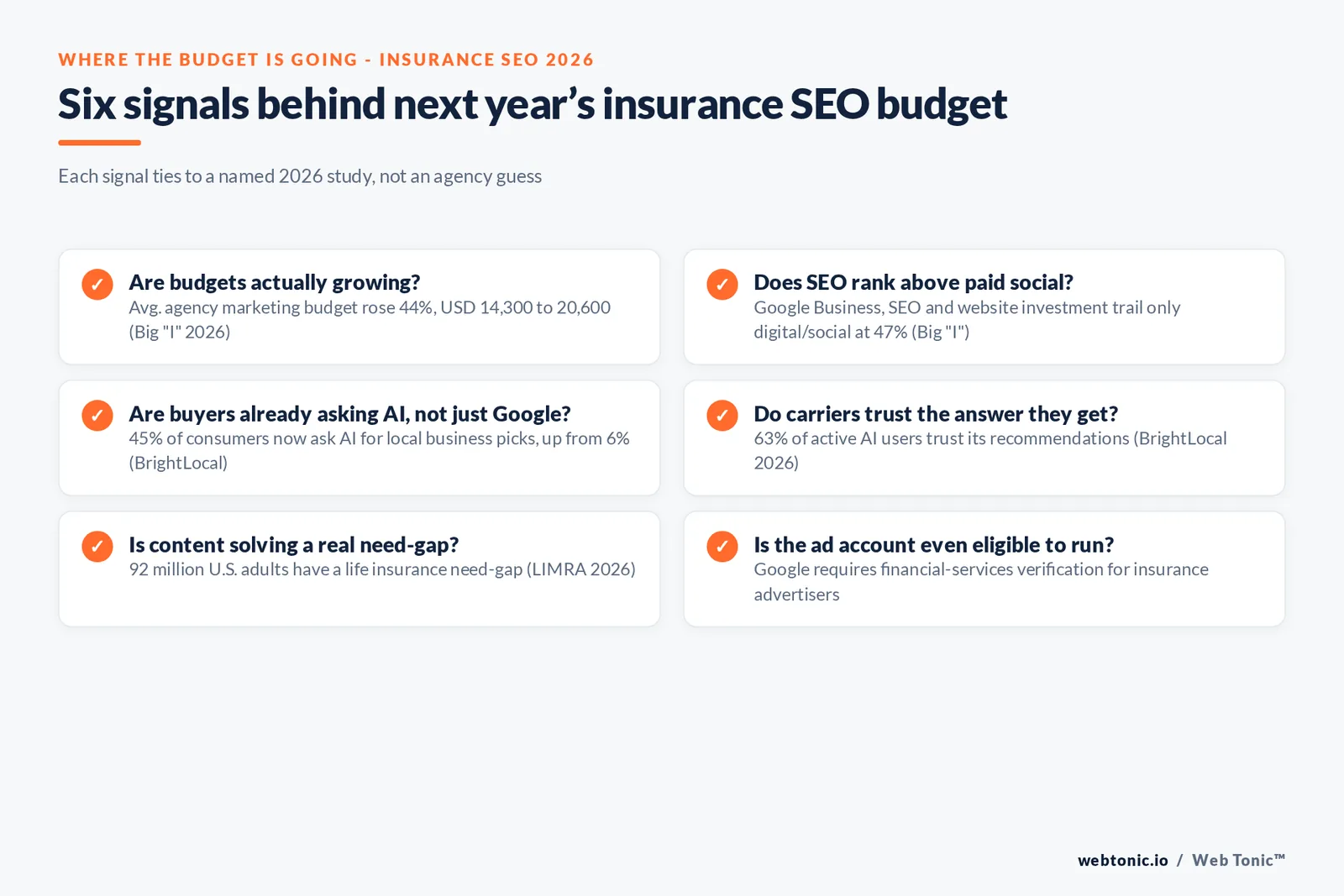
Independent insurance agency marketing budgets rose 44% between 2024 and 2026, and SEO now sits in the same tier as Google Business and website investment - just behind social and digital marketing as agencies' top-ranked activity. That is where next year's budget is actually going, according to the industry's own agent-level study, not an agency's pitch deck.
Key Takeaways
- Average agency marketing budgets rose 44%, from USD 14,300 (2024) to USD 20,600 (2026).
- 47% of agencies rank social/digital marketing as their top activity.
- SEO, Google Business and website investment rank as the next tier of activity.
- Facebook remains the dominant channel at 70% adoption among agencies.
- 46% of agencies now use AI, up from 15% in 2024.
- 49% of AI-using agencies apply it to marketing content generation.
- 45% of consumers used AI for a local business recommendation, up from 6% a year earlier.
- 63% of active AI users trust its recommendations.
- 42% of consumers already trust AI platforms as much as reviews.
- 92 million U.S. adults carry a life insurance need-gap.
- Only 52% of Americans own any life insurance policy.
- The need-gap is highest among households under USD 50,000, at 54%.
- 62% of Americans use social media for financial or insurance information.
- Google requires financial-services verification for insurance advertisers in a growing list of markets.
- 85% of consumers act on positive reviews, a trust signal SEO content still has to earn.
The budget number the industry doesn't usually see
The Big "I" and Future One 2026 Agency Universe Study, a member-agent survey run continuously since 2002 (and first conducted in 1983), found average agency marketing budgets rose from USD 14,300 in 2024 to USD 20,600 in 2026, a 44% increase. That is the agent's own reported spend, not a vendor's benchmark of what agents "should" spend, which makes it a rarer number in this category.
Social media and digital marketing lead as the single most-cited top activity, named by 47% of agencies. It is followed - though not broken out as a single percentage in the published study - by Google Business, search engine optimization and website investment as the next-ranked tier of activity, ahead of everything else agencies reported.
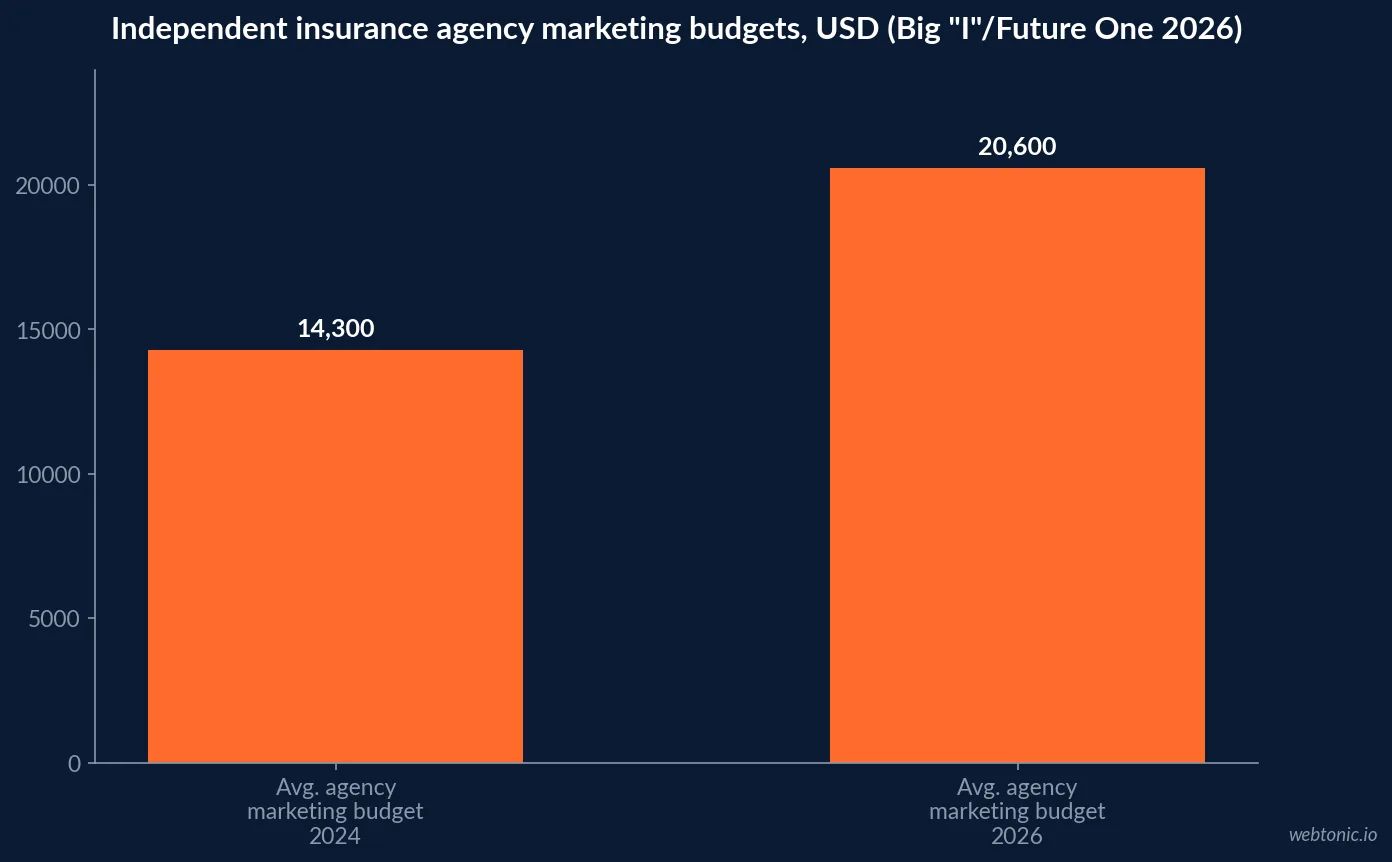
| Insurance agency marketing benchmark (2026) | Figure | Source |
|---|---|---|
| Average agency marketing budget, 2024 | USD 14,300 | Big "I"/Future One Agency Universe Study |
| Average agency marketing budget, 2026 | USD 20,600 | Big "I"/Future One Agency Universe Study |
| Budget increase, 2024-2026 | +44% | Big "I"/Future One Agency Universe Study |
| Rank social/digital as top marketing activity | 47% | Big "I"/Future One Agency Universe Study |
| Agencies now using AI | 46%, up from 15% in 2024 | Big "I"/Future One Agency Universe Study |
Which channels are actually carrying the traffic
Facebook still dominates the channel mix agencies report using, at 70% adoption, ahead of Instagram (46%) and LinkedIn (35%). That matters for SEO planning specifically because it confirms agencies aren't trading search for social - the study shows both growing at once, with 49% of AI-adopting agencies using it for marketing content generation, the single most common AI application ahead of coverage form analysis (43%) and contract reviews (35%).
The barrier is not budget anymore; it's know-how. 60% of agencies cite lack of knowledge about AI capability as their top adoption barrier - up 10 points from 2024 - and 48% cite security and privacy concerns, also up 10 points. Content and SEO teams serving this vertical are often filling a literal skills gap, not just a headcount one.
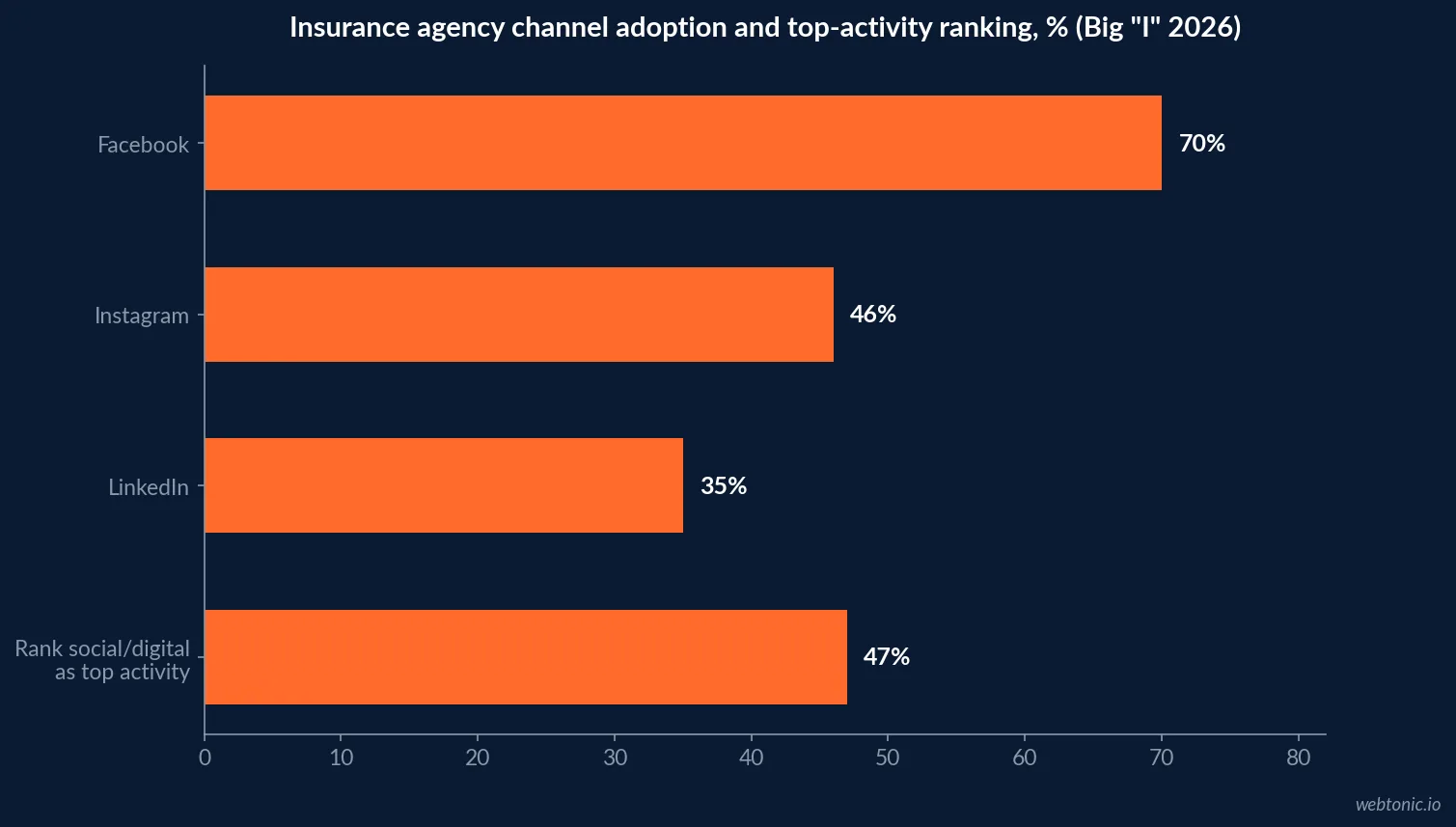
| Channel / activity | Adoption or rank | Source |
|---|---|---|
| 70% of agencies use it | Big "I"/Future One 2026 | |
| 46% of agencies use it | Big "I"/Future One 2026 | |
| 35% of agencies use it | Big "I"/Future One 2026 | |
| Social/digital marketing as top-ranked activity | 47% | Big "I"/Future One 2026 |
| AI for marketing content generation | 49% of AI-adopting agencies | Big "I"/Future One 2026 |
The demand-side shift SEO content has to answer for
BrightLocal's 2026 Local Consumer Review Survey found 45% of consumers have used an AI tool for a local business recommendation in the past year, up sharply from just 6% twelve months earlier, with ChatGPT leading and Google's AI tools second. Among active AI users, 63% trust the tool's recommendations, and 42% of all consumers already trust AI platforms as much as traditional reviews when picking a local business - though 88% still fact-check what an AI tool cites.
Insurance content built only for a Google Search snippet is increasingly being read by an AI answer engine first. The traditional review economics still hold too: BrightLocal's broader survey found 85% of consumers are more likely to use a business after reading positive reviews and 77% are put off by negative ones, so a carrier or agency SEO program now has to satisfy both the review layer and the AI-citation layer at once.
| Consumer search behavior (2026) | Figure | Source |
|---|---|---|
| Used AI for a local business recommendation | 45%, up from 6% | BrightLocal 2026 |
| Active AI users who trust its recommendations | 63% | BrightLocal 2026 |
| Consumers who trust AI as much as reviews | 42% | BrightLocal 2026 |
| Consumers who fact-check what AI cites | 88% | BrightLocal 2026 |
| Consumers more likely to use a business after positive reviews | 85% | BrightLocal 2026 |
The need-gap that gives content teams their keyword map
LIMRA's 2026 Insurance Barometer Study, a national survey of 5,237 adult financial decision-makers fielded in January 2026, found 92 million U.S. adults carry a life insurance need-gap, while only 52% of Americans own any policy at all. The gap is not evenly distributed: it is highest among households earning under USD 50,000 (54%), Black Americans (48%), Hispanic Americans (46%) and Gen Z ( 45%). Separately, 62% of Americans say they use social media when seeking information on financial or insurance products.
That segmentation is a content-planning input as much as a demand number: pages built for these specific audiences (income tier, generation, life stage) are chasing a documented gap, not a generic "life insurance near me" query with no framing behind it.
| Life insurance need-gap segment (LIMRA 2026) | Share with need | Non-owners (millions) |
|---|---|---|
| Households under USD 50K | 54% | 21M |
| Black Americans | 48% | 11M |
| Hispanic Americans | 46% | 17M |
| Gen Z | 45% | 18M |
| Millennials | 43% | 26M |
| Women (all) | 41% | 38M |
The compliance layer that doesn't exist for most SEO clients
Google's financial services advertiser verification policy names insurance explicitly among the products requiring verification against a market-specific regulator, with enforcement dates that have continued rolling out market by market through 2026. That is a paid-media requirement on its face, but it affects SEO teams too: a lapsed verification can suspend the account's ads entirely, and content strategies that assume a stable paid-search presence to support organic (shared landing pages, combined tracking) need to confirm that status before building around it. State-level insurance advertising rules on claims, disclosures and licensing apply on top of Google's own policy, regardless of channel.
| Compliance layer | What it requires | Who it affects | Source |
|---|---|---|---|
| Google financial services verification | Advertiser ID check per targeted market | Paid accounts; shared landing pages with SEO | Google Ads Policy Help |
| State insurance advertising rules | Accurate claims, required disclosures | All channels, including organic content | State insurance regulators (NAIC member states) |
| NAIC advertising model regulation | Bars misleading statements in ads | Life insurance and annuity advertising specifically | NAIC Model Regulation 570 |
What this means for next year's SEO plan
The budget is growing (44% in two years), it's already being spent alongside social rather than instead of it, and the audience reading the content is increasingly asking an AI tool the question before it reaches a search results page. A 2026 insurance SEO plan built only around keyword volume and a Google Business listing is behind two data points at once: the channel-mix reality agencies already report, and the AI-citation behavior BrightLocal has now tracked jumping sevenfold in a year.
If GEO and AI-citation visibility is the gap, our growth marketing practice builds that alongside traditional SEO rather than as an afterthought, our data and analytics team can tie content performance back to quote and bind data rather than traffic alone, and our breakdown of cost per lead by industry is a useful benchmark once the content plan is funded.
What agencies are missing versus what carriers are missing
The Big "I" study is agent- and agency-level, which means it understates what national carriers spend on brand and category-defense SEO - a distinct budget line most agent-facing surveys don't capture. That gap matters for anyone scoping a content plan: an independent agency competing on local, transactional queries ("home insurance quote [city]") is fighting a different SEO battle than a carrier defending its brand name against comparison sites, even though both sit in the same vertical. The budget growth documented above (44% in two years) is real at the agency level, but it should not be read as a proxy for carrier-level SEO investment, which the Big "I" study does not measure. Scoping an insurance SEO engagement should start by asking which of the two the client actually is, since the keyword universe, the content depth required and the compliance review process all differ between a local agency page and a national carrier hub page competing against a comparison site.
Frequently Asked Questions
Are insurance agencies actually increasing their marketing budgets?
Yes, sharply. The Big "I" and Future One 2026 Agency Universe Study, run since 1983, found average agency marketing budgets rose from USD 14,300 in 2024 to USD 20,600 in 2026 - a 44% increase. Social media and digital marketing is the most-cited top activity at 47%, followed by Google Business, search engine optimization and website investment, so SEO is riding the same wave rather than a separate one.
Where does SEO fit against paid channels for insurance agencies?
The Agency Universe Study doesn't break out a single percentage for SEO specifically, only that it ranks alongside Google Business and website investment as the second tier of activity behind social and digital marketing broadly. Facebook remains the dominant channel at 70% adoption, ahead of Instagram (46%) and LinkedIn (35%), which matters for SEO planning because agencies are clearly not choosing between search and social - most run both.
Are insurance shoppers actually using AI search instead of Google?
It's growing fast but still behind traditional search. BrightLocal's 2026 Local Consumer Review Survey found 45% of consumers have used an AI tool for a local business recommendation in the past year, up from just 6% twelve months earlier, and 63% of active AI users say they trust its recommendations. That is a demand shift insurance SEO content has to answer for even while Google Search remains the primary channel most agencies still rank on.
What demand gap is insurance content actually trying to close?
LIMRA's 2026 Insurance Barometer Study (a national survey of 5,237 adult financial decision-makers) found 92 million U.S. adults have a life insurance need-gap, and only 52% of Americans own any life insurance policy at all. Need is highest among households earning under USD 50,000 (54%), Black Americans (48%) and Hispanic Americans (46%) - a segmentation gap that maps directly onto content and local-page strategy, not just keyword volume.
Does insurance SEO carry any compliance restrictions that other industries don't?
Yes. Google requires financial-services advertiser verification for insurance advertisers in an expanding list of markets, with new enforcement dates rolling out through 2026, on top of state-level insurance advertising rules that govern claims and disclosures regardless of channel. An SEO or content team writing for an insurance client should confirm the account's verification status before publishing pages that drive paid traffic to them, since a lapsed verification can pull the account's ads - and by extension its landing pages' paid visibility - entirely.
Sources
IA Magazine - Big "I" and Future One release 2026 Agency Universe Study
Insurance Business - Independent agency revenue rose as AI adoption tripled, Big I study finds
BrightLocal - Half of consumers are asking AI for business recommendations
BrightLocal - Local Consumer Review Survey 2026
LIMRA - 2026 Insurance Barometer Study Member PR Toolkit
Google Ads Help - Financial Services Verification: Relevant Regulators and Enforcement Dates