Table of contents
Immigration law is one of the most competitive corners of legal marketing, and one of the most unusual. A family in Los Angeles searching for a Spanish-speaking attorney, a tech worker researching an H-1B-to-green-card path, and an employer starting a PERM filing are all potential clients of the same firm, yet they need completely different content to find you. Getting SEO for immigration lawyers right means building for both a local searcher who needs a consultation this week and a global one who's still months from choosing an attorney.
An estimated 18,417 immigration law firms currently operate in the United States, so visibility in Google search results is what separates firms that grow from firms that stay small. This playbook covers the local, multilingual, and content strategy that actually moves the needle for immigration practices in 2026.
Key Takeaways
- 96 percent of people seeking legal help start with a search engine, and immigration clients are no exception, so local SEO and Google Business Profile optimization are non-negotiable.
- A complete Google Business Profile with the correct "Immigration Attorney" category (not a generic "Lawyer" label) is the single highest-leverage local ranking factor available to a firm.
- Legal keywords carry the highest average cost-per-click of any industry, making organic SEO a better long-term investment than PPC alone for most immigration practices.
- Multilingual content, especially in Spanish and Mandarin, opens up client segments that competitors publishing English-only content never reach.
- Consistent NAP (name, address, phone) listings across Avvo, Justia, and other legal directories directly influence local map pack rankings.
- Evergreen content on USCIS processing times, green card timelines, and PERM delays builds topical authority while capturing searchers researching their own case.
Why SEO for immigration lawyers is different
Most legal SEO advice is written for personal injury or family law, where clients are almost always local and searching in English. Immigration law breaks that pattern. Immigration is federal law, so a firm can represent clients nationwide, but the majority of high-intent searches still include a location, because people want an attorney who knows their local USCIS field office and immigration court.
On top of that dual local-and-national audience, immigration clients frequently search in a language other than English. Spanish, Mandarin, Hindi, Portuguese, Tagalog, and Arabic are among the most common languages used by immigration searchers, and a firm that only publishes in English is invisible to a meaningful share of its own local market. In Los Angeles County alone, 33.6 percent of the population was born outside the United States, and Spanish, Korean, Cantonese, and Mandarin are all common languages among prospective clients there.
The content itself is also more volatile than most legal niches. Immigration policy, visa bulletins, and USCIS processing times change constantly, which means a firm's blog needs a standing system for publishing timely updates, not a static set of practice-area pages.
Why local SEO drives immigration law firm growth
The numbers make the case clearly. 96 percent of people seeking legal advice use a search engine at some point in their research, and Google Business Profile factors have the single biggest impact on local pack rankings. For a firm competing on visibility, that makes local SEO the foundation everything else builds on.
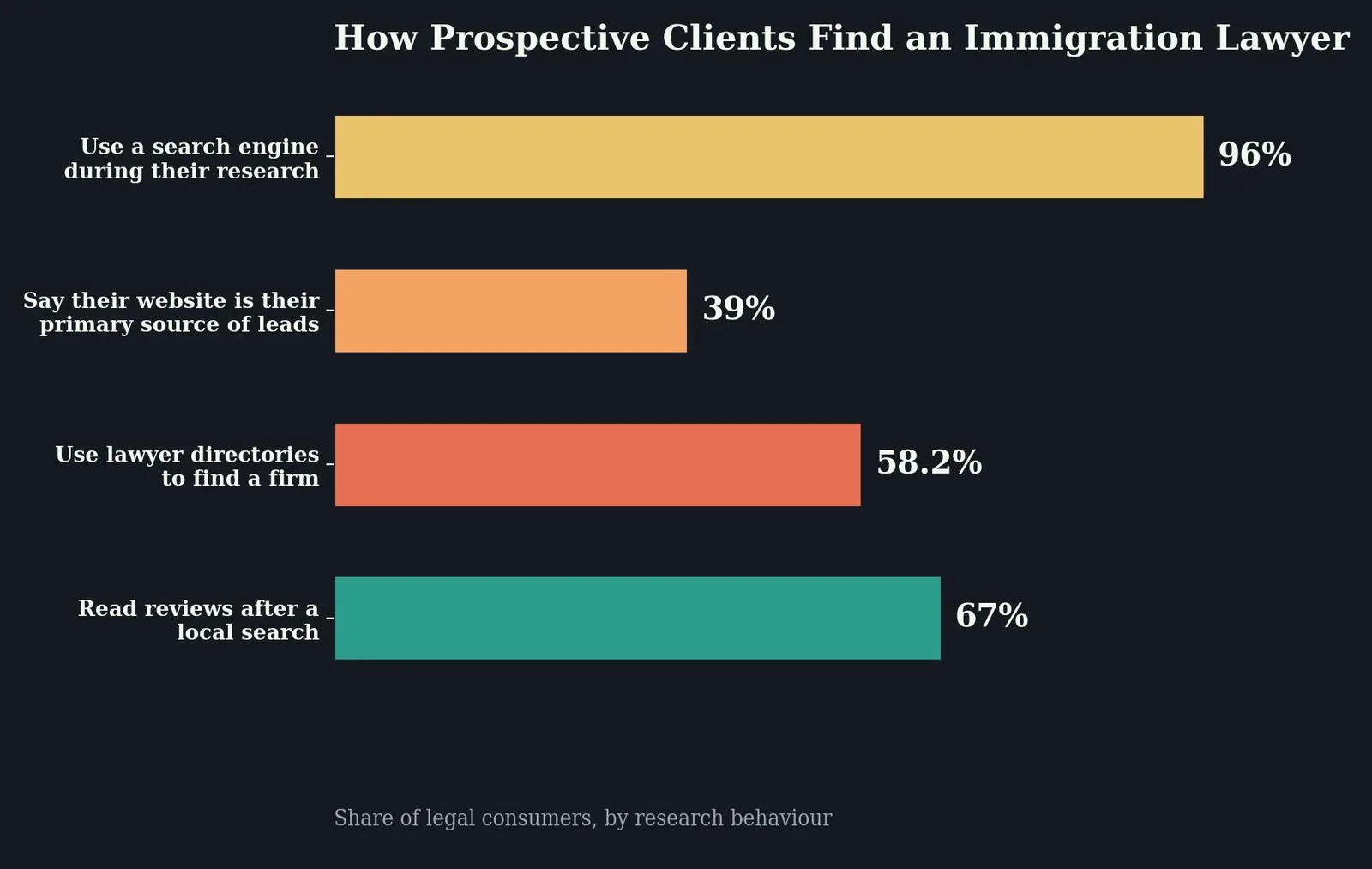
28 percent of lawyers say showing up in legal directories helped them attract more clients, and reviews compound that effect further: 67 percent of consumers often or always check reviews after a local search. None of this works if the underlying Google Business Profile is incomplete or inconsistent. The primary category matters more than most firms realize: setting it to "Immigration Attorney" rather than a generic "Lawyer" label signals relevance directly to Google's local ranking systems.
Firms with a strong online presence consistently report their website as their primary source of new leads, not referrals or paid ads. That's exactly why a documented SEO strategy covering search engines broadly, not just Google, and full Google Maps visibility, deserves a permanent line item in the firm's marketing budget rather than an occasional project. A site that's easy to find is the foundation every other tactic in this playbook depends on.
Use the checker below to see how your firm's local SEO foundation stacks up.
Free SEO tool
Is your firm's local SEO consultation-ready?
Check off what your firm already has in place. Your local SEO readiness score updates as you go.
Local SEO readiness score
0 of 6
Check off what your firm already has to see your score.
Local SEO vs. multilingual and national content
Immigration firms generally need two content strategies running side by side, not one. The table below breaks down when each applies.
| Strategy | Who it targets | Core tactics | Typical content |
|---|---|---|---|
| Local SEO | People ready to book a consultation nearby | Google Business Profile, NAP consistency, city-specific landing pages, reviews | "Immigration Attorney in [City]," local USCIS office info |
| Multilingual SEO | Non-English-speaking prospective clients in your service area | Native-language content (not machine translation), hreflang tags, language-specific Google Business Profile fields | Spanish, Mandarin, or Tagalog versions of key service pages |
| National / global content | Prospects still researching visa options before choosing an attorney | In-depth visa guides, comparison content, evergreen educational hubs | "H-1B to green card timeline," "EB-2 vs. EB-3 comparison" |
Firms that only build one of these three tend to plateau. A firm with excellent local pages but no multilingual content misses a large share of its own service area; a firm that only publishes English-language local pages with no educational hub content struggles to compete for the searchers still comparing their options months before they're ready to hire.
The cost of visibility: paid search vs. organic
Legal keywords are expensive everywhere, but immigration and general legal terms sit near the very top of that scale. Attorneys and legal services had the highest average cost-per-click of the 23 industries WordStream tracked in 2026, at roughly $9.87, compared to a $5.42 cross-industry average.
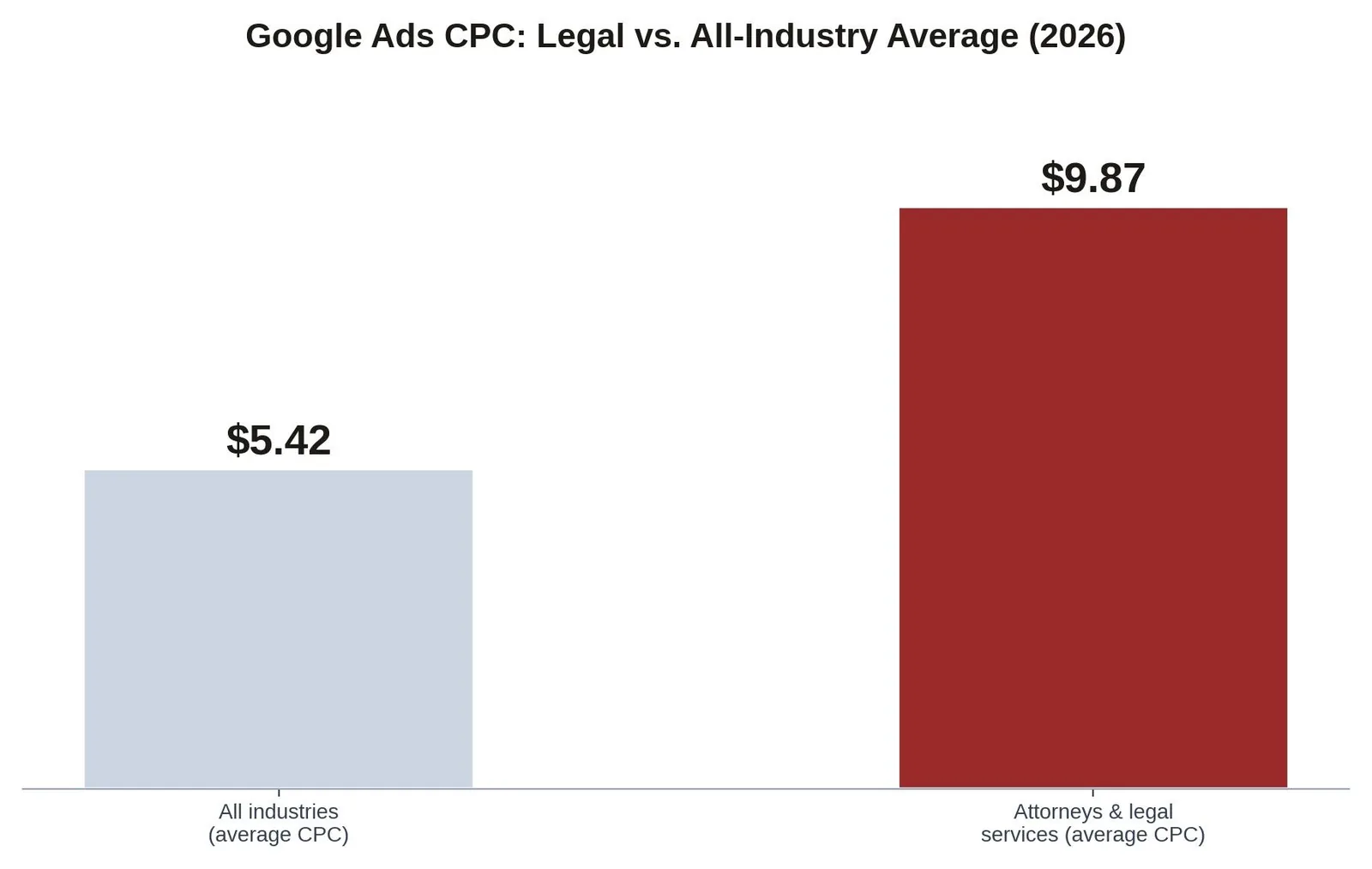
That cost gap is exactly why organic SEO carries so much long-term weight for this vertical. Organic search generates an average 7.5 percent conversion rate in the legal sector, more than three times PPC's 2.2 percent.
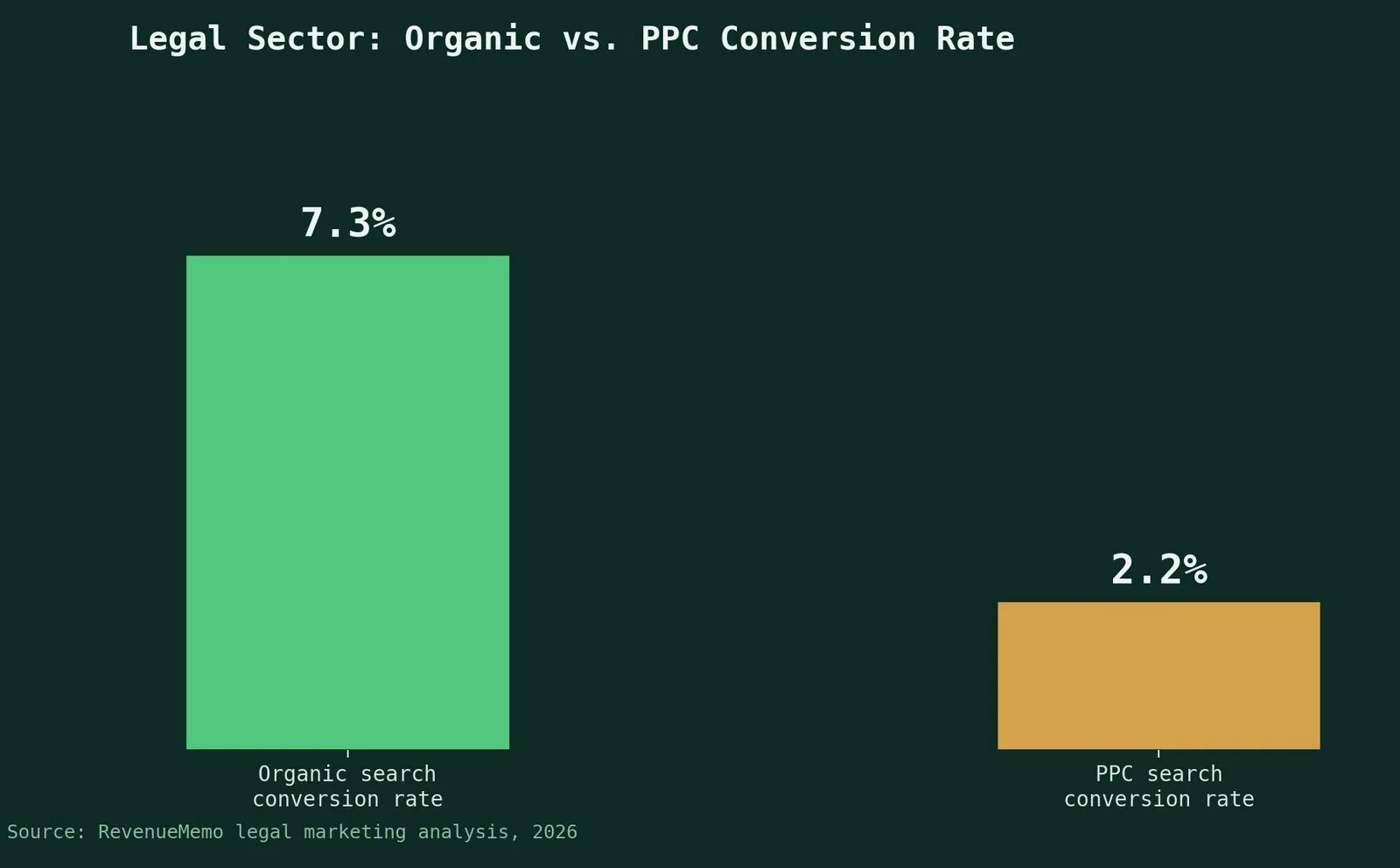
Paid search still has a place in an immigration firm's marketing. PPC and Local Services Ads deliver leads immediately while SEO compounds in the background, and most firms get the best results running both at once. Given the cost gap, though, SEO deserves to be treated as the primary long-term channel, not an afterthought squeezed in around the ad budget.
Building a multilingual, USCIS-aware content strategy
Immigration clients research more extensively before hiring an attorney than clients in almost any other legal niche, which makes content depth a genuine competitive advantage. A few priorities stand out.
Publish visa-specific hub pages with real depth. A page covering eligibility, required documents, process steps, and realistic timelines for a single visa category (H-1B, family-based green cards, asylum) outperforms a shallow page trying to cover everything at once. For employment-based cases specifically, timely content on PERM delays and Form I-140 timelines demonstrates real technical fluency, since PERM processing has stretched well past a year in 2026 and is one of the most-searched pain points for employer-sponsored green card applicants.
Translate with real native-language writers, not machine translation. Cultural nuance and correct legal terminology matter enormously in immigration content, and a poorly translated Spanish or Mandarin page can actively damage trust with the audience it was meant to reach.
Track what's actually working. Google Analytics and Search Console show which visa-type pages generate the most engagement and which local landing pages are converting, which lets a firm double down on the specific practice areas and cities driving the most consultations.
Keep a standing news section for policy changes. USCIS updates, new fees, and visa bulletin movements all drive search volume in the days after they're announced, and firms that publish quickly capture that traffic while it's active.
Common mistakes to avoid
Treating immigration SEO like general legal SEO is the most common misstep. A personal injury firm can usually succeed with pure local optimization, but an immigration firm that skips multilingual and national content leaves significant demand on the table. Letting directory listings drift out of sync is another frequent problem: an inconsistent NAP across the firm's website, Google Business Profile, Avvo, and Justia actively suppresses local rankings rather than just failing to help them.
Firms also commonly under-invest in review generation, despite reviews being one of the strongest local ranking signals available, and many never build a system for timely content around USCIS and policy changes, leaving that search volume entirely to competitors and news outlets.
Frequently asked questions
How long does it take for an immigration law firm's SEO to show results?
Most firms see initial keyword movement within 60 to 90 days of a structured campaign, with meaningful organic traffic increases typically appearing in months four to six and consistent consultation growth by months six to nine.
Do I need a website in Spanish or Mandarin if my firm is in an English-speaking area?
If any meaningful share of your local population speaks another language at home, yes. Even firms in areas that seem predominantly English-speaking often find a significant, underserved audience of potential clients searching in another language once they check their own local demographics.
Should immigration lawyers focus on local SEO or national content?
Both, but for different reasons. Local SEO captures people ready to book a consultation now, while national and educational content captures people still researching their options, often months before they choose an attorney.
How important are legal directories like Avvo and Justia?
Very. Beyond referral traffic, consistent listings on these directories reinforce the NAP consistency signal that search engines use to validate a firm's local legitimacy.
Is paid search worth it for immigration lawyers given the high CPC?
It can be, especially for immediate lead volume, but the high cost-per-click makes organic SEO a better primary long-term investment. Most firms get the strongest results running both channels together rather than relying on either alone.
Turning search visibility into signed cases
SEO for immigration lawyers works as one system: local optimization, multilingual content, and a standing system for timely USCIS-related publishing, all working together. Firms that treat these as one connected system, rather than three separate projects, are the ones that consistently convert search visibility into booked consultations.
Start with the fundamentals: confirm your Google Business Profile category and NAP consistency, then build outward from there into multilingual pages and evergreen visa content.
More from Web Tonic: growth marketing services, data & analytics.
Sources: ibisworld.com · growzify.net · reachattorneys.com · growlaw.co · savvylawfirmmarketing.com · seoprofy.com · searchenginejournal.com · revenuememo.com