Table of contents
USCIS had 12.1 million cases pending in FY2026 Q2, up 7.2% year over year, while Google's AI Overviews are now cutting position-one clicks by 58%. Immigration law SEO in 2026 sits at the intersection of those two facts: real, growing demand meeting a search results page that increasingly answers the question before anyone clicks through.
Key Takeaways
- USCIS had 12.1 million cases pending as of FY2026 Q2.
- That is up 7.2% year over year from the same quarter in FY2025.
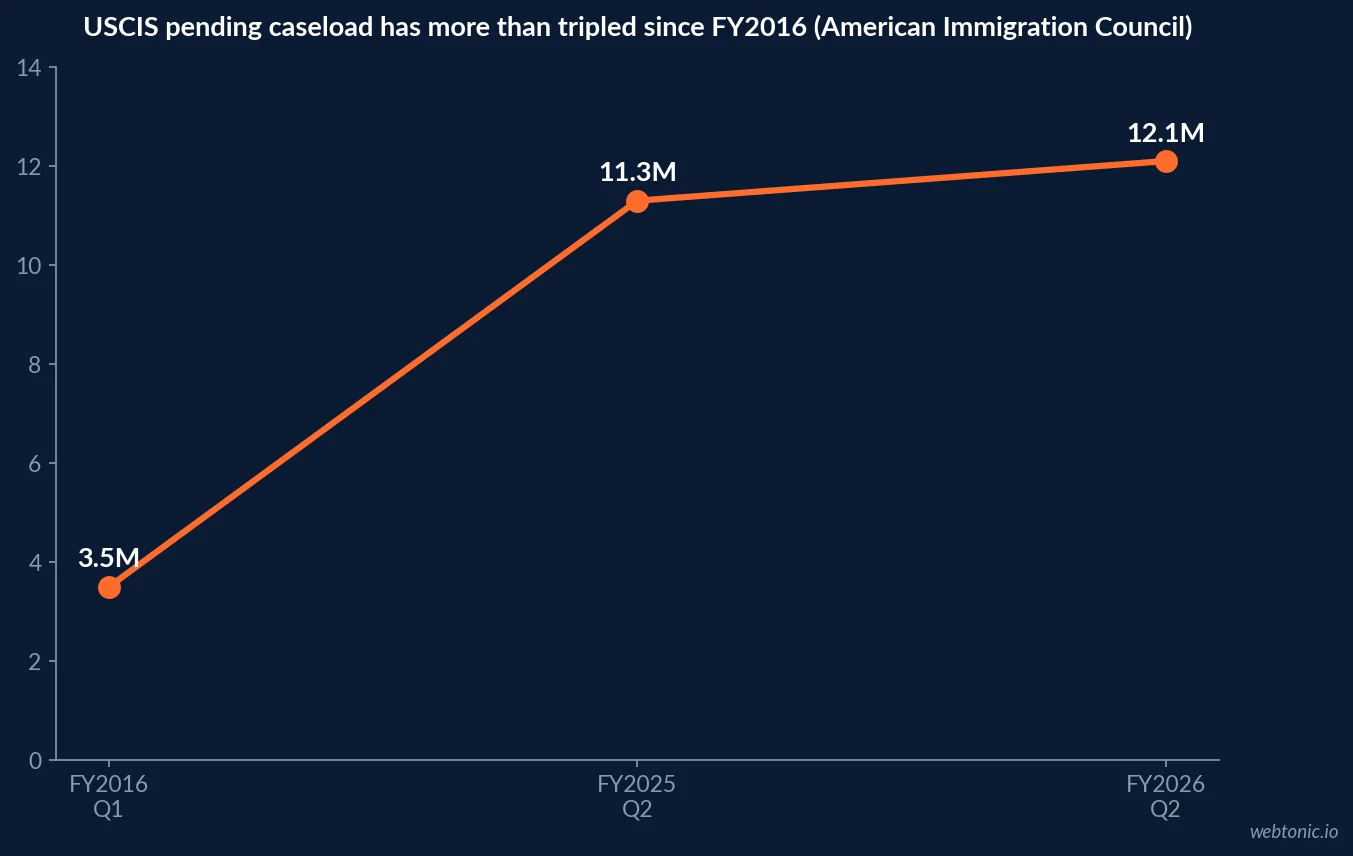
- The USCIS pending caseload has more than tripled since FY2016 (3.5M to 12.1M).
- USCIS completions fell to 1.5 million even as new filings slowed.
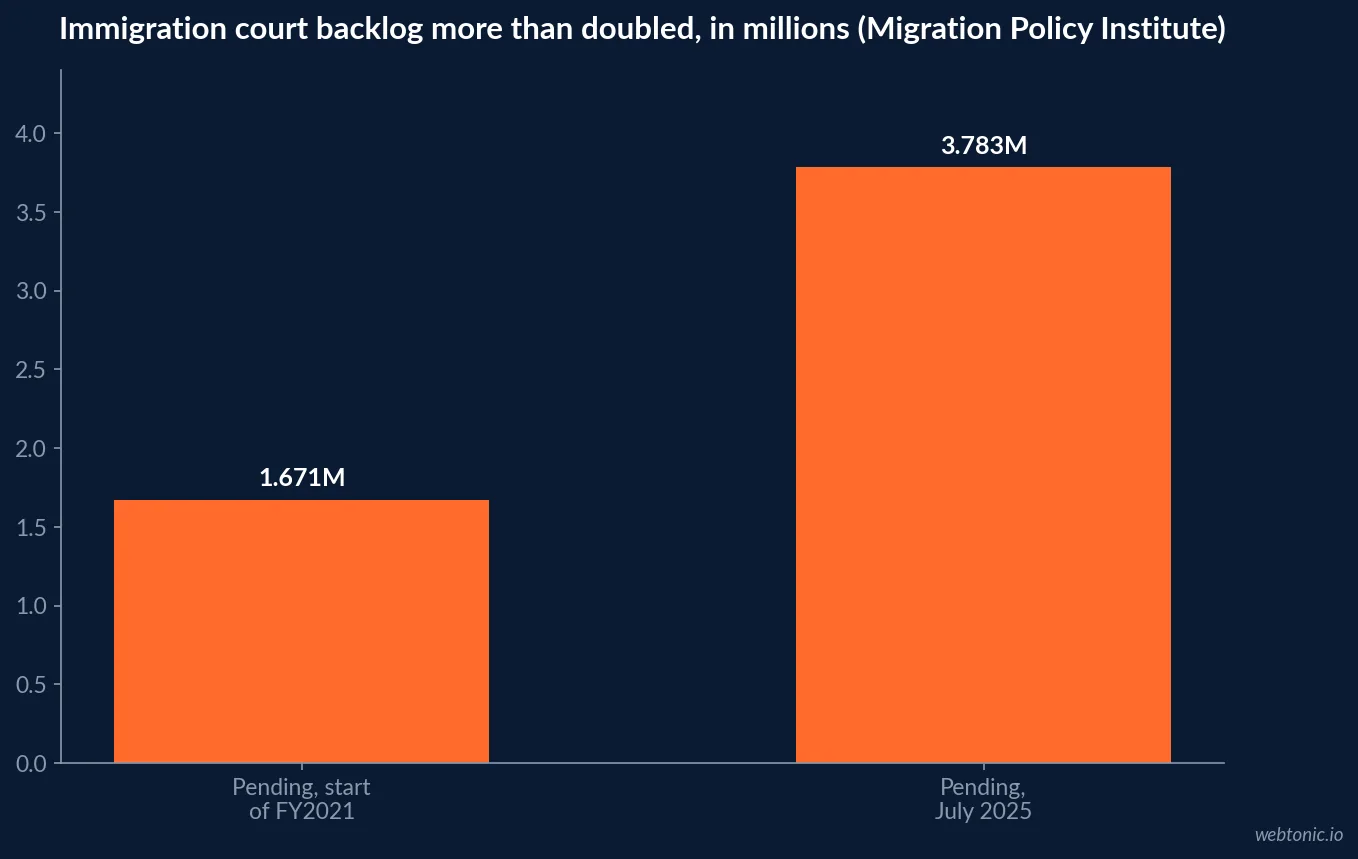
- EOIR's immigration court backlog reached 3,783,000 pending cases as of July 2025.
- That backlog more than doubled since FY2021, when it stood at 1,671,000.
- EOIR also reported cutting its pending caseload by over 447,000 cases since Jan. 2025.
- 92.4% of legal consumers research before contacting an attorney at all.
- Ahrefs' 2026 update found AI Overviews cut position-one clicks by 58%.
- That is up from an earlier measured drop of 34.5% in the same study series.
- 80% of law firms maintain a social media presence, per ABA TechReport 2025.
- 78% of those firms use LinkedIn specifically.
- Nearly 70% of legal consumers cite reviews as their top decision factor.
- 54% of law firms plan an SEO investment increase in 2026, per CallRail.
- The FTC has run repeated consumer alerts warning that notarios are not attorneys.
The demand side: a backlog that keeps growing
The American Immigration Council's analysis of USCIS's own published data shows pending cases climbing from about 3.5 million in FY2016 Q1 to 12.1 million in FY2026 Q2, a 7.2% year-over-year increase most recently measured. Completions are moving the wrong direction at the same time: USCIS's FY2025 completions fell to roughly 1.5 million, even as the agency received fewer new filings. That combination - flat or falling filings, falling completions, rising pending total - is what "backlog" means in practice, and it is the closest public proxy available for how much status-check and eligibility search demand exists.
| USCIS caseload measure | Figure | As of | Source |
|---|---|---|---|
| Pending cases, FY2016 Q1 | ~3.5 million | Oct-Dec 2015 | American Immigration Council |
| Pending cases, FY2026 Q2 | 12.1 million | Jan-Mar 2026 | American Immigration Council |
| Year-over-year change | +7.2% | FY2026 Q2 vs FY2025 Q2 | American Immigration Council |
| FY2025 completions | ~1.5 million | Full fiscal year | American Immigration Council |
The court side moves on a different, more political clock
The immigration court backlog, tracked separately by EOIR, tells a two-directional story depending on the window. The Migration Policy Institute's 2025 report put the pending caseload at 3,783,000 as of July 2025, more than double the 1,671,000 pending at the start of FY2021. But the Department of Justice's own EOIR office separately reported reducing the pending caseload by over 447,000 cases since January 2025 through a sharp rise in completions. Both figures are accurate for their stated dates - the backlog grew for years, then started shrinking under a faster completion rate, and any SEO content citing a specific backlog number needs to state the as-of date to avoid contradicting itself within the same page.
| EOIR measure | Figure | As of / period | Source |
|---|---|---|---|
| Pending immigration court cases | 3,783,000 | July 2025 | Migration Policy Institute |
| Pending cases, start of FY2021 | 1,671,000 | FY2021 | Migration Policy Institute |
| Reduction in pending caseload | 447,000+ cases | Since Jan. 2025 | DOJ / EOIR |
| Pending asylum applications | 2,424,061 | End of FY2025 | Congressional Research Service |
The supply side: what the SERP actually gives that demand
The click a piece of immigration SEO content is competing for is getting harder to earn even when it ranks. Ahrefs' updated 2026 study found AI Overviews reduce click-through rate for the position-one organic result by 58%, a sharper drop than the 34.5% the same research team measured in an earlier pass across 300,000 keywords. Immigration content - visa eligibility rules, processing-time questions, document checklists - is exactly the answerable, informational query type AI Overviews are built to summarize directly on the results page, which makes this decline more relevant here than for a typical local-service query.
| AI Overviews finding | Figure | Source |
|---|---|---|
| Position-one CTR reduction (2026 update) | 58% | Ahrefs |
| Position-one CTR reduction (2025 measurement) | 34.5% | Ahrefs |
| Keywords analyzed in the original study | 300,000 | Ahrefs |
| Click likelihood with an AI summary present | 8% | Pew Research Center |
| Click likelihood without an AI summary present | 15% | Pew Research Center |
What legal consumers actually do before they click through
Martindale-Avvo, Avvo, and FindLaw's State of the Legal Consumer 2026 report found 92.4% of legal consumers say they research their issue before contacting an attorney, and nearly 70% cite reviews as the most helpful factor in that research, ahead of pricing and fees (61.6%) and responsiveness (58%). The same report notes that trust-signal platforms - Avvo, Martindale, FindLaw, SuperLawyers, Nolo - are frequently referenced by AI search systems building their own shortlists, which means an immigration firm's structured data and review profile on those platforms now functions as an AI-citation input, not just a directory listing.
| Legal-consumer research finding | Figure | Source |
|---|---|---|
| Research an issue before contacting an attorney | 92.4% | Martindale-Avvo 2024 survey |
| Cite reviews as the most helpful decision factor | ~70% | Martindale-Avvo 2024 survey |
| Cite pricing and fees as a decision factor | 61.6% | Martindale-Avvo 2024 survey |
| Cite responsiveness as a decision factor | 58% | Martindale-Avvo 2024 survey |
Where firms are actually putting SEO budget
The ABA's 2025 TechReport survey found 80% of law firms maintain a social media presence, with 78% on LinkedIn, ahead of Facebook (53%), Instagram (22%), and X (18%) - but the same report notes SEO and content-marketing adoption varies widely by firm size, with no immigration-specific breakout published. The 2026 CallRail Legal Marketing Outlook survey found 54% of law firms planning an SEO investment increase this year, tied with video as the top two growth areas. Neither figure isolates immigration practices, so treat both as general legal- marketing context, not an immigration-specific channel mix.
| Legal-marketing channel signal | Figure | Source |
|---|---|---|
| Firms with any social media presence | 80% | ABA TechReport 2025 |
| Of those, firms using LinkedIn | 78% | ABA TechReport 2025 |
| Firms using Facebook | 53% | ABA TechReport 2025 |
| Firms planning an SEO investment increase in 2026 | 54% | CallRail 2026 Legal Marketing Outlook |
What the AI Overviews decline means for immigration content specifically
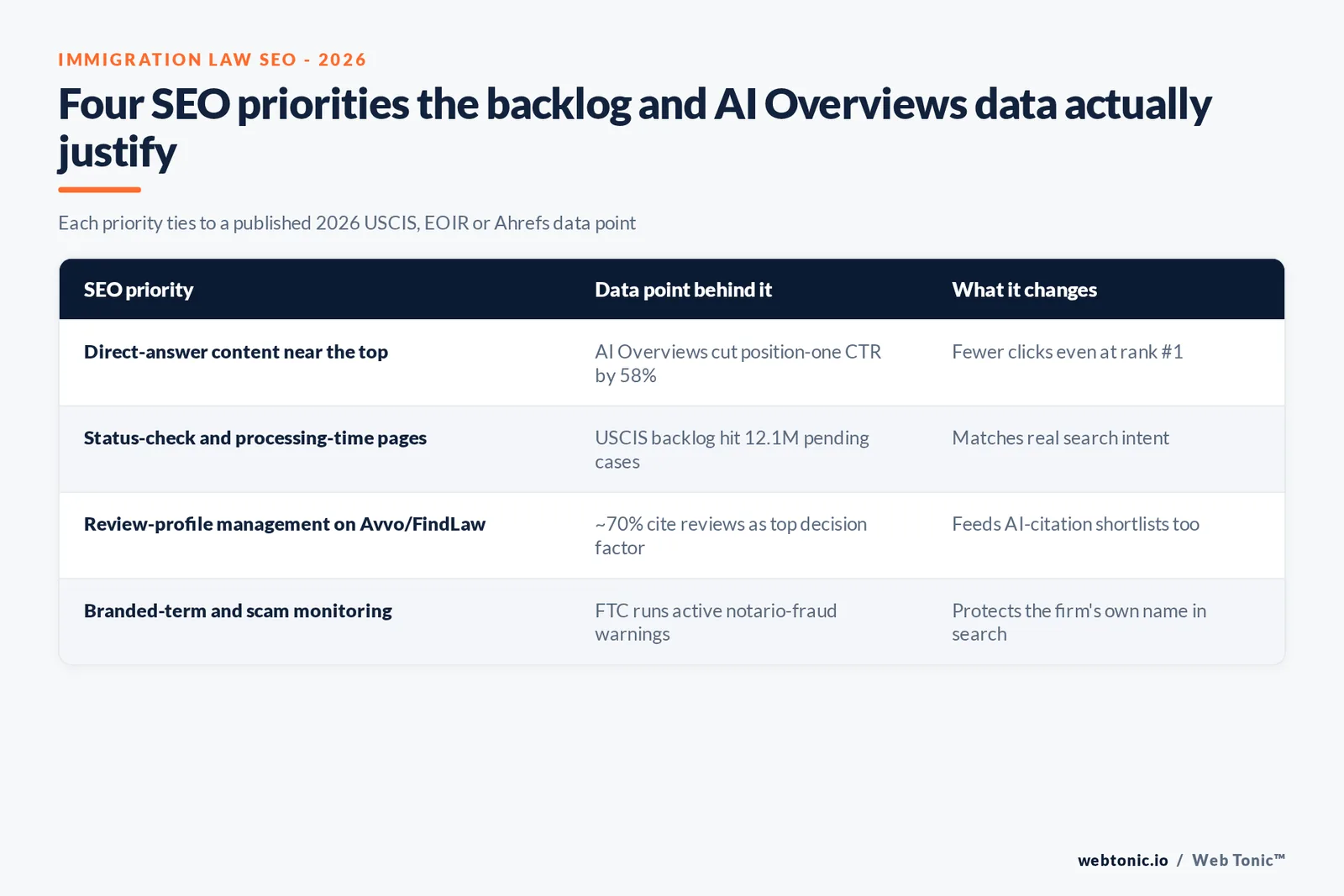
Immigration content skews toward exactly the query type AI Overviews are built to answer directly: "how long does a green card take," "what documents do I need for a K-1 visa," "why is my case status still pending." Pew Research Center's analysis found users click a traditional organic result only 8% of the time when an AI summary is present, versus 15% when it isn't - meaning even a well-ranked immigration FAQ page is competing against the page it's supposed to win traffic on. The practical response isn't to stop writing that content; it's to make sure the page itself is structured so an AI system can extract and cite it accurately (clear headings, a direct answer near the top, and correctly dated figures), since citation inside an AI Overview is now a visibility channel in its own right, separate from the organic click.
The content risk unique to immigration: notario and consultant fraud
The Federal Trade Commission has run repeated public-awareness campaigns, including a Spanish-language graphic novel, specifically warning that notarios, "notary publics," and unlicensed immigration consultants are not attorneys and cannot legally give immigration advice - a distinction that matters because scammers actively use search and social platforms to find victims. An immigration firm's SEO program should include monitoring and, where possible, claiming branded search terms (the firm's own name plus "reviews," "scam," or "complaint") since that is exactly where impersonation and misinformation tend to surface first.
Building an SEO plan around a backlog, not a keyword list
The practical takeaway from the demand-side data is that "immigration lawyer" content built purely around service pages misses the actual search behavior a 12.1-million-case backlog generates: status checks, processing-time expectations, and document-specific questions. Content built to answer those specific, timely questions is also the content most exposed to the AI Overviews click decline above, which means structured data, clear direct answers near the top of the page, and a strong review profile on the platforms AI systems already cite matter more here than link volume alone. Our growth marketing practice builds that structure before writing a single page of content.
If you want your firm's own case-status and eligibility content audited against this framework, talk to us, or see how we scope acquisition spend in our guide to what Google Ads actually costs before deciding how much of the budget goes to organic versus paid.
Frequently Asked Questions
Is there more search demand for immigration lawyers because of the backlog?
The backlog data supports that inference but doesn't measure search volume directly. USCIS's own reporting shows pending cases climbed from roughly 3.5 million in FY2016 Q1 to 12.1 million in FY2026 Q2 - a 7.2% year-over-year increase most recently - and the American Immigration Council's analysis confirms completions are falling even as new filings slow. A caseload that size sitting in limbo is a reasonable proxy for rising 'case status', 'processing time', and 'immigration lawyer near me' search intent, but no public dataset ties USCIS backlog directly to search volume, so treat that link as inference, not a cited fact.
How big is the immigration court backlog specifically?
The Migration Policy Institute's 2025 analysis put EOIR's pending caseload at 3,783,000 as of July 2025, more than double the 1,671,000 pending at the start of FY2021. The Department of Justice's own EOIR office reported a reduction of more than 447,000 pending cases since January 2025 through aggressive case completions, so the two figures describe the same backlog moving in different directions depending on the measurement window - always state the as-of date when citing either number.
Do law firms actually invest in SEO, or mostly paid ads?
Both, and the split is shifting. The American Bar Association's 2025 TechReport survey found 80% of firms maintain a social media presence (78% on LinkedIn), and separate 2026 CallRail survey data shows 54% of law firms planning SEO investment for the year, alongside 50% planning more video. Neither source breaks results out by immigration law specifically, so apply these as general legal-industry benchmarks, not immigration-specific figures.
Are AI Overviews making SEO less effective for immigration content?
For informational content generally, yes, and immigration content is heavily informational (visa eligibility, processing times, form requirements). Ahrefs' updated 2026 study found AI Overviews reduce click-through rate for the position-one result by 58%, up from an earlier 34.5% estimate. That is a general search-behavior finding, not immigration-specific, but immigration content sits squarely in the question-and-answer category AI Overviews target first.
Should immigration firms worry about 'notario' scam content ranking above them?
It's a real, documented risk worth monitoring, not a rumor. The Federal Trade Commission has run consumer-alert campaigns for years warning that notarios and unlicensed 'immigration consultants' are not attorneys and cannot give legal advice, specifically because scammers target search and social media to find victims. A firm's SEO strategy should include claiming and monitoring branded search terms and its own name, since that is where scam impersonation and misinformation most often surface.
Sources
American Immigration Council - USCIS backlog grows even as filings fall
American Immigration Council - USCIS filing trends, 2026
USCIS - Immigration and Citizenship Data
Migration Policy Institute - Breaking the Cycle of Dysfunction at the US Immigration Courts, 2025
US Department of Justice / EOIR - Immigration court milestones announcement
Ahrefs - AI Overviews Reduce Clicks by 58%, 2026 update
Martindale-Avvo, Avvo & FindLaw - The State of the Legal Consumer 2026
American Bar Association - 2025 TechReport survey on legal tech trends
Federal Trade Commission - Avoiding scams that target immigrants