Table of contents

Someone gets arrested at 11 p.m. on a Friday. They don't call a friend for a referral. They pull out their phone and search. That single moment, repeated thousands of times a night across the country, is the entire business case for SEO. Criminal defense clients search under pressure, on mobile, usually within minutes of an arrest, and whichever firm shows up first often gets the call.
SEO for criminal defense lawyers is the practice of optimizing a law firm's website, local listings, and content so it ranks for the terms someone facing charges actually searches — DUI lawyer near me, criminal defense attorney in a specific city, drug possession attorney — rather than generic legal terms that don't match how people search in a crisis. Search engine optimization for this practice area differs from other legal niches in one critical way: the urgency. A personal injury client might research for weeks. A criminal defense client is often searching from a police station, and potential clients in that moment rarely wait to compare more than a page of results.
Key Takeaways
- 96% of people seeking legal advice start their research with a search engine, and mobile "near me" searches for legal services have increased roughly 500%, so a firm invisible on mobile local search is invisible to most of the market. (Rankings.io)
- Organic and paid search combined account for roughly 82% of criminal defense leads, and 87% of consumers never scroll past the first page of Google, which makes ranking on page one a genuine pass-or-fail outcome for client acquisition. (Savvy Law Firm Marketing, YMM Digital)
- Cost per click for competitive criminal defense keywords typically runs $100 to $200 or more, and runs even higher in dense metros like Los Angeles, New York City, and Chicago — a gap that makes organic SEO matter more in this practice area than almost any other. (Savvy Law Firm Marketing)
- Charge-specific keywords — DUI lawyer near me rather than criminal lawyer — convert meaningfully better than generic legal terms, because they match the exact situation a searcher is actually in. (YMM Digital)
- Legal directories like Avvo and Justia still drive real backlink authority and direct client inquiries, but most now apply nofollow or sponsored attributes to outbound links, so directory listings should be treated as a trust and visibility play first, and a backlink strategy second. (Jasmine Directory)
- 70% of criminal defense marketing directors rank local SEO as their top digital priority, and an optimized Google Business Profile is frequently the asset that actually drives the phone to ring, more than the homepage itself. (Savvy Law Firm Marketing — note: this figure and the 82% lead-channel stat above come from a source that synthesizes several named studies without attributing individual numbers to each; treat both as directional industry estimates rather than a single traceable survey result)
Why Criminal Defense Clients Search Differently
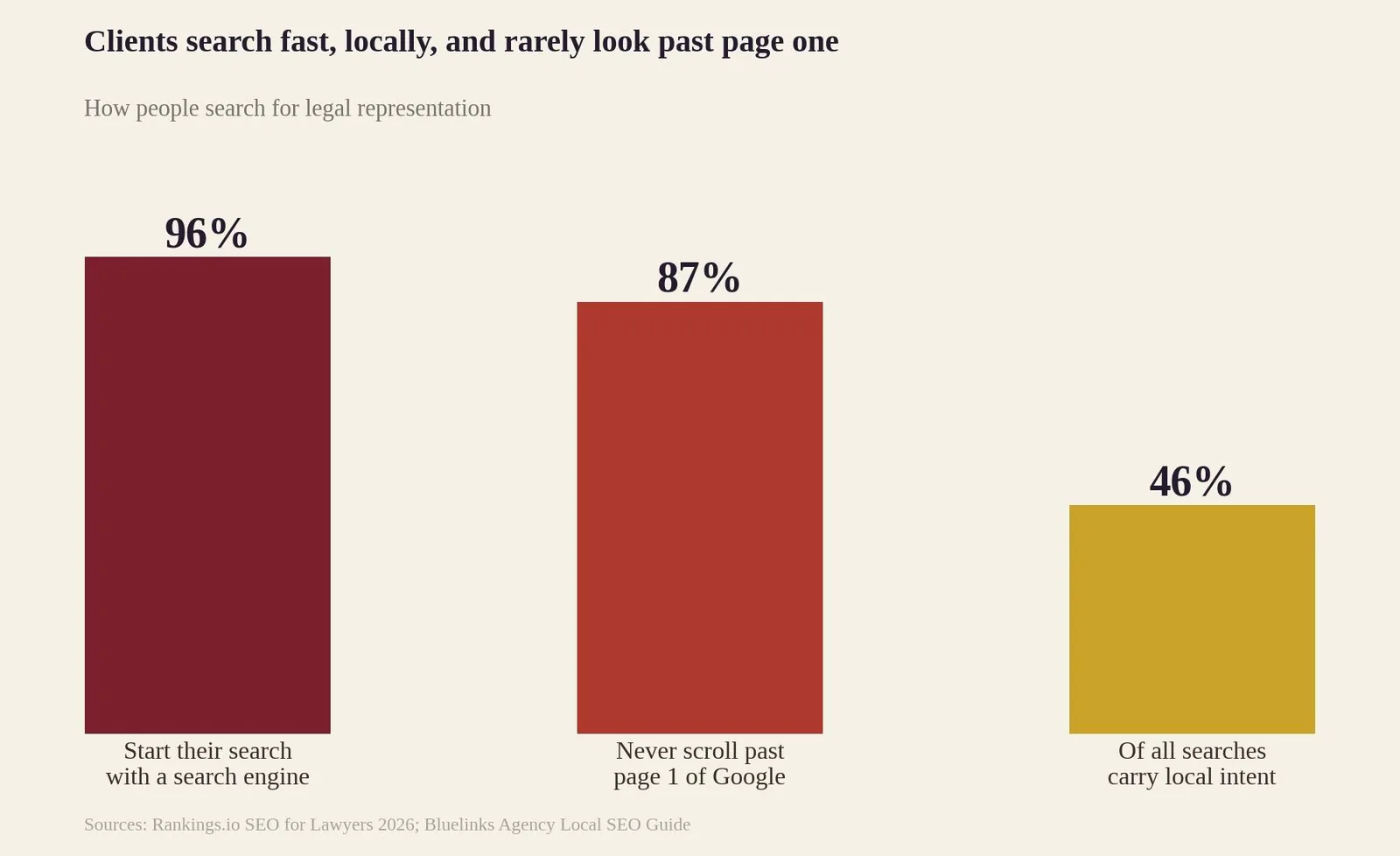
Criminal defense search behavior looks nothing like most other practice areas. 96% of people seeking legal advice start with a search engine, and mobile "near me" searches for legal services have climbed roughly 500% as more of that search happens from a phone in the moments after an arrest. Once someone starts searching, 87% never scroll past the first page of Google, and over 70% of all legal searches now happen on mobile (Josh Brown Consulting), which compounds the urgency problem for any firm running a slow or poorly optimized site. 46% of all searches carry local intent (Bluelinks Agency), higher still for legal queries, since almost nobody hires a criminal defense attorney based in another city.
This combination — urgency plus locality plus a hard cutoff at page one — means a firm's SEO for criminal defense lawyers strategy has to win the map pack and the top organic results in its own city, not compete nationally. Defense attorneys who treat their online presence as optional are effectively invisible to prospective clients the moment they need help most. How search engines rank local businesses hasn't changed in principle, but a firm ranking beautifully for "criminal defense lawyer" as a broad national term while invisible for "criminal defense attorney [city name]" in Google search is optimizing for the wrong search entirely.
Local SEO and Google Business Profile for Criminal Defense Firms
An optimized Google Business Profile is frequently the single highest-leverage asset a criminal defense firm has, often driving more calls than the homepage itself. Accurate categories, current photos, prompt responses to Google's Q&A section, and a steady flow of recent reviews all signal to Google that a listing is active and trustworthy, which matters directly for map pack placement.
NAP consistency — name, address, and phone number matching exactly across the website, Google Business Profile, and every legal directory — is a foundational local ranking signal that's easy to get wrong across a busy multi-attorney practice. Inconsistent suite numbers or old phone numbers listed on Avvo or Justia can quietly suppress local rankings even when everything else on a site is done well.
How Local SEO Differs From General SEO for Law Firms
| Factor | General SEO for law firms | Local SEO for criminal defense |
|---|---|---|
| Primary goal | Rank organically nationwide for broad legal terms | Rank in the local map pack and organic results for one city or county |
| Key asset | Website content and backlinks | Google Business Profile, NAP consistency, local reviews |
| Search urgency | Often research-driven over days or weeks | Often same-day or same-hour, post-arrest |
| Keyword pattern | Broad practice-area terms | Charge-specific plus city ("DUI lawyer [city]") |
| Content focus | General practice overviews | Court-specific, charge-specific, jurisdiction-specific pages |
Criminal defense SEO tool
What is your firm actually paying per lead?
Adjust the numbers to your market and see your real cost per lead and per month.
Monthly ad spend
$0
Cost per consultation
$0
This models paid search only. Organic SEO leads don't carry a per-click cost once a page ranks, which is why firms that combine both channels typically see their blended cost per lead fall over time, even as PPC costs stay flat or rise.
Criminal defense SEO tool
What is your firm actually paying per lead?
Adjust the numbers to your market and see your real cost per lead and per month.
Monthly ad spend
$0
Cost per consultation
$0
This models paid search only. Organic SEO leads don't carry a per-click cost once a page ranks, which is why firms that combine both channels typically see their blended cost per lead fall over time, even as PPC costs stay flat or rise.
What Criminal Defense PPC and SEO Actually Cost
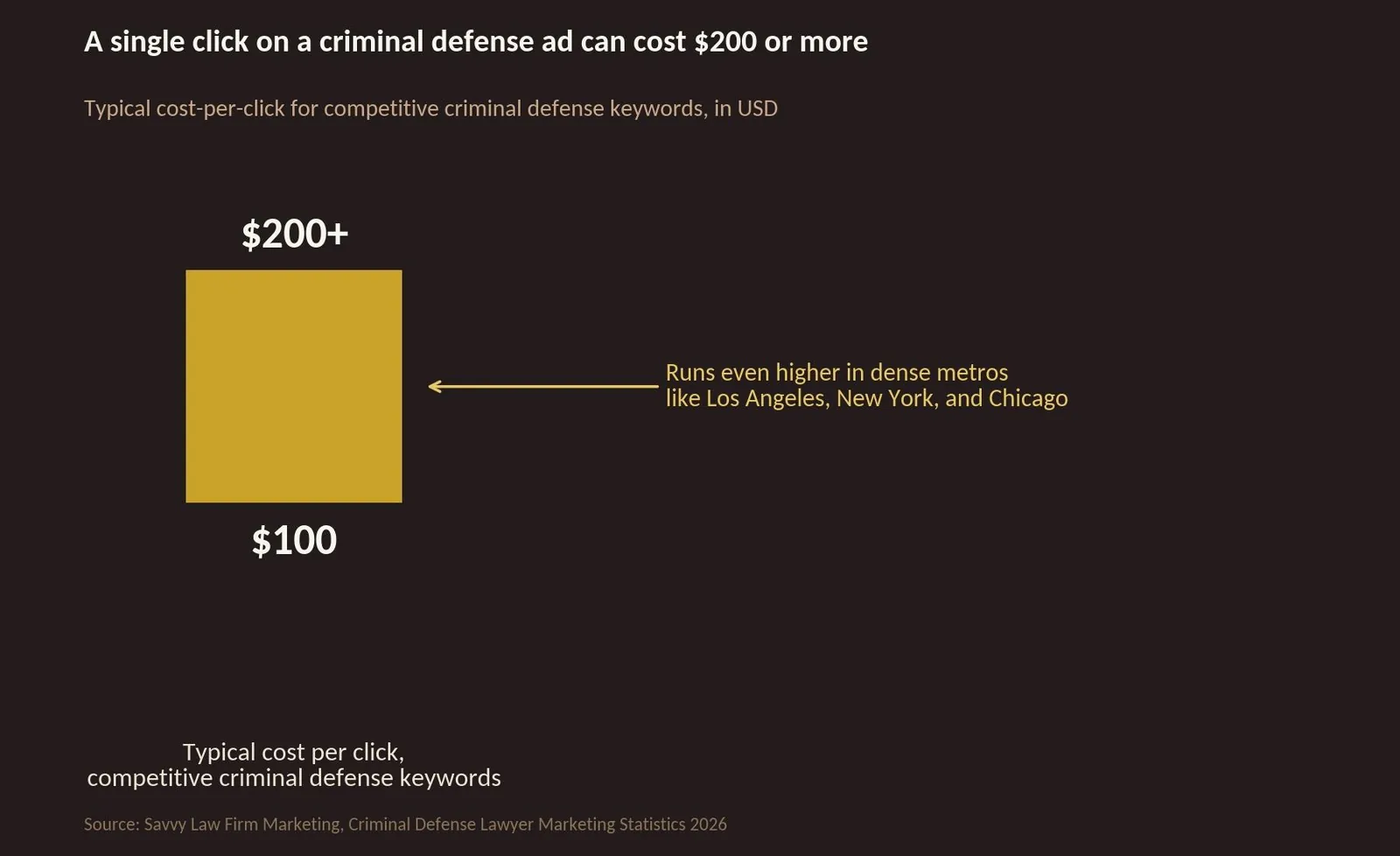
Cost per click for competitive criminal defense keywords typically runs $100 to $200 in most US markets, running even higher in dense metros like Los Angeles, New York City, and Chicago (Savvy Law Firm Marketing). That's expensive enough that many firms treat PPC as a way to buy visibility while organic rankings build, rather than a permanent primary channel, since every click stops producing leads the moment the budget runs out.
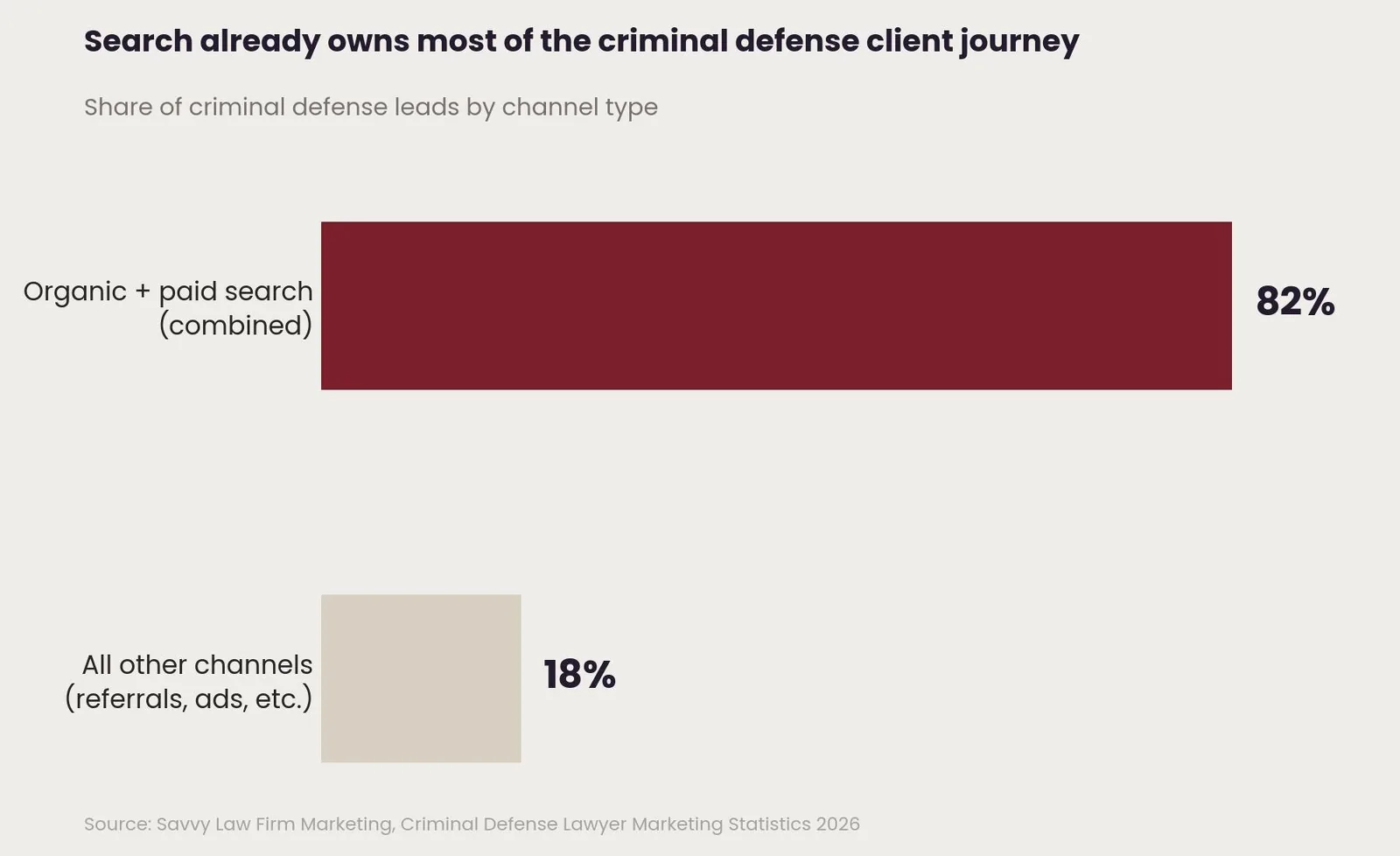
Industry estimates suggest organic and paid search combined account for roughly 82% of criminal defense leads, which is why a firm's website and Google Business Profile matter more than almost any other marketing asset it owns. Organic SEO tends to deliver the lowest long-term cost per lead of any channel available, precisely because a page that ranks keeps generating calls long after the content was written, with no per-click cost attached.
Writing Content That Ranks for Charge-Specific Searches
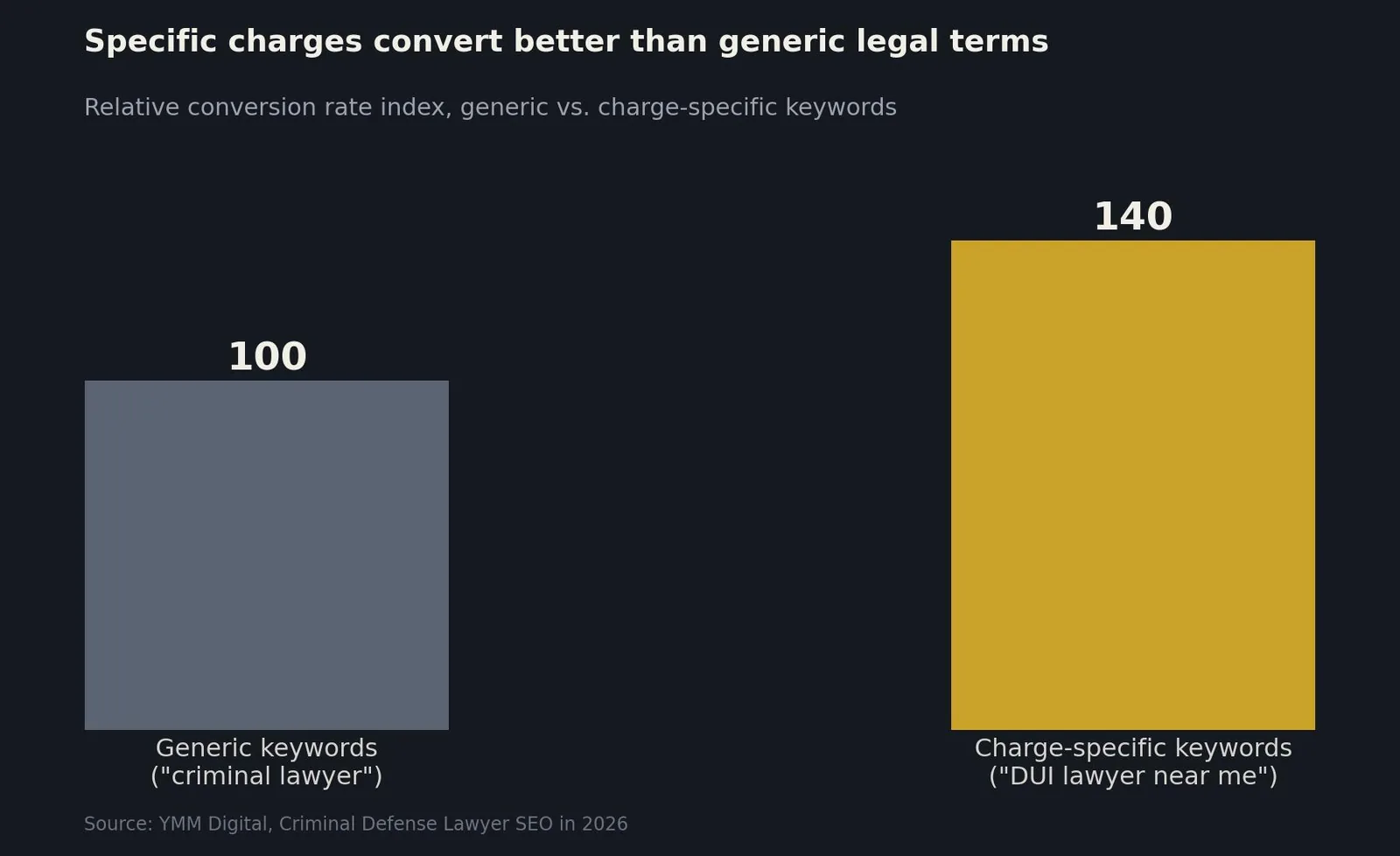
Charge-specific keywords convert meaningfully better than generic legal terms. A dedicated page for "DUI lawyer near me" or "drug possession attorney" matches exactly what a searcher facing that specific charge is looking for, while a generic "criminal lawyer" page competes against every firm in the market for a much vaguer signal (YMM Digital). Long tail keywords built around a specific charge, city, or even court name capture searchers who are further along and more ready to call.
An FAQ section addressing the questions someone actually has right after an arrest — what happens at arraignment, how bail works, whether a public defender is different from a private attorney — tends to perform well precisely because it matches real search behavior rather than legal jargon. This kind of content also builds the credibility that matters most for a first-time criminal defense client deciding who to trust.
Legal Directories, Backlinks, and Off-Page SEO
Legal directories including Avvo, Justia, and FindLaw still matter for a criminal defense firm's off-page SEO, both as a source of direct client inquiries and as a credibility signal. Most of these directories now apply nofollow or sponsored attributes to outbound profile links, meaning the direct backlink value has weakened even as the referral traffic and trust value remains real.
How Major Legal Directories Compare
| Directory | Best for | Link value today |
|---|---|---|
| Avvo | Personal injury, family law, criminal defense volume | Mostly nofollow; strong for referral traffic and reviews |
| Justia | Free profile, attorney blog integration | Mostly nofollow; useful for branded search visibility |
| FindLaw | Broad national visibility | Mostly nofollow; strongest for directory-level traffic |
| Bar association directories | Practice-area specific credibility | Often followed; smaller traffic, real authority signal |
Genuine backlink authority for a criminal defense firm increasingly comes from sources outside the major directories: local news coverage of criminal justice topics, bar association profiles, guest commentary on legal blogs, and community sponsorships that earn a link from a local organization's website back to the firm website. Link building efforts should stay narrowly focused on legally relevant, locally relevant sources rather than volume for its own sake. Monitoring which pages actually earn clicks and impressions in Google Search Console is a better use of time than chasing vanity backlink counts. Social media, particularly a consistently updated Instagram or Facebook presence, won't build backlinks directly but reinforces the same trust signals a first-time client is already looking for before they call.
Common SEO Mistakes Criminal Defense Firms Make
The most common mistake is targeting only broad, generic keywords. Terms like "criminal lawyer" carry enormous competition and don't match how someone in a specific situation actually searches, which leaves a firm chasing broad terms fighting the hardest possible battle for a lower-intent visitor.
Neglecting the Google Business Profile costs firms just as often, and it's one of the more expensive mistakes given how much of the map pack's visibility depends on it. A profile claimed once and never updated again quietly loses ground to competitors who post updates and respond to reviews weekly.
Inconsistent NAP data across directories is a subtler problem. Nothing looks broken on the surface, but Google's confidence in the firm's location data erodes, and local rankings slip without an obvious cause to point to.
Backlinks from low-quality or irrelevant sources, rather than legal directories, bar associations, and local media, undermine the very credibility signals a criminal defense firm depends on, in a niche where trust is the entire sale.
Frequently Asked Questions
How is SEO for criminal defense lawyers different from other legal SEO? The core difference is urgency. Criminal defense clients typically search within hours of an arrest, on mobile, with immediate local intent, which puts far more weight on Google Business Profile optimization and page-one local rankings than in practice areas where clients research for weeks.
How much does SEO cost for a criminal defense law firm? Costs vary by market and competition, but ongoing SEO programs for competitive practice areas commonly run into the thousands of dollars per month, while PPC alone can cost $100 to $200 or more per click for the same keywords, making organic rankings the better long-term investment for most firms.
Do legal directories like Avvo and Justia still help SEO? They still help, mainly through referral traffic, credibility, and NAP consistency, though most directories now use nofollow or sponsored link attributes, so the direct backlink value has diminished compared to a genuinely followed link from a local news outlet or bar association.
What's the fastest way to improve local rankings for a criminal defense firm? Claiming and actively maintaining a Google Business Profile — accurate categories, regular photo updates, prompt review responses — tends to produce the fastest visible improvement in map pack visibility of any single action a firm can take.
Should a criminal defense firm use PPC, SEO, or both? Most firms benefit from both. PPC buys immediate visibility while organic rankings build, and organic search typically becomes the lower-cost, higher-volume channel over time once a firm's content and local signals are established.
Web Tonic's legal services marketing team builds SEO and Google Ads programs specifically for criminal defense and other legal practice areas, combining local search optimization with the paid visibility firms often need while organic rankings are still building.
Where Criminal Defense Firms Should Start
SEO for criminal defense lawyers rewards firms that treat local search as the primary battlefield: an actively maintained Google Business Profile, charge-specific content that matches real search behavior, consistent NAP data across every directory, and backlinks earned from genuinely relevant legal and local sources.
Start with the Google Business Profile audit, since it's the single highest-leverage fix available, then build out charge-specific pages for the two or three case types that make up most of the firm's caseload before expanding further.
More from Web Tonic: growth marketing services, data & analytics.
Sources: rankings.io · savvylawfirmmarketing.com · ymmdigital.com · jasminedirectory.com · joshbrown.io · bluelinks.agency