Table of contents

Someone in [city] just got rear-ended. Their neck hurts, their car is totaled, and they're already searching "car accident lawyer near me" before they've even called their insurance company. Three law firms show up in Google's map pack. If yours isn't one of them, that case, worth anywhere from $50,000 to $500,000+ in fees, goes to whichever firm did show up.
SEO for personal injury lawyers is the work of making sure your firm is one of those three names, consistently, for every city and practice area you serve. This is one of the most competitive and expensive verticals in digital marketing, which makes doing it right worth more here than almost anywhere else.
Key Takeaways
- The local map pack captures roughly 42 to 46 percent of all clicks for legal queries, and 75 percent of users only engage with the top three local pack results, making local visibility the single highest-leverage investment for a personal injury firm.
- 76 percent of local searches lead to a call or visit within 24 hours, and businesses with a complete Google Business Profile are 70 percent more likely to attract those visits.
- Cost per click for competitive personal injury terms regularly runs $200 to $1,000 in major metro markets, making organic search rankings dramatically more cost-efficient over time than paid alone.
- Law firm SEO delivers an average 526 percent return over 3 years, according to Rankings.io's 2026 analysis, though it typically takes 6 to 12 months of consistent investment before that return shows up.
- Avvo and FindLaw carry domain authority in the 84 to 88 range, compared to typically far lower scores for a regional firm site, which is why broad, generic terms are nearly unwinnable without a local and case-specific strategy.
- Choosing "Personal Injury Attorney" as your primary Google Business Profile category, not the generic "Lawyer," is the single highest-leverage local ranking factor according to Whitespark's 2026 Local Search Ranking Factors report.
What Is SEO for Personal Injury Lawyers?
SEO for personal injury lawyers is the practice of optimizing a law firm's website, Google Business Profile, and legal directory presence so the firm appears in search results and the map pack when accident victims search for representation. It follows the same search engine optimization fundamentals as any other local SEO effort, Google Business Profile completeness, consistent citations, and active reviews, but weighted heavily toward local, case-specific, and urgency-driven searches, since almost nobody researching a personal injury claim searches casually.
That urgency matters because of what's actually at stake per case. Unlike most local seo categories, a single signed personal injury case can be worth tens or hundreds of thousands of dollars in fees, which is why cost per click for this vertical runs so much higher than nearly any other industry, and why organic search rankings that keep generating leads without a per-click cost matter so much more here. A law firm website built around high quality, jurisdiction-specific content consistently outperforms a generic site trying to compete on broad terms alone.
The Map Pack Is Where PI Cases Are Won
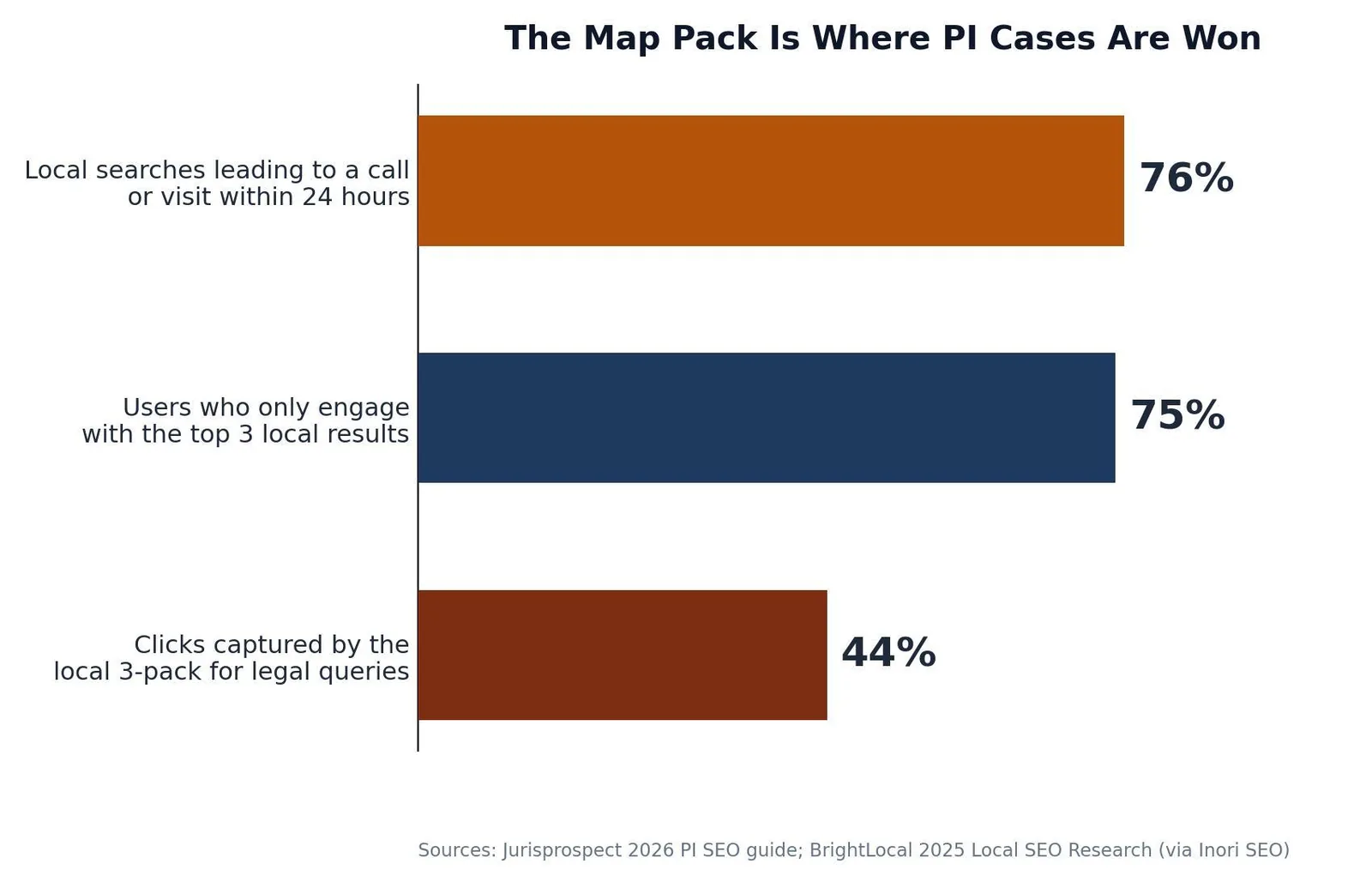
The numbers make the priority obvious. According to Jurisprospect's 2026 personal injury SEO guide, Google's local map pack captures roughly 42 to 46 percent of all clicks for legal queries. BrightLocal's 2025 local SEO research, cited by Inori SEO, found that 75 percent of users only engage with the top three local pack results, and 76 percent of local searches lead to a call or visit within 24 hours. A firm that isn't in that top three for its city and practice areas is largely invisible to the exact potential clients most likely to sign.
Why Organic Beats Paid for PI Firms Long-Term
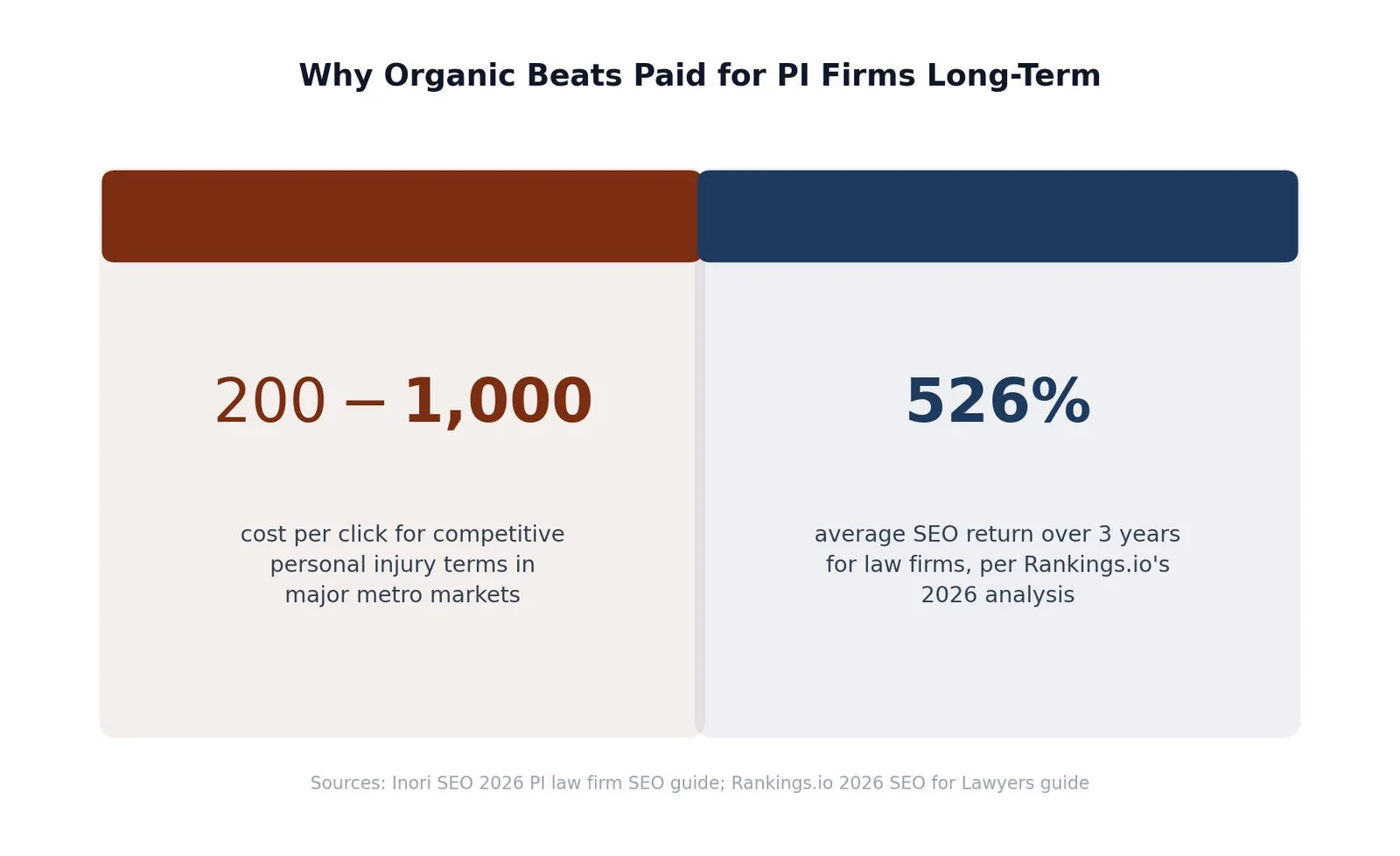
The economics explain why organic search matters so much in this vertical specifically. Cost per click for terms like "car accident lawyer" regularly exceeds $200, and can run as high as $1,000 per click in major metro markets. Meanwhile, Rankings.io's 2026 guide to SEO for lawyers puts the average SEO return for law firms at 526 percent over 3 years, dramatically outperforming the roughly 2x return typical of PPC alone over the same period, though it takes 6 to 12 months of consistent work before that return materializes.
Why Broad Terms Favor the Big Directories
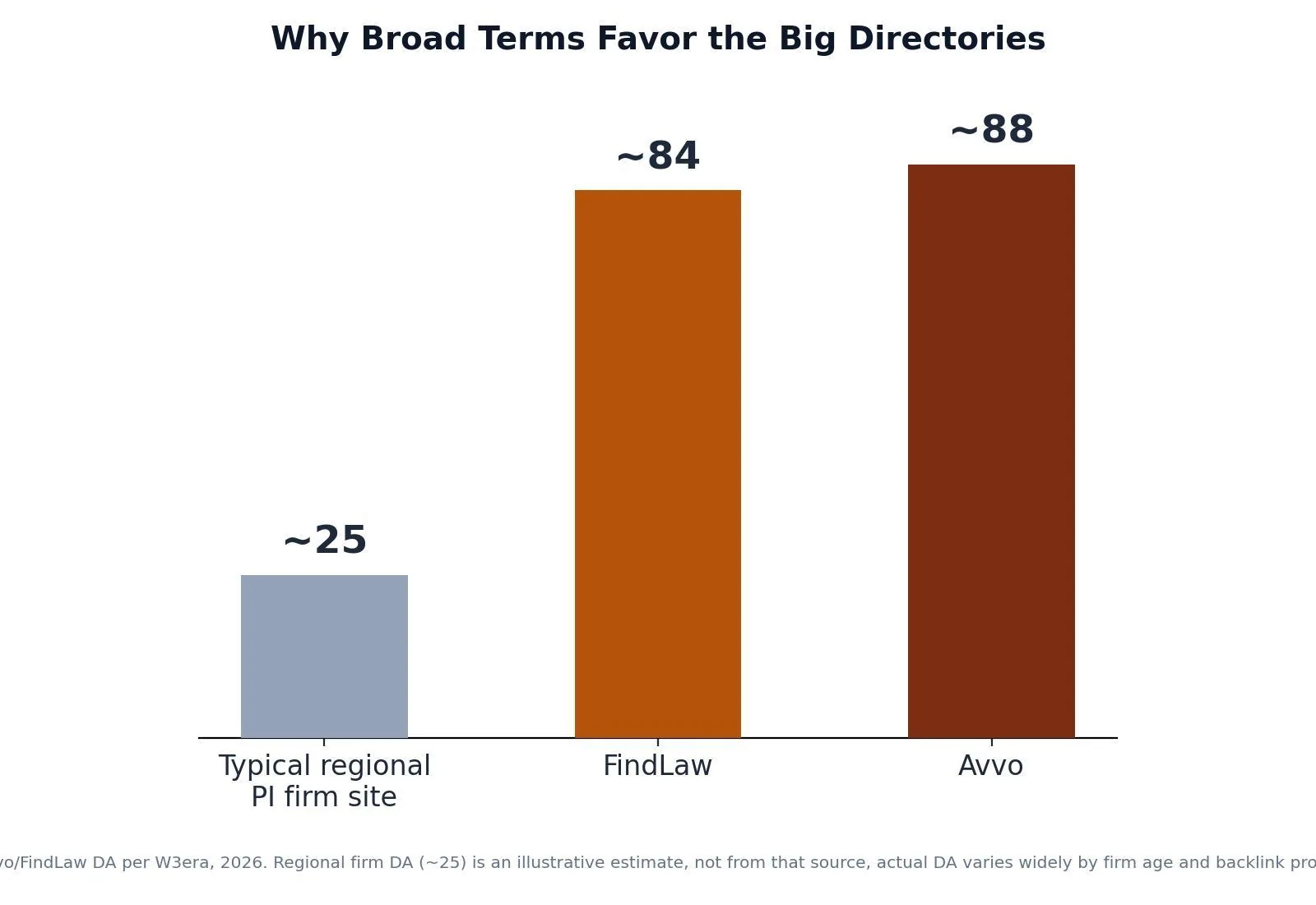
Competing head-on for generic terms like "personal injury lawyer" is a losing strategy for most firms. Avvo and FindLaw carry domain authority scores in the 84 to 88 range, built up over years of aggregated content and legal citations. A typical regional firm site usually sits far below that, often in the 20s or 30s depending on age and backlink history, though the exact gap varies firm to firm. The winning approach isn't beating Avvo and Justia on their own turf, it's flanking them with local specificity and case-type depth they'll never bother building.
Legal Directory Presence Compared
| Platform | Typical Domain Authority | Best For | Action Needed |
|---|---|---|---|
| Avvo | ~88 | Attorney profile searches, informational queries | Claim, complete profile, match NAP exactly |
| Justia | High, aggregator-level | Legal content and attorney directory searches | Claim profile, keep information current |
| FindLaw | ~84 | Broad practice-area informational queries | Claim, complete profile, link back to firm site |
| Your own firm website | Typically 20s-30s for regional firms | Local, case-specific, and geo-targeted searches | Build dedicated pages per practice area and city |
None of the big directories replace a firm's own website. They serve as trust signals and independent ranking assets, while the firm's own local seo and content strategy is what actually wins the specific, local searches that convert into signed cases.
Legal SEO tool
Is your firm set up to win the map pack?
Check off what's already true for your firm. Your score updates as you go.
0 of 5
Check off items above to see how ready your firm is to win local search.
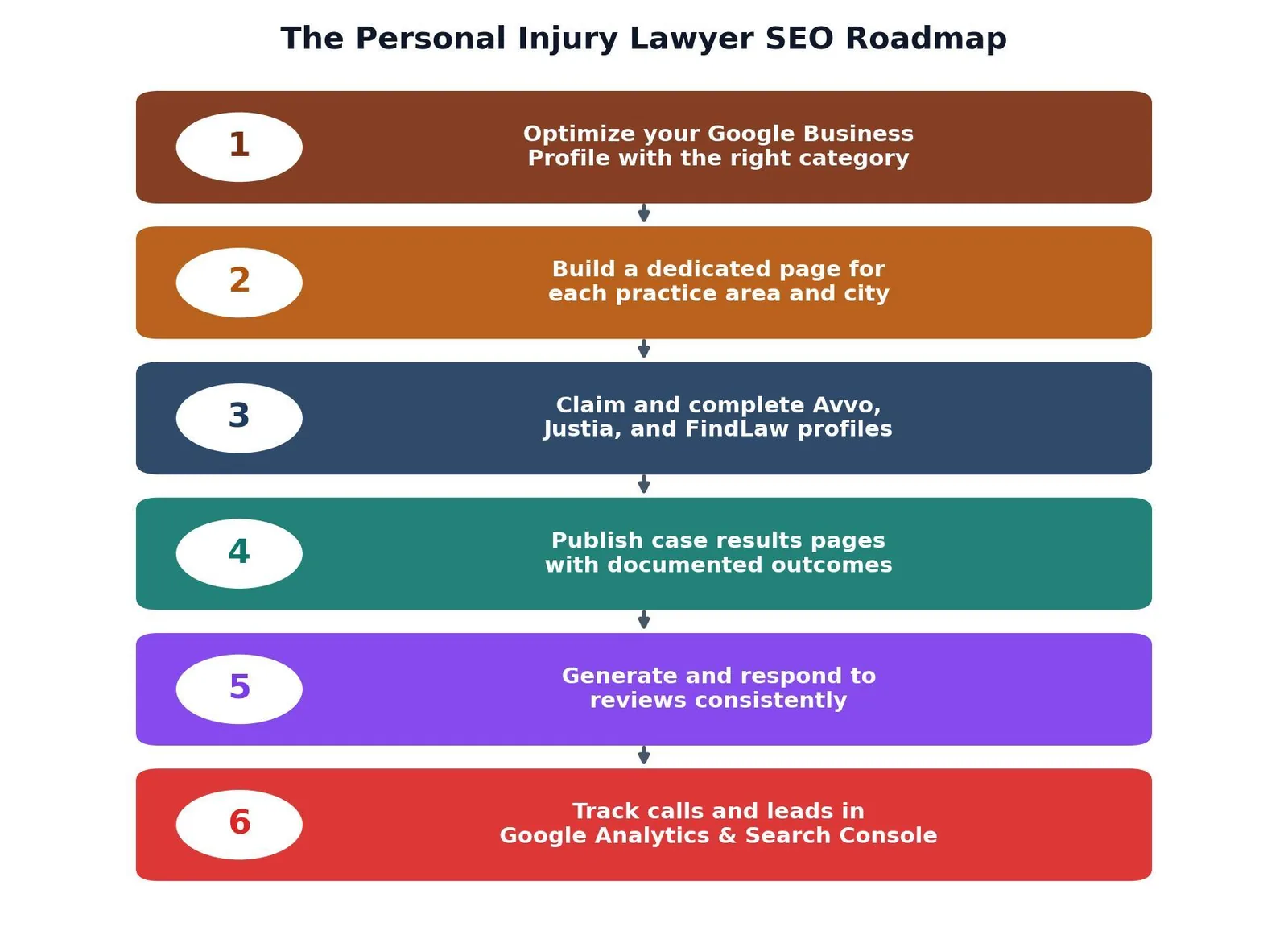
Step 1: Optimize your Google Business Profile with the right category
Set the primary category to "Personal Injury Attorney," never the generic "Lawyer." According to Whitespark's 2026 research, this single choice is the #1 Google Maps ranking factor for firms in this space. Add secondary categories, complete every service field, and use the full character limit on your business description. Make sure your firm's pin is accurate on Google Maps too, since a misplaced or duplicate listing splits your review count and confuses the exact local signal you're trying to build.
Step 2: Build a dedicated page for each practice area and city
A single generic "Personal Injury" page will never rank for car accidents, truck accidents, and slip-and-fall cases simultaneously. Each practice area, combined with each city or region served, deserves its own page targeting that specific combination directly. Running each target phrase through Google Keyword Planner first confirms there's real search volume behind it before you invest in building the page.
Step 3: Claim and complete Avvo, Justia, and FindLaw profiles
These profiles rank independently for your firm's name and build the entity authority that strengthens your own website's signals. Keep your name, address, and phone number identical across every platform, even a "Suite 200" versus "Ste 200" mismatch can weaken local trust signals. Genuine link building, earned media, bar association mentions, guest contributions to legal publications, does more for a personal injury marketing program long-term than any volume of directory submissions.
Step 4: Publish case results pages with documented outcomes
Case results pages, structured within bar advertising compliance rules, are one of the strongest E-E-A-T signals available to a personal injury firm, and one of the most consistently neglected by competitors.
Step 5: Generate and respond to reviews consistently
Review volume and velocity are both local pack ranking factors. Respond to every review within 48 hours, since Google's algorithm rewards profiles that stay active far more than ones that go quiet after the first few reviews. A consistent social media presence reinforces the same trust signals, since prospective clients often check a firm's recent activity there as part of deciding whether to call.
Step 6: Track calls and leads in Google Analytics and Search Console
Google Analytics and Google Search Console show which pages actually generate calls and form submissions, not just traffic, which is the only reliable way to know whether the previous five steps are converting into signed cases.
Common Personal Injury SEO Mistakes to Avoid
The most common one is going after only broad, generic terms, which puts a regional firm in direct competition with Avvo, Justia, and national aggregators that have a decade-long domain authority advantage.
A stale Google Business Profile costs map pack visibility that's otherwise free to earn. Firms that stop posting updates or responding to reviews quietly lose ground to competitors who treat the profile as a living asset.
Inconsistent business information across directories, even something as small as an abbreviated suite number, confuses both search engines and potential clients trying to verify a firm is legitimate.
Cheap, high-volume link packages round out the list, and they're a bigger risk than they look. Google's spam detection in YMYL categories like legal is aggressive, and a lead-gen link footprint can trigger suppression rather than a ranking boost.
Frequently Asked Questions
How long does SEO take to work for a personal injury law firm?
Most firms see meaningful movement within 4 to 6 months, with significant ranking improvements by 12 months. Quick wins like Google Business Profile optimization can show results within weeks.
How much does SEO cost for a personal injury law firm?
Quality SEO for competitive legal markets typically ranges from $3,000 to $10,000 per month, though the right figure depends heavily on market competitiveness and firm size. Get a quote specific to your market before committing budget, since one signed case can pay for a full year of the investment.
Is SEO or PPC better for a personal injury law firm?
They serve different purposes. PPC delivers potential clients immediately but at a cost per click that can exceed $200 to $1,000 in competitive metros, with costs continuing indefinitely. SEO takes longer to build but keeps generating leads without a per-click cost once rankings are established, which is why most firms eventually run both.
Do I need to be listed on Avvo, Justia, and FindLaw if I already rank well organically?
Yes. These directories rank independently for your firm's name and serve as trust and citation signals that Google and AI search tools both reference when evaluating your firm's authority, regardless of how well your own site already ranks.
The Bottom Line on SEO for Personal Injury Lawyers
Personal injury is one of the most competitive, most expensive search verticals that exists, which is exactly why doing local SEO well pays off more here than almost anywhere else. A complete Google Business Profile with the right category, dedicated pages per practice area and city, consistent directory presence, and documented case results consistently beat competitors relying on generic pages and paid clicks alone.
Start with your Google Business Profile category this week. It's free, it takes minutes, and it's the single highest-leverage fix on this entire list.
Ready to Capture More High-Value Cases?
Web Tonic runs a dedicated legal marketing program, built around exactly this combination: high-intent keyword research, content that builds trust and answers real client questions, and local SEO tailored to how personal injury clients actually search. For firms that would rather hand this off than build it internally, that's the program this team runs day to day.
More from Web Tonic: growth marketing services, data & analytics.
Sources: whitespark.ca · jurisprospect.com · inoriseo.com · rankings.io · w3era.com · brdmediallc.org