Table of contents

This article covers marketing and SEO strategy for financial advisory practices. It is not compliance, legal, or investment advice. Confirm any marketing, testimonial, or disclosure practices with your firm's compliance officer before implementing them.
Even a referral doesn't skip the search bar anymore. A prospect gets a name from a friend, a CPA, or a colleague, and the very next thing they do is Google it. 96 percent of prospects research a financial advisor online before making contact, whether they were referred or not. If what comes back looks thin, outdated, or invisible, the referral doesn't survive first contact.
SEO, short for search engine optimization, for financial advisors is the work of making sure that search holds up: a complete Google Business Profile, a website that clearly states a niche and credentials, and enough genuine content and authority signals that a prospect trusts the firm before ever picking up the phone. Despite how well it performs, most of the profession still isn't doing it, which is exactly why the ones who do stand out.
Key Takeaways
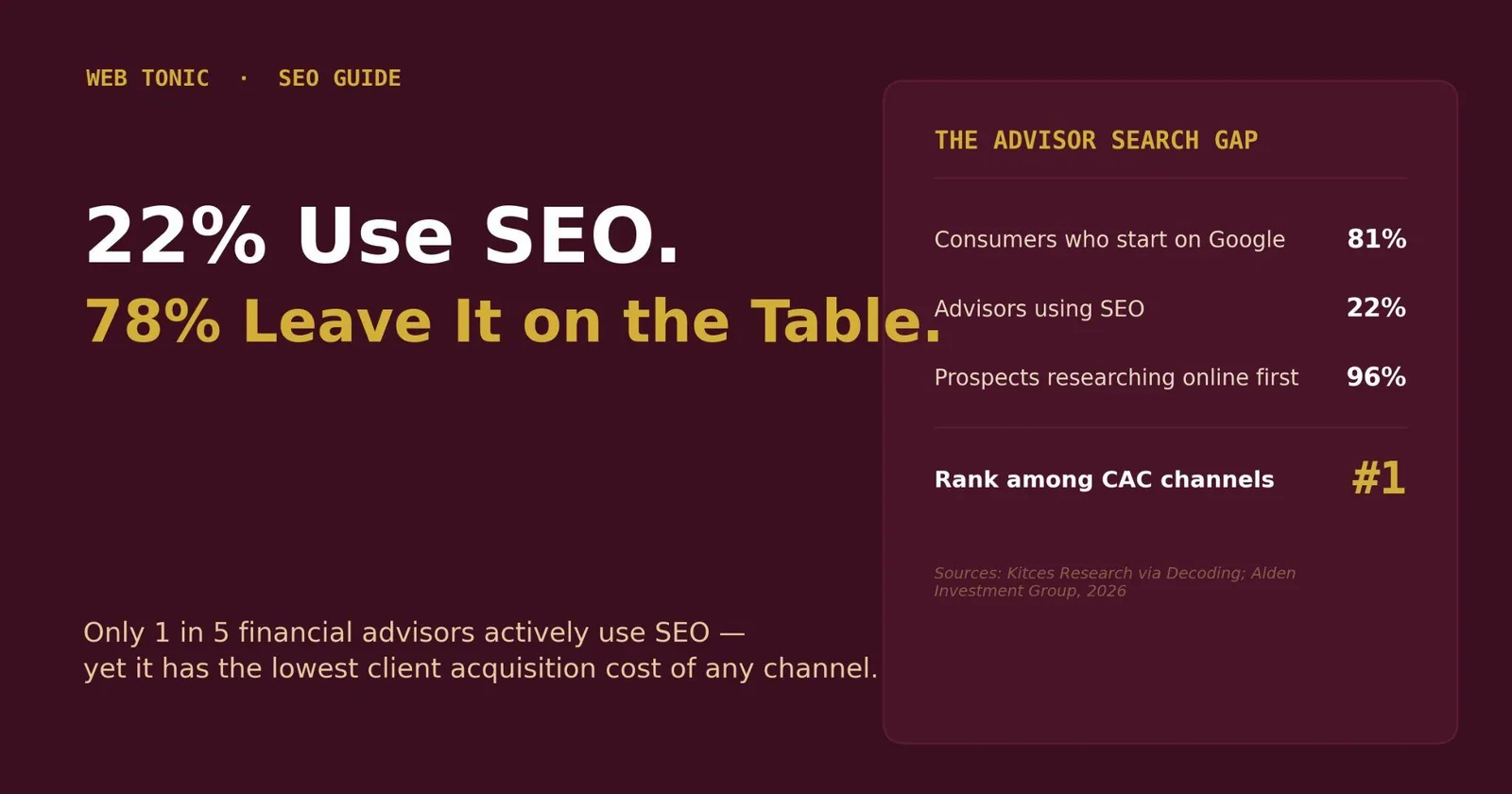
- Only 22 percent of financial advisors actively use SEO as part of their marketing strategy (Kitces Research, via Decoding 2026), despite 81 percent of consumers starting their search for services on Google: a substantial, underexploited gap.
- SEO has the lowest client acquisition cost of any marketing tactic evaluated in Kitces Research's advisor marketing study, ahead of paid ads, podcasting, and social media.
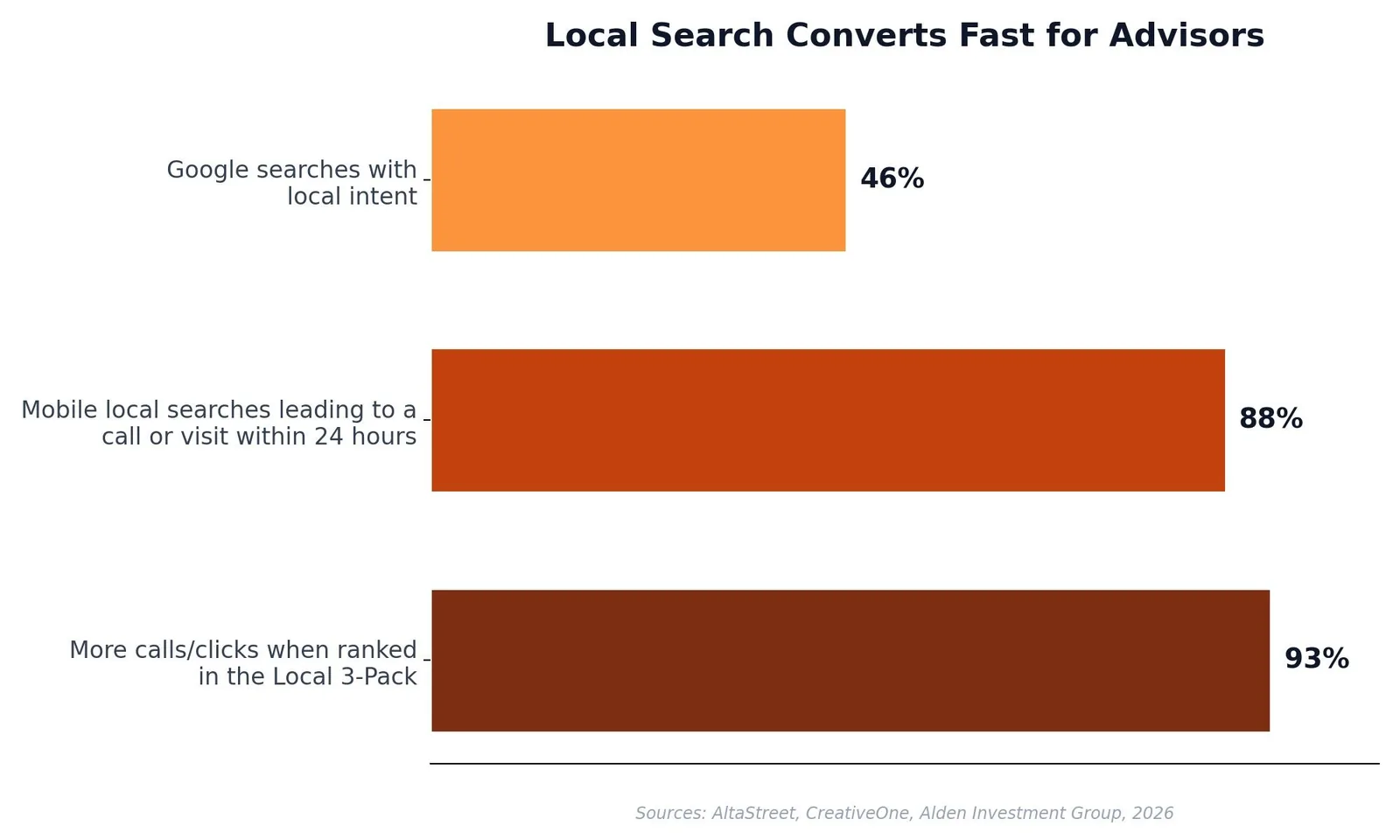
- 46 percent of Google searches carry local intent, and 88 percent of local mobile searches lead to a call or visit within 24 hours (AltaStreet, 2026) which is why "financial advisor near me" searches convert fast.
- Ranking in the Local 3-Pack can drive up to 93 percent more calls, clicks, and direction requests (Alden Investment Group, 2026) compared to not appearing there at all.
- SEO typically takes 6 to 12 months to show meaningful ROI, but the payoff compounds: one wealth management firm invested USD $300,000 over 5.5 years and generated over USD $2.8 million in annual recurring revenue from organic traffic alone (Storyenvelope, 2026), a third-party case study, not a Web Tonic client result.
- Reviews and testimonials are compliant for financial advisors under the SEC's 2021 Marketing Rule update (Optuno, 2026), provided they're properly disclosed. Confirm specific requirements with your compliance officer, as noted above.
What Is SEO for Financial Advisors?
SEO for financial advisors is the process of optimizing a firm's website, Google Business Profile, and content so it ranks when prospects search for financial planning, retirement strategies, or investment help in their area. It runs on the same fundamentals as SEO anywhere: technical health, on-page content, and off-page authority signals that help search engines and prospects arrive at the same conclusion about who to trust. What's different is the stakes. Financial advice is a high-trust, high-consequence category, so Google applies extra scrutiny to credibility signals, and prospects apply even more.
That trust dynamic changes the priority order. A generic "financial advisor" positioning competes against every wirehouse and national brand in the category. Advisors who position clearly for a specific niche, business owners, physicians, widows, federal employees, high earners in their 40s, consistently outperform generalists in local search, because Google rewards specificity and so do prospects evaluating who actually understands their situation.
Why 78 Percent of Advisors Are Leaving This Channel Open
The opportunity gap here is unusually wide for a mature marketing channel. Only 22 percent of financial advisors actively use SEO, according to Kitces Research, despite 81 percent of consumers beginning their search for services on Google. The same research found that SEO has the lowest client acquisition cost of any marketing tactic evaluated, lower than paid ads, podcasting, or social media.
Local intent makes the gap more expensive to ignore. 46 percent of all Google searches carry local intent, and 88 percent of local searches on mobile lead to a call or visit within 24 hours (AltaStreet, 2026). For an advisor, ranking in the coveted Local 3-Pack can mean up to 93 percent more calls, clicks, and direction requests than not appearing there. Prospects searching "financial advisor near me" or "retirement planner in [city]" have usually just had a life event, a new job, a marriage, an inheritance, and are ready to talk, not just browsing.
SEO vs. Google Ads for Financial Advisor Client Acquisition
| Factor | SEO (organic) | Google Ads (PPC) |
|---|---|---|
| Cost model | Time and content investment; no per-click cost | USD $20 to $50 per click for financial services keywords |
| Time to results | 6 to 12 months to meaningful ROI | Immediate, live same day |
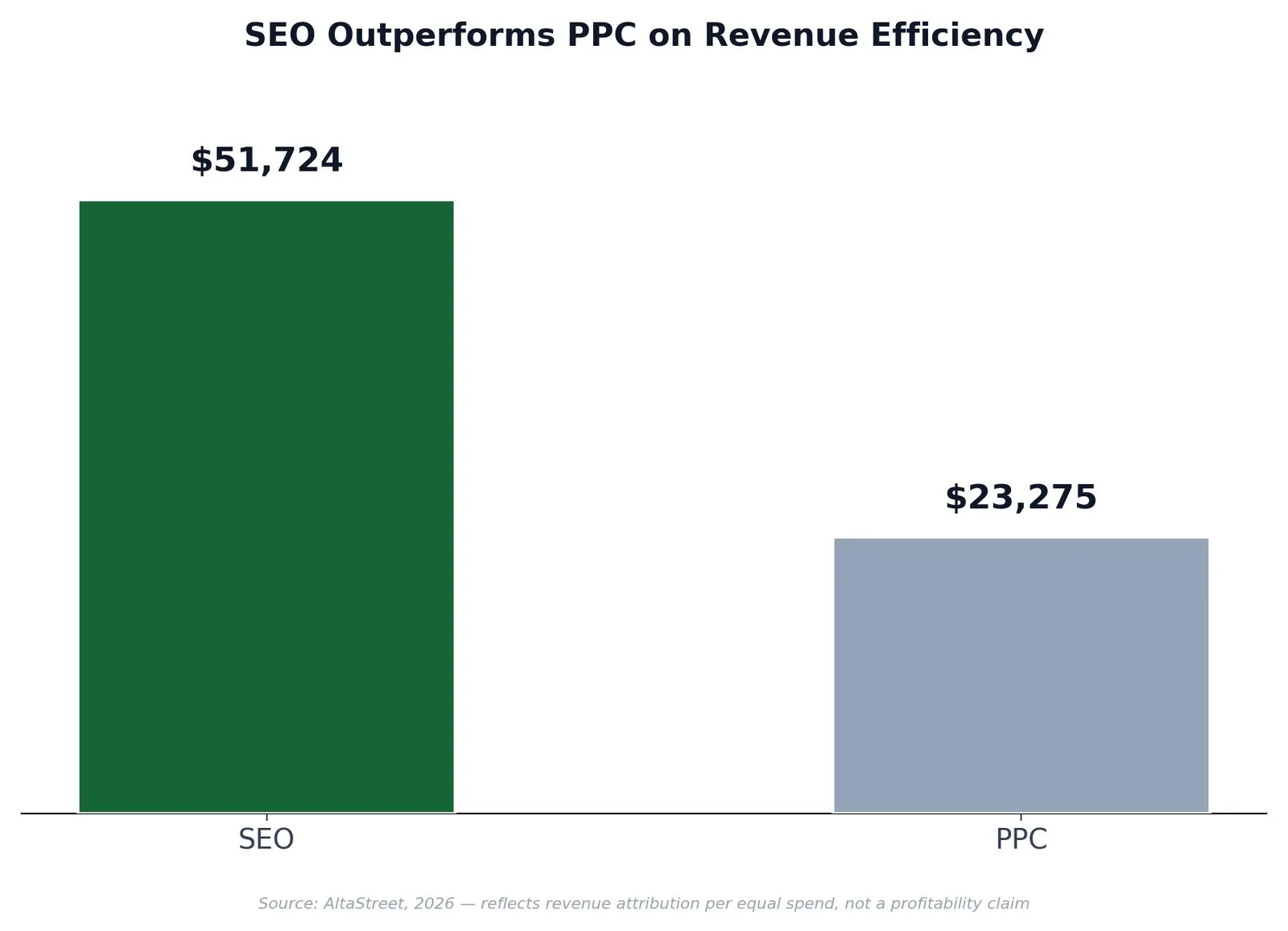
| Revenue efficiency | Roughly USD $51,724 generated per USD $100K spend | Roughly USD $23,275 generated per USD $100K spend |
| Longevity | Compounds; rankings and content keep working after publication | Stops the moment ad spend stops |
| Client acquisition cost | Lowest of any channel evaluated | Higher, and rising as platforms get more competitive |
| Best fit | Long-term, compounding pipeline in a specific niche and market | Immediate visibility while organic authority builds |
That revenue-efficiency comparison reflects attribution per equal spend, not a standalone profitability claim, but the direction is consistent with the client acquisition cost data: most advisors would get more from the same dollar in SEO than in PPC, they just aren't spending it there yet.
Even a Referral Gets Googled First
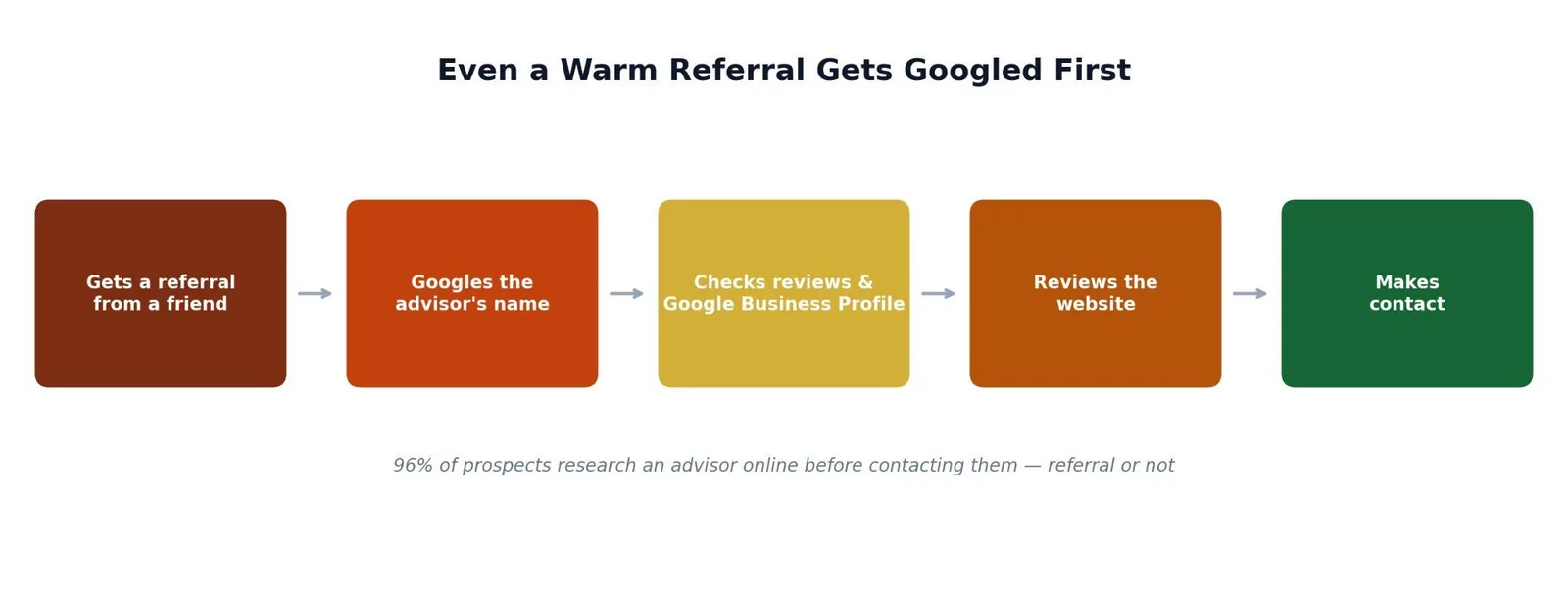
Financial advising is still a relationship-driven business, and referrals generate the largest share of most advisors' leads. That doesn't mean the search bar gets skipped. 96 percent of prospects research an advisor online before making contact (Alden Investment Group, 2026), checking reviews, scanning the Google Business Profile, and comparing the website against other advisors in the area, even when a trusted friend made the introduction.
That means the website and profile aren't just top-of-funnel tools, they're the credibility check every warm lead runs before calling. A thin or outdated presence can quietly kill a referral that would have converted with almost no additional effort. Real photos of the actual office, team, and conference room outperform generic "businessmen in suits" stock photography here, because credibility is the entire product being evaluated.
The Financial Advisor Local SEO Roadmap
Step 1: Claim and fully build out your Google Business Profile
Choose "Financial Planner" or "Financial Consultant" as the primary category, and add relevant secondary categories: "Investment Service," "Retirement Planning Service," "Insurance Agency" if applicable. Most advisors barely touch their profile, which is why the ones who do have such an easy edge over larger competitors.
Step 2: Build a genuine, compliance-safe review cadence
Reviews and testimonials are permitted under the SEC's 2021 Marketing Rule update, provided they're properly disclosed. That makes a real review cadence a usable, compliant lever, not a regulatory risk to avoid entirely. Confirm exact disclosure requirements with your compliance officer before launching any review program — the rule permits testimonials, but the specifics of proper disclosure are firm- and situation-dependent.
Step 3: Position for a specific niche, not "financial advisor" in general
Advisors who position clearly for a specific niche consistently outperform generalists in local search, because Google rewards specificity, and so do prospects trying to determine whether an advisor actually understands their situation.
Step 4: Publish location- and service-specific content
Content addressing "retirement planning in Denver" or "financial advisor for business owners in Austin" captures long tail keywords a generic services page never will, while also demonstrating the local and niche expertise prospects are actively evaluating.
Step 5: Earn authority signals from reputable financial sources
Brand mentions and backlinks from recognized financial publications carry outsized trust in this category. Credentials from bodies like the CFP Board or NAPFA, cited clearly on the site, function as real E-E-A-T signals, not just badges. Sites like Investopedia are useful models for how to explain complex financial topics clearly, a standard AI systems and Google both reward.
Step 6: Structure content for AI search, not just classic rankings
With nearly 60 percent of Google searches now ending without a click, content that educates clearly, cites reputable sources, and gets straight to the answer has a real shot at being surfaced in AI-generated summaries, not just classic blue links.
On-Page Basics and Tools Advisors Skip
Every page on an advisory site needs a unique title tag and meta description that states the niche and location plainly, "Retirement Planning for Federal Employees in Austin" outperforms "Home" or a generic firm name on every ranking and click-through metric that matters. Google Search Console and Google Analytics should be set up before any content push, since Search Console shows exactly which queries already bring traffic and where technical issues are quietly limiting visibility. A rank tracker or platform like Ahrefs or Semrush adds visibility into which local competitors already hold the searches worth targeting, and where high quality backlinks from reputable financial publications might realistically be earned.
Is Your Advisory Practice SEO-Ready?
Financial advisor SEO tool
Is your practice SEO-ready?
Check off what's already true for your firm. Your score updates as you go.
0 of 5
Check off items above to see how SEO-ready your practice is.
What Results Actually Look Like
One wealth management firm's numbers illustrate the compounding effect well (Storyenvelope, 2026): USD $300,000 invested over 5.5 years generated more than USD $2.8 million in annual recurring revenue, with the firm adding an estimated USD $40 to $50 million in assets under management each year through organic traffic from SEO-based content alone. This is a third-party case study, not a Web Tonic client result, and results like it aren't guaranteed or typical for every firm, they depend heavily on niche, location, and competition, but they illustrate why SEO is described as a compounding asset rather than a recurring expense.
For perspective on cost: DIY SEO tools run roughly USD $100 to $300 per month, while full-service agency management for financial advisors typically runs USD $2,000 to $5,000 per month, depending on market competitiveness and scope. Major metro markets like Austin or Denver typically see 2,000 to 5,000 monthly searches for financial advisor-related terms, which gives a sense of the addressable demand in a competitive market.
Common SEO Mistakes Financial Advisors Make
The most common one is generic positioning: a homepage that says "financial advisor" without stating a niche, a specialty, or who the firm actually serves best. Google and prospects both reward specificity, and a generalist page competes against every wirehouse in the category.
Treating the Google Business Profile as a formality is a close second. An incomplete profile, generic stock photography, and stale categories signal low trust in a category where trust is the entire sale.
Avoiding reviews entirely out of compliance concern is the quieter mistake. Since the SEC's 2021 Marketing Rule update, testimonials are permitted with proper disclosure, which means most advisors are leaving a compliant, high-impact lever unused out of outdated caution — though the specific disclosure language should still go through compliance review before publishing.
And expecting results within weeks is the mistake that kills otherwise sound SEO investments early. SEO typically takes 6 to 12 months to show meaningful ROI; firms that abandon it in month three are stopping right before the compounding effect would have started.
Frequently Asked Questions
How much does SEO cost for a financial advisor?
DIY tools run roughly USD $100 to $300 per month. Full-service agency management typically runs USD $2,000 to $5,000 per month, depending on market competitiveness and the scope of work.
How long does it take to see results?
Most advisors should expect 6 to 12 months before seeing meaningful ROI. Results compound after that point, which is why SEO is best treated as a long-term asset rather than a short-term campaign.
Is SEO worth it for every financial advisor?
Not necessarily. It tends to work best for advisors in cities of 300,000 or more residents, or those competing in a specific niche where local, high-intent searches exist in meaningful volume. Advisors in very small or highly rural markets may see a lower return.
Are client reviews and testimonials compliant for financial advisors?
Yes, under the SEC's 2021 Marketing Rule update, testimonials and reviews are permitted, provided they're properly disclosed according to the applicable regulations. This is general information, not compliance advice — confirm the specific disclosure requirements with a compliance professional before implementing a review program.
Does AI search change SEO for financial advisors?
Yes, to a degree. With a majority of searches now ending without a click, content that answers questions clearly, cites reputable sources, and demonstrates real expertise has a better shot at being surfaced in AI-generated summaries, in addition to ranking well in classic search.
The Bottom Line on SEO for Financial Advisors
Financial advisor SEO rewards precisely the qualities the profession already needs to demonstrate: clear positioning, real credentials, and genuine local trust. The fact that only 22 percent of advisors are actually doing this well is the opportunity, not a reason for caution, since prospects are already searching whether or not a given firm shows up.
Start with a full Google Business Profile audit and a clear statement of your specific niche on the homepage. Both are inexpensive to fix and disproportionately impactful for how a firm shows up in local search.
Ready to Turn Search Visibility Into Client Meetings?
Coordinating Google Business Profile optimization, compliant review generation, niche positioning, and content strategy all at once is where most advisory practices run out of internal bandwidth. Web Tonic's growth marketing team handles the technical SEO, local content, and reputation work covered in this playbook as part of a full-funnel approach, so search visibility turns into consultation requests instead of just impressions.
More from Web Tonic: growth marketing services, data & analytics.
Sources: trydecoding.com · altastreet.com · aldeninvestmentgroup.com · storyenvelope.com · optuno.com