Table of contents

Meta-description: Struggling to attract high-value divorce cases? Master SEO for family law with our 2026 playbook to dominate local search results and scale your firm.
URL: /blog/seo-for-family-law

When a marriage ends or a custody dispute reaches a breaking point, the search that follows isn't casual browsing. It's "divorce lawyer near me" typed at 2 AM, or "emergency custody attorney" searched between arguments. Whichever family law firm shows up first, with a complete profile and real reviews, tends to get the call.
SEO for family law, short for search engine optimization applied specifically to family law services, is how a firm earns that spot. It combines a properly categorized Google Business Profile (GBP), dedicated pages for each practice area, hyperlocal content, and a review process that respects client privacy. According to LawyerSEOService's 2026 guide, nearly 56,970 family law and divorce attorneys compete across the U.S. for the same searches, so a generic law firm SEO approach isn't enough. This playbook covers what actually moves the needle in 2026.
Key Takeaways
- Family and estate law sees a 7.1% visitor-to-lead conversion rate, among the highest of any legal practice area reported by industry research, when the SEO foundation is built correctly.
- Your Google Business Profile's primary category should be "Family Law Attorney," not the generic "Lawyer" category, which forces the firm to compete against every attorney in the market.
- NAP consistency (name, address, phone number) across the firm's website, Avvo, Justia, and FindLaw is foundational; mismatches erode local rankings in ways that are easy to miss.
- Hyperlocal beats statewide: a page targeting "divorce attorney in [Dallas neighborhood]" outperforms a generic "divorce attorney Dallas" page competing against dozens of firms.
- Typical SEO investment for a competitive family law firm runs $3,000 to $10,000 USD per month, with most firms reportedly seeing measurable ranking movement within 3 to 4 months.
- 98% of consumers reportedly read online reviews before choosing a local business, making review velocity one of the strongest local ranking and conversion signals for family lawyers.
What is SEO for family law?
SEO for family law is the process of optimizing a firm's Google Business Profile, website, and content so it ranks when potential clients search for divorce, custody, or other family law services in their area. It differs from general legal marketing in one critical way: family law searches are hyperlocal by nature. Family law is governed by state law and often county court procedure, so clients want an attorney who knows their specific courthouse and jurisdiction, not just their state.
Urgency sets it apart too. Someone searching for a divorce attorney or a child custody lawyer is rarely browsing casually; they're often searching in a moment of crisis, at unusual hours, with high emotional stakes. That combination, hyperlocal intent plus high urgency, shapes almost every decision in a family law SEO strategy, from technical SEO fundamentals like page speed and mobile user experience to how content is written.
The family law search landscape in 2026
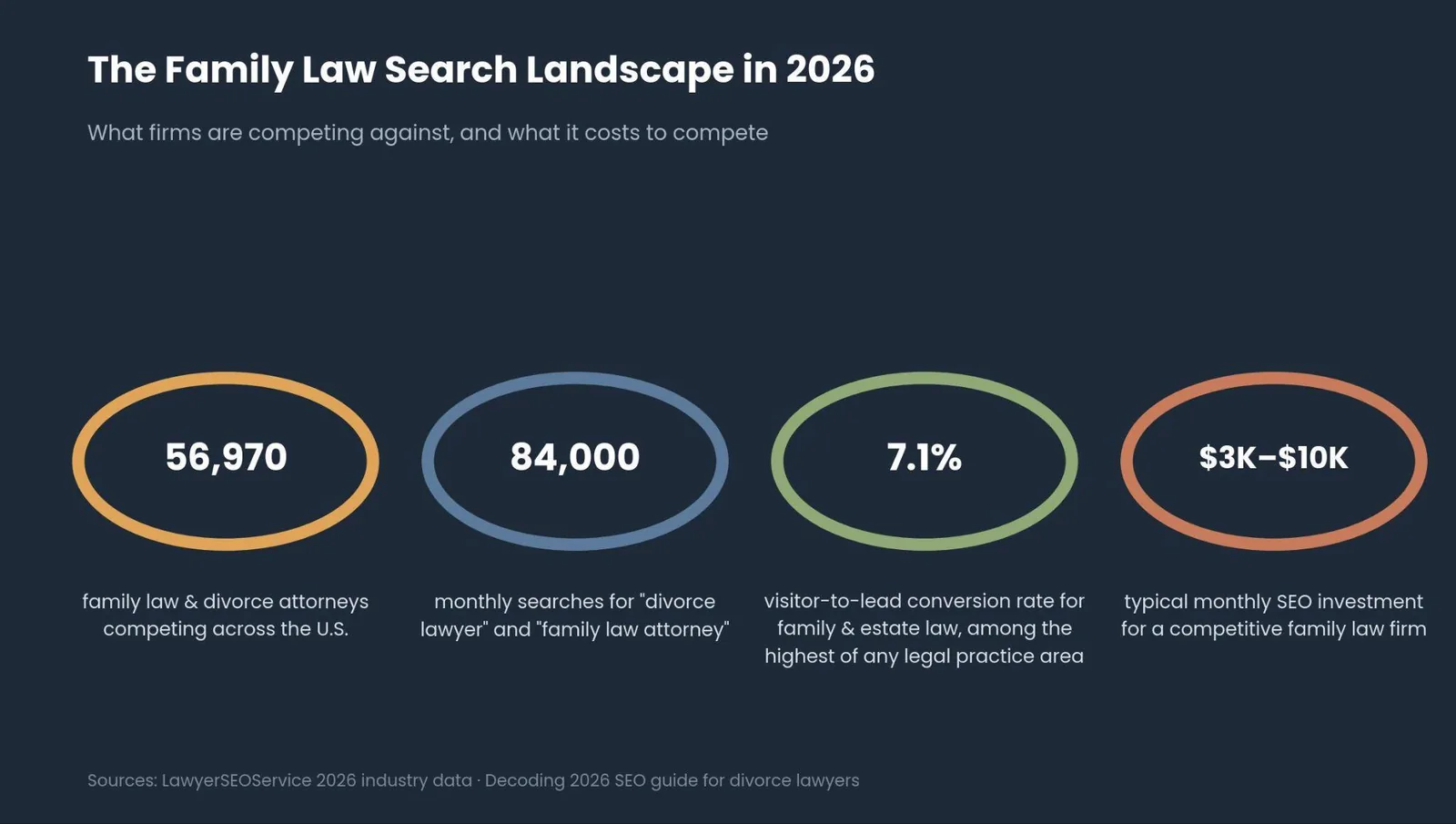
Competition is real: the same LawyerSEOService research cited above puts nearly 56,970 family law and divorce attorneys in competition across the United States, with keywords like "divorce lawyer" and "family law attorney" seeing roughly 84,000 combined monthly searches. Despite that competition, the same source reports that family and estate attorneys see a 7.1% visitor-to-lead conversion rate from organic traffic, among the highest of any legal practice area, because clients who find the right firm through search engines tend to be ready to act. All three of these figures trace back to one industry source rather than independently cross-verified research, so they're worth using as planning benchmarks rather than guaranteed numbers.
Budgets reflect the stakes. According to Decoding's 2026 guide for divorce lawyers, firms typically invest $3,000 to $10,000 USD per month in SEO for a competitive market. Per LRMC's family law SEO resource, most firms see measurable ranking movement within 3 to 4 months, with meaningful traffic and lead growth by month 6.
SEO vs. PPC for family law firms
| Factor | SEO (organic) | PPC (paid ads) |
|---|---|---|
| Cost model | Time and investment in GBP, content, and reviews | Ongoing cost per click |
| Time to results | Typically 3-4 months for movement, 6+ for growth | Immediate |
| Long-term value | Compounds, keeps generating leads after the work is done | Stops the moment spend stops |
| Best for | Firms building a durable, long-term pipeline of cases | Firms needing immediate visibility in a new market |
| Primary channel | Google Business Profile, practice area pages, reviews | Google Ads, Local Services Ads |
| Typical monthly cost | $3,000 to $10,000 USD | Scales directly with ad spend and click costs |
Most competitive firms run both. PPC fills the visibility gap while local SEO compounds in the background, and firms with a strong organic foundation often reduce paid spend over time as the Map Pack and organic listings do more of the work for free.
The family law SEO roadmap
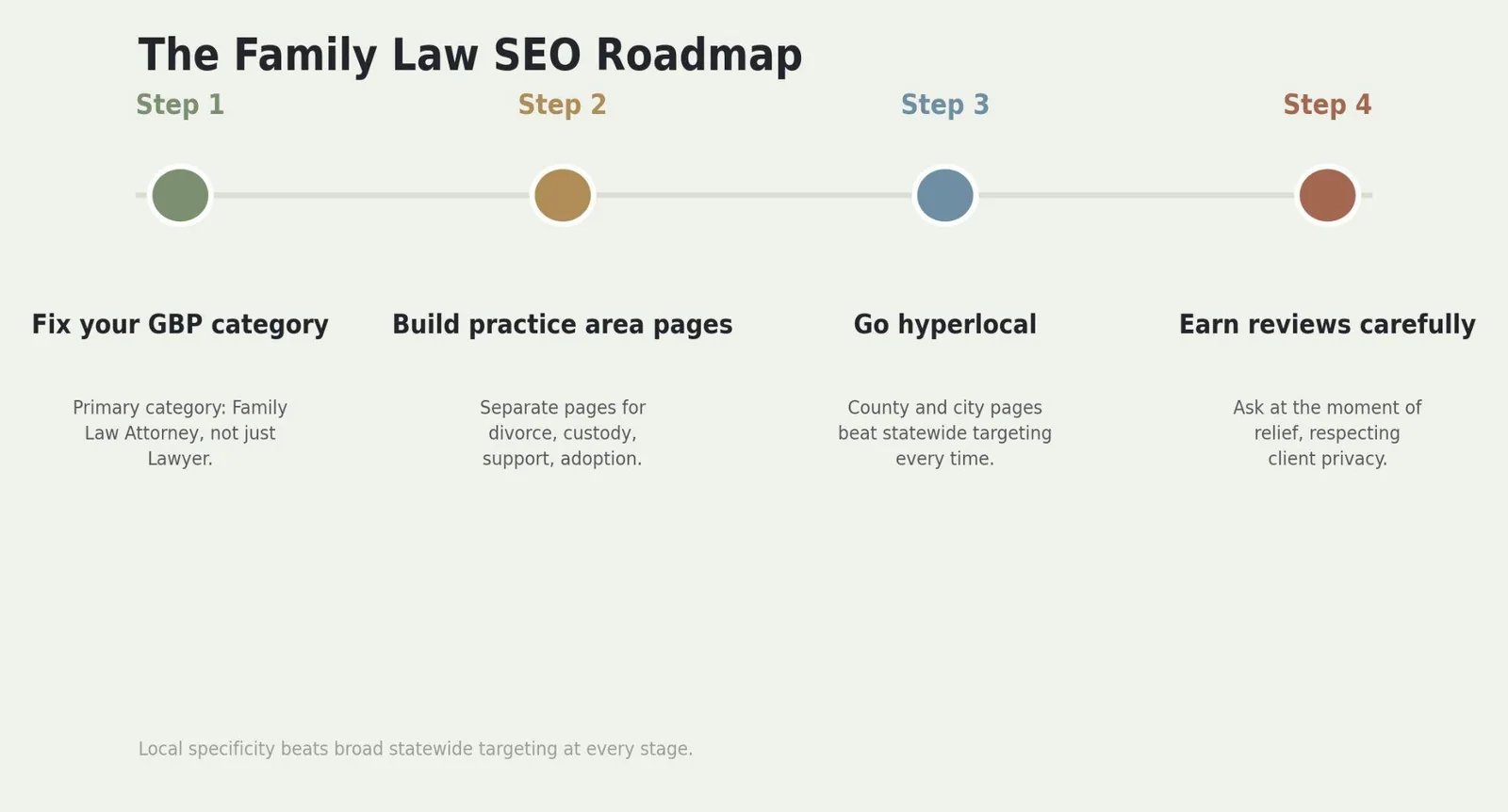
Step 1: Fix your Google Business Profile category
If a firm's primary Google Business Profile (GBP) category is simply "Lawyer," it's competing against every attorney in the market on the broadest possible term. The primary category should be "Family Law Attorney," with "Divorce Lawyer" added as a secondary category if that's a core service. This single change is often the fastest way to improve local SEO visibility in the Map Pack.
Step 2: Build dedicated practice area pages
Family law covers divorce, child custody, child support, adoption, domestic violence, and property division, each with its own search volume and client intent. One page cannot rank for all of them. Each practice area needs its own page on the law firm website, at least 800 words, with real information about how that type of case works in the firm's specific state and county, written for family law clients rather than other attorneys.
Step 3: Go hyperlocal, not statewide
Ranking for "family law attorney [state]" is not a realistic goal for most family law practices, and it isn't where the cases come from either. The Map Pack works at the city and county level. A page targeting "divorce attorney in Oak Park" will rank faster and convert better than a generic "divorce attorney Chicago" page competing against dozens of established firms. The same logic applies whether the market is Chicago, Dallas, or a smaller Florida county. Keyword research tools like Google Keyword Planner can confirm real search volume for each city or county before content gets built.
Try it yourself: the tool below scores your firm's local SEO foundation across the six checks that matter most.
Family law SEO tool
Is your firm's local SEO ready to compete?
Check off what's already true for your firm. Your score updates as you go.
0 of 6
Check off items above to see how your firm's local SEO foundation stacks up.
Step 4: Earn reviews carefully and ethically
Reviews are one of the strongest local ranking and conversion signals available, but family law clients are often hesitant to leave a public review about something this personal. Ask for the review at the moment of relief, right after a decree is finalized or a custody matter resolves, and let clients know they can use just a first name if they prefer. Automating the request through practice management software removes the awkwardness of asking directly.
Why local search wins family law cases
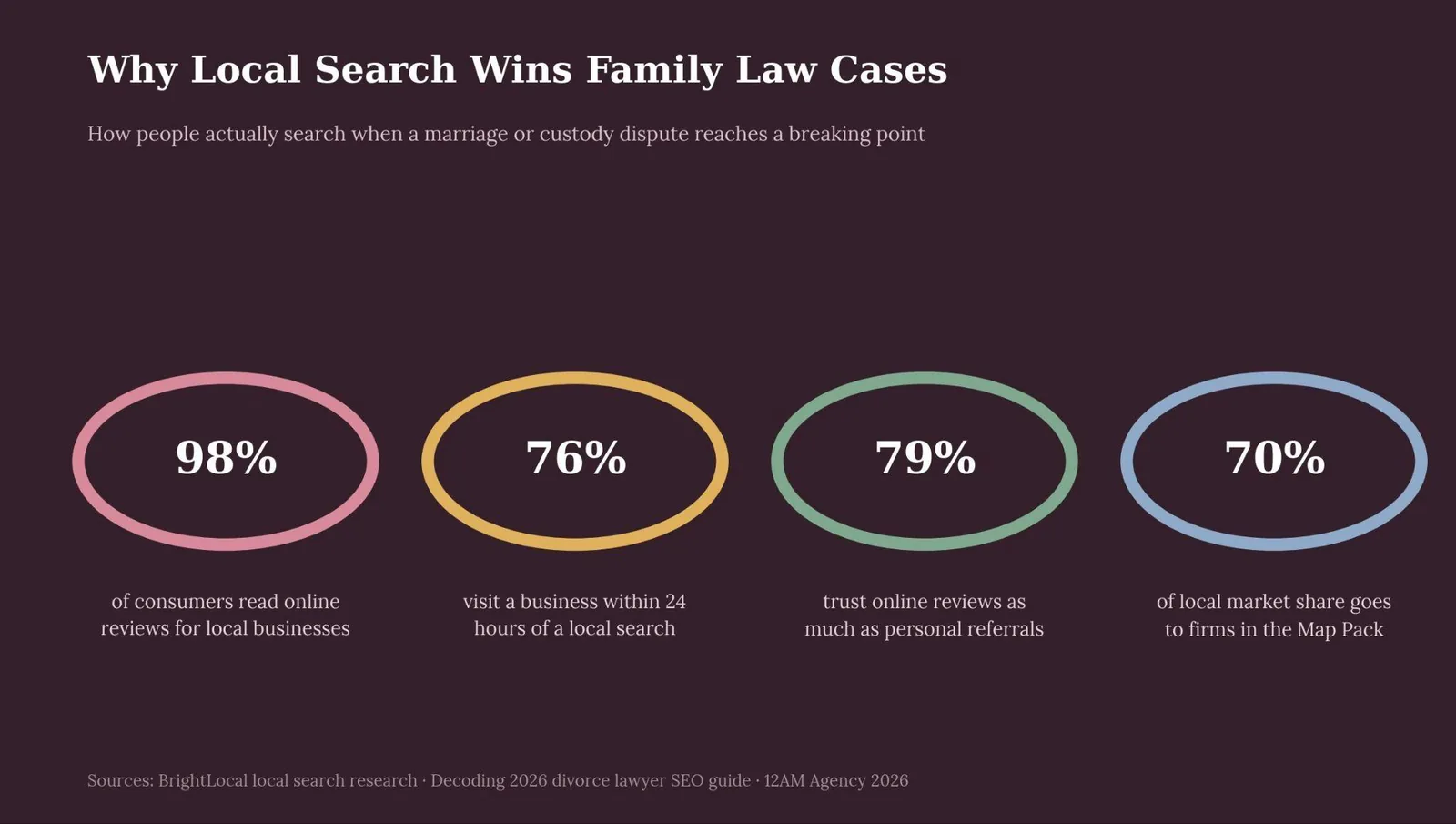
The behavioral data explains why local SEO matters so much for family law firms. Citing BrightLocal research, Matador Solutions' divorce lawyer SEO guide reports that 98% of consumers read online reviews for local businesses, and 76% of people who search for something nearby visit a business within 24 hours. Separately, Decoding's guide found that 79% of consumers trust online reviews as much as a personal referral, which matters enormously for a decision this sensitive. 12AM Agency puts one more number on the table: firms outside the Map Pack reportedly lose roughly 70% of their local market share to competitors who do appear there. That last figure is a single agency's estimate rather than independently verified research, so it's the softest claim in this section.
Local citations and directories that matter
Beyond Google Maps and Google Business Profile, NAP consistency across legal-specific directories carries real weight for local SEO for lawyers. Per Fortress's family law SEO services guide, Avvo, Justia, FindLaw, and Lawyers.com are the directories that appear most consistently in family law citation audits. Keeping name, address, phone number identical across every one of these, along with the firm's own site, closes off one of the most common and least visible sources of ranking loss. Link building through guest content on credible legal sites and collaborations with law schools can add further authority, though ethical compliance with State Bar advertising rules should guide every tactic.
Common family law SEO mistakes
Treating family law as one broad category instead of separate family law practices is the most common mistake. A firm that lumps divorce, custody, and adoption into a single page loses the chance to rank for any of them specifically.
Targeting the state instead of the city or county is a close second. Google's Map Pack doesn't work at the state level, and neither do most potential clients' searches.
Ignoring Google Search Console and Google Analytics is a quieter mistake. Without them, a firm has no reliable way to know which practice area pages are actually generating clients versus which ones are just sitting there.
And treating reviews as an afterthought, rather than a structured, ethical part of client intake, leaves one of the strongest local ranking signals unused.
Frequently asked questions
How much does SEO cost for a family law firm?
It depends on market competitiveness and whether the work is handled in-house or outsourced. As a planning frame, most competitive family law firms invest $3,000 to $10,000 USD per month. Get a quote specific to your market before committing a budget.
How long does it take to see results from family law SEO?
Most firms reportedly see measurable ranking improvements within 3 to 4 months, with meaningful traffic and lead gains by month 6. Full Map Pack dominance in a competitive city can take 6 to 9 months of consistent optimization and review building.
What is AEO and does it matter for family law firms?
AEO, or Answer Engine Optimization, means structuring content so AI tools like ChatGPT or Google's AI Overviews can cite it directly when someone asks a question like "what are my first steps after being served divorce papers." As more legal searches start inside AI chat tools instead of Google, being the source an AI cites matters even when it doesn't result in a click.
Should a family law firm use PPC as well as SEO?
Many competitive family law attorneys use both. PPC, including Google Local Services Ads, provides immediate visibility, while SEO builds a durable pipeline that keeps generating leads without ongoing ad spend. Firms with a strong organic foundation often reduce paid spend over time.
Do legal directories like Avvo and Justia still matter?
Yes, primarily for NAP consistency and citation signals rather than direct traffic. Keeping information identical across Avvo, Justia, FindLaw, and Lawyers.com supports local ranking, even though most case volume still comes through Google and the firm's own site.
The bottom line on SEO for family law
SEO for family law rewards specificity over broad strokes. Fix the Google Business Profile category, build a dedicated page for every practice area, target cities and counties instead of entire states, and build a review process that respects how personal these cases are. None of it produces results overnight, but firms that commit to this for 6 to 12 months typically build a pipeline of potential clients that outlasts any single ad campaign.
Start this week with the fastest lever available: check whether the Google Business Profile category actually says "Family Law Attorney," not just "Lawyer."
Ready to grow your family law practice online?
Building dedicated practice area pages, keeping citations consistent across Avvo, Justia, and FindLaw, and earning reviews the right way is a lot to manage alongside actually practicing law. Web Tonic's legal marketing team builds SEO, content, and Google Ads strategy specifically for family law firms, so the pipeline keeps compounding without pulling attorneys away from clients.
More from Web Tonic: growth marketing services, data & analytics.
Sources: lawyerseoservice.us · trydecoding.com · lrossmarketingconsulting.com · matadorsolutions.net · 12amagency.com · fortressgrowth.com