Table of contents
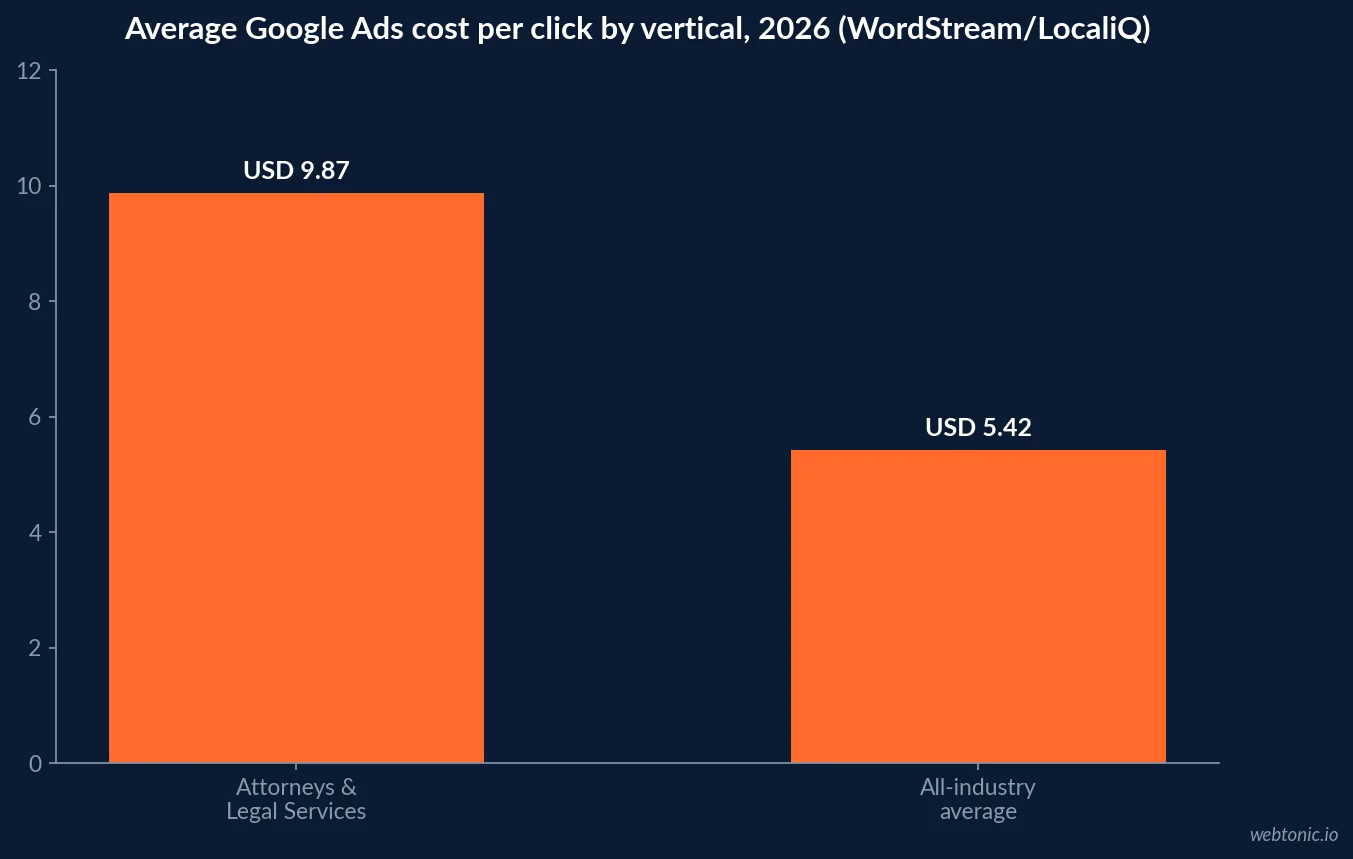
Attorneys and Legal Services has the highest average cost per click ($9.87) and the highest average cost per lead ($131.63) of any industry WordStream/LocaliQ tracked in its 2026 Google Ads benchmark report. That single fact is why local organic visibility, reviews, and Google Business Profile signals carry a disproportionate share of family law client acquisition compared with most other local service categories, and why the local-SEO-versus-paid-ads question is less theoretical here than almost anywhere else.
Key Takeaways
- Attorneys and Legal Services averaged $9.87 per click on Google Ads in 2026, the highest of any tracked industry.
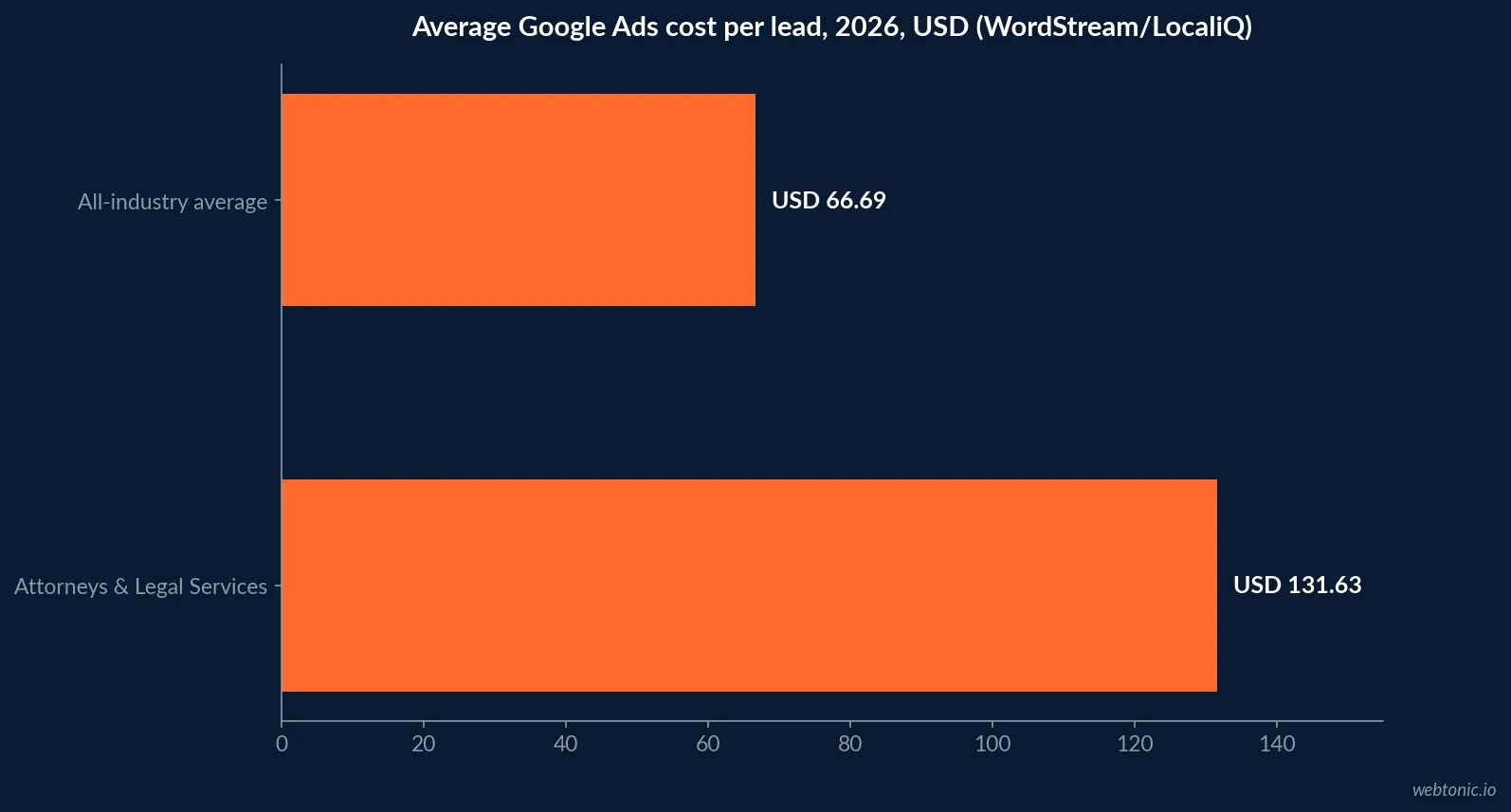
- Average cost per lead for the vertical was $131.63, also the highest, nearly double the $66.69 all-industry average.
- Only 4% of consumers say they never read online reviews before choosing a local business, per BrightLocal.
- 74% of consumers check two or more review sources before deciding, up from prior years.
- 63% of consumers say mostly negative reviews would make them lose trust in a business.
- Consumers asked for a review by email now comply 40% of the time, up from 32% the year before.
- 63% of consumers expect a review response within two to three days, up to a week.
- 70% of consumers say they had an easy time finding and hiring a lawyer, largely through referrals and online search, per Clio's 2025 Legal Trends Report.
- 77% of legal problems never reach a legal professional at all, an access-to-justice gap Clio cites from World Justice Project research.
- 42% of law firms plan to increase SEO spend in 2026, and 48% added SEO as a new channel in the past year, per CallRail.
- SEO/organic search is the single biggest driver of new legal business at 54% of firms surveyed, ahead of video (50%) and paid search (47%).
- Local Services Ads for attorneys require state bar license checks for every listed lawyer, per Google's own verification requirements.
The cost gap that drives the question
WordStream and LocaliQ's 2026 Search Advertising Benchmarks report is unambiguous: Attorneys and Legal Services is the single most expensive vertical in Google Ads, full stop. Its $9.87 average cost per click tops every other tracked industry, ahead of Home and Home Improvement ($8.33) and Dentists and Dental Services ($8.00). Its $131.63 average cost per lead is likewise the highest recorded, ahead of Furniture ($106.70) and Real Estate ($102.51).
Family law is not broken out separately inside that vertical, and this page states that plainly: every dollar figure here describes Attorneys and Legal Services as a whole, the closest published cohort a family law buyer has. The direction of the number, expensive relative to every other local-service category, is what makes organic local visibility a structurally bigger lever here than in, say, home improvement or retail.
| Metric (Google Ads, 2026) | Attorneys & Legal Services | All-industry average | Rank among tracked industries |
|---|---|---|---|
| Average cost per click | $9.87 | $5.42 | Highest of all |
| Average cost per lead | $131.63 | $66.69 | Highest of all |
| Average click-through rate | Not isolated in 2026 report | 6.64% | n/a |
| Average conversion rate | Not isolated in 2026 report | 8.18% | n/a |
Why local organic visibility carries more weight here
When the paid channel's floor price is this high, the calculus shifts toward channels with no per-click cost. BrightLocal's Local Consumer Review Survey found just 4% of consumers say they never read online reviews before choosing a local business, and 74% check two or more sources before making a decision, a habit that has grown, not shrunk. For a decision as consequential and infrequent as hiring a divorce or custody attorney, that research-heavy behavior is a reasonable assumption to carry over, if not an underestimate.
The same survey found 63% of consumers say seeing mostly negative reviews would make them lose trust in a business, and that consumers are increasingly checking review recency and detail: photo- or video-backed reviews and long, detailed reviews both saw upticks in how positively consumers respond to them.
| Consumer review behavior | Share of consumers | Source |
|---|---|---|
| Never read online reviews before choosing a local business | 4% | BrightLocal 2025/2026 |
| Check two or more review sources before deciding | 74% | BrightLocal 2025/2026 |
| Would lose trust after mostly negative reviews | 63% | BrightLocal 2025/2026 |
| Comply with a review ask sent by email | 40% (up from 32%) | BrightLocal 2025/2026 |
| Most likely to leave a review when asked in person | 27% | BrightLocal 2025/2026 |
| Expect a review response within 2-3 days to a week | 63% | BrightLocal 2025/2026 |
How clients actually find a family law attorney
Clio's 2025 Legal Trends Report found 70% of consumers who recently hired a lawyer say they had an easy time finding and hiring one, largely through referrals and online searches, and that for future legal needs, more than half say they would also turn to the internet, with firm websites and reviews playing a growing role even among clients who still start with a referral. Millennials and Gen Z consumers lean even harder on digital search, and Clio notes that trend holds across older generations too, just less strongly.
The report also surfaces a demand-side number worth sitting with: 77% of legal problems never reach a legal professional at all, a gap Clio attributes to World Justice Project research on global access to justice. Local visibility is not just a competitive lever between firms, it is one of the few channels that can reach people who have a legal problem but have not yet searched for a specific firm by name.
Where SEO ranks against every other channel
CallRail's 2026 Legal Marketing Outlook Report, surveying 100 legal professionals, asked firms which channel actually drives new business, not just which one gets budget. SEO/organic search topped the list at 54%, ahead of video at 50%, paid search at 47%, paid social at 38%, and content at 37%. Separately, 42% of firms plan to increase SEO spend in 2026 and 48% added SEO as a brand-new channel in the past year.
| Channel | Share of firms naming it a top new-business driver | Source |
|---|---|---|
| SEO / organic search | 54% | CallRail 2026 Legal Marketing Outlook |
| Video | 50% | CallRail 2026 Legal Marketing Outlook |
| Paid search (PPC) | 47% | CallRail 2026 Legal Marketing Outlook |
| Paid social | 38% | CallRail 2026 Legal Marketing Outlook |
| Content | 37% | CallRail 2026 Legal Marketing Outlook |
Local Services Ads: the paid channel closest to local SEO
For firms weighing a paid channel that behaves more like a local listing than a keyword auction, Google's Local Services Ads screening and verification requirements spell out that attorneys must pass state bar license checks for every lawyer listed on a firm's profile, in addition to standard business verification. That bar is higher than a standard Google Ads campaign requires, and it means a "Google Screened" badge functions partly as a trust signal borrowed from the same review-and-credibility research that drives organic local rankings.
The practical read: Local Services Ads sit in between organic local SEO and standard search ads. They cost per lead rather than per click, and their verification bar rewards firms that already have the licensing and review profile organic visibility depends on.
| Channel | Cost model | What it depends on | Time to results |
|---|---|---|---|
| Organic local SEO / Google Business Profile | No per-click cost | Reviews, citations, site relevance, licensing signals | Months, compounding |
| Local Services Ads | Per lead, after verification | State bar checks, review volume/rating | Weeks, after screening |
| Standard Google Ads (search) | Per click, $9.87 vertical avg | Keyword bids, Quality Score, landing page match | Immediate, ongoing cost |
A sequencing model that respects both the cost data and the trust data
Given a $131.63 average cost per lead on paid search, most family law firms cannot afford to buy every lead from Google Ads alone and still hit a sane cost-to-value ratio on a family law matter. The workable sequence most firms land on: run standard Google Ads to cover volume while organic local visibility, reviews, and a Google Business Profile with complete NAP data build in the background, then let paid spend taper as organic share of voice grows. Our growth marketing team builds that handoff plan explicitly rather than running both channels independently, using the same cost-per-lead benchmarks by industry and conversion rate data referenced above to set the budget split. Firms weighing a first paid test can also see our breakdown of Google Ads management before committing spend.
Reviews sit at the center of that transition. A firm converting a strong share of its Google Ads clicks into consultations, but not asking for a review afterward, is leaving the compounding channel's biggest lever unused: the jump from a 32% to 40% review-ask success rate by email is close to free to capture and directly feeds the local trust signals BrightLocal's data shows consumers already rely on.
What the local search ranking factors research says drives it
Whitespark's 2026 Local Search Ranking Factors report, a survey of 47 local search experts scoring 187 individual factors, groups everything Google weighs into seven buckets: Google Business Profile signals, on-page signals, review signals, link signals, behavioural signals, citation signals, and (new for 2026) AI search visibility signals. Review signals, specifically first- and third-party review count, quality, and velocity, sit alongside Google Business Profile signals as two of the categories the survey's experts weight most heavily for local pack rankings, which lines up directly with the BrightLocal consumer data above: rankings and consumer trust are being driven by the same review inputs, not two separate systems.
For a family law firm, that overlap is good news operationally: the reviews a front-desk team collects to build consumer trust are the same signals a local SEO program needs to rank in the first place. There is no separate "SEO reviews" workflow to run.
| Whitespark 2026 ranking factor category | What it covers | Why it matters for family law |
|---|---|---|
| Google Business Profile signals | Proximity, categories, business name keywords | Practice-area accuracy directly affects which searches surface the profile |
| Review signals | First/third-party review count, quality, velocity | Same data BrightLocal shows consumers actively check before calling |
| On-page signals | NAP presence, title tag keywords, domain authority | Practice-area pages need to match how clients actually search |
| Citation signals | Location data, NAP consistency, citation volume | Consistent listings reduce the trust friction reviews are meant to solve |
What "good" looks like on a family law Google Business Profile
Given the review-trust data above, three elements do the most work: a complete, accurate practice-area list (divorce, custody, support, adoption, so the profile matches what people search), a steady drip of recent reviews rather than a cluster from years ago, and prompt, professional responses to every review, which BrightLocal's data shows consumers now actively expect within a week. None of this replaces a broader SEO program, but it is the fastest-moving lever inside one.
Frequently Asked Questions
Is local SEO cheaper than Google Ads for a family law firm?
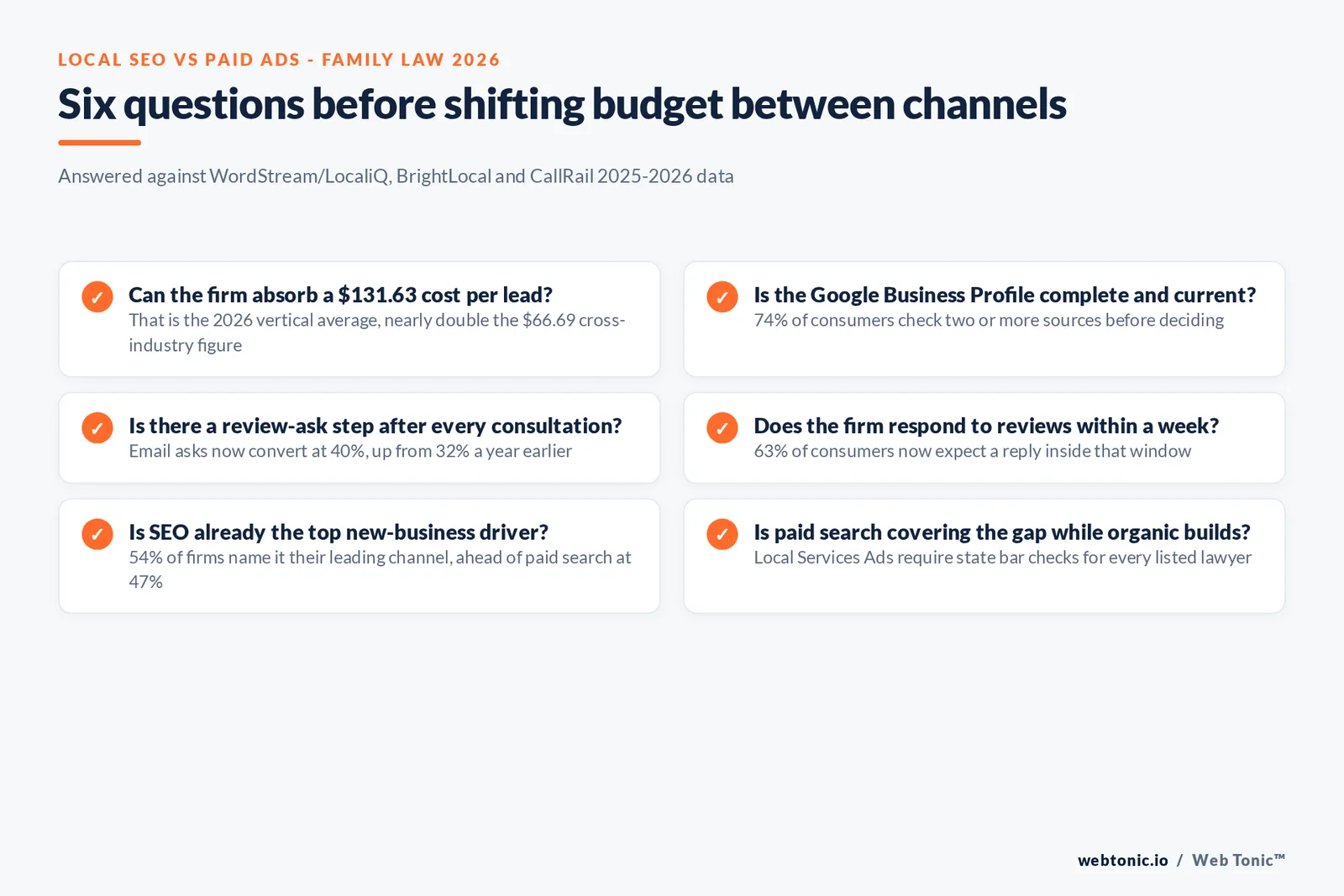
On the numbers, yes, structurally. WordStream/LocaliQ's 2026 Search Advertising Benchmarks report found Attorneys and Legal Services carries the highest average cost per click ($9.87) and the highest average cost per lead ($131.63) of every industry it tracks. Local SEO carries no per-click cost at all once a listing and site rank, though it takes months to build rather than hours to turn on, which is the real trade-off, not price alone.
How much does it cost to run Google Ads for family law keywords?
The all-industry average cost per lead in Google Ads was $66.69 in 2026, but Attorneys and Legal Services averaged $131.63, roughly double. Average cost per click for the vertical was $9.87 against a $5.42 all-industry average. A firm budgeting a Google Ads test for family law keywords should plan against the vertical figure, not the cross-industry one.
Do online reviews actually influence which family law firm someone calls?
BrightLocal's Local Consumer Review Survey found just 4% of consumers say they never read online reviews before choosing a local business, and 74% check two or more sources before deciding. For a purchase as high-stakes and low-frequency as hiring a family law attorney, that review-checking behavior is arguably even more pronounced than in the average local business BrightLocal surveyed.
What is the fastest way to get more family law reviews?
BrightLocal found that consumers who are asked to leave a review by email have gone from doing so 32% of the time to 40%, the single biggest jump among ask channels tracked, while 27% say they are most likely to leave one when asked in person. A short, templated post-consultation email ask outperforms a generic in-office sign for most firms.
Should a family law firm run Google Ads and local SEO at the same time?
Most firms end up doing both, because they solve different problems: paid search buys visibility immediately at the vertical's $131.63 cost per lead, while organic local visibility compounds over months and, once established, keeps producing calls without a per-click cost. The mistake is treating them as substitutes rather than sequencing paid to cover the gap while organic visibility builds.
Sources
WordStream/LocaliQ - Search Advertising Benchmarks by Industry 2026
BrightLocal - Local Consumer Review Survey
Clio - 2025 Legal Trends Report
CallRail - 2026 Legal Marketing Outlook Report
Google - Local Services Ads screening and verification requirements
Google - Understand the screening and verification process
Whitespark - 2026 Local Search Ranking Factors Report