Table of contents
92.4% of legal consumers research a family law issue online before they ever call a firm - and Clio's own phone testing found nearly half of law firms cannot be reached by phone at all. Family law SEO is not a rankings project; it is the only part of the client relationship most prospects experience before deciding whether to call.
Key Takeaways
- 92.4% of legal consumers research online before contacting an attorney.
- Nearly 70% say reviews are the most helpful part of that research.
- Pricing and fees influence 61.6% of consumers, responsiveness 58%.
- Only 40% of firms answered Clio's test phone call in 2024.
- 48% of firms could not be reached by phone at all, up nearly a third from 2019.
- Only 20% of firms returned a voicemail, down from 43% in 2019.
- Just 2% of firms referenced the caller's actual legal situation, down from 27% in 2019.
- 47.6% of consumers list responsiveness as a key hiring criterion.
- Solo attorney website adoption reached 70% in 2024, up from 53% in 2021.
- Only 11% of solo attorneys blog, though 40%+ who do report it retained clients.
- The average law firm Google Business Profile scores 71.9 out of 100.
- 25.6% of law firms have never posted to their Google Business Profile.
- Top-scoring profiles carry 4.4 times more reviews than bottom-scoring ones.
- 45% of consumers now ask AI for local business recommendations, up from 6% in 2025.
- Google review usage for local search slipped from 83% to 71% in the same year.
- 672,502 divorces and annulments were recorded in the US in 2023.
The client relationship starts before the call
Martindale-Avvo's State of the Legal Consumer 2026 report puts a number on what every family law intake team already suspects: 92.4% of legal consumers say they are likely or very likely to research their issue before contacting an attorney. Of the factors that shape that research, reviews rank first (helpful to almost 70% of consumers), followed by pricing and fees (61.6%), responsiveness (58%), and overall reputation (53%). For family law specifically - where the searcher is often mid-crisis - a page that answers cost and process questions clearly is doing more qualifying work than a page that only lists practice areas.
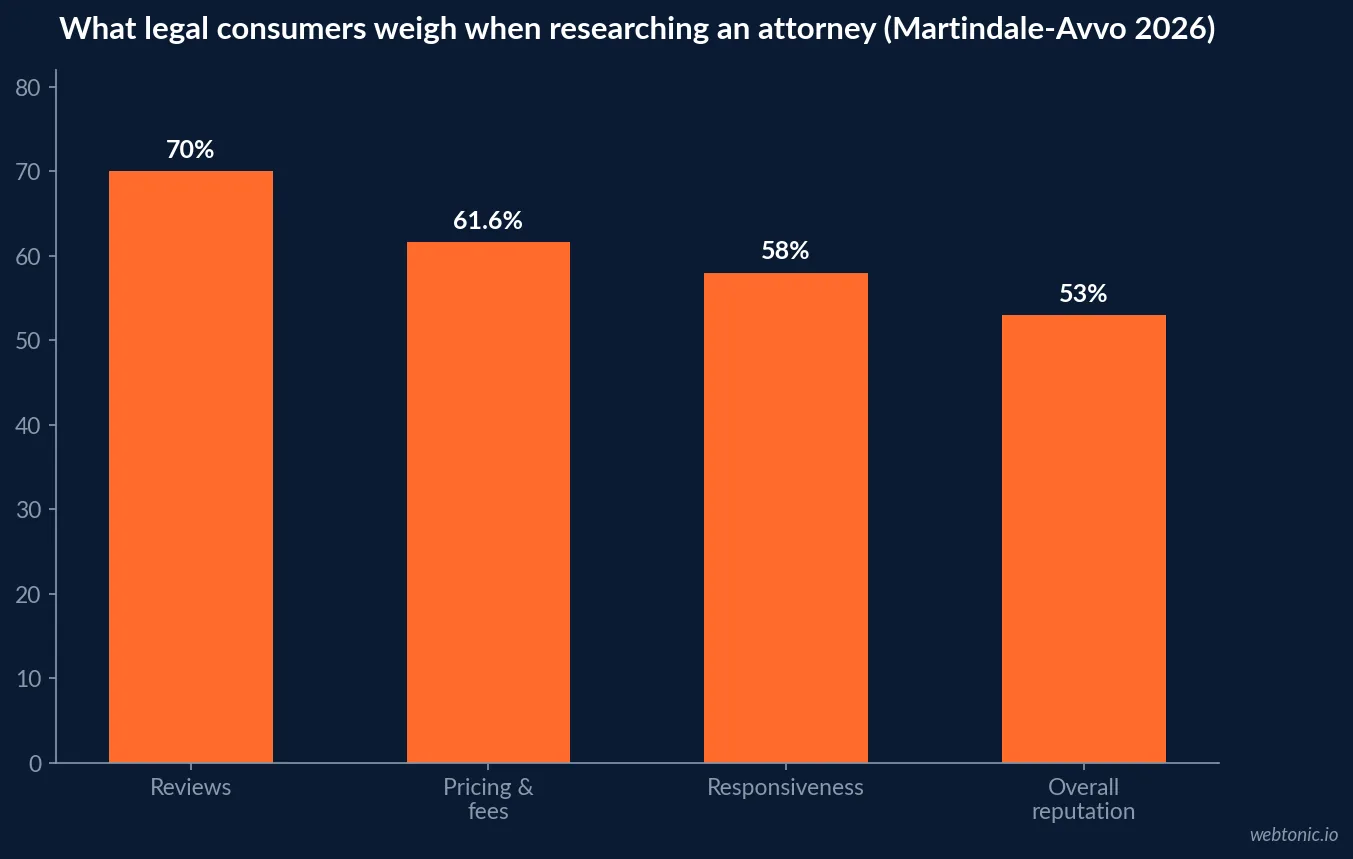
| What legal consumers weigh (Martindale-Avvo 2026) | Share citing it |
|---|---|
| Reviews | ~70% |
| Pricing and fees | 61.6% |
| Responsiveness | 58% |
| Overall reputation | 53% |
| Research before ever contacting an attorney | 92.4% |
Ranking is wasted if nobody answers
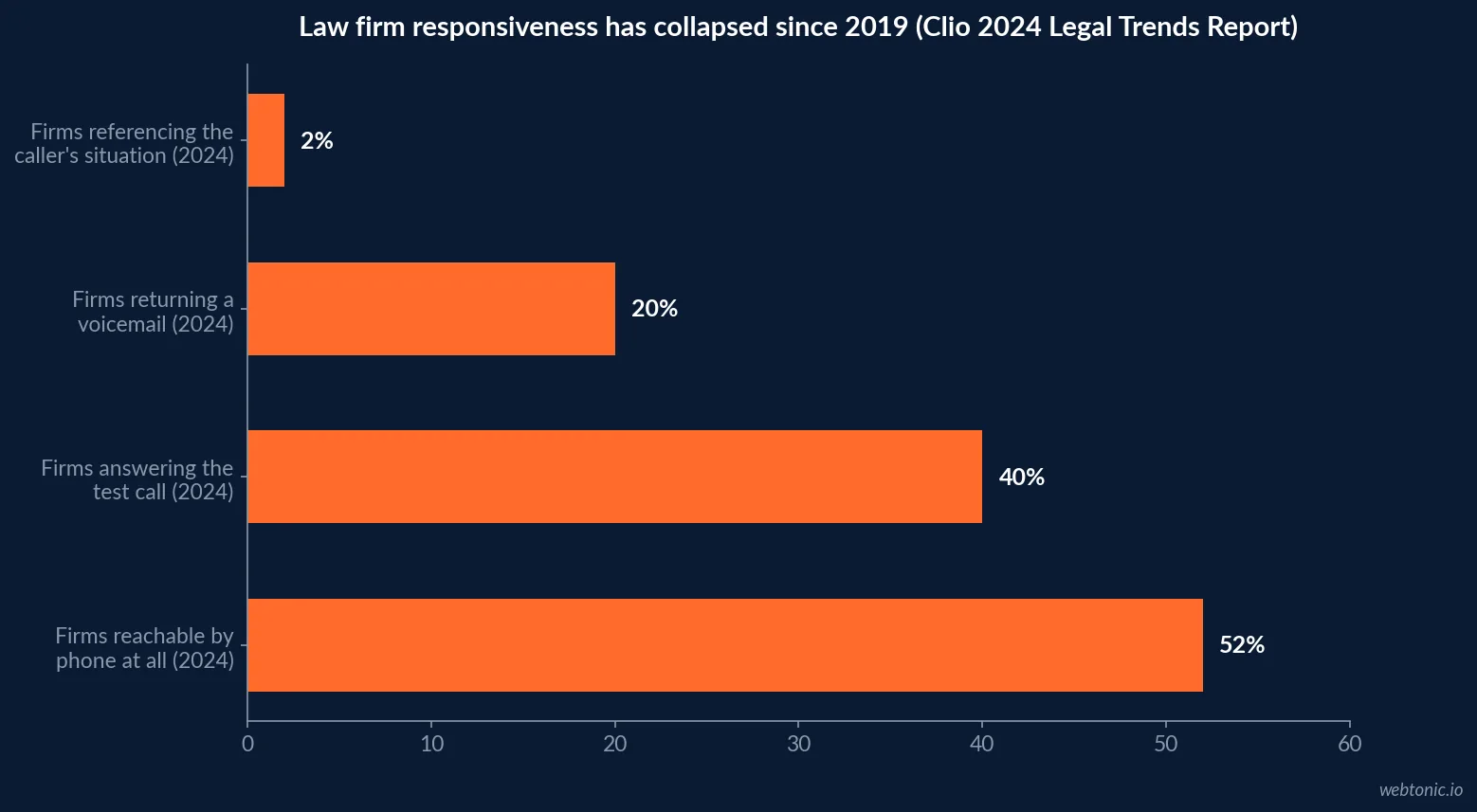
Clio's Legal Trends Report tested real law firms with real phone calls and emails, and found firm responsiveness dropped by nearly a third compared to 2019. Only 40% of firms answered the test call outright, and combining answered calls with call-backs still left 48% of firms unreachable by phone. Only 20% of firms returned a voicemail, down from 43% five years earlier, and 30% of firms that did call back never left a voicemail in the first place - meaning a caller who didn't answer got nothing. Even among firms that responded, only 2% referenced the caller's actual legal situation, down sharply from 27% in 2019.
This matters for SEO because it changes what "ranking well" is actually worth. A page that earns the click and the call, into a firm that can't answer, converts none of that visibility into a client - and Martindale-Avvo separately identifies slow response time as the single most common reason consumers say they chose not to hire a lawyer.
| Clio 2024 responsiveness test | 2024 result | 2019 result |
|---|---|---|
| Firms that answered the test call | 40% | n/a (first tested 2024 methodology) |
| Firms reachable by phone at all (answer or call-back) | 52% | n/a |
| Firms that returned a voicemail | 20% | 43% |
| Firms referencing the caller's actual situation | 2% | 27% |
| Callback firms that left no voicemail if unanswered | 30% | lower |
The on-site basics: adoption is up, depth is thin
The ABA's 2024 Legal Technology Survey (Solo and Small Firm TechReport) found solo attorney website adoption climbed to 70% in 2024, up from 53% in 2021 - a real gain, but still short of universal. Content depth lags further behind: only 11% of solo attorneys blog (19% at small firms), even though more than 40% of those who do report it resulted in retained legal work. Social presence also skews narrower than expected: solo LinkedIn presence fell from 95% in 2021 to 70% in 2024, while Facebook climbed to 63%.
| Solo/small firm marketing adoption (ABA 2024 TechReport) | 2021 | 2024 |
|---|---|---|
| Firm has a website | 53% | 70% |
| Presence on LinkedIn | 95% | 70% |
| Presence on Facebook | n/a | 63% |
| Attorney blogs | n/a | 11% (solo), 19% (small firm) |
| Content syndicated to third-party sites | n/a | 5% (solo) vs 27% (large firms) |
The Google Business Profile gap is measurable, not anecdotal
Constellate Research's 2026 study analyzed 324 law firm Google Business Profiles across 25 high-growth markets and five practice areas, and scored each on a 100-point completeness and activity rubric. The average firm scored 71.9 out of 100, but 25.6% of firms had never made a single post - despite the profile appearing before any organic result on a "family law attorney near me" search. The gap between the top and bottom deciles was stark: top performers averaged 99.7 out of 100 with 4.4 times more reviews (247 versus 56) and consistent weekly posting; bottom performers had never posted at all.
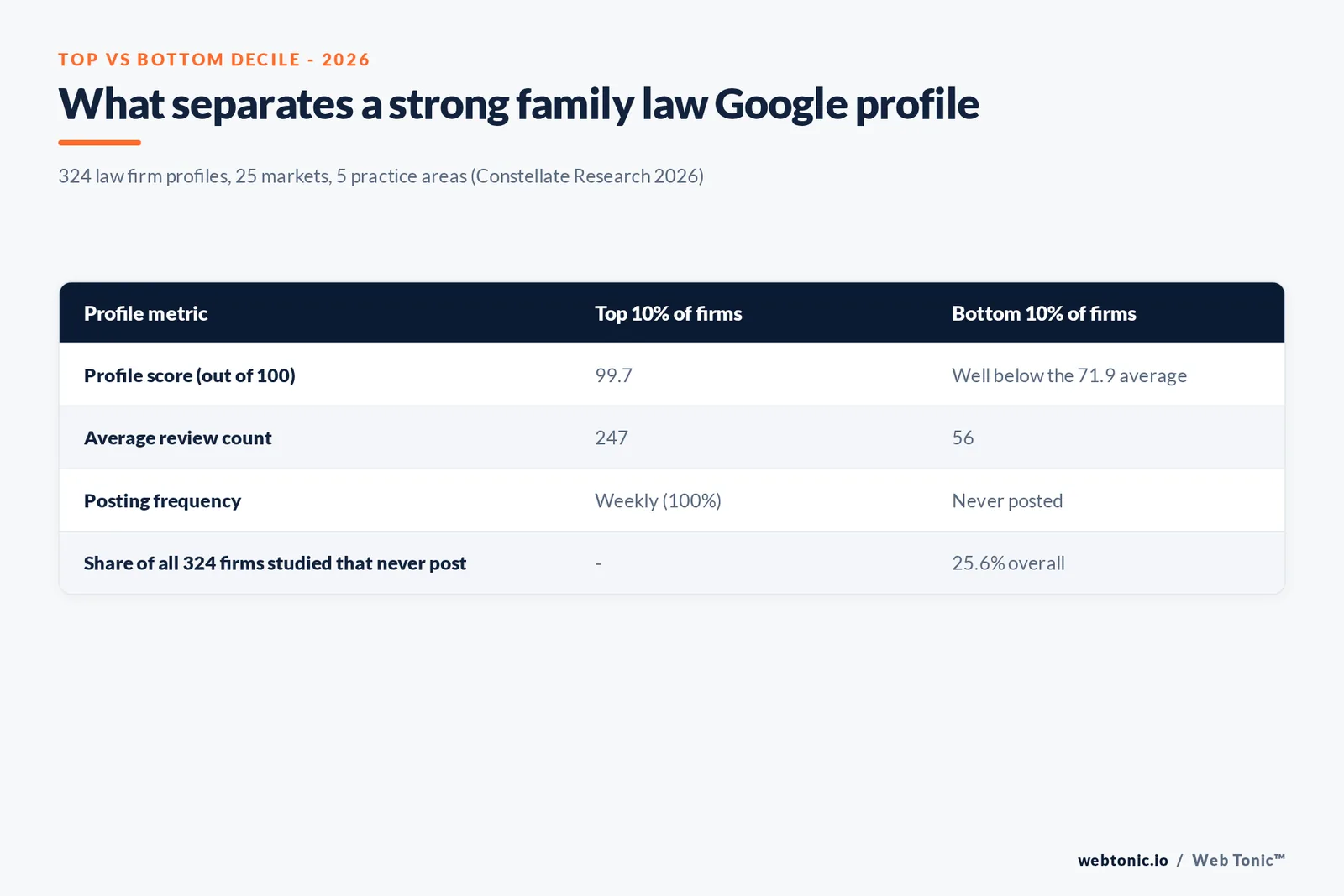
| Google Business Profile metric (Constellate 2026) | Top 10% of firms | Bottom 10% of firms |
|---|---|---|
| Profile score (out of 100) | 99.7 | well below average |
| Average review count | 247 | 56 |
| Posting frequency | Weekly (100%) | Never posted |
| Firms studied, overall average score | 71.9 / 100 (all 324 firms) | - |
| Firms that have never posted at all | 25.6% of all firms studied | - |
AI answers are starting to sit ahead of the review platforms
BrightLocal's Local Consumer Review Survey found the share of consumers using AI tools for local business recommendations jumped from 6% in 2025 to 45% in 2026, overtaking Yelp and TripAdvisor as a discovery channel behind only Google and Facebook. Adults 30-44 - the age band most likely to be searching for a divorce or custody attorney - lead adoption at 64%. Over the same period, reliance on Google reviews for local recommendations slipped from 83% to 71%. The practical read for family law SEO: the content that answers a specific question clearly (cost ranges, process timelines, jurisdiction-specific custody standards) is now competing to be the source an AI answer cites, not just to rank on a results page.
| US marriage & divorce data (CDC/NCHS, 2023) | Count | Rate per 1,000 population |
|---|---|---|
| Marriages | 2,041,926 | 6.1 |
| Divorces and annulments | 672,502 | 2.4 |
| Reporting coverage | 45 states + D.C. | - |
The demand behind the keyword is not seasonal
CDC/NCHS data recorded 672,502 divorces and annulments in the US in 2023 (a rate of 2.4 per 1,000 population across the 45 reporting states and D.C.), against 2,041,926 marriages the same year. Unlike personal injury or real estate law, where search volume tracks accidents or transaction cycles, family law demand is a stable, recurring population figure - which argues for SEO investment built for the long term rather than for a seasonal campaign push. A content program built around that stability - custody-standard explainers by state, cost-and-process guides, mediation-versus-litigation comparisons - compounds in a way a paid campaign restarted every quarter cannot.
What this means for a family law SEO plan
Fix the parts of the funnel the data shows are broken before optimizing the parts that already work: confirm every published number gets answered and every voicemail gets a call-back, complete and actively post to the Google Business Profile, and publish content that answers the pricing and process questions Martindale-Avvo's data says consumers weight most. Ranking without responsiveness is visible but unprofitable; responsiveness without visibility never gets tested at all.
For the paid side of a family law growth plan, start with our general breakdown of building a paid search strategy, review the growth marketing services we run for lead-gen firms, or talk to us about a full intake-to-ranking audit.
Frequently Asked Questions
Do family law clients actually research online before contacting a firm?
Yes, almost universally. Martindale-Avvo's State of the Legal Consumer 2026 report finds 92.4% of legal consumers say they are likely or very likely to research their issue before contacting an attorney. Nearly 70% say reviews are the most helpful element in that research, ahead of pricing and fees (61.6%) and responsiveness (58%). A family law firm's search visibility is doing the qualifying work before the phone ever rings.
Why does responsiveness matter so much for family law specifically?
Clio's Legal Trends Report testing found overall law firm responsiveness dropped by nearly a third in 2024: only 40% of firms answered a test call, and 48% of firms could not be reached by phone at all between a missed call and a missed voicemail return. Family law leads are typically in crisis - a custody dispute or a divorce filing - and Martindale-Avvo separately found slow response time is the single most common deal-breaker consumers cite when they choose not to hire a lawyer.
How much does a Google Business Profile actually matter for a family law firm's local visibility?
A lot, and it's measurable. Constellate Research's 2026 study of 324 law firm profiles across 25 high-growth markets found the top 10% of profiles scored 99.7 out of 100 with 4.4 times more reviews (247 versus 56) than the bottom 10%, which had never posted at all. A quarter of all firms studied (25.6%) had never made a single post on a profile that is both free and shown before any organic result on a "family law attorney near me" search.
Is AI search changing how people find a family law attorney?
It's moving fast. BrightLocal's Local Consumer Review Survey found the share of consumers using AI tools for local business recommendations jumped from 6% in 2025 to 45% in 2026, with adults 30-44 - a core family law demographic - the most likely age group to ask AI for a recommendation, at 64%. Meanwhile Google review usage for local recommendations slipped from 83% to 71% over the same period, which suggests AI Overviews and chat answers are starting to sit ahead of the review platforms firms have optimized for over the last decade.
Does divorce and custody search demand actually justify the SEO investment?
The underlying demand is structural, not seasonal. CDC/NCHS data records 672,502 divorces and annulments in the US in 2023 (a rate of 2.4 per 1,000 population, from the 45 states and D.C. that report), against 2,041,926 marriages the same year. That is a stable, recurring pool of people who will search for a divorce or custody attorney regardless of economic conditions, which is a different demand pattern than most other legal practice areas tied to accident or transaction volume.
Sources
Martindale-Avvo/FindLaw - State of the Legal Consumer 2026
Clio - 2024 Legal Trends Report
American Bar Association - 2024 Solo and Small Firm TechReport
Constellate Research - Google Business Profile Optimization Among Law Firms (2026)
BrightLocal - Local Consumer Review Survey, AI Trust (2026)
CDC/NCHS - FastStats: Marriage and Divorce