Table of contents
A local pack sitting on a "near me" immigration lawyer search drops the organic #1 result's click-through rate by roughly 94%, per Advanced Web Ranking's 2026 data. That single figure reframes what a local SEO program for an immigration firm is actually competing to win - the map pack, not the blue links below it.
Key Takeaways
- 94% drop in organic #1 click-through rate when a local pack also appears on the page (Advanced Web Ranking, 2026).
- 27.6% baseline organic #1 click-through rate with no local pack present (Backlinko, 2025).
- 1.17% is what that same #1 spot's CTR falls to once a local pack shows.
- 14% of local searchers start on a maps app, more than any other channel except a traditional search engine (GatherUp, 2025).
- Only 1% of local searchers start on social media.
- 4.5 stars / 45 reviews is the cross-industry legal-services benchmark (Feedback Guru).
- 47% of U.S. immigrants ages 5+ spoke English less than "very well" in 2024 (Migration Policy Institute).
- That is 23.5 million people, about 81% of all limited-English- proficient U.S. residents.
- 12.1 million USCIS cases were pending in FY2026 Q2, the demand pool this local search competition serves.
- USCIS and the FTC both warn that notarios are not attorneys and cannot legally represent someone in immigration matters.
What the click actually goes to
Backlinko's analysis of 4 million Google search results puts the average organic #1 click-through rate at 27.6% when no other feature dominates the page. But Advanced Web Ranking's 2026 organic CTR study, tracked monthly across millions of SERPs since 2015, finds that a local pack showing on the same page cuts that #1 organic CTR by 94%, down to just 1.17%. Local legal intent - "immigration lawyer near me," "visa attorney [city]" - is exactly the query type that triggers a local pack almost every time.
That is the honest starting point: an immigration firm that ranks #1 organically but is absent from the map pack is capturing a fraction of the traffic the page could otherwise send it.
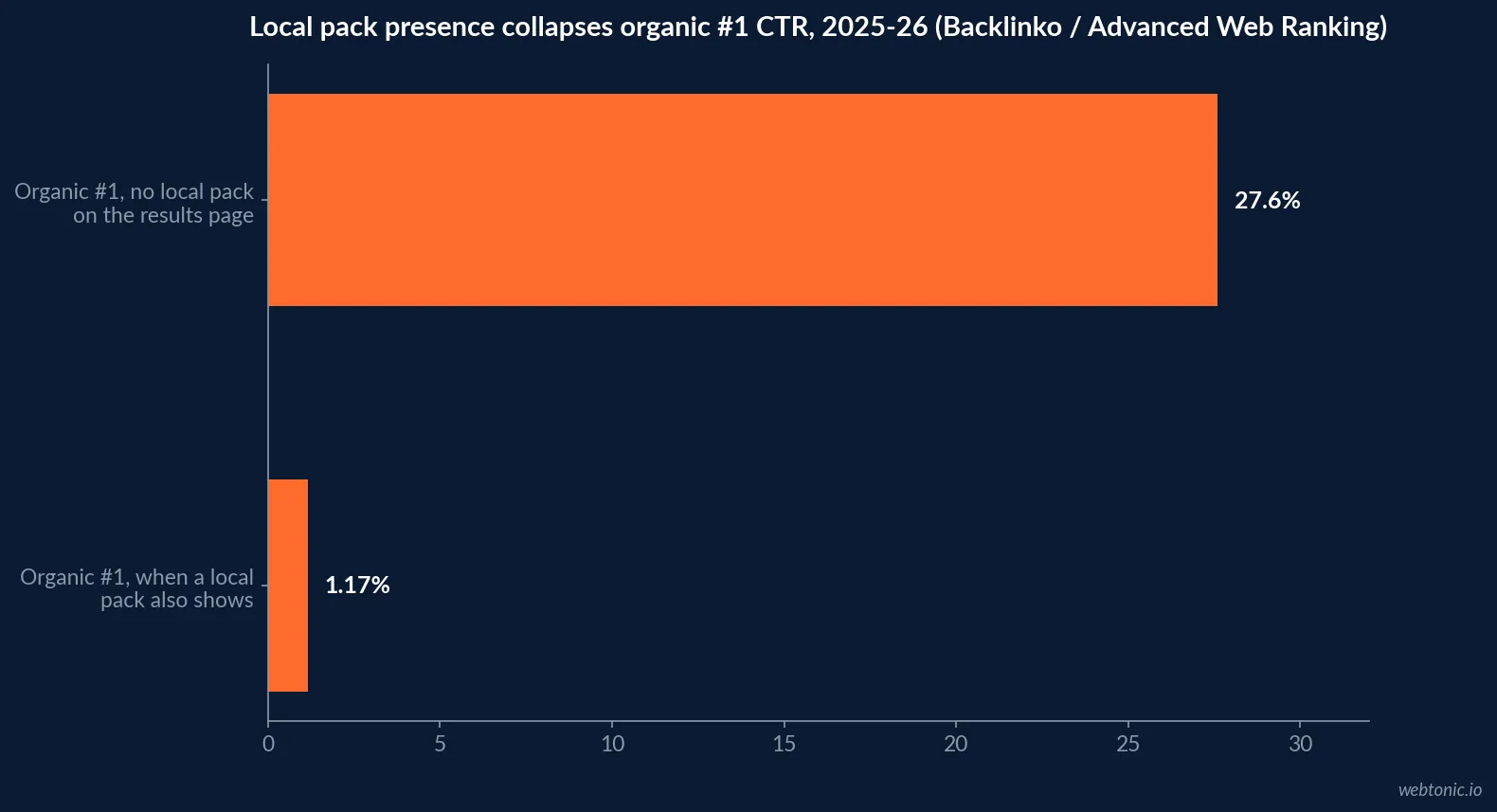
| Search results page state | Organic #1 CTR | Change | Source |
|---|---|---|---|
| No local pack on the page | 27.6% | Baseline | Backlinko, 4M-query study, 2025 |
| Local pack also present | 1.17% | Down 94% | Advanced Web Ranking, 2026 |
| AI Overview also present | Down further still | Compounds with local pack | Advanced Web Ranking, 2026 |
Where the search itself starts
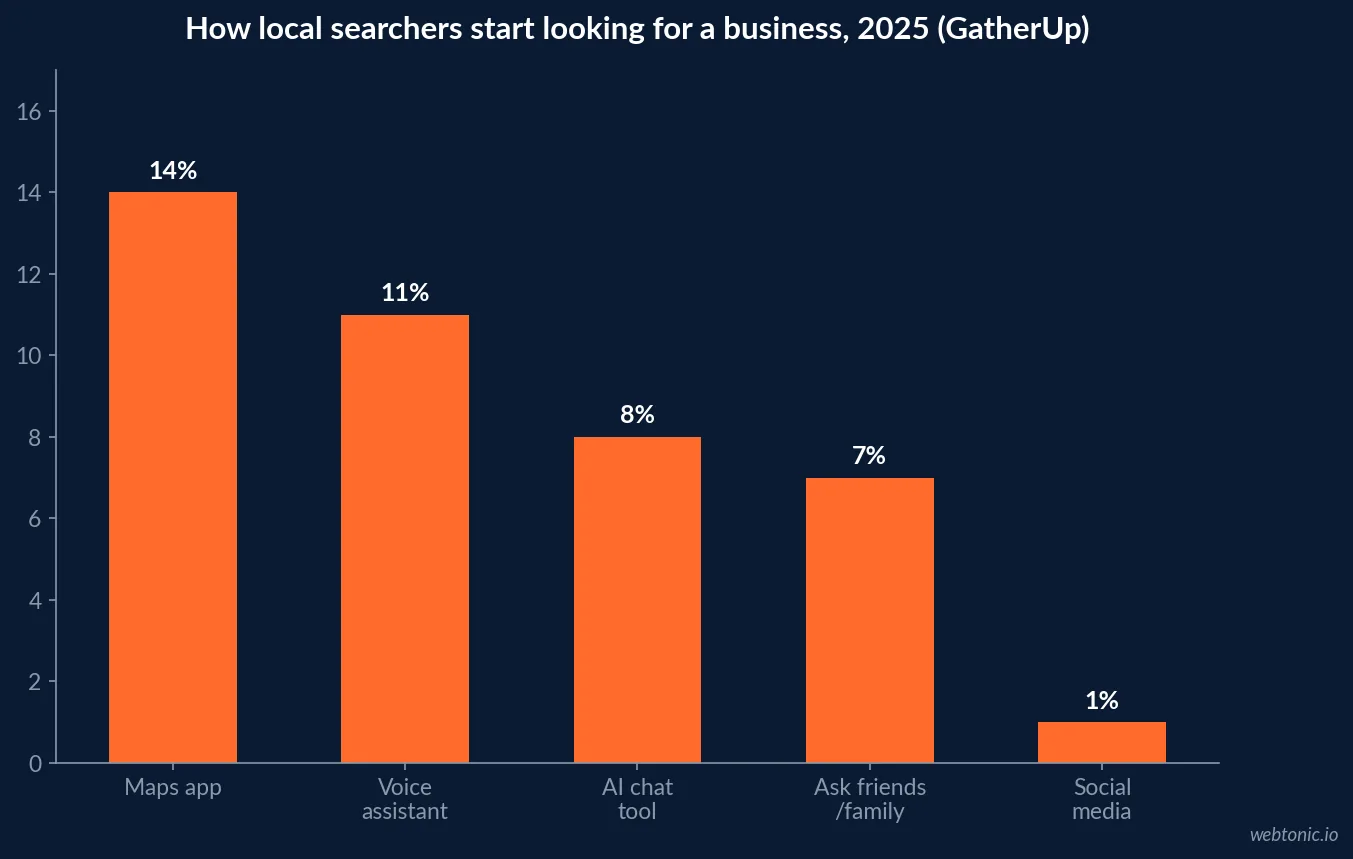
Before any pack or organic listing enters the picture, the search has to start somewhere. GatherUp's 2025 consumer research found 14% of people begin by typing directly into a maps app such as Google Maps or Apple Maps, 11% start by speaking to a voice assistant, 8% begin by prompting an AI chat tool, and 7% start by asking friends or family. Only 1% begin on social media. BrightLocal's parallel research on consumer search behavior makes the same point from a different angle: businesses optimizing only for organic rankings are ignoring the map-first habit a growing share of searchers already have.
What the profile itself needs to compete
No published dataset scores immigration law Google Business Profiles specifically, but no agency has published a comparable law-firm-specific Google review audit with a stated methodology and sample size. A cross-industry benchmark from Feedback Guru puts legal services at a 4.5-star average with 45 reviews, which this page uses as the working target since it is the only sourced figure available, while noting it is not immigration- or even law-firm-specific.
| Google Business Profile metric | Published figure | Sample | Source |
|---|---|---|---|
| Legal services benchmark rating | 4.5 stars | Cross-industry benchmark | Feedback Guru |
| Legal services benchmark review count | 45 reviews | Cross-industry benchmark | Feedback Guru |
The language gap most local SEO programs ignore
The Migration Policy Institute reports that in 2024, 47% of the 49.8 million U.S. immigrants ages 5 and older - 23.5 million people - spoke English less than "very well," accounting for roughly 81% of the country's 28.9 million limited-English-proficient residents. That is not a rounding error in the immigration-law search audience; it is close to half of it. A Google Business Profile description, services list and posts that exist only in English are structurally invisible to a large share of the exact population searching for help.
Demand for that help is not shrinking. USCIS data analyzed by the American Immigration Council put pending cases at 12.1 million in FY2026 Q2, which is the pool of prospective clients a local search program ultimately serves, language barriers and all.
| Migration Policy Institute figure (2024) | Value | Share of relevant population |
|---|---|---|
| Immigrants ages 5+ in the U.S. | 49.8 million | Base population |
| Speak English less than "very well" | 23.5 million | 47% of immigrants ages 5+ |
| Share of all U.S. limited-English-proficient residents | 81% | Of 28.9 million total |
What ranking in the pack actually requires
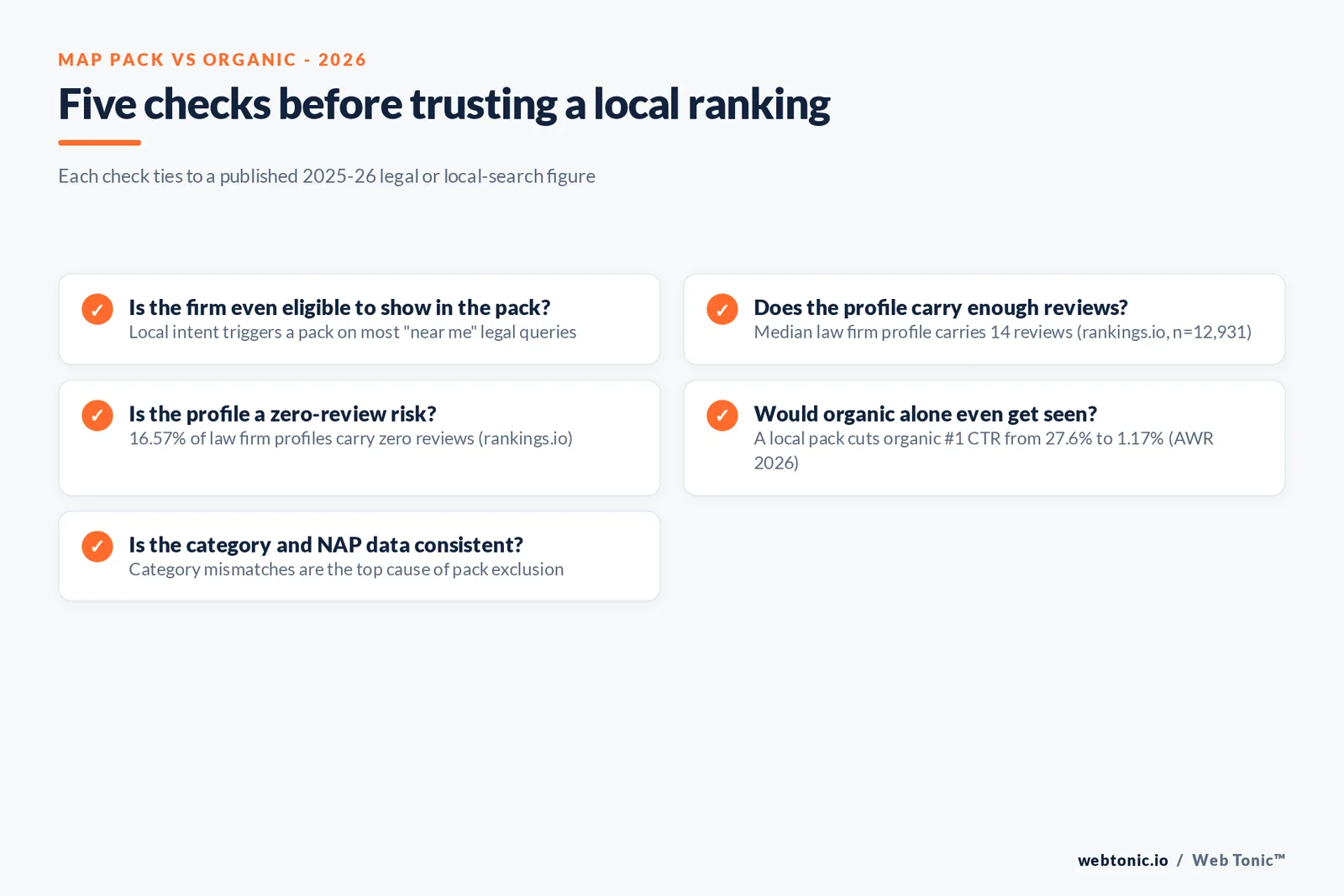
Google weighs proximity, relevance and prominence for local pack inclusion, and prominence is where review volume and consistent NAP (name, address, phone) data do the most work. A firm sitting below the Feedback Guru cross-industry benchmark of 45 reviews is not automatically excluded from the pack, but it is competing against peers closer to that benchmark and is starting from behind on the prominence signal every time a searcher compares two similar-looking listings.
Category selection matters just as much. A profile filed only under a broad "Lawyer" category instead of "Immigration Attorney" is opting out of the exact query match that triggers the pack for a "near me" immigration search, regardless of how many reviews it has collected.
| Local pack input | What moves it | Evidence | Practical read |
|---|---|---|---|
| Review volume | More reviews, sustained over time | Feedback Guru cross-industry legal benchmark: 45 reviews | Below-benchmark firms are behind on prominence |
| Review recency | Recent reviews outweigh old ones | Not itemized in this dataset | Treat as an ongoing process, not a one-time push |
| Category accuracy | Specific category over a generic one | Not itemized in this dataset | File under the specific practice area |
| NAP consistency | Matching name/address/phone across the web | Not itemized in this dataset | Audit citations before a local SEO push |
Why the map pack is also where fraud hides
A high review count or a professional-looking Google profile is not proof of legal accreditation. USCIS maintains a standing warning that only attorneys or accredited representatives may give immigration legal advice, and the Federal Trade Commission separately warns that notarios and notary publics in the U.S. are not lawyers and cannot represent anyone before USCIS or in immigration court, regardless of how their listing appears in local search. A licensed firm's own local SEO content should make its bar credentials explicit, both because it is required and because it is the differentiator a fraudulent competitor's profile cannot legitimately match.
Our growth marketing practice builds Google Business Profile and local content programs around exactly this kind of audience and compliance gap; get in touch to see what that looks like for a specific market. Our review of conversion rate benchmarks and the cost-per-lead data by industry both help frame what a local SEO program should be worth once it starts sending qualified traffic instead of just impressions.
Building a realistic local SEO scorecard
Given what is and is not measured for immigration specifically, a defensible scorecard tracks four things a firm can actually influence: whether it appears in the pack for its top three service-plus-city queries, its review count against the Feedback Guru cross-industry benchmark, whether its Google Business Profile content exists in the languages its client base actually reads, and its own tracked conversion rate from map-pack clicks specifically, since that figure is not published anywhere at the immigration-law level.
None of the four require waiting on a new industry study - all four can be measured directly from a firm's own Google Business Profile dashboard and call tracking within a single reporting cycle. Running that scorecard quarterly, rather than as a one-time audit, is also the only way to catch a category or NAP drift before it costs a firm its pack placement, since none of the vendors cited on this page track immigration-specific listings for early warning signs.
| Scorecard item | How to measure it | Benchmark to compare against |
|---|---|---|
| Pack appearance for top queries | Manual search or rank tracker, by city | Appear for the firm's top 3 service+city terms |
| Review count vs. peers | Google Business Profile review count | Feedback Guru cross-industry target of 45 |
| Multilingual profile coverage | Audit profile description, posts, Q&A by language | Match the top 2 languages of the client base |
| Map-pack click-to-lead rate | Call tracking tied to GBP source | The firm's own trailing quarter, not an external benchmark |
Frequently Asked Questions
Does the map pack or organic search send more clicks for a local legal search?
When a local pack appears on the results page, it absorbs most of the click volume that organic results would otherwise get. Advanced Web Ranking's 2026 organic CTR study finds that a local pack alone drops the organic #1 result's click-through rate by 94%, from a baseline of 27.6% (Backlinko's 2025 study of 4 million searches) down to 1.17%. For an immigration firm, that means winning the organic #1 spot on a 'near me' search is worth far less if a map pack is also showing, which it almost always is for local legal intent.
How do people actually start looking for a local business now?
GatherUp's 2025 consumer survey found only 1% of people start their search for a local business on social media. The more common starting points were a maps app such as Google Maps or Apple Maps at 14%, a voice assistant at 11%, an AI chat tool such as ChatGPT or Gemini at 8%, and asking friends or family at 7%. That spread means a Google Business Profile still carries more weight for a first-time searcher than a firm's Instagram or Facebook page.
How many Google reviews does a competitive immigration firm profile need?
There is no immigration-specific dataset, and no law-firm-specific Google review audit with a stated methodology and sample size is currently available either. Feedback Guru's cross-industry benchmark puts the legal-services average at a 4.5-star rating and 45 reviews. Read that figure as a competitive target, not a legal requirement, until a sourced legal-vertical dataset exists.
Does limited English proficiency change how immigration clients search locally?
It is a real factor to plan around. The Migration Policy Institute reports that in 2024, 47% of the 49.8 million U.S. immigrants ages 5 and older - 23.5 million people - spoke English less than 'very well,' accounting for about 81% of the country's 28.9 million limited-English-proficient residents. A Google Business Profile and website that only exist in English are filtering out a meaningful share of the exact population searching for immigration help.
Can a notario or unaccredited consultant legitimately compete for the same local searches?
They can show up in the same map pack, which is precisely the problem USCIS and the FTC warn consumers about. A high review count or a plausible-looking Google Business Profile does not indicate legal accreditation, and both agencies publish standing consumer warnings that notarios, notary publics and immigration consultants in the U.S. are not attorneys and cannot represent someone before USCIS or in immigration court.
Sources
Backlinko, Google organic CTR study (4M results)
Advanced Web Ranking, organic CTR by position 2026
GatherUp, 2025 local discovery research
BrightLocal, consumer search behavior research
Migration Policy Institute, immigrant statistics
American Immigration Council, USCIS backlog analysis
USCIS, avoiding immigration legal-services scams
Federal Trade Commission, notario fraud alert