Table of contents
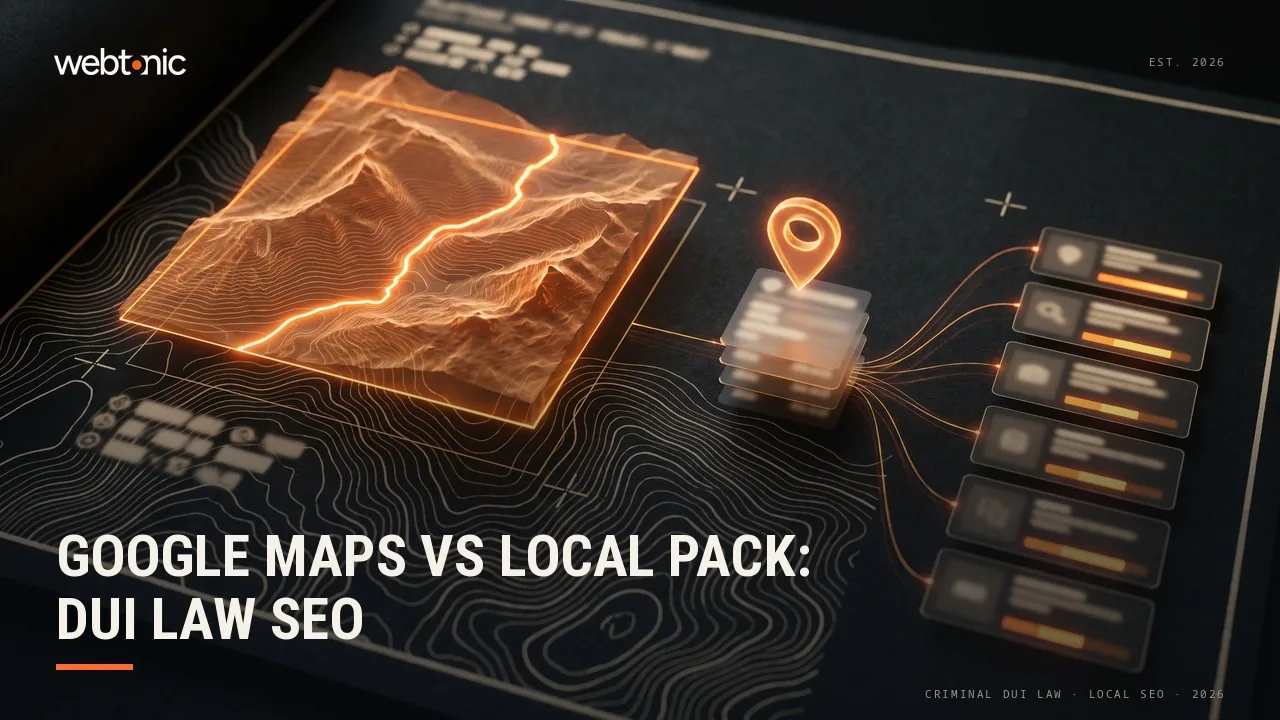
No published study measures Google Maps clicks separately from Local Pack clicks for DUI-related legal searches. What BrightLocal and Google's own lawyer verification rules do measure is how local search behavior, review trust, and platform verification work for local businesses generally - and this page applies those numbers honestly to a criminal defense firm's local presence.
Key Takeaways
- 42% of local searchers click a result inside the Map Pack when it appears.
- 83% of consumers use Google to read reviews before choosing a local business.
- Trust in online reviews fell to 42% in 2025, down from 79% in 2020.
- 48% of consumers also check local news sites for reviews.
- 44% check Yelp and 40% check Facebook for the same purpose.
- Only 20% of consumers use TikTok to find local business reviews.
- Google tightened Local Services Ads verification for lawyers in 2024.
- Firms have a 30-day window to complete that identity check.
- Only 40% of firms answered a secret-shopper test call, Clio found.
- Just 33% responded to a secret-shopper test email.
- 52% of firms responded by either channel, leaving 48% unreachable.
- 79% of consumers expect a response within 24 hours, per Clio's research.
- 78% of law firms maintain a LinkedIn presence, ABA's 2025 survey found.
- 59% of solo and small firms cite referrals as their top lead source.
- Attorneys & Legal Services carries the highest Google Ads CPC of any industry, $8.58.
- ABA Rule 7.1 bars misleading claims in local listings and profile descriptions alike.
Maps, Pack, and Profile are three different things
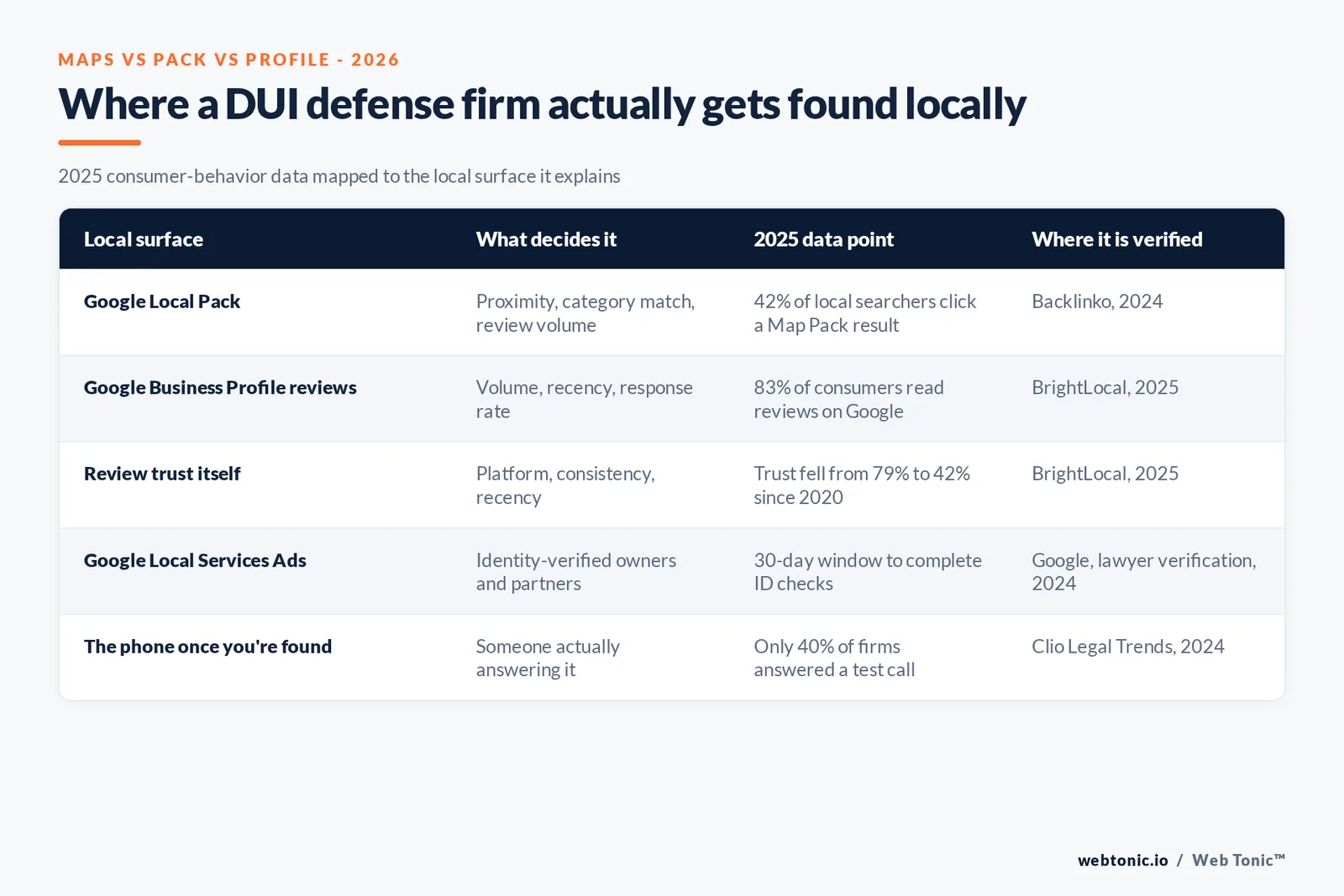
"Google Maps vs Local Pack" is often used loosely, but they measure different behavior. The Local Pack is the three-result block embedded directly in regular Google search for queries with local intent; the standalone Maps app or tab is a separate surface someone opens on purpose to browse. No single, current primary study isolates the click share going specifically to the Map Pack versus the rest of the results page for local-intent DUI searches, so this page treats Local Pack presence as a binary requirement instead: appear in it for the firm's core service-plus-city queries, or lose that visibility entirely.
No public study breaks that 42% down by legal sub-practice, so treat it as the ceiling on attention a well-optimized Google Business Profile can capture for a "DUI lawyer near me" query, not a DUI-specific number.
| Local surface | What it is | 2024-2025 data point | Source |
|---|---|---|---|
| Local Pack | Three-listing block inside search results | No isolated legal-vertical click split published | N/A |
| Google Maps app | Standalone browsing surface | No published legal-vertical split | Not directly benchmarked |
| Google Business Profile reviews | Trust and ranking signal | 83% of consumers read reviews there | BrightLocal, 2025 |
| Local Services Ads | Pay-per-lead placement above the pack | Requires verified attorney identity since 2024 | Google, 2024 |
Review trust is falling even as review reading holds steady
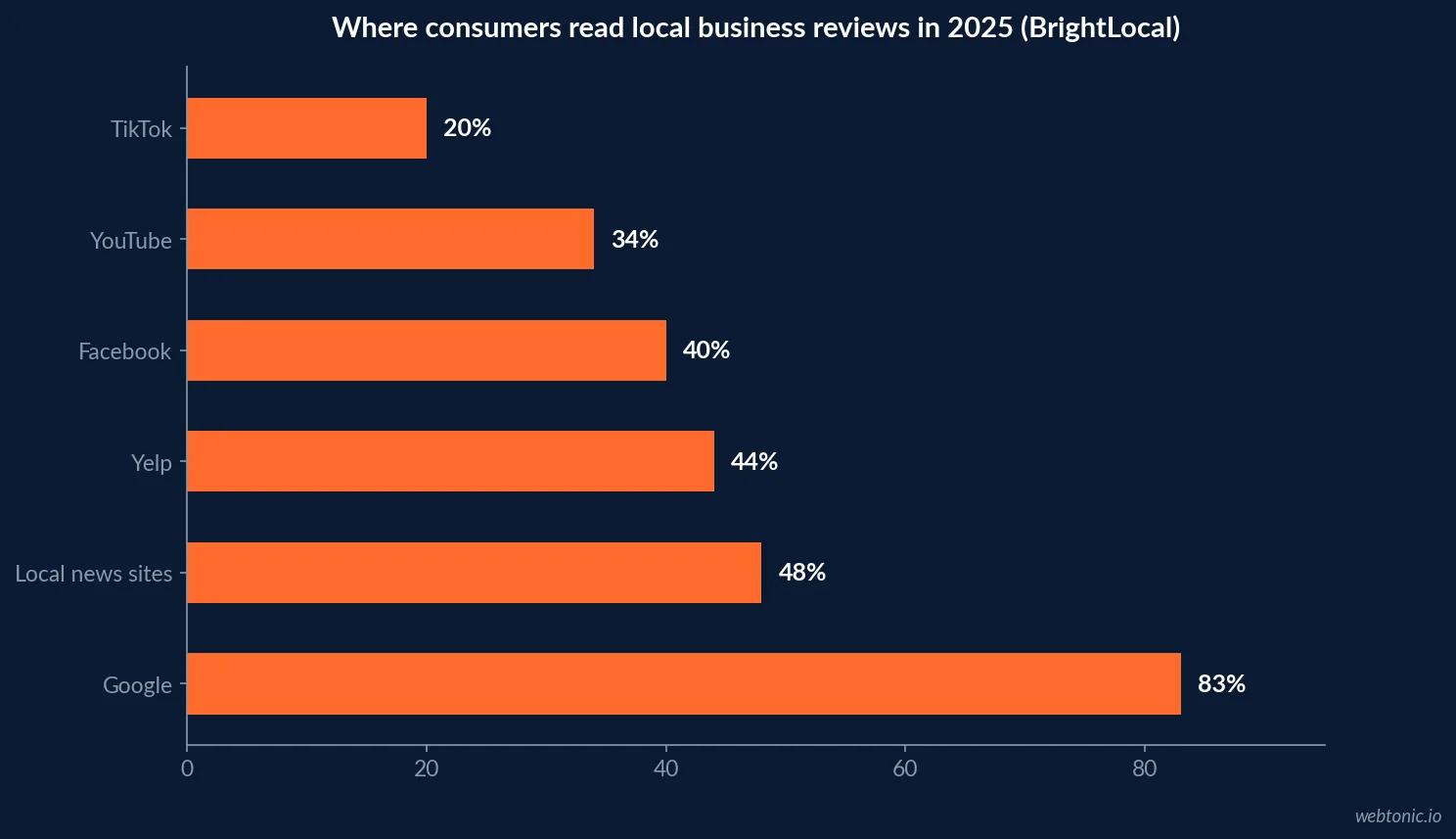
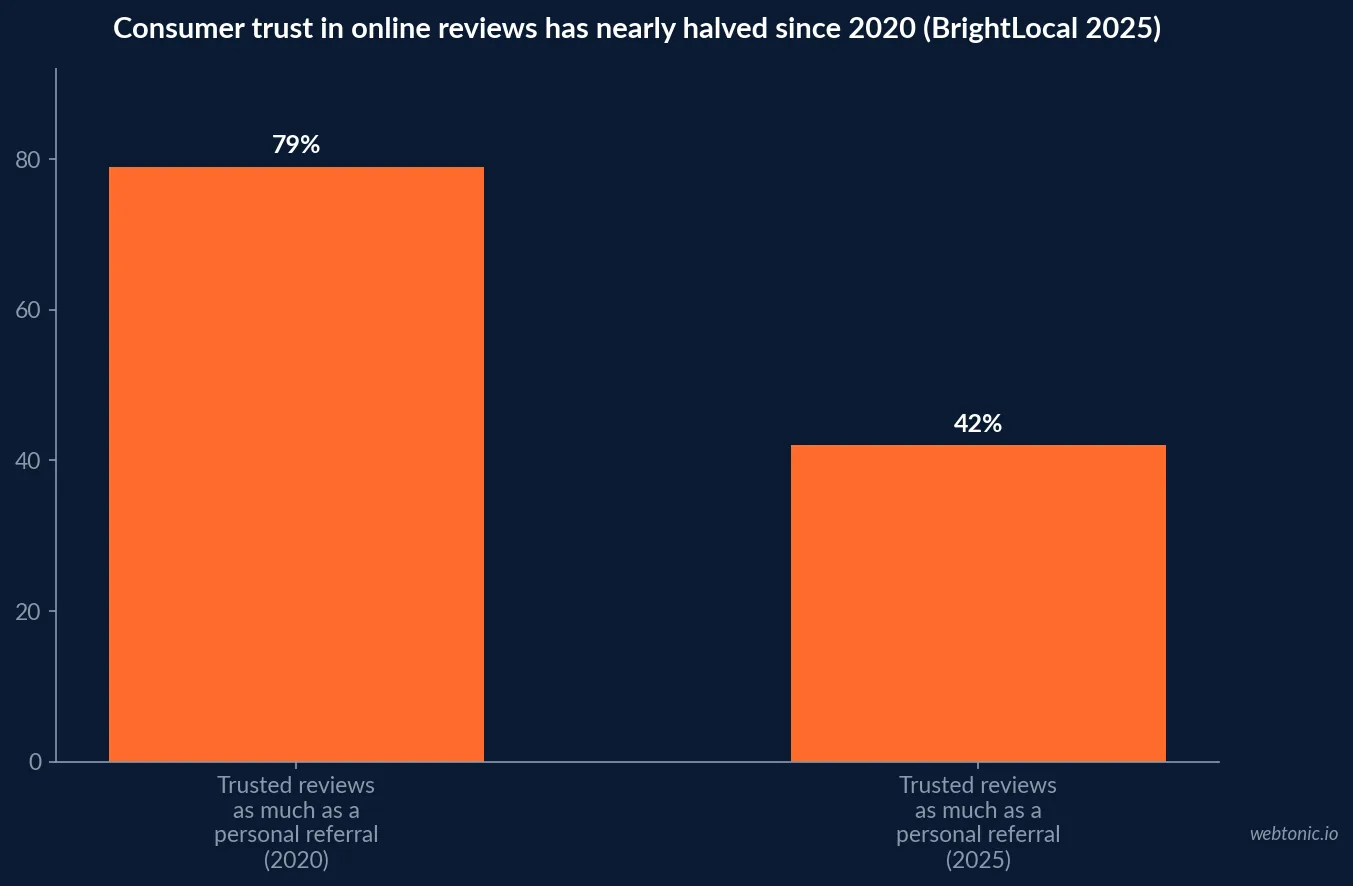
BrightLocal's 2025 Local Consumer Review Survey found that only 42% of consumers now trust online reviews as much as a personal recommendation from someone they know, down from 79% in 2020. Consumers are still reading reviews closely - the same survey shows Google is where 83% of them do it - but they read with more skepticism than five years ago, checking recency, response patterns, and consistency rather than taking a star average at face value.
For a criminal defense firm, that shift raises the bar on review management: a static 4.8-star profile with no recent activity now reads as less credible than the same score did in 2020, and a profile that responds to reviews signals the kind of attentiveness that trust-eroded consumers are specifically looking for.
| BrightLocal 2025 Local Consumer Review Survey | Figure | What it measures |
|---|---|---|
| Trust reviews as much as a personal recommendation, 2025 | 42% | Down from 79% in 2020 |
| Consumers who use Google to read reviews | 83% | The dominant review-reading surface |
| Consumers who also check local news sites | 48% | A secondary channel worth monitoring |
| Consumers who check Yelp | 44% | Still relevant, though smaller than Google |
| Consumers who check TikTok for reviews | 20% | The smallest surface BrightLocal tracked |
Local Services Ads now carry an identity check, not just a listing fee
Google's Local Pack and organic Local SEO sit beside a paid placement most DUI defense firms also consider: Local Services Ads. Google's own screening and verification process already required background, license, and insurance checks by category, and in 2024 Google specifically tightened requirements for lawyers, adding identity verification for business owners, senior partners, and any featured attorney, cross-checked against professional license information with a 30-day completion window. Google's Local Services platform policy confirms the entity-level verification requirement sits on top of the regular screening process.
A firm that skips the identity verification for a newly featured attorney risks losing that attorney's Local Services Ads eligibility entirely, independent of how well the firm ranks in the organic Local Pack.
| Local Services Ads requirement (Google, 2024-2026) | Detail |
|---|---|
| Who must verify | Business owners, senior partners, featured attorneys |
| Verification method | Identity checks cross-referenced with license records |
| Completion window | 30 days from notification |
| Consequence of missing it | Loss of Local Services Ads eligibility |
| Underlying screening | Background, business registration, insurance, license checks |
Ranking is only half the funnel
Every figure above measures visibility or trust; none measures what happens after the click. Clio's 2024 Legal Trends Report ran a secret-shopper test across real law firms and found only 40% answered a test phone call and 33% responded to a test email, for a combined 52% response rate - meaning 48% of firms tested went entirely unreachable. Clio's earlier consumer research also found 79% of legal consumers expect a response within 24 hours of first contact.
A firm that ranks first in the Local Pack for "DUI attorney [city]" but answers less than half its calls is losing the intake it worked to win. Fixing the answer rate is usually cheaper than the SEO work that produced the ranking in the first place.
| Clio 2024 secret-shopper result | Figure | Consequence for local rankings |
|---|---|---|
| Firms that answered a test call | 40% | Most of the ranking's value is lost on the phone |
| Firms that responded to a test email | 33% | Email intake is not a safe fallback |
| Firms responding by either channel | 52% | Just over half convert visibility into contact |
| Consumers expecting a same-day reply | 79% | The bar the 52% figure is failing to clear |
Mobile makes the local surfaces matter more, not less
A DUI arrest search is overwhelmingly a mobile, urgent search, which raises the stakes on whichever surface actually gets found. BrightLocal's local SEO survey data also finds Google organic rankings among the metrics marketers rate most important when judging local SEO performance, named by 41% of surveyed marketers - ahead of most other single ranking-factor proxies. For a DUI defense firm, that reinforces the same priority order this page has already built from BrightLocal and Google's own data: profile accuracy and category match first, review recency and response second, verified paid placement third.
None of that changes if the search happens from a jail visitation waiting room or a family member's kitchen table at 2 a.m. - the ranking factors are the same, but the tolerance for a slow or unanswered follow-up is lower given how time-sensitive a DUI case actually is.
How to prioritize the work
Given the data above, the highest-leverage local SEO work for a criminal DUI defense firm is, in order: keep the Google Business Profile category and service list accurate (it decides Local Pack eligibility), build a steady flow of recent reviews with owner responses (trust has fallen, recency and response now carry more weight than raw star count), complete Local Services Ads identity verification for every named attorney before it lapses, and instrument phone and email intake so the ranking work is not being wasted on unanswered contact.
Our growth marketing team builds local visibility plans around this exact sequence, and our guide on what search advertising costs is useful context if Local Services Ads spend is also on the table. Talk to us about auditing a specific market's Local Pack standing.
Treat the numbers on this page as a recurring check, not a one-time audit. Review trust is a five-year downward trend, not a fixed baseline, so a profile that looked strong in 2023 needs fresh evidence today, and the Local Services Ads identity verification resets whenever a new attorney joins a listing. A quarterly review against each row above tends to catch drift - a stale review section, an unverified new hire, a category mismatch - before a competitor's fresher profile takes the click a slower-moving firm assumed it still owned.
Frequently Asked Questions
What is the difference between the Local Pack and Google Maps for a law firm?
The Local Pack is the three-listing block that appears directly in Google's regular search results for a local query; Google Maps is the separate, full-screen app or tab someone opens deliberately to browse nearby options. No isolated legal-vertical study reports the click split between the Map Pack and the standalone Maps app, but the Map Pack sits directly inside the regular search results page a DUI searcher already has open, while the Maps app requires a second, deliberate step - which is why this page treats Map-Pack presence, not Maps-app presence, as the surface worth optimizing for.
Do online reviews still matter for a DUI defense search?
Less than they used to, but they still matter. BrightLocal's 2025 Local Consumer Review Survey found just 42% of consumers now trust online reviews as much as a personal recommendation, down from 79% in 2020. Reviews remain a ranking input and a conversion signal, but a firm leaning entirely on star count without freshness or response is fighting a five-year decline in blind trust.
Where do people actually read reviews before calling a lawyer?
Overwhelmingly on Google. BrightLocal's 2025 survey found 83% of consumers use Google to read reviews, ahead of local news sites at 48%, Yelp at 44%, Facebook at 40%, YouTube at 34%, and TikTok at just 20%. For a local legal search, optimizing the Google Business Profile review flow outranks chasing reviews on any other single platform.
Has Google made it harder for lawyers to run Local Services Ads?
Yes. Google tightened its Local Services Ads verification for law firms in 2024, requiring identity checks for business owners, senior partners, and any featured attorney, cross-checked against professional license records, with a 30-day window to complete the process. A firm relying on Local Services Ads for DUI leads needs every named attorney verified, not just the account owner.
Does ranking well matter if the phone doesn't get answered?
No, and this is the gap most local SEO reporting skips. Clio's 2024 Legal Trends Report ran a secret-shopper test and found only 40% of firms answered a test phone call and 33% responded to a test email - a combined 52% response rate. Winning the Local Pack for a DUI-related search only produces a client if someone actually picks up.
Sources
BrightLocal - Local Consumer Review Survey 2025
Google - Understand the Local Services screening and verification process
Google - Local Services platform policies
Clio - 2024 Legal Trends Report
Clio - 2025 Legal Trends for Solo and Small Law Firms
American Bar Association - 2025 legal technology survey
WordStream - Google Ads Benchmarks 2025