Table of contents

Carl Chamoiseau is Head of SEO at Web Tonic. He leads SEO strategy to help brands grow organic visibility and revenue, working across technical SEO, content strategy, and authority building, with over 10 years of experience in semantic SEO, topical authority, and internal linking architecture.
Marianne Michel handles SEO content strategy and optimization at Web Tonic, working across French and English markets on keyword research, on-page content, and site structure projects for clients in Quebec, Canada, and the US.
A single enterprise software purchase in the United States doesn't involve one buyer typing a query and clicking "buy." It involves a CFO checking ROI, an IT lead checking integration specs, a procurement officer checking compliance, and several other people search engines never see coming. SEO for B2B has to answer all of them, not just the one who eventually signs the contract.
That's the entire structural difference from consumer SEO. A content strategy built for one buyer with one intent misses most of the decision makers who actually approve a purchase. This guide covers what a real B2B SEO strategy looks like once you account for that.
Key Takeaways
- The average B2B buying group includes 6 to 10 decision-makers, each searching independently, and a full decision cycle can take 3 to 18 months.
- Organic search leads close at a 14.6 percent rate versus just 1.7 percent for outbound efforts, making SEO one of the highest-quality lead channels available.
- SEO produces leads at roughly $206 per lead, compared to $408 for LinkedIn Ads and $463 for PPC, the lowest cost per lead of the three.
- B2B prospects conduct an average of 12 searches before ever reaching a vendor's website, which means content needs to answer questions long before a brand is even under consideration.
- Listicle-style roundups earn 21.9 percent of AI citations, ahead of standard articles (16.7 percent) and product pages (13.7 percent), making format choice a real factor in generative engine optimization.
- Long tail keywords with low search volume are often the right target in B2B, since the specific, technical phrases decision-makers actually use rarely show high volume in a keyword tool.
What Makes SEO Different for B2B?
SEO for B2B is the practice of optimizing content and technical infrastructure to reach every stakeholder in a multi-person buying committee, not a single consumer making an impulse decision. The core mechanics of search engine optimization, technical health, content strategy, link building, stay the same. What changes is the target: B2B decision makers search with technical precision, evaluate over longer sales cycles, and rarely convert on a first visit.
That difference shows up directly in keyword strategy. A B2C marketer dismisses a keyword with 40 monthly searches. In B2B, that low-search volume, highly specific phrase is often exactly what an evaluating buyer types when they're seriously comparing vendors. Chasing high volume, generic terms usually means competing for audience attention that was never going to convert into a real lead. That precision starts with a clear ICP (ideal customer profile). Without one, content ends up written for a generic audience instead of the specific roles that actually sit on a real buying committee.
Organic search leads close at a 14.6 percent rate, compared to just 1.7 percent for outbound efforts, a large enough quality gap to justify the extra content investment reaching a full buying committee requires.
The B2B Buying Committee, By the Numbers
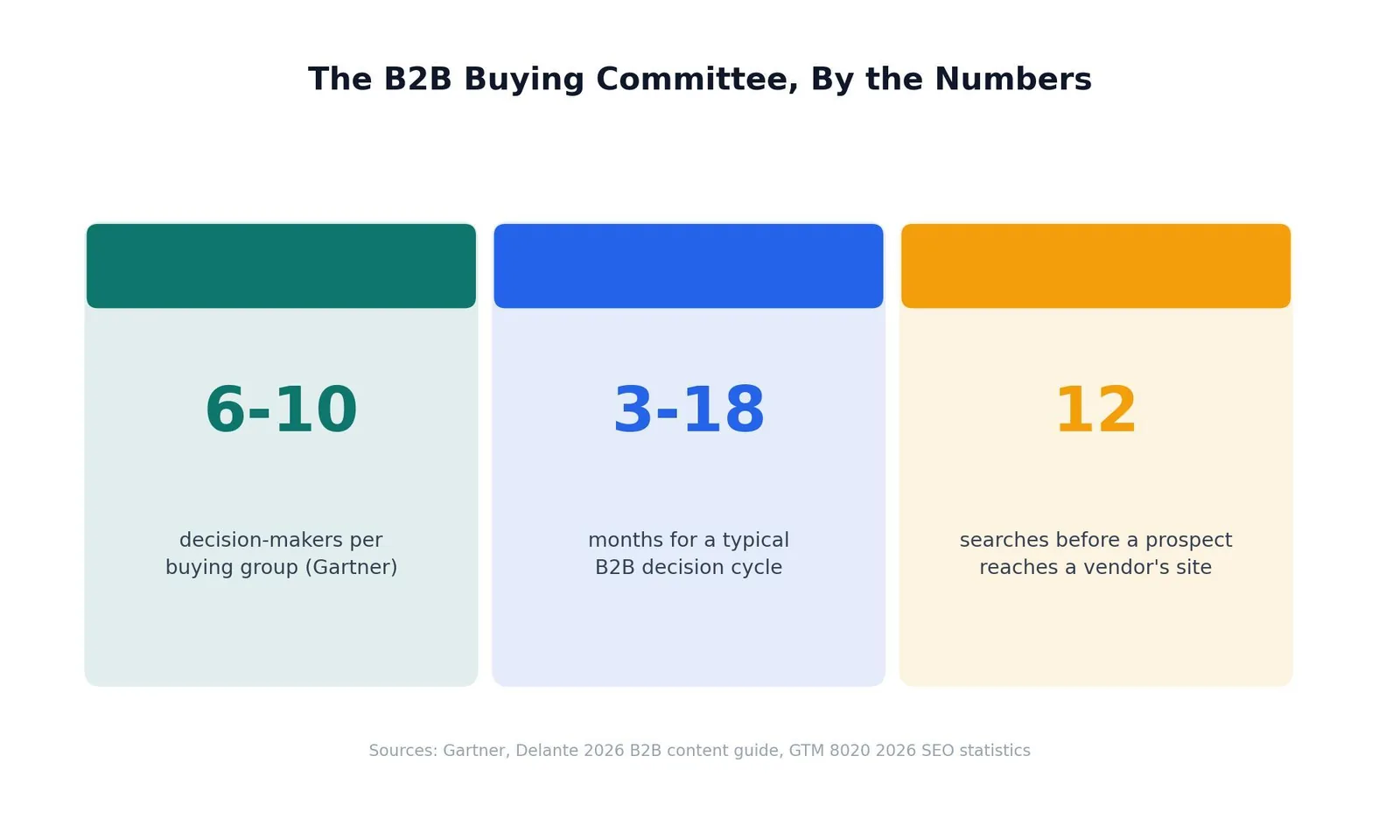
The scale of a typical B2B purchase decision explains why single-persona content strategies fail. Gartner's research, cited by Delante's 2026 B2B content guide, puts the average buying group at 6 to 10 decision-makers, each researching independently, with a full decision cycle running 3 to 18 months depending on complexity. Separately, GTM 8020's 2026 research found prospects conduct an average of 12 searches before ever landing on a vendor's website, meaning a huge share of the buying journey happens before any single company even enters consideration.
SEO Is the Cheapest B2B Lead Channel
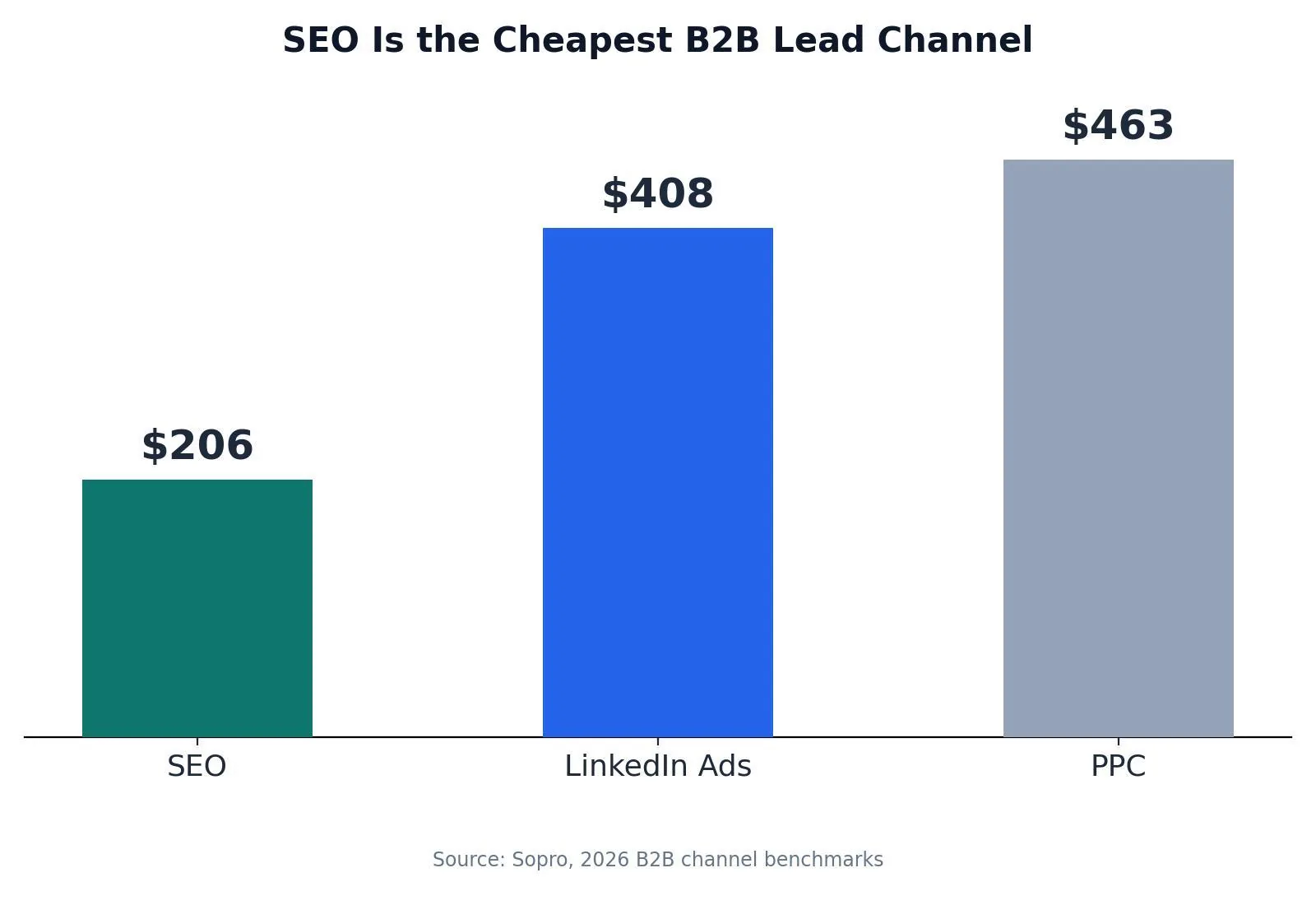
The economics favor organic content once volume builds. According to Sopro's 2026 B2B channel benchmarks, the average cost per lead for SEO runs about $206, compared to $408 for LinkedIn advertising and $463 for PPC. That gap compounds over time, since organic content keeps generating leads long after a PPC or CPC-based campaign budget runs out.
SEO vs. Paid Channels for B2B Lead Generation
| Channel | Cost Per Lead (USD) | Time to Results | Best For |
|---|---|---|---|
| SEO | ~$206 | 6-12 months to build | Long-term, compounding pipeline |
| LinkedIn Ads | ~$408 | Immediate | Targeting specific job titles and companies |
| PPC (Google Ads) | ~$463 | Immediate | Fast visibility for a launch or event |
Most B2B companies run all three. SEO builds the durable, lowest-cost foundation, while PPC and LinkedIn fill immediate gaps around launches or account-based campaigns targeting specific buying committees.
Mapping Keywords to the B2B Funnel
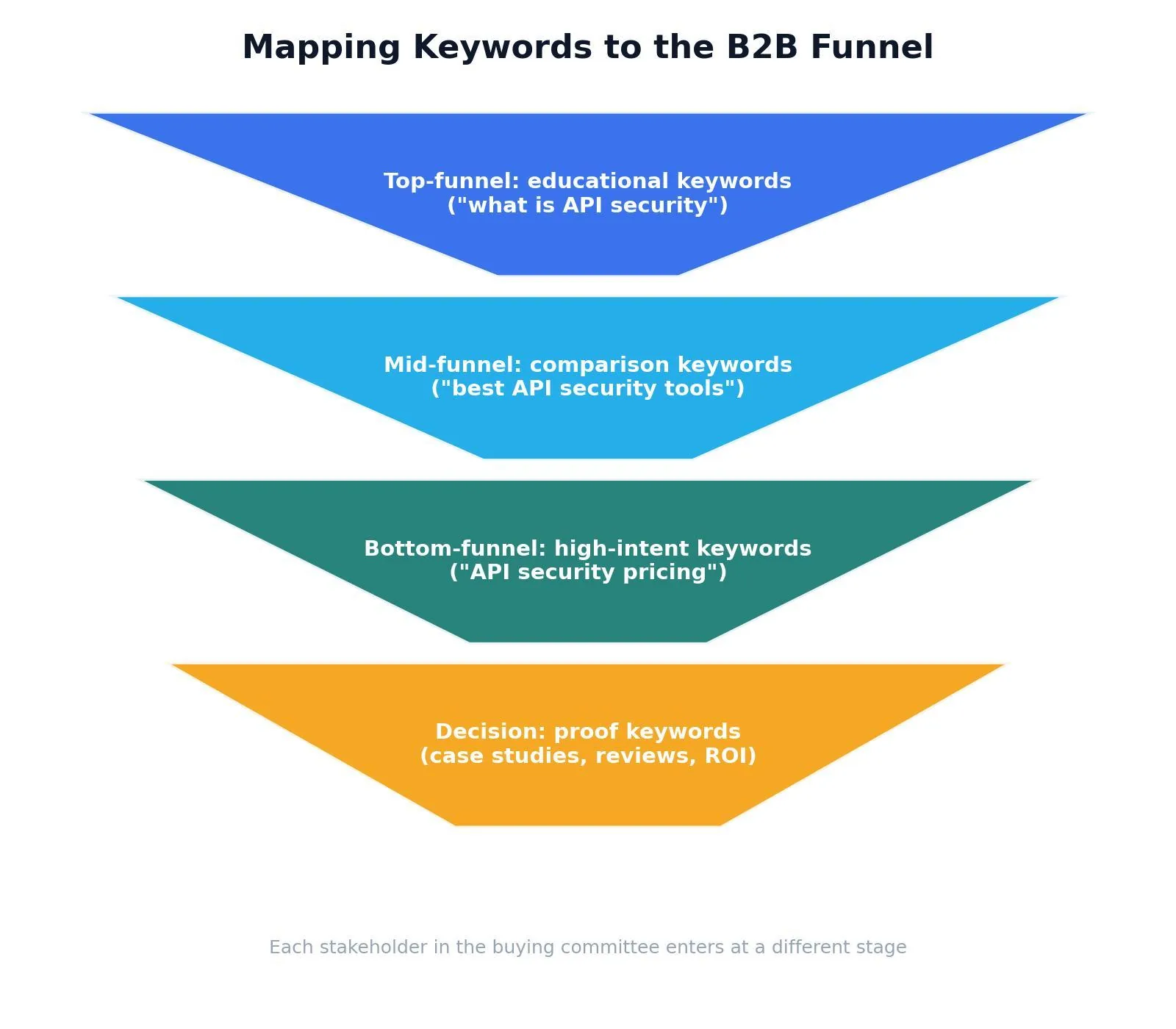
Different members of a buying committee search at different stages, which means funnel keywords need to be mapped deliberately rather than treated as one undifferentiated list. Top funnel searches are educational ("what is API security"). Mid-funnel searches compare options ("best API security tools"). Bottom funnel keywords carry direct evaluation intent ("API security pricing"). A final layer, proof content like case studies and ROI data, serves the internal champion who has to justify the purchase to the rest of the committee.
B2B SEO tool
Which funnel stage does this keyword target?
Pick what the searcher is trying to do, and see which content format fits.
Which Content Formats Do AI Tools Cite Most?
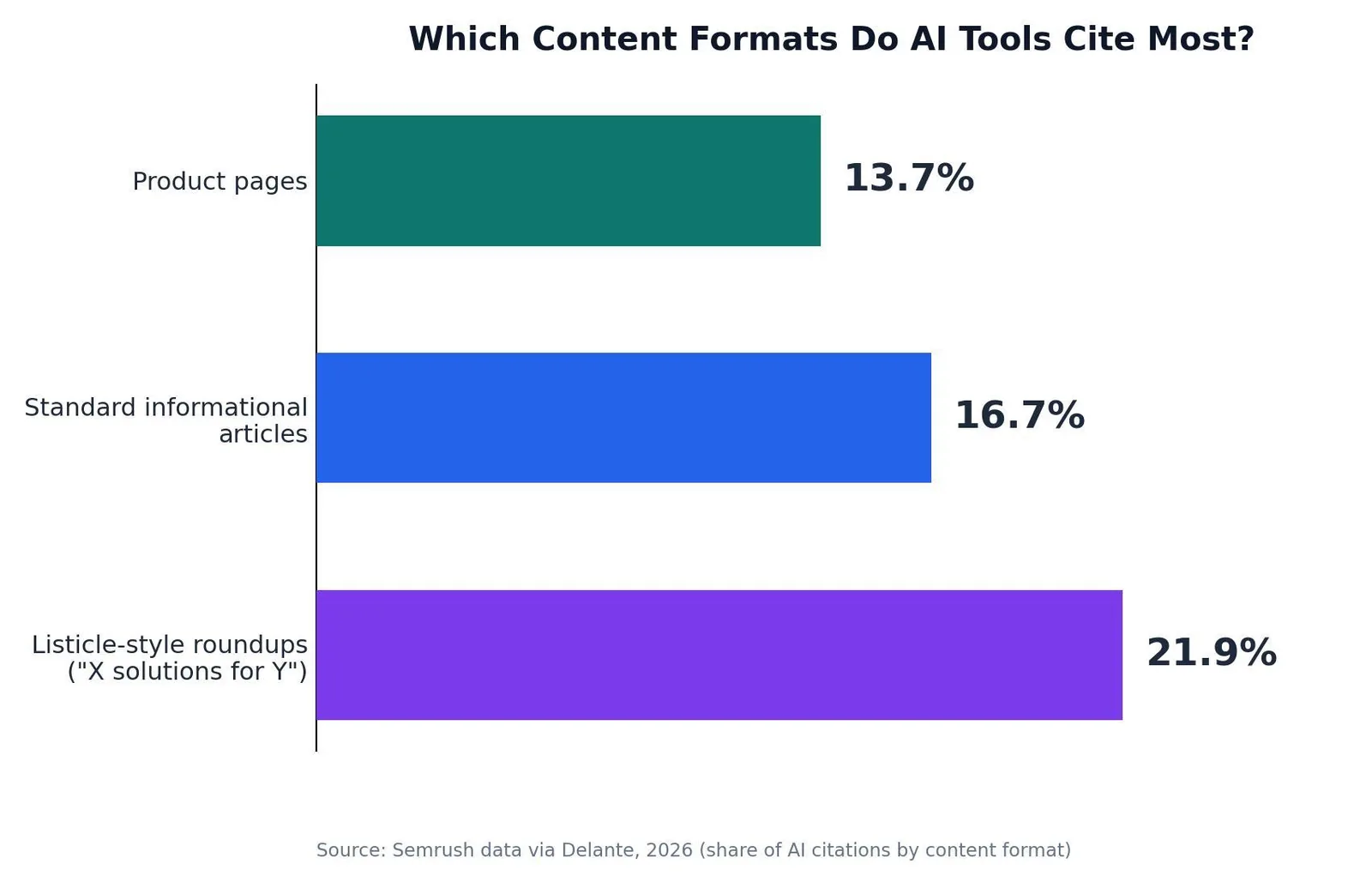
Generative engine optimization (GEO) is now a real factor in B2B visibility, since tools like Perplexity and other AI search products increasingly summarize research on a buyer's behalf. According to Semrush data cited by Delante's 2026 B2B content guide, listicle-style roundups earn 21.9 percent of AI citations, ahead of standard informational articles at 16.7 percent and product pages at 13.7 percent. Structuring key pages as clear, well-organized comparisons improves the odds of appearing in both a traditional SERP and an AI-generated answer.
The B2B SEO Roadmap
Step 1: Build content around every stage of the funnel
Map top funnel, mid-funnel, and bottom funnel keywords to specific pages rather than assuming one blog post can serve every stakeholder. Each decision maker in the committee needs content that matches where they actually are in the process.
Step 2: Target long tail, high intent keywords
Low search volume terms with specific, technical phrasing consistently convert better in B2B than broad, high-volume terms that mostly attract the wrong audience.
Step 3: Fix technical SEO fundamentals
Core Web Vitals metrics like LCP (load speed) and INP (responsiveness) directly affect both rankings and whether a CTA actually converts once a decision-maker lands on the page. Google's own Core Web Vitals documentation sets clear thresholds for both: Largest Contentful Paint under 2.5 seconds and Interaction to Next Paint under 200 milliseconds. A clean, well-maintained CMS makes this ongoing work far less error-prone than retrofitting fixes onto a rigid, outdated platform.
Step 4: Publish case studies and proof content
Case studies and data-backed proof points give internal champions the ammunition they need to advocate for a purchase to the rest of the buying committee, directly supporting the bottom of the decision making process.
Step 5: Build backlinks through genuine industry authority
Link building in B2B works best through original research, guest contributions, and Reddit or community engagement that puts a brand in front of the specific professional audience that eventually becomes a buyer.
Step 6: Track pipeline, not just traffic
Google Analytics and Google Search Console show traffic, but multi touch attribution connecting that traffic to actual pipeline in a CRM is what proves SEO's real contribution to revenue. CTR and organic traffic trends are useful early signals, but they only become meaningful once tied to actual pipeline movement in a CRM.
Common B2B SEO Mistakes to Avoid
The most common one is writing for a single generic persona instead of the multiple, distinct decision makers who actually participate in a real buying committee.
High-search-volume keywords get chased more often than they should, which wastes budget on traffic that rarely converts, when the same effort spent on specific, technical long tail keywords would reach people who are actually evaluating a purchase.
SEO success also gets measured by traffic or rankings alone far too often. Without connecting those numbers to CRM data and multi touch attribution, it becomes nearly impossible to prove the channel's real value to leadership.
GEO tends to get ignored entirely, which misses a growing share of research now happening through Perplexity and other AI tools that summarize sources before a buyer ever clicks through to a website.
Frequently Asked Questions
How is B2B SEO different from B2C SEO?
B2B involves multiple decision makers, longer sales cycles, and highly specific, technical search terms, compared to the faster, often single-buyer decisions typical in B2C. A B2B keyword strategy has to account for several people searching independently across the same purchase decision. Social media and digital marketing more broadly still play a role, but they tend to support research rather than drive the final decision the way they might in a B2C purchase.
Should B2B companies target low search volume keywords?
Often, yes. A highly specific, technical phrase with 40 monthly searches can carry far more buying intent than a broad term with thousands of searches, since B2B decision makers search with precision once they're seriously evaluating a solution.
What is GEO, and does it matter for B2B?
Generative engine optimization is the practice of structuring content so AI tools like Perplexity cite and summarize it correctly. It matters increasingly for B2B, since buyers now often start research through an AI tool before ever visiting a search engine directly.
How much should a B2B company budget for SEO?
It depends heavily on industry competitiveness and sales cycle length, so there's no single number that applies broadly. Get a quote specific to your market before committing budget, and treat any figure quoted in USD as a starting point for negotiation.
The Bottom Line on SEO for B2B
B2B SEO succeeds by treating the buying committee as what it actually is: several people, searching independently, at different stages, over months rather than minutes. Content built for one persona and one moment misses most of that committee entirely. Content mapped to the real funnel, backed by proof points and technical performance, reaches all of them.
Start by identifying the three or four distinct roles in your typical buying committee, then check whether your content actually addresses each one. That gap is usually where the fastest wins are.
Ready to Reach Every Decision-Maker?
Web Tonic runs a dedicated B2B digital marketing program, combining SEO, PPC, and LinkedIn advertising specifically to reach the key decision-makers inside a buying committee, backed by high-intent content like case studies and white papers built to move a complex sale forward. If mapping content to every stakeholder isn't something your team has bandwidth for internally, that's exactly the kind of work this program handles.
More from Web Tonic: growth marketing services, data & analytics.
Sources: seosherpa.com · delante.co · gtm8020.com · mangothrive.com · developers.google.com