Table of contents

Every full-service agency eventually gets the same request from a client: "Can you handle our SEO too?" Agencies that say yes with a real plan capture a client relationship that tends to run years, not months. Agencies that say yes without one end up with an unhappy client, a team stretched too thin, and a service line quietly bleeding margin.
SEO for agencies covers two related problems: how an agency builds or buys the capability to deliver search engine optimization, and how it packages that capability into a service clients will actually renew. Some agencies position themselves as a dedicated SEO company; others fold it into a broader digital marketing agency lineup alongside web design, paid media, and social. Either way, a single SEO agency handling every client's website and rankings needs a repeatable engine, not a one-off engagement. This playbook covers the delivery models, the pricing reality, and the mistakes that show up most often when agencies add SEO to their menu.
Key Takeaways
- The global agencies SEO services market is valued at $87.82 billion in 2026 and is projected to reach $165.29 billion by 2030 — the demand is already there for agencies that can deliver, in the United States and beyond. (Research and Markets)
- Retainer-based SEO clients churn at roughly 18% annually, versus 42% for project-based clients, making retainer pricing the more defensible model for an agency's own recurring revenue. (Forge Agency Benchmarks)
- SEO ROI varies as much as 12x by client vertical: real estate clients see roughly 1,389% ROI over three years, compared to 117% for technical-SEO-only engagements. (First Page Sage)
- Building a genuine in-house SEO team can run over $300,000 a year in salaries alone, before tools like Semrush or Ahrefs. That's why many agencies start with white-label or freelance delivery instead.
- Monthly SEO retainers scale sharply by client size, from roughly $750–$3,000 for startups and local businesses to $5,000–$50,000 for enterprise accounts. (Resourcera)
- Delivery dissatisfaction, not price, is now the top reason clients leave an agency, cited by 48 percent of departing clients. (Swydo)
What Is SEO for Agencies?
SEO for agencies means an agency building the internal capability, delivery model, and pricing structure to sell search engine optimization as a repeatable service, rather than treating it as a one-off project bolted onto web design or paid media work. The technical and content fundamentals are the same as any SEO strategy — technical health, relevant content, authority signals — and how search engines like Google evaluate a site hasn't fundamentally changed. What has changed is the scale: an agency has to standardize that work across many accounts at once, each with a different budget, vertical, and level of client sophistication.
That standardization problem is why agencies that jump into SEO services without a clear delivery model tend to struggle. A single freelancer or a scattered mix of subcontractors can handle one or two clients reasonably well, but scaling past that takes a defined process for keyword research, standardized reporting, and a clear read on which clients the agency can take on profitably.
Why Agencies Are Adding SEO to the Service Menu
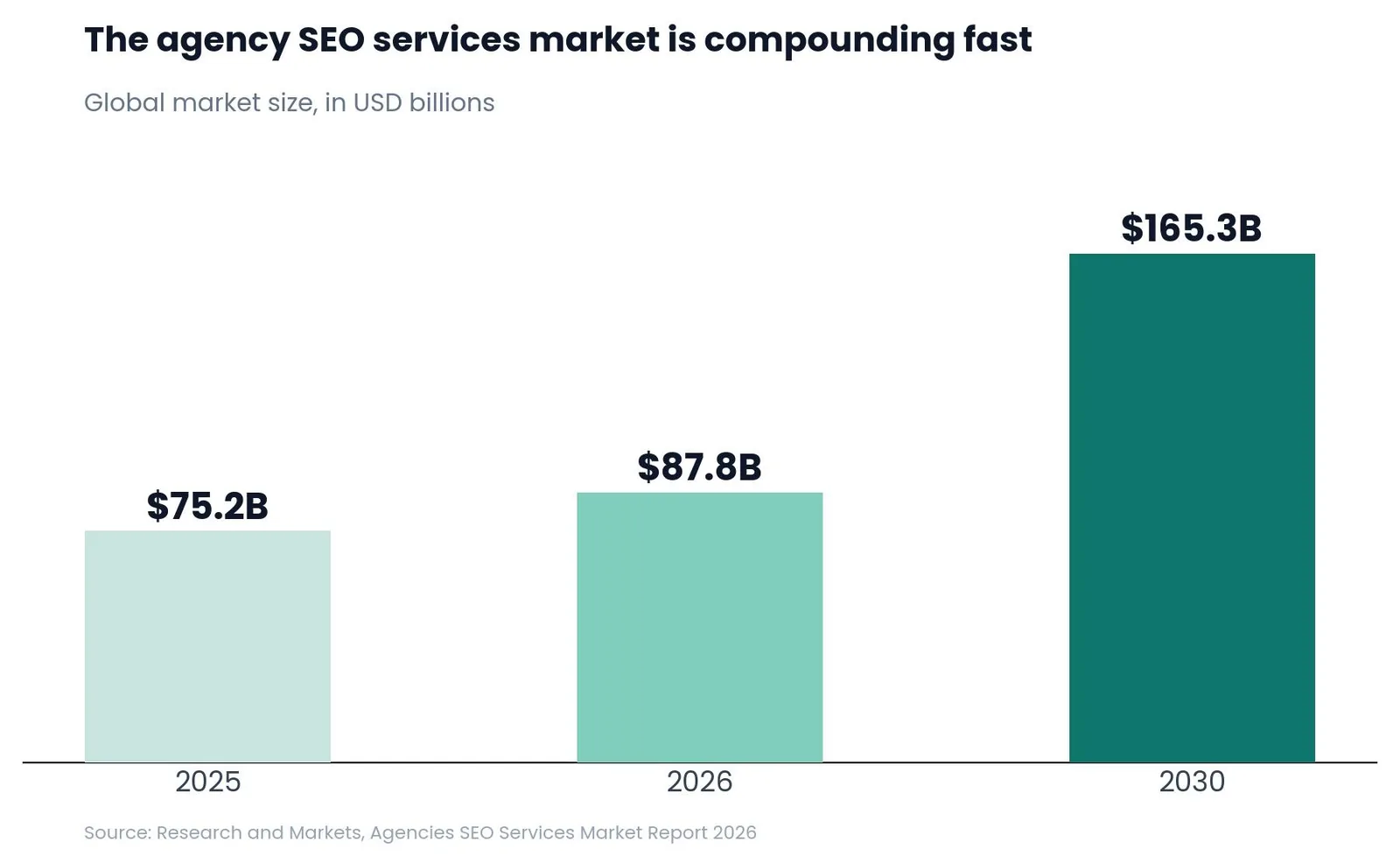
The agencies SEO services market is projected to grow from $75.22 billion in 2025 to $87.82 billion in 2026, reaching $165.29 billion by 2030, a 17.1 percent CAGR (Research and Markets). That growth tracks a real shift in client expectations: businesses that once treated PPC and organic as separate budgets increasingly want one marketing agency managing both, with content and technical SEO feeding the same attribution model as paid media. Agency service menus are broadening on the paid side too, from Amazon Ads management to programmatic display, so clients expect the SEO piece to be just as polished as the paid media they already buy.
There's a defensive reason too. Full-service agencies competing purely on social media management or paid media are more exposed to client in-housing, since those functions are easier for a client's internal team to absorb with AI tools. Agencies with structural, technical, and content work spanning organic traffic growth have a much harder service to replicate in-house.
Choosing a Delivery Model: In-House, White-Label, or Freelance
The first real decision isn't which keywords to target — it's how the work gets produced. There's no single best SEO delivery model that fits every agency; the right choice depends on client volume today, not where the agency wants to be in three years.
| Factor | In-house team | White-label partner | Freelance / contractor mix |
|---|---|---|---|
| Setup cost | High — strategist, technical specialist, content, link building can exceed $300,000/year in salaries alone | Low — pay per client engagement, no hiring | Low to moderate, scales with volume |
| Time to launch | Months (hiring, onboarding, tooling) | Weeks | Days to weeks |
| Quality control | Highest, direct oversight | Depends heavily on partner vetting | Inconsistent across contractors |
| Best for | Agencies with 15+ SEO clients already or a specialized SEO division | Agencies testing demand or scaling fast without hiring risk | Small agencies handling 1-5 SEO clients |
| Margin at scale | Improves significantly past breakeven headcount | Steady, predictable per-client margin | Variable, depends on contractor rates |
Most agencies that add SEO successfully start with white-label or a freelance mix, prove out demand and retention with real clients, then bring specific functions in-house once volume justifies the fixed cost. Building a full internal team before signing the first SEO client is one of the more common ways agencies lose money on this service line in year one.
Agency SEO tool
Is your agency ready to sell SEO?
Check off what's already true for your team. Your score updates as you go.
0 of 6
Check off items above to see if your agency is ready to sell SEO.
What Agency SEO Retainers Actually Cost
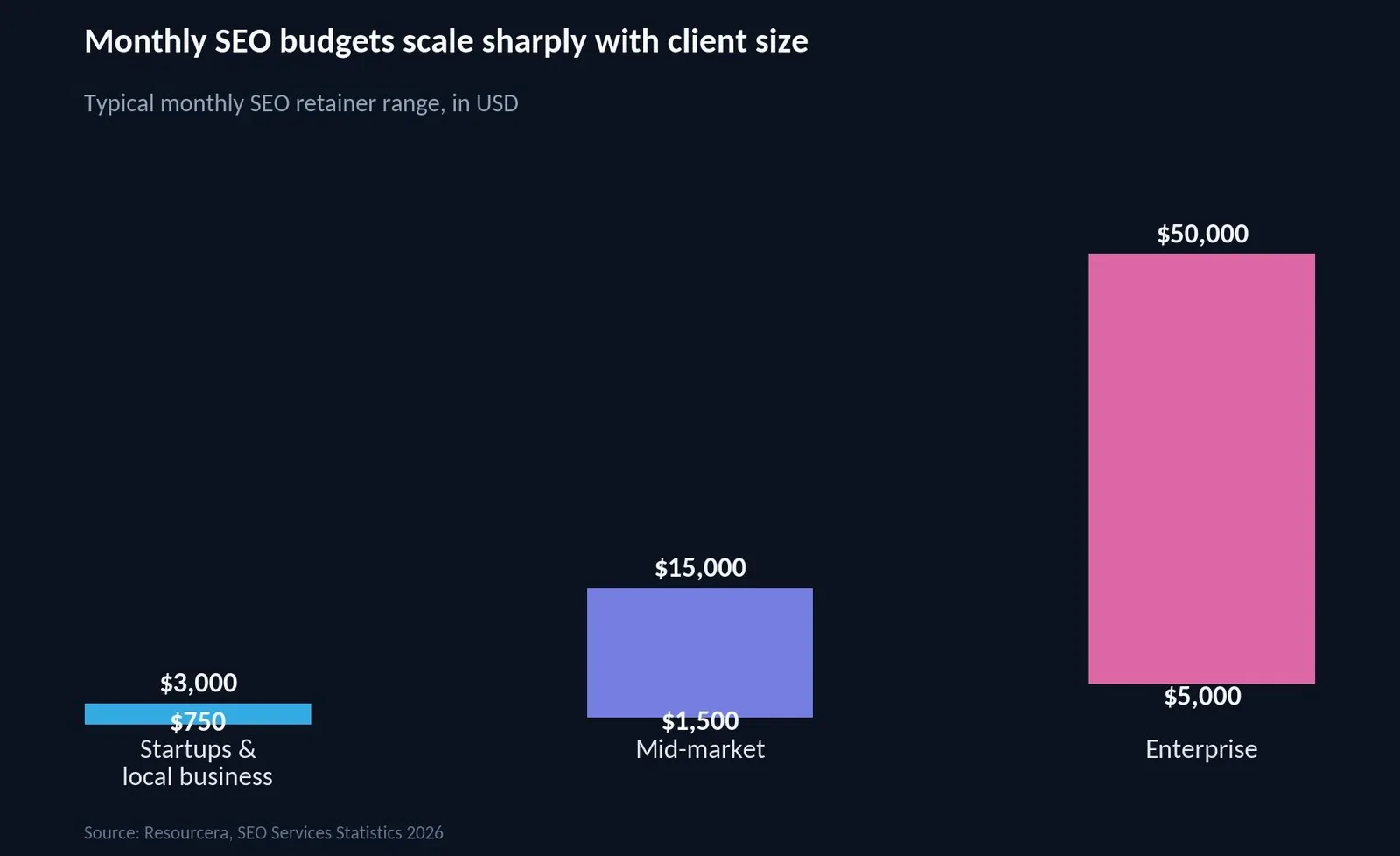
Monthly budgets scale sharply by client size: startups and local businesses typically pay $750 to $3,000 a month, mid-market companies pay $1,500 to $15,000, and enterprise accounts range from $5,000 to $50,000 a month (Resourcera). Two large industry surveys converge at the low end: most SEO agencies still price retainers below $1,000 a month, and only about 14 percent of the market operates in the $15,000-plus enterprise tier (Arvow). Here's a quick look at services offered across the three tiers, along with typical SEO content cadence:
| Client segment | Typical monthly retainer (USD) | Typical engagement length | Common scope |
|---|---|---|---|
| Startups & local business | $750 – $3,000 | 12+ months | Local SEO, Google Business Profile optimization, on-page basics |
| Mid-market | $1,500 – $15,000 | 24–36 months | Technical SEO, content production, link building |
| Enterprise | $5,000 – $50,000 | 36+ months | Multi-site technical SEO, GEO/AEO, dedicated team |
Data across multiple pricing surveys shows agencies charging roughly 138 percent more than freelancers on comparable retainers, reflecting the account management and quality-control overhead a freelancer doesn't carry. Reporting is where that premium earns its keep: tying rankings to Google Analytics conversion and revenue data, not just position tracking, is what separates a service clients renew from one they quietly cancel.
The ROI Case: Why SEO Retention Beats Project Work
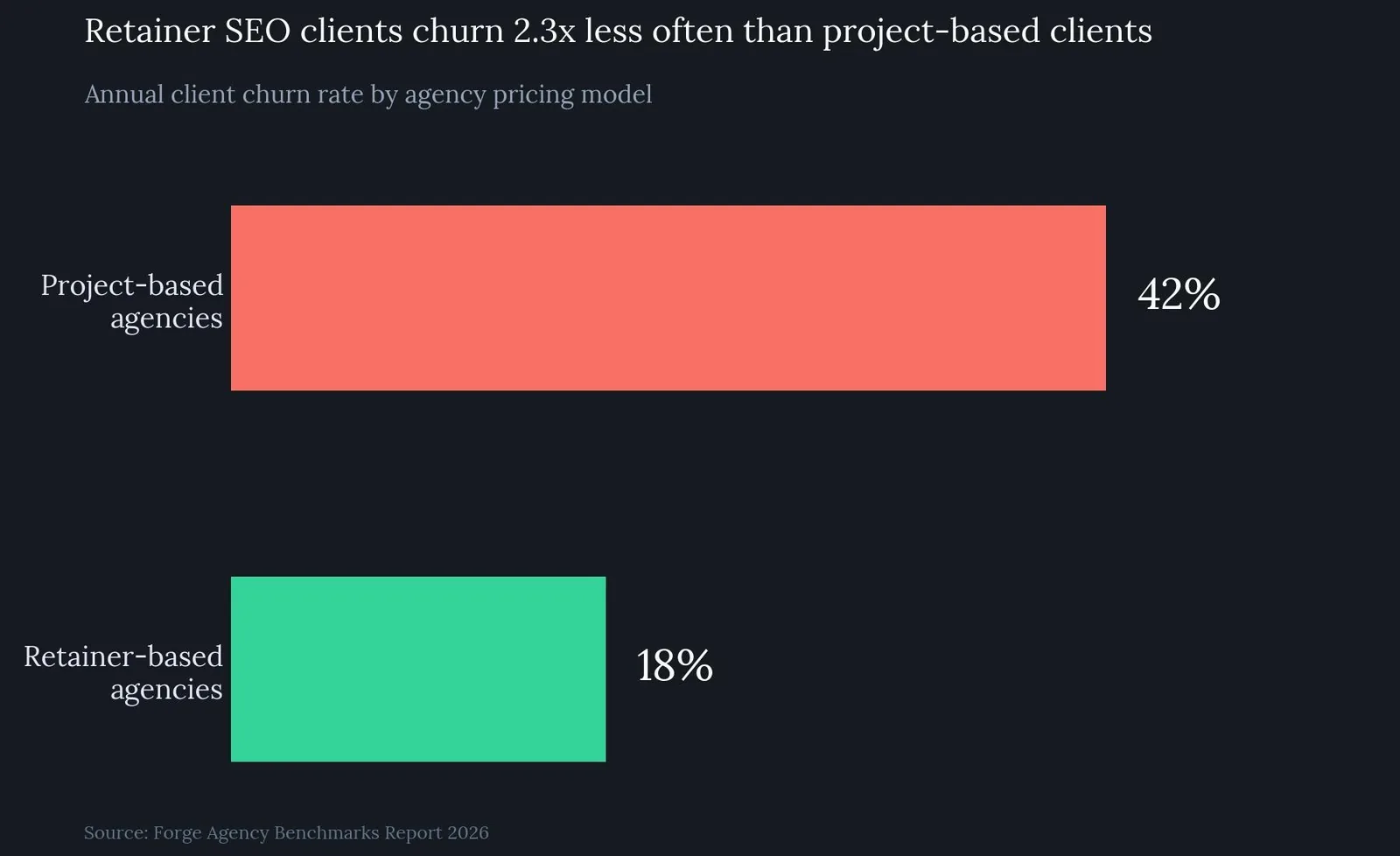
Retainer-based agencies see roughly 18 percent annual client churn, compared to 42 percent for project-based agencies (Forge Agency Benchmarks), a gap driven largely by the fact that SEO results compound over many months. Average client lifespan follows the same pattern: retainer relationships run closer to 56 months, against 24 months for project work.
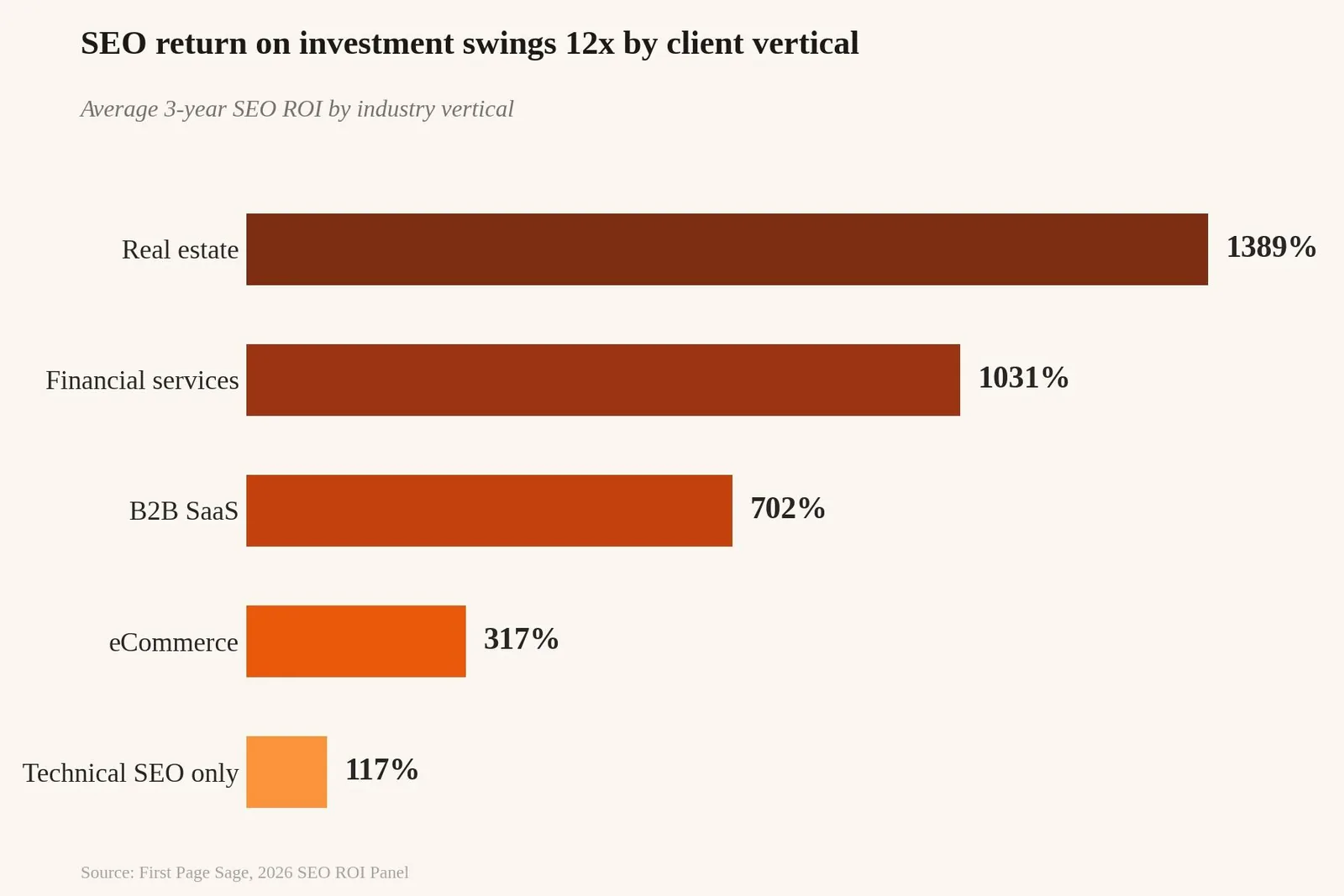
ROI also varies far more by client vertical than most agencies expect. Real estate clients see roughly 1,389 percent ROI over three years, financial services 1,031 percent, and B2B SaaS 702 percent, compared to 317 percent for eCommerce and just 117 percent for narrowly scoped technical-SEO-only engagements (First Page Sage). An agency that understands this spread can prioritize its client roster more intelligently, whether that roster spans fintech clients in New York, healthcare practices in Chicago, or retail chains headquartered in Austin, TX.
Common Mistakes Agencies Make Adding SEO
The most expensive mistake is promising fast results to close the sale. Search engine optimization compounds over 6 to 12 months at minimum. Setting a client's expectations around a 90-day turnaround creates a churn risk the agency built into its own contract.
Underpricing runs a close second. An agency that prices its SEO retainer like a freelancer, without accounting for account management overhead, ends up subsidizing the client relationship instead of profiting from it.
There's also the tendency to treat SEO as a bolt-on to paid media rather than a distinct discipline with its own on-page optimization, SEO audits, and technical requirements. A PPC specialist and an SEO specialist solve different problems.
And ignoring AI search entirely is quickly becoming a fourth mistake. Client-facing reporting that only tracks classic Google rankings, with no visibility into AI Overviews, Perplexity, or generative engine optimization, is going to look incomplete within the next year or two.
AI Search Is Changing the Pitch: GEO, AEO, and AI Overviews
AI Overviews now appear on a meaningful share of Google search results, and click-through rates on queries that trigger them have reportedly dropped, with declines showing up even on searches without an AI Overview present (DesignRush). That shift is pushing generative engine optimization (GEO) and answer engine optimization (AEO) from a nice-to-have into a core part of what agencies need to sell.
GEO focuses on structuring a client's content so LLM-based tools like Perplexity cite or surface it in generated answers. AEO focuses more narrowly on answer-format results: featured snippets, direct answers, and AI Overview citations. That's especially true for agencies serving clients across the U.S. and the broader United States market, and for USA-based enterprise brands in particular, where budgets skew toward the higher end of the retainer range.
Frequently Asked Questions
How much should an agency charge for SEO services? It depends heavily on client size and delivery model. As a planning frame: $750–$3,000/month for startups and local businesses, $1,500–$15,000 for mid-market, $5,000–$50,000 for enterprise. Price in account management and reporting overhead, not just execution time.
Should an agency build an in-house SEO team or go white-label? Most agencies without an existing SEO division start with white-label or a freelance mix to prove out demand without the fixed cost of hiring, then bring functions in-house once client volume justifies it.
How long does it take to see results from agency-delivered SEO? Tell clients to expect 6 to 12 months before meaningful, consistent results. A shorter promise during the sales process is one of the most common reasons SEO clients later leave.
Do agencies need to offer GEO and AEO alongside traditional SEO now? Increasingly, yes. With AI Overviews appearing across a growing share of search results, agencies that only report on classic rankings risk looking behind the curve within the next year or two.
What's the biggest retention risk for an agency's SEO service line? Delivery dissatisfaction, cited by 48 percent of departing clients, not price (Swydo). Clear, consistent reporting tied to business outcomes is the strongest lever against that risk.
Agencies that would rather plug into a proven delivery team than build one from scratch don't have to choose between speed and quality. Web Tonic's SEO - GEO - LLMs service line handles technical SEO, content, local optimization, and AI-search visibility, and partners with other agencies looking to add or scale an SEO offering without the in-house hiring risk.
Where Agencies Should Start
Adding SEO as a service line rewards agencies that treat it as a distinct discipline with its own delivery model, pricing logic, and reporting standard, not a bolt-on to existing paid media work. Pick a delivery model that matches current client volume, price in the overhead a freelancer doesn't carry, set honest timelines, and build AI search visibility into reporting from the start.
A realistic starting point for most agencies: pick one delivery model, price one retainer tier properly, and take on a single SEO client before scaling further.
More from Web Tonic: growth marketing services, data & analytics.
Sources: researchandmarkets.com · forge.so · firstpagesage.com · resourcera.com · swydo.com · arvow.com · news.designrush.com