Table of contents

37% of shoppers now begin their shopping journey directly on a marketplace, not on Google, according to Channel Engine's Marketplace Shopping Behavior Report, as cited by Intelligence Node's guide to marketplace optimization. But the marketplace itself still has to win the search traffic that gets shoppers there in the first place, and that's a fundamentally different discipline than SEO for a single-brand website. SEO for marketplaces means optimizing a platform with thousands or millions of listings, most of it written by sellers or hosts you don't control, without collapsing under duplicate content and wasted crawl budget.
This playbook breaks down why marketplace SEO strategy differs so sharply from standard SEO, how leading platforms like Amazon, Etsy, and Airbnb structure their sites to handle scale, and the specific technical fixes that prevent a growing marketplace from quietly sabotaging its own rankings.
Key takeaways
- 37% of shoppers begin their shopping journey on a marketplace directly, making the platform's own SEO a genuine growth channel, not an afterthought.
- The top 3 organic positions capture roughly 68.7% of all clicks on a clean SERP, so marketplace rankings below position 3 are competing for a shrinking slice of available traffic.
- Faceted navigation, if left uncontrolled, is the single biggest technical threat to marketplace SEO: filters for color, size, and price can generate near-infinite duplicate URL variations.
- User-generated content (UGC) at scale is a double-edged sword. It fuels the long-tail content marketplaces need, but unmanaged, it produces thin and duplicate listings that suppress rankings platform-wide.
- SEO cannibalization is a structural risk unique to marketplaces: category pages, individual listings, and seller profiles can all target the same keyword and compete against each other in the same search results.
Why marketplace SEO is a fundamentally different discipline
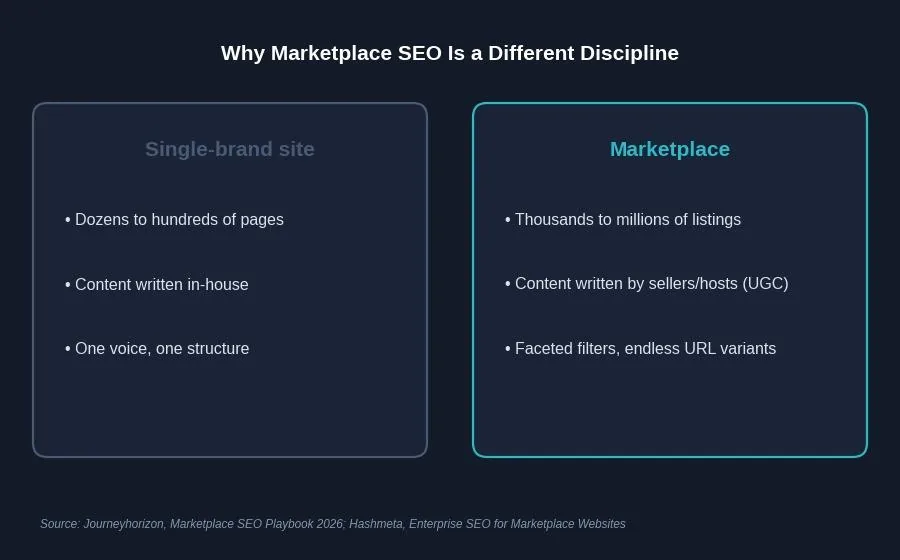
A typical single-brand website might have dozens to hundreds of pages, all written in-house with one consistent voice and structure. A marketplace looks nothing like that. It can carry thousands to millions of individual listings, most of the content written by sellers, hosts, or freelancers the platform doesn't directly control, layered with filterable search results that generate URL variations Google was never meant to see.
Journeyhorizon's 2026 marketplace SEO playbook breaks this down into three structural challenges that don't really exist for a normal website:
- Complex navigation structures. Faceted navigation, if not controlled with canonical tags or noindex directives, leads to duplicate URLs and wasted crawl budget.
- SEO cannibalization. When category pages, listings, and vendor profiles all target the same keyword, they compete against each other in the same search results instead of reinforcing one another.
- Domain authority fragmentation. Using subdomains for individual sellers, or dividing geography into unreasonably granular categories, can fragment the authority that would otherwise concentrate on fewer, stronger pages.
How the largest marketplaces structure their sites
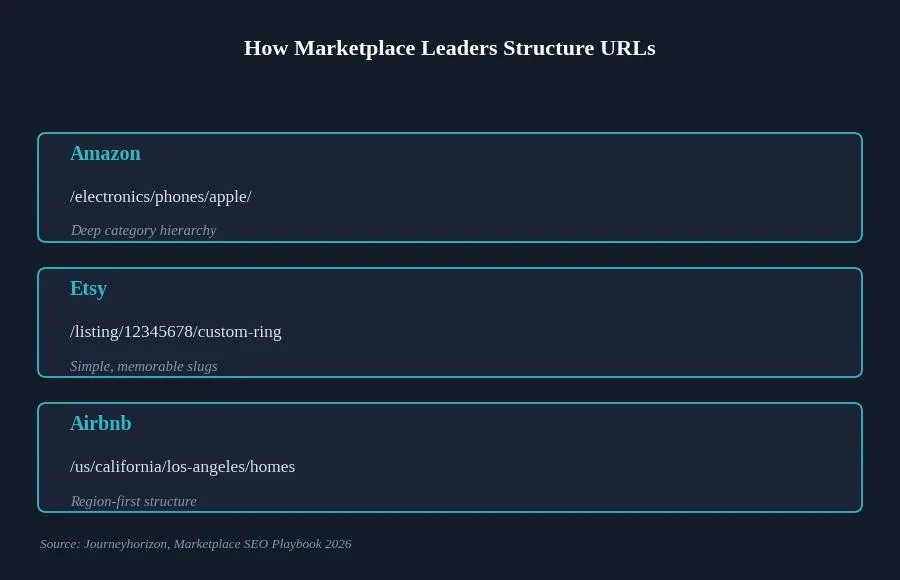
URL and information architecture has to be a foundation capable of scaling as the number of listings and sellers grows exponentially, and the leading platforms each solve this differently based on what their inventory actually looks like:
- Amazon builds its architecture around deep category hierarchies, like /electronics/phones/apple/, giving Google clear signals about where each product sits in a broader taxonomy.
- Etsy uses simple, memorable listing slugs like /listing/12345678/custom-handmade-ring, prioritizing uniqueness per product over category depth.
- Airbnb structures pages by region, such as /us/california/los-angeles/homes, which reinforces local relevance for location-based searches.
The same logic applies well beyond these three platforms. Poshmark's resale model and Walmart's marketplace both face the identical structural question: how to organize listings so search engines can distinguish a category page from an individual seller's inventory.
On the technical side, Dittofi's guide to marketplace SEO strategies notes that Etsy uses server-side rendering (SSR) and preloads data so Google can reliably crawl dynamic content, while Amazon leans on canonical tags to control how product variants appear in search results.
The technical checklist every marketplace needs
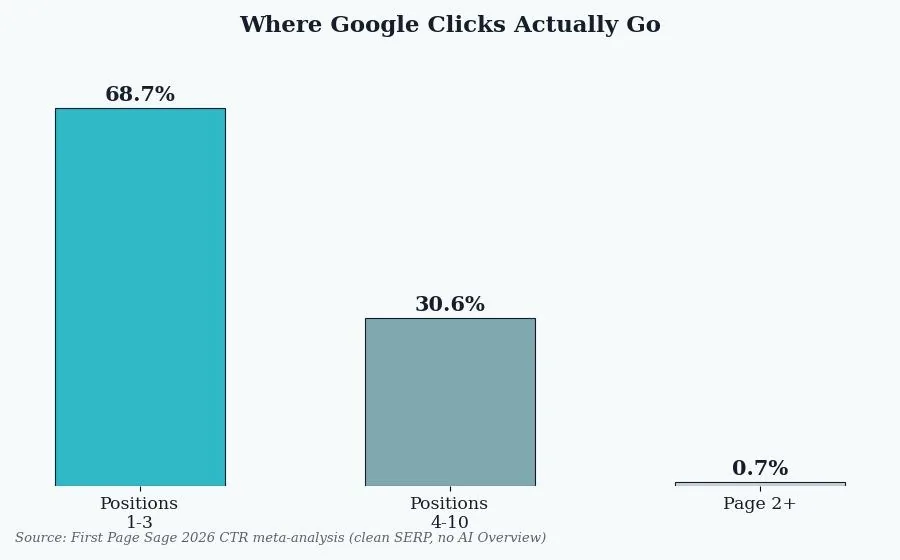
On a clean SERP with no AI Overview present, the top 3 organic positions still capture roughly 68.7% of all clicks, per First Page Sage's 2026 meta-analysis of multiple independent CTR studies. That share compresses somewhat on queries where an AI Overview appears, but the underlying pattern holds: a listing or category page ranking outside the top 3 is competing for a small, shrinking slice of available demand. That makes the technical fundamentals below non-negotiable, not optional polish:
- Canonical tags on filtered and paginated URLs, so Google consolidates ranking signals onto one authoritative version instead of splitting them across near-duplicate variants.
- Crawl budget management at enterprise scale. With millions of listings, Google simply won't crawl everything; Hashmeta's guide to enterprise SEO for marketplace websites covers how to prioritize which pages matter most.
- Structured data (schema markup) on listings to surface reviews, availability, and pricing directly in search results.
- Core Web Vitals, particularly Largest Contentful Paint (LCP), since a slow-loading marketplace loses both rankings and conversions even when the underlying content is strong.
- SSL across the entire domain, a baseline trust and ranking signal Google has required for years.
Marketplace SEO tool
Duplicate content risk calculator
Estimate how exposed your marketplace is to duplicate content and crawl budget waste based on scale and current safeguards.
Estimated risk level
--
Adjust the sliders and checkboxes to see your result.
Measuring what actually matters
Rankings alone are a weak signal for whether marketplace SEO is actually working. Pair Google Search Console (GSC) for crawl stats, index coverage, and which queries are actually surfacing your listings, with Google Analytics for what happens after the click: search-to-purchase conversion, not just traffic volume. Most marketplaces run on a custom CMS or a hybrid build rather than an off-the-shelf platform, which makes this pairing even more important, since GSC data is often the clearest signal into how well that custom architecture is actually being crawled.
Comparing UGC management approaches
| Approach | How it works | Best for | Main risk |
|---|---|---|---|
| Unmanaged UGC | Sellers write descriptions freely, no minimum standards | Very early-stage marketplaces with few listings | Duplicate, thin content suppresses rankings as volume grows |
| Guided UGC | Templates and required fields nudge sellers toward unique, complete listings | Most growing marketplaces | Still requires ongoing spot-checks for quality |
| Platform-enhanced UGC | Seller content is enriched with structured data and platform-level uniqueness checks | Large, mature marketplaces (Etsy, Airbnb scale) | Requires meaningful engineering investment |
Approaches reflect patterns observed across major marketplace platforms; the right model depends on marketplace size and seller sophistication.
Turning user-generated content into an asset, not a liability
Many marketplaces have plenty of user-generated content and still fail to rank, because content volume alone isn't the advantage; organizing that content properly is. A breakdown of Airbnb's SEO strategy makes the point directly: Airbnb's real strength is turning millions of individual host listings into a structure that both Google and users can actually navigate, not the raw volume of listings itself.
This is also where semantic keyword coverage, still sometimes called LSI terms even though Google's systems have moved well past the original latent semantic indexing concept, matters more than exact-match density in seller-written descriptions. Brodie Clark's guide to marketplace SEO reinforces a related point: localized content strategy and deliberately minimizing page exclusions both matter more, at marketplace scale, than they would on a typical site, precisely because small structural mistakes get multiplied across so many pages at once. For marketplaces expanding into new regions, such as Australia, that same UGC structure has to extend to localized spelling, currency, and search behavior, not just translated text.
Common marketplace SEO mistakes
- Leaving faceted navigation completely open to crawling, generating thousands of near-duplicate URLs from filter combinations alone.
- Letting category pages, listings, and seller profiles cannibalize the same target keyword instead of assigning each a distinct, non-overlapping purpose.
- Copying the same UGC-handling approach regardless of scale. What works for a few hundred listings breaks down completely at hundreds of thousands.
- Treating link building as generic outreach instead of building genuine community assets, like Airbnb's destination guides, that attract backlinks organically.
- Measuring success by keyword rankings alone. CraftPixie's 2026 marketplace SEO guide pushes for tracking the business metrics that actually matter instead, like organic positions on transactional keywords and search-to-purchase conversion.
Frequently asked questions
How is SEO for marketplaces different from regular SEO?
A typical website has dozens to hundreds of pages written in-house. A marketplace can have millions of listings, most written by sellers or hosts, layered with faceted filters that generate endless URL variations. That combination creates duplicate content, crawl budget, and keyword cannibalization risks a standard site never has to manage.
What's the single biggest technical risk for marketplace SEO?
Uncontrolled faceted navigation. Filters for attributes like color, size, and price can generate a near-infinite number of duplicate URLs if canonical tags and noindex rules aren't applied deliberately from the start.
Does user-generated content hurt or help marketplace SEO?
Both, depending on how it's managed. UGC fuels the long-tail content marketplaces need to rank for thousands of specific searches, but unmanaged, it produces thin and duplicate listings that can suppress rankings across the entire platform.
How do Amazon, Etsy, and Airbnb structure their URLs differently?
Amazon uses deep category hierarchies (/electronics/phones/apple/), Etsy uses simple unique listing slugs (/listing/12345678/custom-ring), and Airbnb structures pages by region (/us/california/los-angeles/homes). Each pattern reflects what actually needs to rank for that specific type of inventory.
Why does Core Web Vitals matter so much for a marketplace specifically?
At marketplace scale, a slow-loading experience compounds across millions of pages rather than a few dozen. A weak LCP score can quietly suppress rankings platform-wide even when individual listing content is strong, and it directly hurts conversion too.
Building a marketplace that search engines can actually understand
SEO for marketplaces isn't a scaled-up version of standard SEO; it's a structural discipline that has to be built into the product roadmap from the start, not bolted on after the listing count already runs into the hundreds of thousands. The platforms winning long-term organic growth, Amazon, Etsy, Airbnb, and the marketplaces studying their approach, treat crawl efficiency, UGC structure, and keyword cannibalization as core product decisions, not a marketing afterthought. Get that foundation right early, and every new listing strengthens the platform instead of quietly competing against it.
If you're building or scaling a marketplace and need an SEO strategy that holds up at scale, Web Tonic's ecommerce team works across marketplace, DTC, and omnichannel retail models to build the technical foundation growth actually depends on. See Web Tonic's e-commerce services
More from Web Tonic: growth marketing services, data & analytics, performance creative.
Sources: intelligencenode.com · journeyh.io · dittofi.com · hashmeta.ai · dmthriveagency.com · brodieclark.com · craftpixie.app