Table of contents

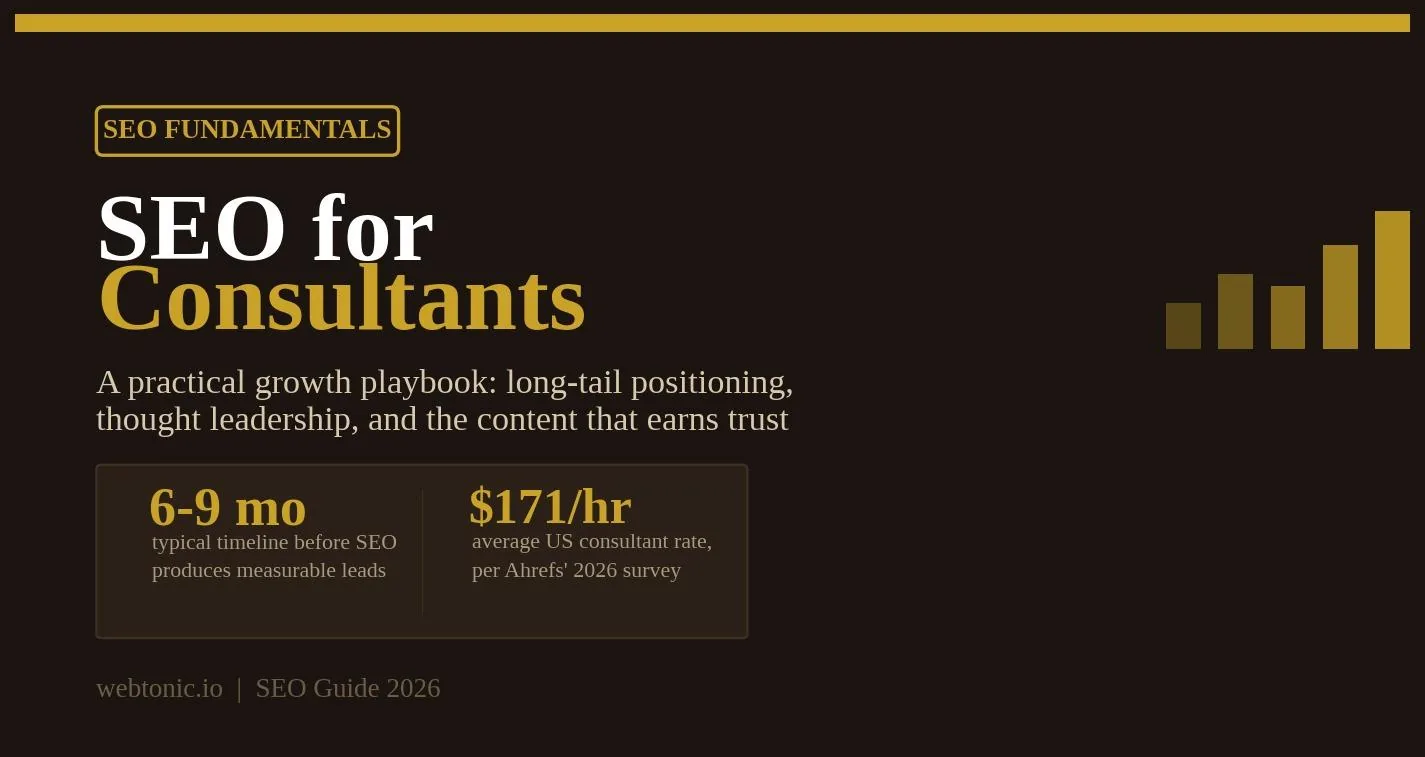
Most established consultants don't have an expertise problem. They have a visibility problem. The case studies are real, the methodology works, and the results speak for themselves, but the business consulting clients who need exactly that expertise are finding a cheaper generalist instead, or not finding the consultant at all. SEO for consultants is not the same discipline as SEO for an ecommerce store or a local business, because a consultant isn't selling a product page. A consultant is selling judgment, and search engines have to be convinced of that before a prospect ever picks up the phone.
This guide covers what actually works: why chasing generic keywords is a losing strategy for most consulting practices, how thought leadership content functions as a search engine optimization strategy rather than just a branding exercise, a realistic timeline for when SEO starts producing leads, and what consultants typically pay when they hire this work out instead of doing it themselves. Whether you run a solo practice or lead a small consulting firm competing against larger marketing agencies and full-service digital marketing shops, the underlying seo strategies are the same: match content to real business goals, and let organic traffic do the work, referrals and outreach can't scale to match.
Key Takeaways
- The head term "consultants" pulls enormous search volume but ranks Wikipedia, Cambridge Dictionary, and Merriam-Webster on page one; competing there means fighting content that will never convert into a client.
- Long-tail queries that combine a specialty with a location, like "healthcare operations consultant Chicago," face far less competition and match how buyers with real budgets actually search.
- Thought leadership content, built around named experts rather than a generic "editorial team" byline, is increasingly what both search engines and AI models reward, since first-hand experience is what generic AI-written content cannot fake.
- For a consulting practice, SEO content rarely produces trackable inbound leads before the six-to-nine-month mark of consistent publishing; the real payoff, older content still converting while new content stacks on top of it, tends to show up closer to the year-to-eighteen-month range.
- US freelance SEO consultants themselves charge anywhere from USD 50 to USD 500 per hour depending on experience level, with Ahrefs' 2026 rate survey putting the broader market average closer to USD 72-171 per hour. That's a useful context for consultants pricing their own SEO-adjacent advisory work.
- Case studies with specific, documented results function as both content marketing and E-E-A-T evidence, since search engines and prospective clients both respond to verifiable outcomes over generic claims of expertise.
What makes SEO for consultants different from SEO in general
Most SEO advice assumes a business selling a product or a defined service at scale. A consultant is selling judgment, and the sales cycle is longer, more relationship-driven, and far more dependent on demonstrated expertise than a typical ecommerce funnel. That changes which keywords are worth targeting and what content actually needs to exist. A consultant ranking for a broad, generic search rarely converts that traffic into a client; a consultant ranking for a narrow, specific search is usually looking at someone who already has a budget and a defined problem.
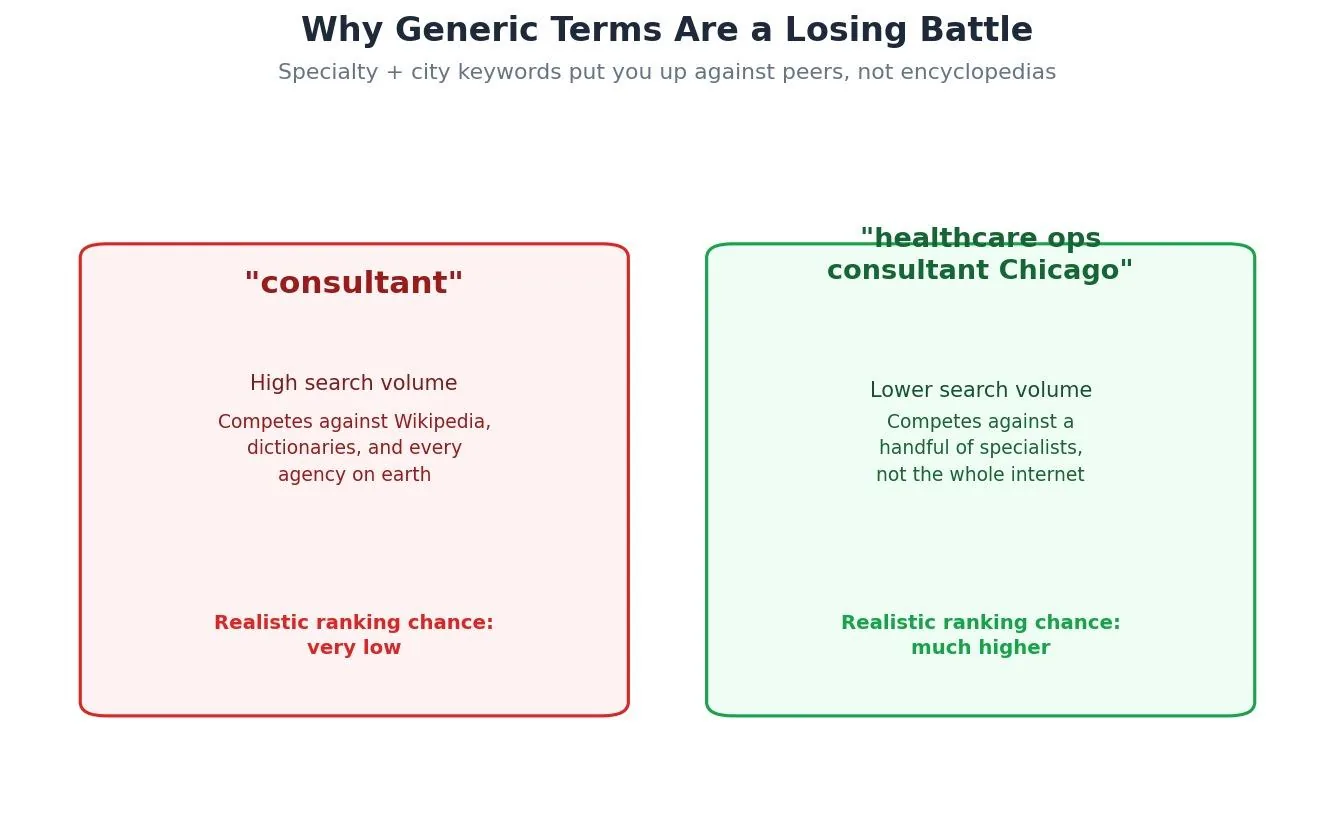
Consider the head term "consultants" on its own: it pulls a large volume of monthly searches, but the actual page-one results are dominated by Wikipedia, dictionary definitions, and generic educational content, not consultants themselves. Competing for that keyword means competing with content that was never going to convert into a client in the first place. The more productive path is long-tail: pairing a specific consulting niche with a location or an industry vertical, such as "change management consultant for healthcare" or "IT strategy consultant in Austin." These searches carry less volume individually, but they match how buyers with an actual, funded problem search, and the competition is a handful of specialists rather than the entire internet.
Thought leadership as a search strategy, not just a branding exercise
For years, the standard B2B content playbook was to publish comprehensive guides under a generic "editorial team" byline and let domain authority do the work. That playbook has weakened considerably now that generative AI can produce a competent generic guide in seconds. What AI cannot fabricate convincingly is first-hand experience: a named consultant's actual case studies, a specific methodology they built, or a documented failure and what they learned from it.
This is why thought leadership content, tied to a real named expert rather than an anonymous corporate voice, functions as a search strategy now, not just brand-building. Consulting firms that get cited by AI answer engines tend to share a pattern: named-expert content, dedicated practice-area pages, and a real presence on high-trust publications, while firms relying purely on conventional SEO tactics rarely show up in that same channel. For a consultant, that means the byline matters, the case studies matter, and publishing under your own name with your own track record attached carries real search value that a faceless company blog post does not.
Content type by funnel stage
| Funnel stage | Content type | Example query | Primary goal |
|---|---|---|---|
| Top of funnel | Educational guides | "how to select a strategy consultant" | Build audience before they know your service exists |
| Middle of funnel | Comparisons, methodology | "best IT consultant for SaaS companies" | Differentiate your approach with case studies |
| Bottom of funnel | Specialty + location pages | "hire change management consultant in Boston" | Convert ready-to-buy, high-intent searches |
The realistic timeline: what to expect and when
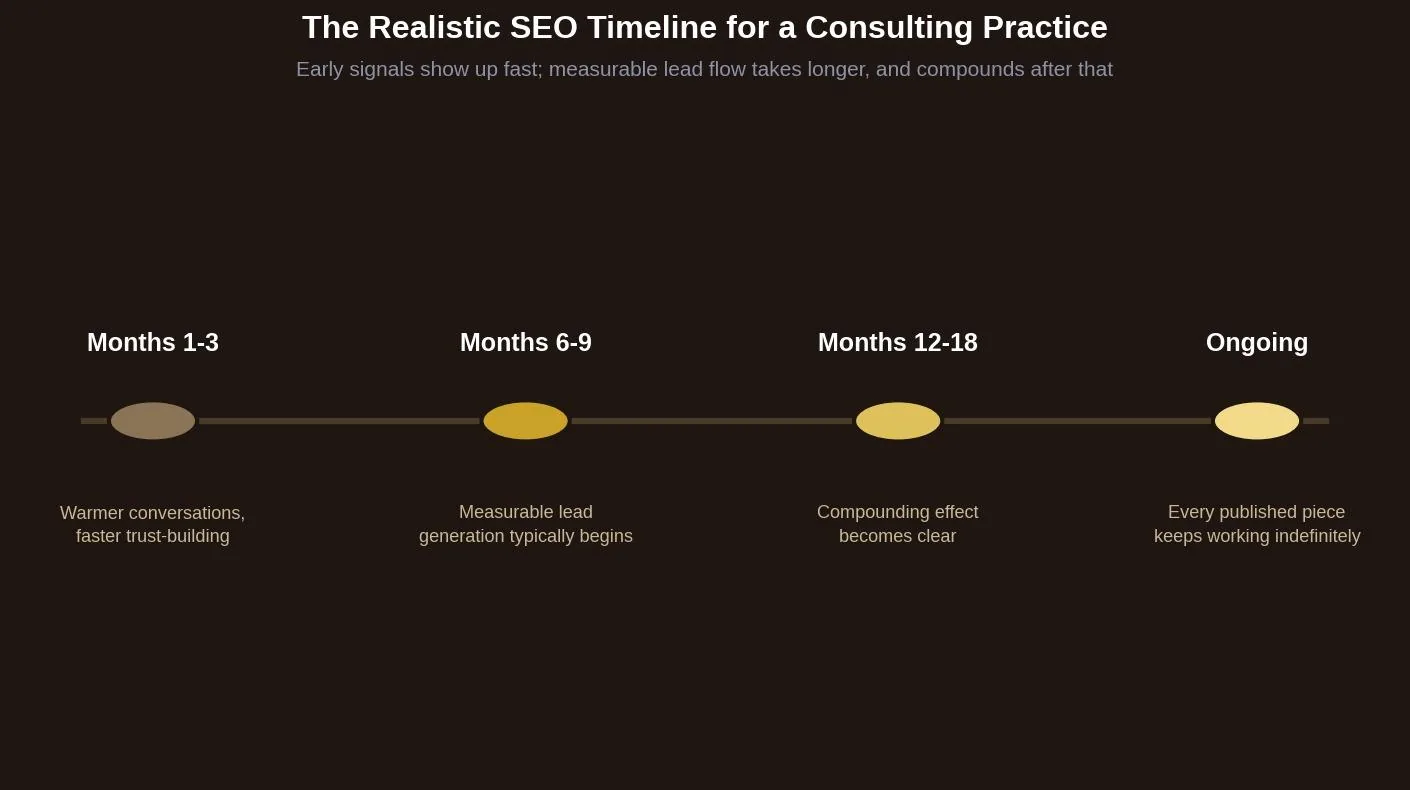
SEO for a consulting practice is a long game, and setting the wrong expectations is one of the most common reasons consultants abandon it too early. Early on, the payoff is hard to put a number on: a prospect mentions they read something you wrote, a first call starts from a position of trust instead of a cold pitch, a referral checks your site and finds exactly the depth they expected. None of that shows up in a lead-tracking spreadsheet. Around the six-to-nine-month mark of consistent publishing, that changes: inbound inquiries start arriving that a consultant can actually trace back to a specific piece of content. Push past a year to eighteen months and the math shifts again, since older pieces keep ranking and converting on their own while new ones stack on top, and unlike a paid campaign, none of it switches off the moment you stop spending.
Try it: what should you write next?
Answer one question about where your current prospects are, and get a content type to prioritize.
Content strategy tool
What should you write next?
Pick where most of your current prospects are, and get a content type to prioritize.
Prioritize
Case studies and named expertise: the content that actually differentiates
A consultant's case studies are simultaneously marketing content and evidence of real-world expertise. That's exactly the combination search engines and AI systems have started to reward more heavily. A generic article about "how to improve operational efficiency" can be produced by anyone, including an AI model. A documented account of how a specific engagement reduced costs by a specific amount, with a defined methodology and a named outcome, cannot be faked the same way. This is also where citing real credentials matters: naming certifications, years of specific experience, and publications a consultant has contributed to gives both readers and search engines something concrete to evaluate rather than an unverifiable claim of expertise.
Named SEO practitioners illustrate the same pattern in their own industry. Figures like Rand Fishkin, known for his work co-founding Moz and later SparkToro, or Lily Ray, widely recognized for her analysis of Google's E-E-A-T guidance, built visibility by publishing consistent, substantive, attributable work over years, not by producing generic content under a company name. The same mechanism applies to a consulting practice in any field: sustained, named, specific content compounds into authority in a way anonymous content does not.
What SEO consulting itself typically costs
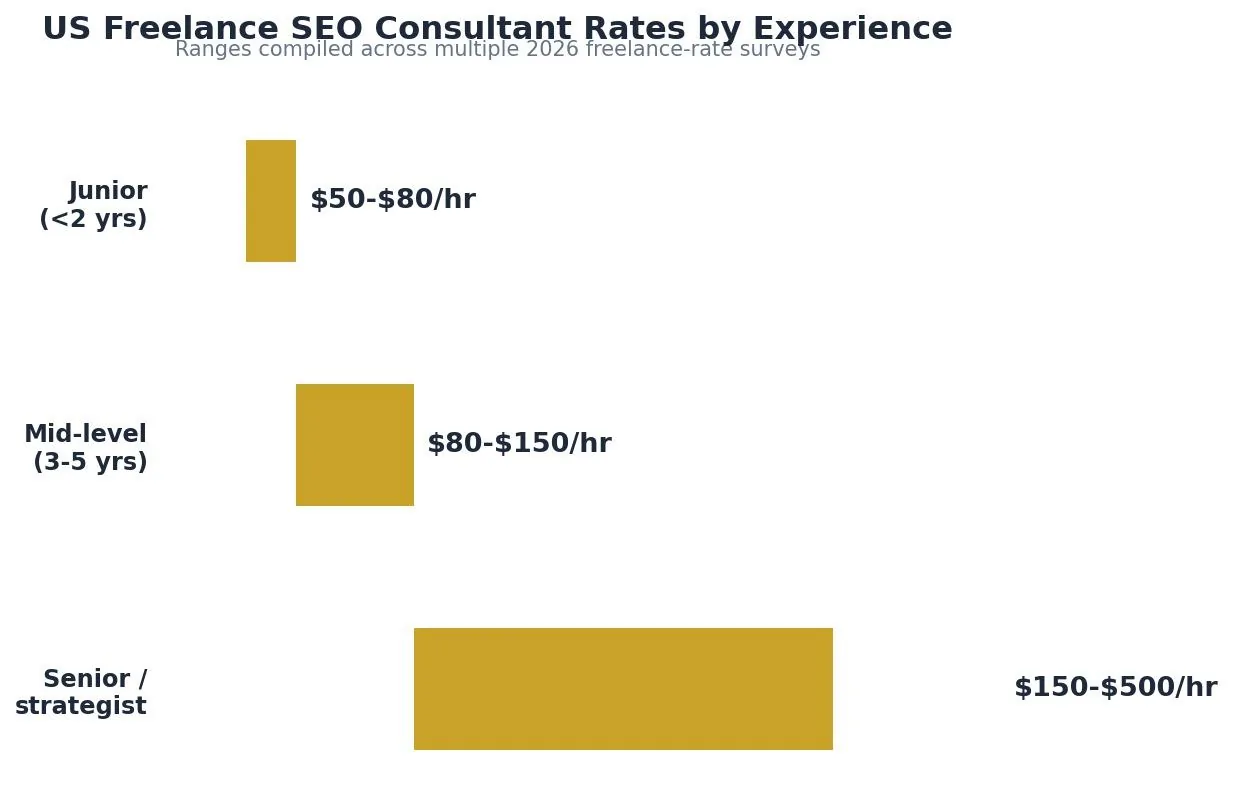
Consultants exploring SEO often end up needing to price their own advisory work in the space, or deciding whether to hire it out instead of doing it themselves. Freelance SEO consultant rates in the US vary widely by experience: junior consultants with under two years of experience typically charge USD 50 to USD 80 per hour, mid-level consultants charge USD 80 to USD 150, and senior strategists command USD 150 to USD 500 or more. Ahrefs' own 2026 rate survey put the average across freelancers, agencies, and consultants at roughly USD 72 to USD 171 per hour depending on the category. Monthly retainers for ongoing work commonly run USD 1,500 to USD 15,000 or more, scaling with scope and competitiveness of the market.
Flagging again per your brief's own instruction: these are third-party market rates, not Web Tonic's pricing — worth a final glance before this goes live under Carl's byline.
Common SEO mistakes consultants make
Writing only about broad, generic topics in the hope of ranking for high-volume terms wastes effort on keywords that rarely convert, since the searchers behind them are rarely ready to hire anyone.
Publishing under a generic company byline instead of a named expert's voice gives up the exact differentiator, verifiable individual expertise, that increasingly matters most for both search visibility and AI citation.
Expecting measurable leads within the first month or two leads many consultants to abandon content efforts right before they would have started working, since real lead flow typically takes several months to materialize.
Publishing without any documented case studies or specific results leaves content generic and unconvincing, indistinguishable from what any competitor, or any AI model, could produce on the same topic.
Tools for SEO-driven consulting growth
Keyword research tools such as Ahrefs or Semrush help identify realistic long-tail specialty and location combinations rather than guessing at generic terms; these tools for seo professionals are worth learning directly rather than outsourcing entirely to an seo agency, since nobody understands a consulting practice's actual differentiation better than the consultant themselves. Google Search Console tracks which queries are actually driving traffic and impressions once content is live, showing which topics resonate before committing more time to similar pieces. A simple content calendar, even a basic spreadsheet, keeps publishing consistent enough for the compounding effect to actually take hold, since sporadic publishing rarely produces the same results as sustained output. For consultants who would rather buy seo services outright than build the skill in-house, that trade-off is reasonable too, as long as expectations about timeline stay realistic and the work still helps business goals rather than just generating generic traffic.
Frequently asked questions
Why doesn't ranking for "consultant" or my broad job title help my business?
That head term carries enormous search volume, but the actual page-one results are dominated by dictionary definitions and generic reference content, not consulting services. The traffic that exists there rarely converts into a client, so competing for it wastes content effort that would perform better aimed at specific, long-tail searches.
How long does SEO take to generate real leads for a consulting practice?
The early payoff is real but hard to quantify: warmer first conversations, faster trust with prospects who've already read your work. Trackable inbound leads tend to arrive closer to the six-to-nine-month mark, and the real acceleration, where a growing back catalog of content keeps converting on its own, tends to show up somewhere between one and one-and-a-half years in.
Should I publish content under my own name or my company's name?
Under your own name, where possible. Named, attributable expertise is what both search engines and AI models increasingly reward over generic corporate content, and it is also what actually builds the personal reputation that shortens a consulting sales cycle.
What should I write about first?
Start with the specific problems your ideal clients are already searching for, paired with your specialty and, if relevant, your location. A quick filter: does the topic connect directly to your services, do you have genuine expertise on it, and can you produce something more specific and useful than what's currently ranking.
How much does it cost to hire someone to do this instead?
US freelance SEO consultant rates typically run USD 50 to USD 500 per hour depending on experience, with monthly retainers commonly falling between USD 1,500 and USD 15,000 or more depending on scope. Rates vary significantly by specialization and region.
Building an SEO strategy that matches how consulting actually sells
SEO for consultants works when it stops imitating ecommerce SEO and starts reflecting how consulting engagements actually get sold: through demonstrated expertise, specific results, and long-tail searches from buyers who already have a defined problem and a budget to solve it. None of the individual pieces — long-tail keyword targeting, named thought leadership, documented case studies — are complicated on their own. What separates the consultants who build a real client-acquisition engine from the ones who give up after three months is simply sustained, attributable publishing long enough for the compounding to show up.
Ready to turn your expertise into a client-acquisition engine?
Positioning a consulting practice for long-tail search, building out thought leadership content under a named expert, and tracking what actually converts is exactly the kind of strategic work that separates consultants who stay busy from those still chasing referrals. Web Tonic's growth marketing team folds this kind of positioning work into a broader content strategy that also covers technical SEO and paid acquisition, so visibility becomes a system rather than a one-off project.
More from Web Tonic: growth marketing services, data & analytics.
Sources: consultingsuccess.com · rankpill.com · neuronwriter.com · 100signals.com · myseoconsult.com · outerboxdesign.com · digitalapplied.com