Table of contents

SEO for plastic surgeons is the work of making one practice the obvious local answer for a small set of high-value procedure searches. The economics are unusually good: a cosmetic surgery patient is worth thousands, while the average search click in the Physicians & Surgeons category costs $4.76.
Key Takeaways
- ASPS members performed 1,585,878 cosmetic surgical procedures and 28,243,407 minimally invasive procedures in 2024 — demand is steady, not shrinking.
- Average surgeon fees run $4,575–$8,000 for breast augmentation and $12,000–$19,000 for a facelift, so one extra case can repay a year of SEO.
- Paid search in Physicians & Surgeons converts at 12.43% at a $40.04 cost per lead — organic and local rankings inherit that same buying intent for free.
- 97% of consumers read reviews and 68% now require a 4-star minimum, which makes reputation a ranking input, not a side project.
- Google still handles roughly 91% of searches, but AI assistants jumped to 45% as a local recommendation source — plastic surgery content now has two audiences.
- The winning structure is boring and repeatable: one page per procedure, one page per city you actually serve, and a Google Business Profile treated like a second website.
Why plastic surgery SEO behaves differently from other local SEO
Most local service businesses fight over one or two keyword clusters. A plastic surgery practice sells fifteen to forty distinct procedures, each with its own search demand, its own price point, and its own competitive field. That fragmentation is the opportunity: the practice that builds a real page for each procedure it performs collects dozens of small rankings that a general "cosmetic surgery" page can never earn.
The second difference is scrutiny. Plastic surgery sits squarely in the territory Google's own guidance calls content where quality and trust matter most, and its helpful content guidance is explicit that experience and expertise must be visible on the page. A surgeon's board certification, case volume, and named authorship are not decoration — they are the difference between a page that ranks and a page that reads like it was outsourced.
Third, the market is measurable. The American Society of Plastic Surgeons statistics release publishes procedure counts, fee ranges, and regional distribution every year. Very few local industries hand you that much demand data for free, and it should drive which pages you build first.
What the demand data says you should build first
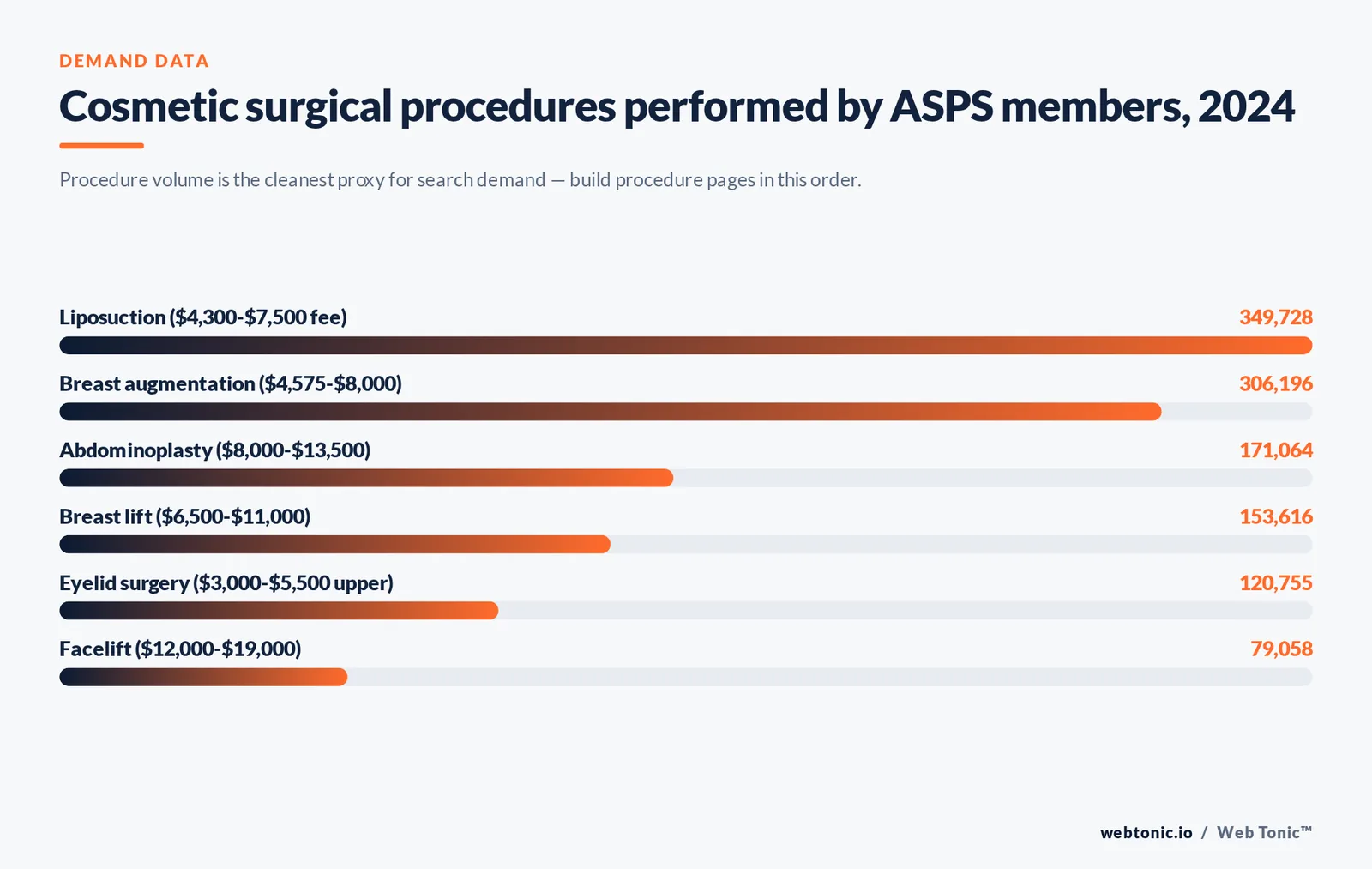
Procedure volume is the cleanest proxy for search demand. Liposuction, breast augmentation, and abdominoplasty dominate the surgical side, while neuromodulator injections dwarf everything on the minimally invasive side. Build pages in that order.
| Procedure | 2024 procedures (ASPS members) | Average surgeon fee | Page priority |
|---|---|---|---|
| Neuromodulator injections (Botox, Dysport, Xeomin) | 9,883,711 | Not published by ASPS | Build first — highest volume, lowest cost objection |
| Liposuction | 349,728 | $4,300–$7,500 | Build first — top surgical procedure |
| Breast augmentation | 306,196 | $4,575–$8,000 | Build first — highest commercial intent |
| Abdominoplasty (tummy tuck) | 171,064 | $8,000–$13,500 | Build second — pairs with post-weight-loss content |
| Breast lift (mastopexy) | 153,616 | $6,500–$11,000 | Build second |
| Eyelid surgery (blepharoplasty) | 120,755 | $3,000–$5,500 (upper) | Build second — strong 55+ demand |
| Facelift (rhytidectomy) | 79,058 | $12,000–$19,000 | Build third — highest revenue per case |
| Breast reduction | 76,734 | $7,000–$12,500 | Build third — often insurance-adjacent |
| Nose reshaping (rhinoplasty) | 48,423 | $7,500–$12,500 | Build third — very competitive in major metros |
| Prescribed weight-loss medication support | 837,485 | Varies by protocol | Build now — newest search demand, thinnest competition |
Rule 1 — a procedure you perform fewer than 10 times a year does not need a 2,000-word page. It needs a paragraph on a parent page and an honest internal link.
Regional competition: where plastic surgery search is hardest
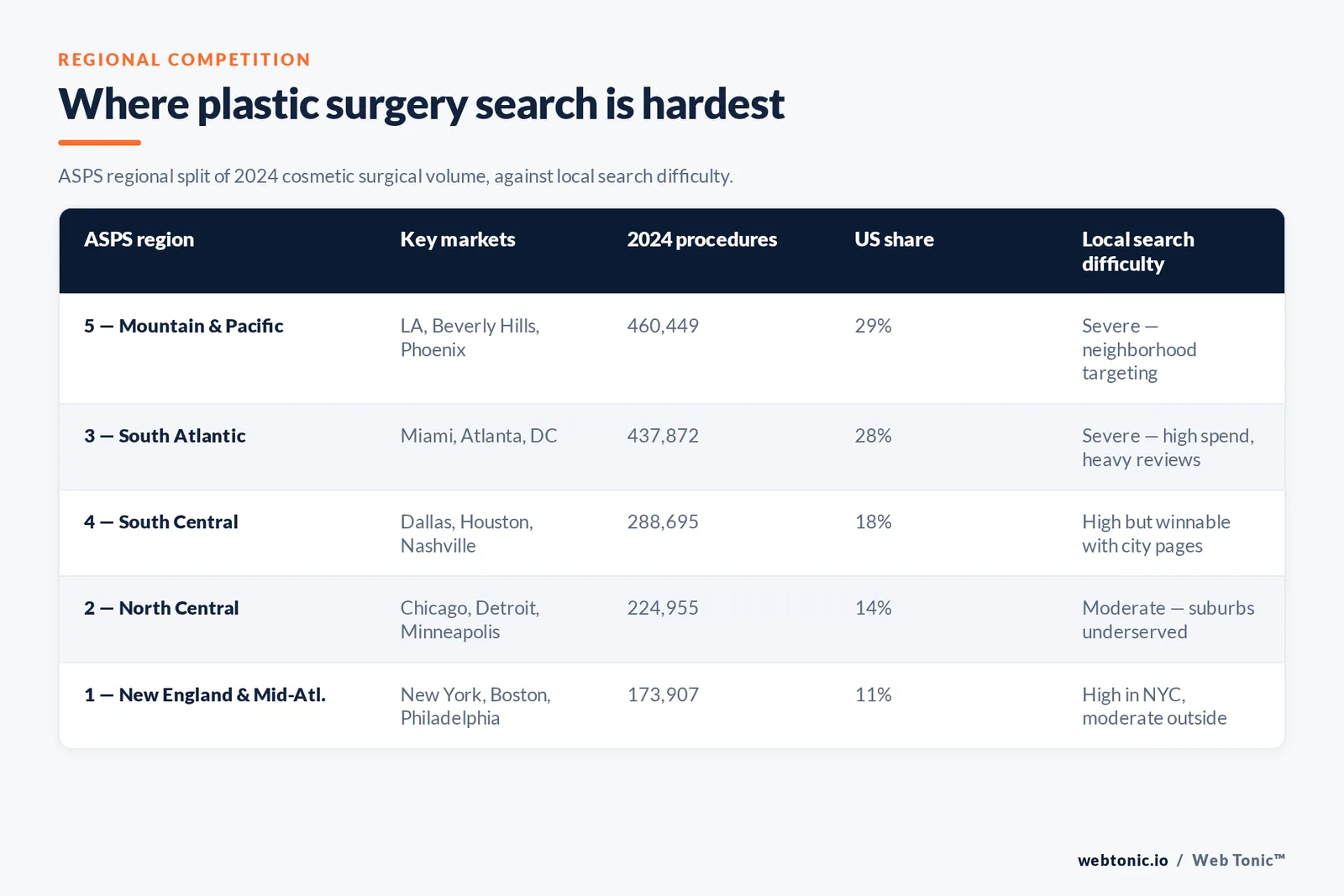
ASPS splits the country into five regions, and the split is lopsided. The Pacific and South Atlantic regions — home to Los Angeles, Beverly Hills, and Miami — absorb the majority of cosmetic surgery volume, which is also where local search competition is fiercest.
| ASPS region | Key markets | 2024 cosmetic surgical procedures | Share of US total | Local search difficulty |
|---|---|---|---|---|
| Region 5 — Mountain & Pacific | Los Angeles, Beverly Hills, Phoenix, Seattle | 460,449 | 29% | Severe — neighborhood-level targeting required |
| Region 3 — South Atlantic | Miami, Atlanta, Washington DC, Charlotte | 437,872 | 28% | Severe — high ad spend, heavy review competition |
| Region 4 — South Central | Dallas, Houston, Nashville, New Orleans | 288,695 | 18% | High but winnable with city pages |
| Region 2 — North Central | Chicago, Detroit, Minneapolis, Columbus | 224,955 | 14% | Moderate — suburban keywords underserved |
| Region 1 — New England & Mid-Atlantic | New York, Boston, Philadelphia | 173,907 | 11% | High in NYC, moderate outside it |
If your practice sits in Region 5 or Region 3, city-level keywords like "plastic surgeon Los Angeles" are effectively locked by established practices with a decade of reviews. Target the layer below: neighborhood plus procedure. Limit 1: only build a location page for a place where you can point to a real address, real staff, or a documented service area — anything else is a thin page waiting to be filtered out.
Keyword strategy: four intents, four page types
The mistake practices make is writing for one keyword per procedure. Real search demand splits into four intents, and each one wants a different page. Use Google Keyword Planner to size each cluster before writing anything.
| Search intent | Example target keywords | Page type that wins | Primary conversion |
|---|---|---|---|
| Transactional local | plastic surgeon near me, tummy tuck Miami | Procedure + city landing page | Consultation booking |
| Commercial research | breast augmentation cost, best rhinoplasty surgeon | Cost and surgeon-selection guide | Pricing guide download, quiz |
| Procedural informational | liposuction recovery time, is a facelift painful | Long-form clinical explainer | Email capture, retargeting pool |
| Brand and reputation | [surgeon name] reviews, [practice] before and after | Surgeon bio + results gallery | Direct call |
Rule 2 — every procedure page should internally link to its own cost page, its own recovery page, and the surgeon bio. Three links, always the same pattern, built once as a template.
The procedure page template that actually converts
A high-performing plastic surgery procedure page is not an essay. It is a stack of answers in the order patients ask them, with the booking option repeated at every scroll depth.
| Section | Purpose | Target length | Trust signal to include |
|---|---|---|---|
| 1. Answer-first summary | Define the procedure and who it suits | 60–90 words | Named board-certified author |
| 2. Candidacy checklist | Let the patient self-qualify | 6–8 bullets | Clear exclusion criteria |
| 3. Technique options | Show surgical judgement, not a menu | 300–450 words | Your own case volume |
| 4. Cost and financing | Remove the biggest objection | 150–250 words | Cite the ASPS fee range |
| 5. Recovery timeline | Answer the highest-volume follow-up query | Day-by-day table | Realistic downtime, not marketing downtime |
| 6. Before-and-after results | Proof | 6–12 cases | Consent statement and unretouched images |
| 7. Risks and complications | Demonstrate honesty; wins trust and rankings | 200–300 words | Link to patient safety resources |
| 8. FAQ block | Capture long-tail and AI answers | 5–8 Q&As | FAQPage structured data |
Limit 2: one call to action per screen, and it should be the same one. Practices that offer a call, a form, a chat widget, and a quiz on the same page convert worse than practices that ask for one thing.
Local SEO: your Google Business Profile is the second website
For "near me" and city searches, the map pack usually sits above the organic results, which means the profile — not the website — is the first impression. Google's Business Profile guidelines and its category guidance define what you are allowed to do; most practices use less than half of it.
| Profile element | What most practices do | What ranks better | Review cadence |
|---|---|---|---|
| Primary category | "Doctor" or "Medical clinic" | "Plastic surgeon", with secondary categories per specialty | Once, then verify quarterly |
| Services list | Empty or 3 entries | Every procedure you perform, named as patients name it | Quarterly |
| Name, address, phone number | Inconsistent across directories | Identical NAP on the site, profile and every citation | Twice a year |
| Photos | Stock interiors | Geotagged real facility, team and equipment images | Monthly, 5–10 uploads |
| Products / procedures with prices | Unused | Populated with ranges that match the site | Twice a year |
| Q&A section | Left to strangers | Seeded with 10 real consultation questions | Monthly |
| Posts / updates | Abandoned after launch | Weekly, each linking a procedure page | Weekly |
| Review responses | Only the negative ones | All of them, inside 48 hours | Continuous |
Trap 1 — practices with several surgeons often create one profile per surgeon at the same address without a genuine separate practitioner listing. That is how a healthy Google Maps presence becomes a suspended one.
Reviews are a ranking factor with a shelf life
Review behaviour has hardened. The BrightLocal Local Consumer Review Survey found 97% of consumers read reviews, 68% require at least four stars — up from 55% a year earlier — and 47% will not use a business with fewer than 20 reviews. Most importantly, 74% only value reviews from the last three months.
| Consumer behaviour | Share of consumers | Operational implication for the practice |
|---|---|---|
| Read reviews before choosing a local provider | 97% | Reviews are a pre-consultation asset, not post-sale admin |
| Require a 4-star minimum rating | 68% | A 3.9 average removes you from most shortlists |
| Avoid businesses with under 20 reviews | 47% | Getting from 0 to 20 is the single highest-ROI task |
| Only trust reviews from the last three months | 74% | Aim for 4–8 new reviews every month, forever |
| Visit the website after reading positive reviews | 54% | Profile-to-site handoff must land on a procedure page |
| Use generative AI tools as a local recommendation source | 45% | Structured, quotable content now feeds two channels |
Practically, that means a request built into discharge: the coordinator asks at the two-week follow-up, sends one link, and never incentivises. Third-party health directories such as Healthgrades also surface for surgeon-name searches, so they deserve the same accuracy pass as the Google profile.
Content that earns links without cheapening the brand
Procedure pages convert; editorial content is what earns the links and authority that let those procedure pages rank. Keep it clinical and specific.
| Content type | Example angle | Publishing effort | What it earns |
|---|---|---|---|
| Annual local demand report | "What our city asked about most in 2026" | 1 week | Local press links, brand searches |
| Post-GLP-1 body contouring guide | Sequencing surgery after significant weight loss | 3 days | Newest demand cluster, low competition |
| Recovery day-by-day series | One timeline per procedure | 2 days each | Long-tail traffic, AI answer citations |
| Surgeon-selection checklist | How to verify board certification | 2 days | Trust, high assisted-conversion rate |
| Cost transparency page | What drives price in your market | 2 days | Qualified consultations, fewer no-shows |
| Video consultations explainer | What happens in the first 30 minutes | 1 day plus filming | On-page dwell time, booking lift |
Advertising claims deserve their own compliance pass. The FTC's health products compliance guidance sets the standard for substantiating outcome claims, and testimonial pages are the most common place practices cross it. Professional guidance from the American Medical Association covers the ethics layer on top.
Technical SEO: the short list that moves rankings
Plastic surgery sites carry unusually heavy image galleries, which is why so many fail on speed. Measure with PageSpeed Insights against the thresholds documented in Core Web Vitals.
| Technical item | Target | Why it matters for a surgery site |
|---|---|---|
| Largest Contentful Paint | Under 2.5 seconds | Hero images and galleries are the usual culprit |
| Gallery image weight | Under 200 KB per image, WebP | A 40-image gallery can add 8 MB unmanaged |
| LocalBusiness / MedicalBusiness schema | On every location page | Feeds map and AI answers; see the local business structured data docs |
| Physician schema with credentials | On every surgeon bio | Machine-readable proof of certification |
| Indexable procedure URLs | One clean URL per procedure | Tabbed or modal content often is not indexed |
| Mobile tap targets and click-to-call | Above the fold | Most consultation calls start on a phone |
| Duplicate city pages | Zero near-duplicates | Templated city pages are the top cause of filtered rankings |
Trap 2 — before-and-after galleries built in JavaScript sliders with no crawlable image URLs. The most persuasive asset on the site becomes invisible to search.
Measurement: what to report and what to ignore
Rankings are a diagnostic, not a result. Consultations booked are the result. Set up Google Search Console and Google Analytics before the first page ships so the baseline exists, then judge the programme against paid-search economics: the Physicians & Surgeons benchmarks published by LocaliQ give you the number your organic channel is competing with.
| Metric | Physicians & Surgeons benchmark | All-industry average | How to use it |
|---|---|---|---|
| Average cost per click | $4.76 | $5.42 | Value organic clicks at this rate to price SEO |
| Average click-through rate | 6.61% | 6.64% | Benchmark for title and meta testing |
| Average conversion rate | 12.43% | 8.18% | If your procedure pages convert under 6%, fix the page before buying traffic |
| Average cost per lead | $40.04 | $66.69 | Your organic cost per lead should beat this within 9 months |
| Beauty & Personal Care cost per lead | $39.25 | $66.69 | Relevant comparison for med-spa service lines |
Search engine share matters for where you spend attention: StatCounter puts Google above 91% of global search. Optimising for Google is still optimising for the market — but with AI assistants now cited by 45% of consumers as a local recommendation source, the structured, clearly-attributed content that machines can quote is no longer optional.
Link building and online authority for a plastic surgery website
Rankings for competitive plastic surgery keywords follow authority. A plastic surgery practice website with strong on-page content but no backlinks will lose to a weaker page on a stronger domain almost every time, which is why link building belongs in the plan from month two rather than year two.
| Authority-building tactic | What it produces for a plastic surgery practice | Difficulty | How often |
|---|---|---|---|
| Local citation consistency | Identical name, address and phone number across healthcare directories, which reinforces local search relevance | Low | Audit twice a year |
| Surgeon expert commentary | Editorial backlinks from health and lifestyle media quoting your surgeons by name | Medium | Monthly pitch cycle |
| Original local demand data | Linkable assets journalists cite, building domain authority and brand searches | Medium | Once or twice a year |
| Professional association profiles | High-trust links plus patient referral traffic from surgeon-finder tools | Low | Set up once, verify annually |
| Local sponsorships and community events | Genuinely local backlinks that generic national link building never delivers | Low | Two or three per year |
| Internal linking from editorial to procedure pages | Passes authority to the pages that convert, improving procedure rankings | Low | Every publish |
| Digital PR around reconstructive work | Human-interest coverage that no competitor can replicate | High | Opportunistic |
Rule 3 — buy no links. Cosmetic surgery is a sector where paid link networks are routinely detected, and a manual action on a practice website can cost a year of visibility for a saving of a few thousand dollars.
How to choose a plastic surgery SEO company
Most practices hire an SEO agency rather than build the capability in-house, and the selection process is where the money is won or lost. A plastic surgery SEO company that cannot name the procedure pages it built, the keywords they rank for, and the consultations they produced is selling reporting, not marketing.
| Question to ask an SEO company | Good answer | Warning sign |
|---|---|---|
| Who writes the clinical content? | Medical writers with surgeon review and named bylines | Unnamed offshore writers or fully automated drafts |
| How many plastic surgery practices do you work with in my market? | One, with an exclusivity clause | Several competitors in the same city |
| What do your monthly SEO services actually include? | Named deliverables: pages, technical fixes, link outreach, review growth | "Ongoing optimization" with no page count |
| How will you report results? | Consultations by procedure, with call tracking and form attribution | Keyword ranking screenshots only |
| Who owns the website, content and Google Business Profile? | The practice, in writing | Agency-owned assets you lose on cancellation |
| What happens in the first 30 days? | Technical audit, profile rebuild, keyword and competitor mapping | Content publishing before any audit |
| How do you handle compliance on before-and-after imagery? | Documented consent workflow and unretouched policy | No answer |
Limit 3: never sign a plastic surgery SEO contract longer than 6 months without a documented 90-day deliverable list. Good agencies will happily show progress against it; the rest need the lock-in.
How plastic surgery SEO compares to other healthcare specialties
Understanding where cosmetic surgery sits relative to neighbouring healthcare verticals helps set expectations with partners and finance teams, because the search economics differ sharply by specialty.
| Healthcare category | Average cost per click | Average conversion rate | Average cost per lead | What it means for organic SEO |
|---|---|---|---|---|
| Physicians & Surgeons | $4.76 | 12.43% | $40.04 | High intent, cheap clicks — organic compounding is very profitable |
| Beauty & Personal Care (med-spa services) | $4.62 | 10.35% | $39.25 | Similar economics; injectables content serves both categories |
| Health & Fitness | $6.17 | 6.94% | $67.36 | Weaker intent; useful only as top-of-funnel content |
| Dentists & Dental Services | $8.00 | 10.67% | $72.97 | The closest comparable local-medical SEO playbook |
| All industries | $5.42 | 8.18% | $66.69 | Plastic surgery outperforms the average on both intent and cost |
The takeaway for any practice weighing digital marketing budget: the cosmetic surgery category converts search traffic at roughly 1.5× the all-industry rate while paying under the all-industry click price. Every organic ranking you win is being valued against those numbers, and a single facelift case at $12,000–$19,000 in surgeon fees outweighs a full year of most practices' SEO investment.
A realistic 90-day plan
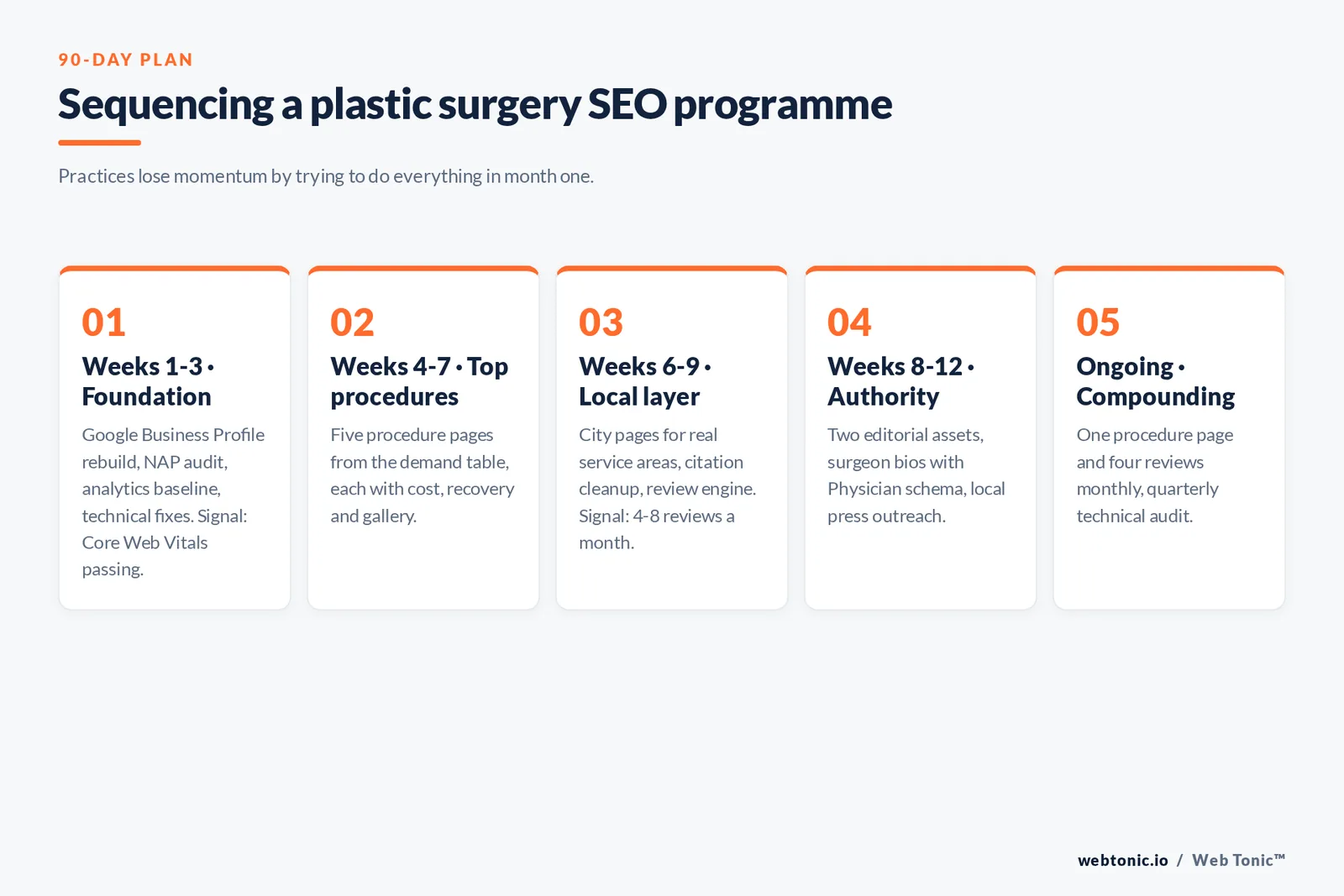
Practices lose momentum by trying to do everything in month one. Sequence it.
| Phase | Weeks | Work | Success signal |
|---|---|---|---|
| Phase 1 — Foundation | 1–3 | Google Business Profile rebuild, NAP audit, Search Console and analytics baseline, technical fixes | Profile 100% complete, all Core Web Vitals passing |
| Phase 2 — Top procedures | 4–7 | Five procedure pages from the demand table, each with cost, recovery and gallery | Impressions rising on procedure keywords |
| Phase 3 — Local layer | 6–9 | City or neighbourhood pages for real service areas, citation cleanup, review engine | Map pack visibility for 3+ terms, 4–8 reviews per month |
| Phase 4 — Authority | 8–12 | Two editorial assets, surgeon bios with schema, local press outreach | First earned links, branded search growth |
| Phase 5 — Compounding | Ongoing | One procedure page and four reviews per month, quarterly technical audit | Organic consultations exceeding paid volume |
Six mistakes that cost plastic surgery practices rankings
| Mistake | Why it happens | Fix |
|---|---|---|
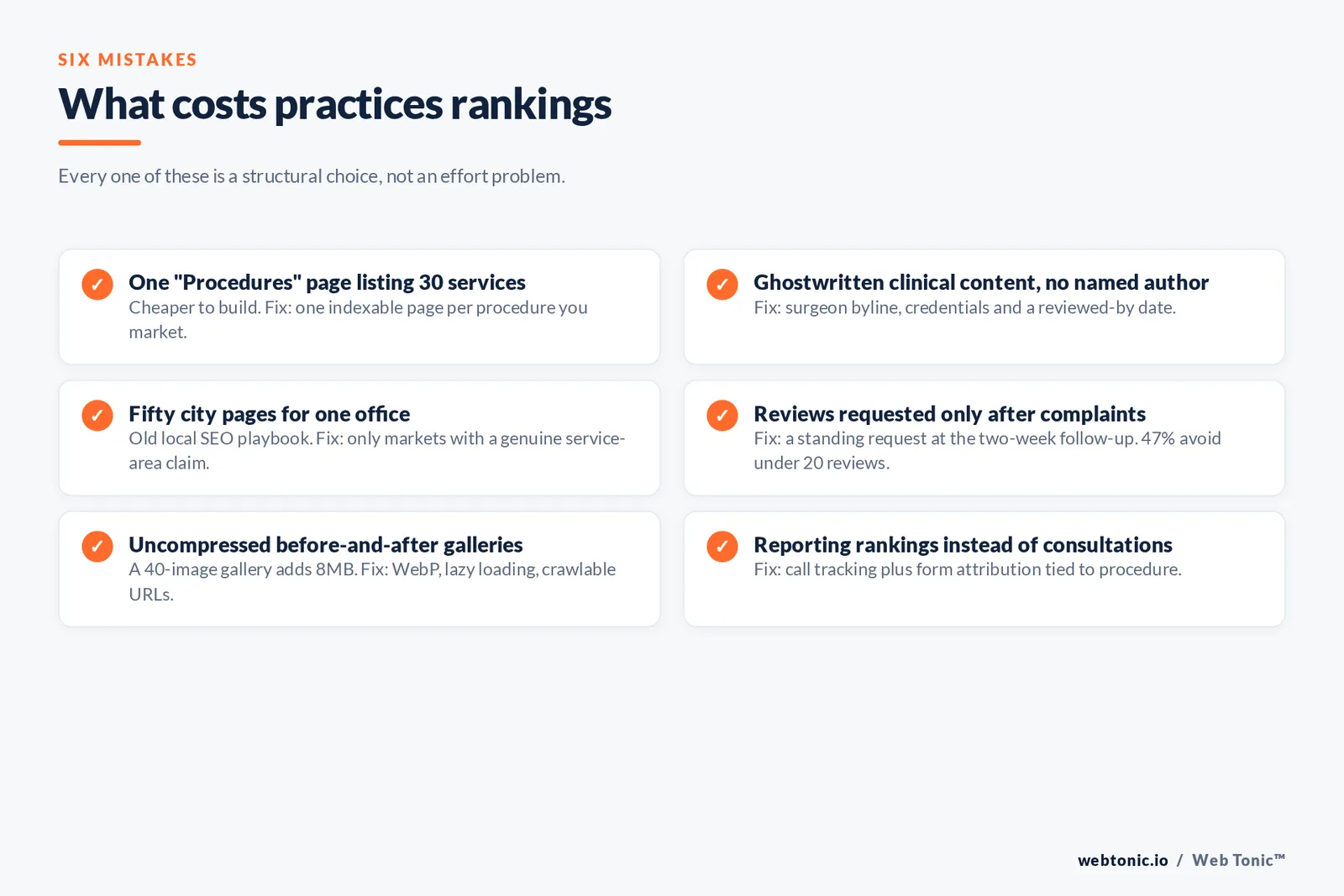
| One "Procedures" page listing 30 services | Cheaper to build | One indexable page per procedure you actually market |
| Ghostwritten clinical content with no named author | Outsourced content mill | Surgeon byline, credentials, and a reviewed-by date |
| Fifty city pages for one office | Old local SEO playbook | Only markets with a genuine service-area claim |
| Reviews requested only after complaints | No process | Standing request at the two-week follow-up |
| Uncompressed before-and-after galleries | Clinical photography workflow | WebP conversion, lazy loading, crawlable URLs |
| Reporting rankings instead of consultations | Agency habit | Call tracking plus form attribution tied to procedure |
If you want this run as a programme rather than a project, our growth marketing and data intelligence teams build exactly this stack for regulated local practices; the full service list shows where SEO sits alongside creative and web. Booking a scoping call through contact is the fastest way to get a market-specific plan.
FAQ
How long does SEO take to work for a plastic surgery practice?
Expect map pack and long-tail movement in 60 to 90 days, and competitive procedure keywords in six to twelve months. The variable is not effort but market: in Region 5 metros like Los Angeles the incumbent practices hold years of reviews and links, so the first wins come from neighbourhood and procedure-specific terms rather than city-level head terms.
Is SEO or Google Ads better for a plastic surgery practice?
Run both, but for different jobs. Paid search buys immediate volume at a benchmark $40.04 cost per lead in the Physicians and Surgeons category, while SEO compounds and eventually undercuts that number. The practical split is ads on your three highest-margin procedures while organic builds the procedure library underneath.
How many reviews does a plastic surgeon need?
Twenty is the credibility floor, since 47% of consumers avoid businesses with fewer. Beyond that, recency beats volume: 74% of consumers only value reviews from the last three months, so a practice with 60 reviews and four new ones each month outperforms a practice with 300 reviews that stopped collecting two years ago.
Do I need separate pages for each city I serve?
Only where you can support the claim with an address, staff, or a documented service area. Templated city pages that differ by one place name are the most common cause of filtered or ignored local content. Two strong location pages beat twenty thin ones, and each should carry unique local detail, directions, and its own reviews.
What should a plastic surgery practice measure to know SEO is working?
Track four things: consultation requests attributed to organic and map traffic, procedure-level page conversion rate against the 12.43% paid benchmark, map pack visibility for your priority terms, and new review velocity. Rankings and sessions are useful diagnostics but should never be the headline number in a monthly report.
Sources: American Society of Plastic Surgeons, 2024 Procedural Statistics Release (procedure counts, average surgeon fees, regional distribution) · LocaliQ, 2026 Search Advertising Benchmarks (CPC, CTR, CVR, CPL by category) · BrightLocal, Local Consumer Review Survey 2026 (review behaviour) · StatCounter Global Stats, Search Engine Market Share · Google Search Central documentation on helpful content and local business structured data · Google Business Profile Help (guidelines and categories) · web.dev, Core Web Vitals · Federal Trade Commission, Health Products Compliance Guidance · American Medical Association · Healthgrades. Figures current as of August 2026.