Table of contents

Two competitors rank on page one for a term your site has never touched. Somewhere in your data, that missing topic is quietly costing you traffic every single day, and no one on the team has noticed because you can't miss what you've never measured. That's the exact problem SEO content gap analysis exists to solve.
SEO content gap analysis is the process of comparing your content against competitors and your audience's actual questions to find topics, keywords, and pain points you haven't covered, or haven't covered well enough to rank. It helps find opportunities hiding in plain sight: keywords competitors rank for that you don't, subtopics your existing content skips, and increasingly, the topics where AI tools like ChatGPT and Gemini cite someone else because your content never gave them anything to cite.
Key Takeaways
- Over 90% of web pages receive zero organic traffic from Google, and a large share of that failure traces back to content gaps, topics that were never covered thoroughly enough to earn a ranking in the first place. That's a different stat from the ChatGPT citation figure below, even though both land close to 90%. (PressFrolic)
- When an AI Overview appears in Google search, clicks to the number one organic result drop by roughly 58%, which means a content gap analysis in 2026 has to account for AI visibility, not just traditional rankings. (Slate)
- Nearly 90% of the webpages ChatGPT cited in one Semrush study sat outside Google's top 20 organic results, proof that ranking well in traditional search doesn't guarantee AI visibility. (Semrush)
- A tool-assisted content gap analysis for a mid-size site typically takes 4 to 8 hours for the analysis step and another 2 to 4 hours to build the content plan, while enterprise-level analysis across multiple stakeholders can take 2 to 3 weeks. (PressFrolic)
- SEO tools like Semrush and Ahrefs list entry-tier plans around $99 a month, but full Content Gap access typically requires a $199-to-$250-a-month plan, while a one-time agency-led content gap audit runs $1,500 to $5,000 depending on site size and depth. (Sight AI, PressFrolic)
- Modern content gap analysis increasingly starts on Reddit and other forums, not just inside SEO tools, since audience interests and pain points often surface there long before they show up as measurable search volume. (BeSky Marketing, ALM Corp)
What Content Gap Analysis Actually Finds
A content gap is any topic, keyword, or question your competitors address that your site doesn't, or doesn't cover well enough to compete. Traditional gap analysis helps find keyword gaps: terms competitors rank for that you don't. Modern content gap analysis goes further, covering four distinct types: keyword gaps, topic gaps, intent gaps, and depth gaps, where a topic exists on your site but doesn't go deep enough to satisfy the search engines or the reader. Every gap you close is a chance to create content a real user actually needed, not content built to satisfy an algorithm; users and search engines tend to reward the same underlying thing, genuine usefulness.
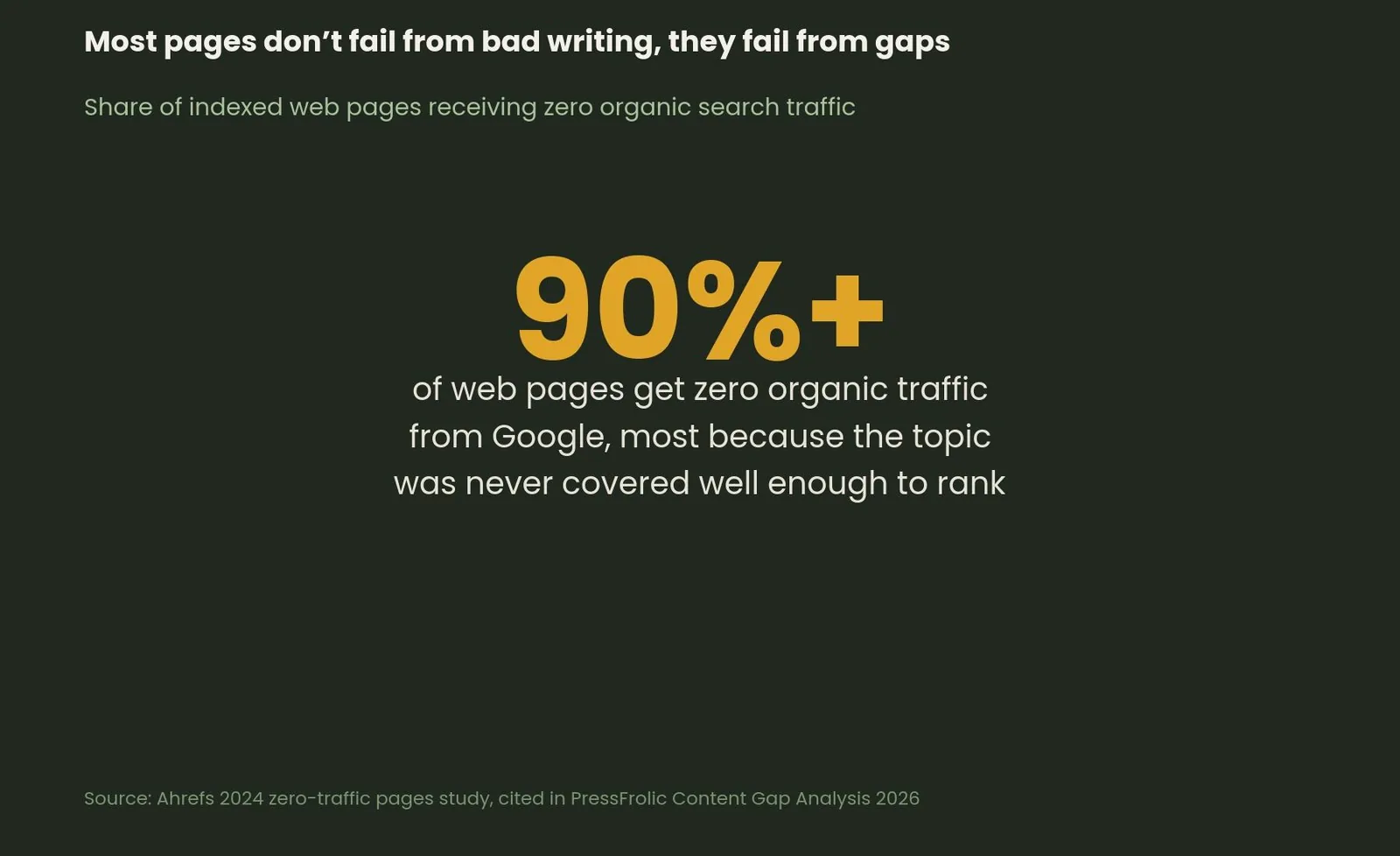
The scale of the problem is larger than most teams assume. Over 90% of web pages receive zero organic traffic from Google, and a large share of that failure traces back to content gaps, topics that were never covered thoroughly enough to earn a ranking in the first place. Google's core updates increasingly reward sites with deep, comprehensive topic coverage, which means a gap in one corner of a topic cluster can quietly hold back rankings across the entire cluster.
How Content Gap Types Compare
| Gap type | What it means | How to spot it |
|---|---|---|
| Keyword gap | Competitors rank for a term you don't target at all | SEO tools like Semrush and Ahrefs, comparing domains directly |
| Topic gap | A whole subtopic within your niche has no coverage on your site | Topic Research tools, competitor content audits |
| Intent gap | You have content, but it doesn't match what the searcher actually wants | Reviewing SERP intent labels against your page's format |
| Depth gap | The topic exists on your site but doesn't cover it thoroughly enough | Manual comparison against top-ranking competitor pages |
The AI Search Visibility Gap
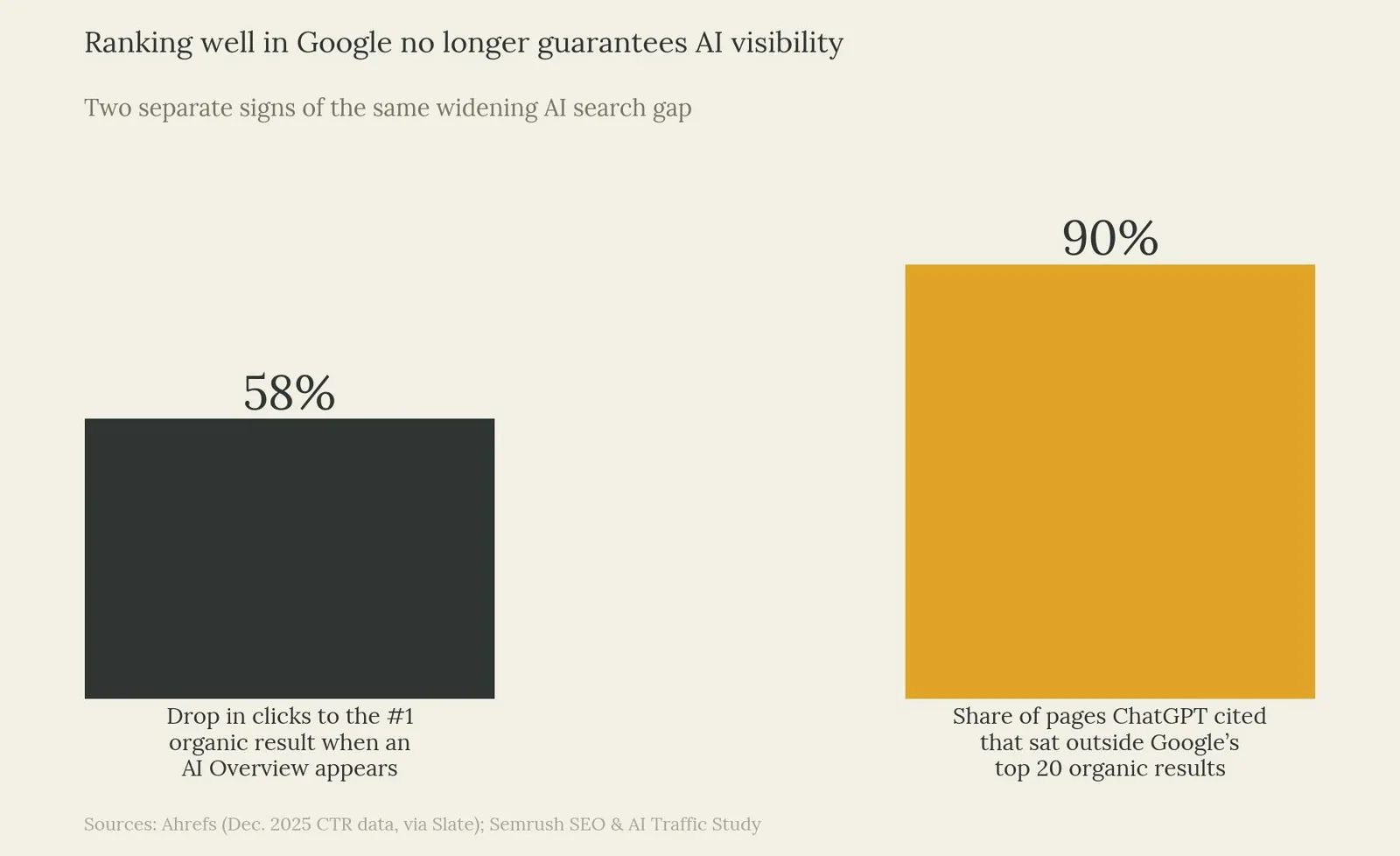
Content gap analysis in 2026 can't stop at traditional rankings. When an AI Overview appears above the organic results for a search, clicks to the number one organic result drop by roughly 58%, a real cost even for pages that already rank well. (Slate) In a separate Semrush study on SEO and AI traffic, nearly 90% of the webpages ChatGPT cited for a set of related queries sat entirely outside Google's top 20 organic results. A page can rank respectably in classic search and still be invisible to a growing share of AI-driven discovery. (Semrush)
This creates a new category worth naming directly: the AI visibility gap, where a competitor gets mentioned by ChatGPT, Gemini, or Perplexity in response to a relevant query and your brand doesn't, regardless of how you rank in classic search. Semrush's LLM Gap Analyzer, launched in April 2026, was built specifically to surface this category of gap, since traditional keyword ranking reports never capture it. (12AM Agency)
Content gap analysis tool
Which content gap should you fill first?
Score one gap at a time on the three factors that actually predict ROI, then compare gaps against each other.
Priority score: 0
How to Run a Content Gap Analysis: Tools and Workflow
A keyword gap analysis usually starts with the Semrush Content Gap tool or Ahrefs' equivalent feature: add your domain and up to four or five competitor domains, run the comparison, and export the resulting keyword list, often as a CSV file, for review. In some cases the tool will return tens of thousands of potential opportunities, so filtering by search intent, volume, and relevance to your actual business matters more than working through the raw list.
Reddit and similar forums deserve a place in the workflow that goes beyond a supplementary check. Audience interests and pain points often surface on Reddit well before they show up as measurable keyword volume in any SEO tool, and a recurring question in a relevant subreddit is a genuine signal, even if a keyword tool shows low or no search volume for it yet. (BeSky Marketing) This kind of research consistently produces stronger content ideas than a keyword export alone — it starts from what people actually ask rather than what a tool has indexed. Building a content strategy this way, one that treats forums as a real input rather than an afterthought, tends to surface a gap. Content built from that gap ends up matching real demand instead of guessing at it. Combining Reddit research with tool-based keyword gap data will help close the loop a purely automated process would otherwise miss. It also captures emerging topics audience research reveals long before search volume data catches up in any keyword tool. (ALM Corp)
Prioritizing and Filling the Gaps You Find
Not every gap deserves the same urgency. Prioritize gaps where search intent aligns with what your product or service actually offers, where the keyword difficulty is realistic given your current authority, and where the traffic potential justifies the production cost. A 200-search-a-month keyword with strong purchase intent is often worth more than a 2,000-search keyword that attracts browsers who were never going to convert. (PressFrolic)
Once a gap is prioritized, map it to a content format, guide, comparison page, FAQ section, or landing page, assign ownership, and set a deadline. This is the step where gap analysis actually converts into content that ranks, rather than sitting in a spreadsheet no one revisits. (Nightwatch)
How Content Gap Analysis Costs Compare
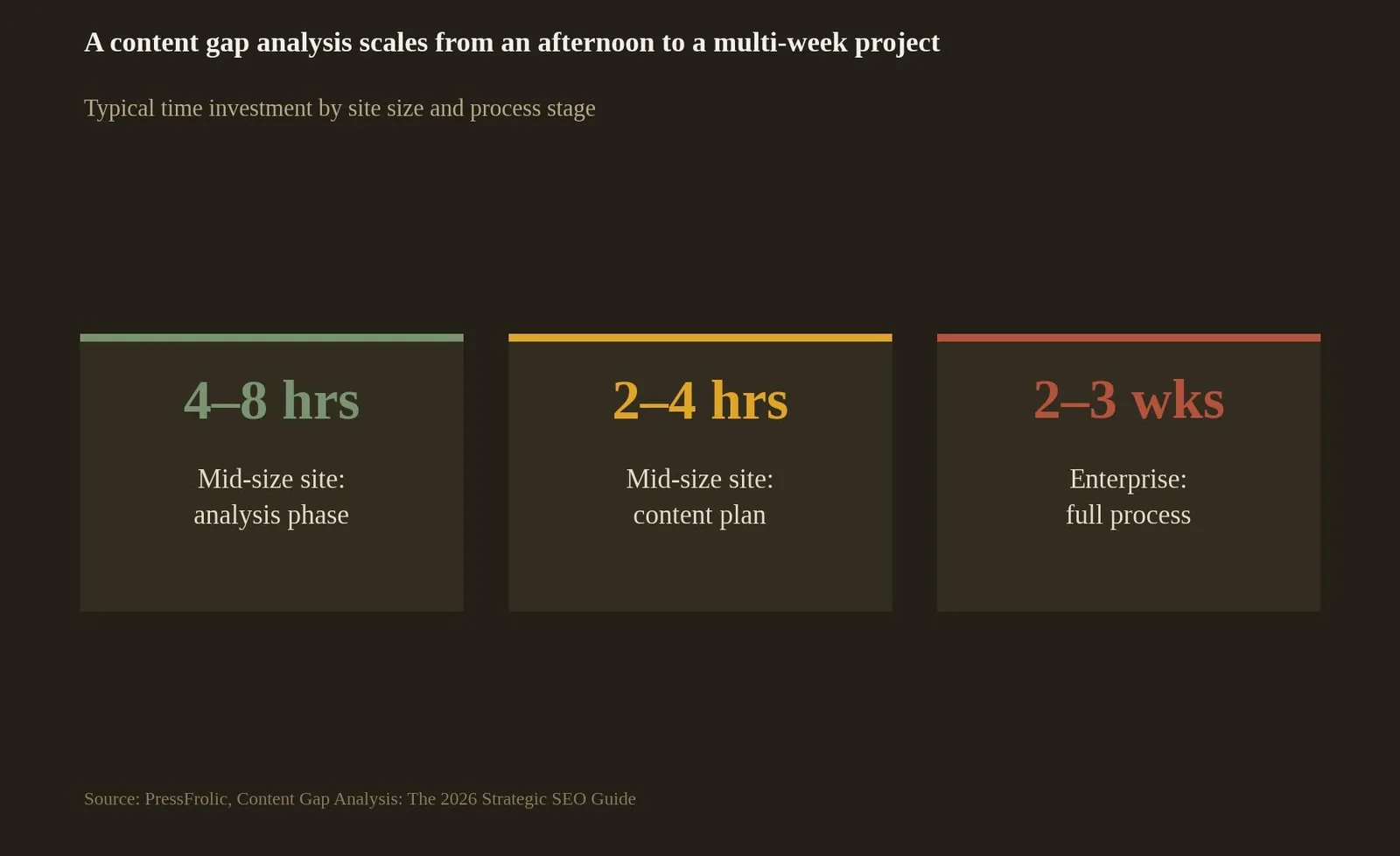
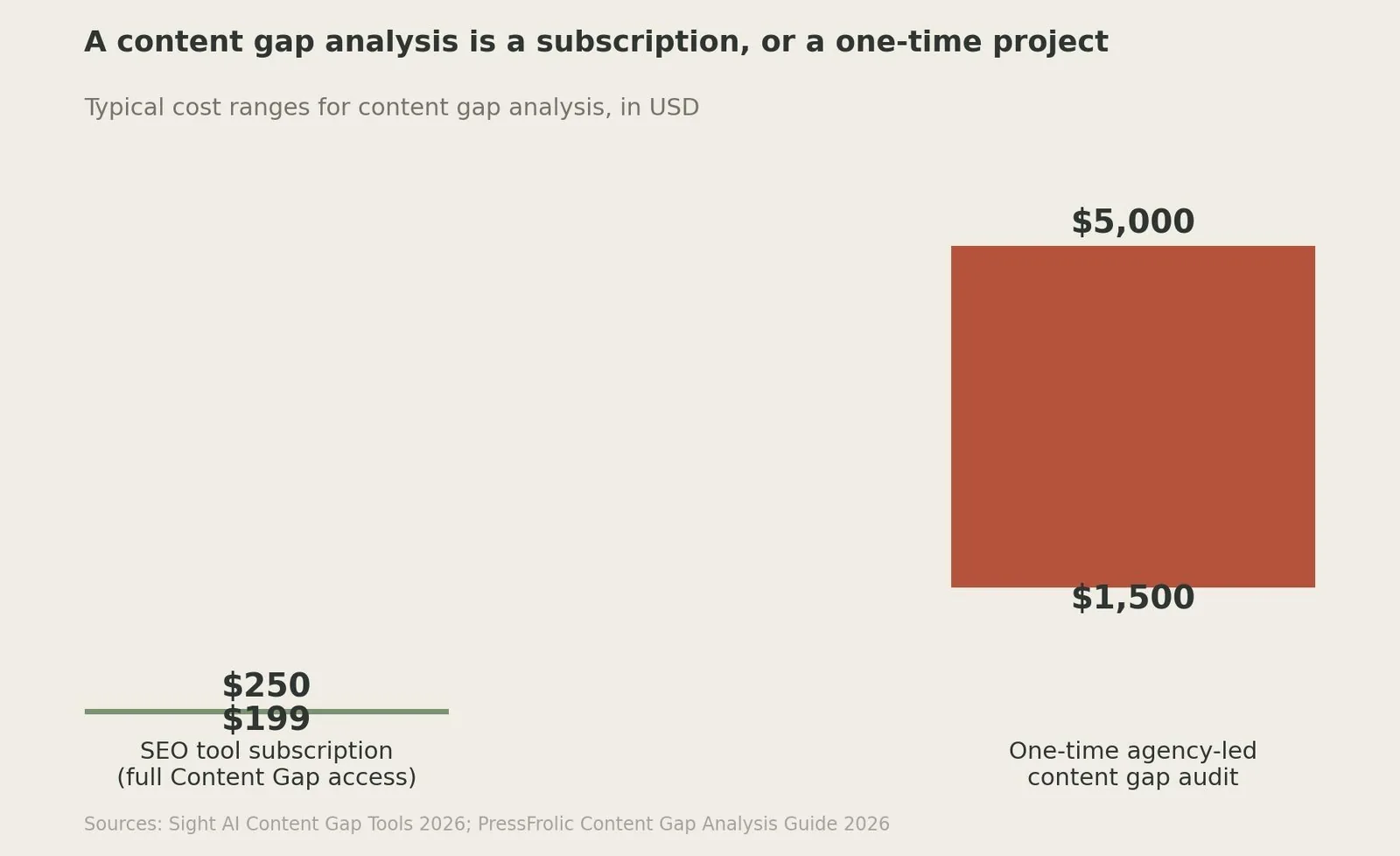
SEO tools like Semrush and Ahrefs list entry-tier plans around $99 a month, but full Content Gap access typically requires a $199-to-$250-a-month plan. (Sight AI) A one-time agency-led content gap audit generally runs $1,500 to $5,000, depending on site size and how deep the deliverable goes, while enterprise platforms built for portfolio-level gap analysis across many properties cost meaningfully more. (PressFrolic) The time investment scales just as widely: a mid-size site's analysis step typically takes 4 to 8 hours, with another 2 to 4 hours to build the content plan, while enterprise-level work involving multiple stakeholders can stretch to 2 to 3 weeks. (PressFrolic)
Common Content Gap Analysis Mistakes
The single most common failure is running the report and freezing there. Exporting a list of 200 keywords feels like progress, but a gap analysis that never turns into an actual content calendar produces nothing measurable.
Not every gap deserves equal urgency, and treating them that way wastes real resources. A gap only pays off when the intent and audience genuinely align with what the business offers.
Search intent gets overlooked more often than it should, which undermines gaps that looked promising on paper. Ranking for a keyword means little if the page format doesn't match what the searcher actually wants, an informational guide won't satisfy someone with clear buying intent, no matter how well-written it is.
A subtler problem is treating traditional rankings as the whole picture. A page can rank well in Google and still sit outside what ChatGPT or Gemini cite for the same topic, and a content gap analysis that only checks classic SERPs will miss that entirely.
Frequently Asked Questions
What's the difference between a content audit and a content gap analysis? A content audit evaluates the quality and performance of content you already have. A content gap analysis identifies what's missing entirely, topics and keywords you haven't covered but should, based on competitor rankings and audience research.
Which tools are best for content gap analysis? Semrush and Ahrefs remain the most widely used platforms for keyword-level and topic-level gap analysis, while Google Search Console is a free option that shows real performance data regardless of budget.
How often should a content gap analysis be run? Quarterly is a reasonable baseline for most sites. Competitive or fast-moving niches benefit from monthly monitoring; new questions and terminology emerge constantly.
Can content gap analysis help with AI search visibility? Yes. AI visibility gaps, where content ranks in traditional search but never gets cited in AI-generated answers, are now a distinct category that tools like Semrush's LLM Gap Analyzer are built specifically to surface.
What's the fastest way to close a content gap? Prioritizing gaps by business fit and realistic difficulty first, then mapping each one to the right content format, guide, comparison, or FAQ, tends to produce results faster than working through a raw keyword export in the order it was exported.
Where to Start With Content Gap Analysis
Content gap analysis rewards a workflow that combines tool-based keyword data with genuine audience research, on Reddit, in forums, and in AI Overviews and citations, not just inside a single SEO platform, since no single source captures every gap on its own.
Start with a keyword gap comparison against two or three real competitors, layer in a quick Reddit search on your core topics, and prioritize whatever surfaces by business fit before committing writing time to any of it.
More from Web Tonic: growth marketing services, data & analytics.
Sources: pressfrolic.com · slatehq.com · semrush.com · trysight.ai · beskymarketing.com · almcorp.com · 12amagency.com · nightwatch.io