Table of contents
SEO content writing is the craft of writing pages that satisfy a specific search intent while giving search engines the signals they need to rank them. This guide covers the process, the keyword and intent work behind it, and how to measure whether it worked.
Key Takeaways
- SEO content writing has 2 jobs in one document: fully answer the query a person typed, and make that answer easy for a search engine to parse.
- Search intent — not keyword density — decides the format. Match the 4 intent types (informational, commercial, transactional, navigational) before writing a word.
- Build one substantial page per topic cluster of 5–15 related queries rather than a thin page per keyword.
- The average blog post in Orbit Media's annual survey runs 1,333 words and takes about 3.5 hours, and only 21% of bloggers report strong results — effort alone is not the differentiator.
- Nielsen's classic reading research found 79% of users scan rather than read, and that concise, scannable copy improved measured usability by 124%.
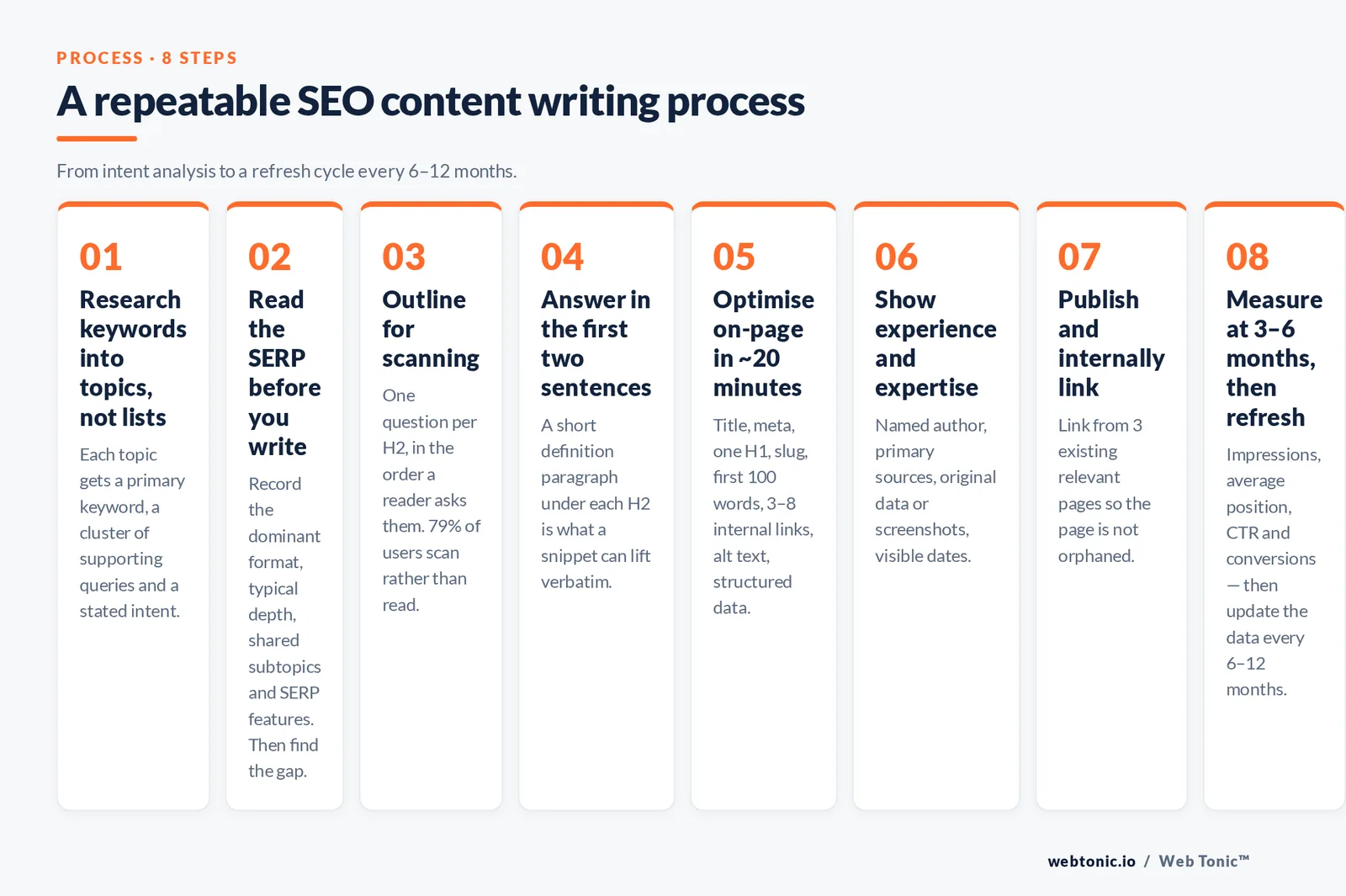
- A repeatable SEO writing process has 8 steps, from intent analysis through to a refresh cycle every 6–12 months.
- Measure success on 4 metrics — impressions, average position, click-through rate and assisted conversions — not on rankings alone.
What is SEO content writing?
SEO content writing is the practice of researching what people search for, then writing and structuring content so it answers that query better than the pages currently ranking. It combines keyword research, search intent analysis, editorial quality and on-page optimisation — titles, headings, internal links and structured data — in a single workflow.
The distinction from general content writing is the input. A copywriter starts from a brief; an SEO content writer starts from demand data — real queries, their volumes, and the pages Google already rewards for them. The distinction from technical SEO is the output: technical work makes a page crawlable and fast, writing makes it worth ranking.
Google's own framing has moved decisively toward the reader. Its helpful content guidance asks whether a page was written for people first, whether it demonstrates first-hand expertise, and whether someone would bookmark or recommend it. The SEO starter guide is blunter still: the biggest wins come from making genuinely useful content, not from optimisation tricks.
SEO writing versus adjacent disciplines
Teams confuse these roles constantly, which is why so many content briefs arrive with the wrong success metric attached.
| Discipline | Starting point | Primary goal | Success metric |
|---|---|---|---|
| SEO content writing | Keyword and intent data | Rank and satisfy the query | Organic impressions, position, conversions |
| Content marketing | Audience and funnel strategy | Build demand and trust | Pipeline influence, engagement |
| Conversion copywriting | Offer and objections | Persuade a visitor to act | Conversion rate |
| Technical SEO | Crawl and index data | Make pages accessible to crawlers | Indexation, Core Web Vitals |
| Digital PR | Newsworthy angle | Earn links and mentions | Referring domains |
| Paid search copy | Ad group keywords | Win the click within a character limit | CTR, cost per acquisition |
They overlap in practice. A strong SEO content writer borrows the conversion writer's discipline about the offer, and the PR writer's instinct for what earns a link. What they cannot borrow is the paid search habit of stuffing the keyword into every line: responsive search ads live inside a 30-character headline limit, as Google's responsive search ad documentation sets out, whereas an article has room to answer properly.
Step 1 — Keyword research that produces topics, not lists
Keyword research fails when it ends as a spreadsheet of 800 terms. The useful output is a set of topics, each with a primary keyword, a cluster of supporting queries, and a stated intent.
Start with the free demand sources. Google Search Console shows the queries your site already gets impressions for — filter for pages at average positions 8–30, because those are near-misses you can win with a rewrite. Autocomplete and the People Also Ask box supply the phrasings real searchers use. Google Trends tells you whether a topic is growing or seasonal.
Then layer paid tools for volume and difficulty. Whatever tool you use, the judgement is the same: prefer specific queries with obvious intent over vague high-volume heads. As long tail keyword research consistently shows, the tail carries most of total search demand and far less competition, which is why a new site should start there.
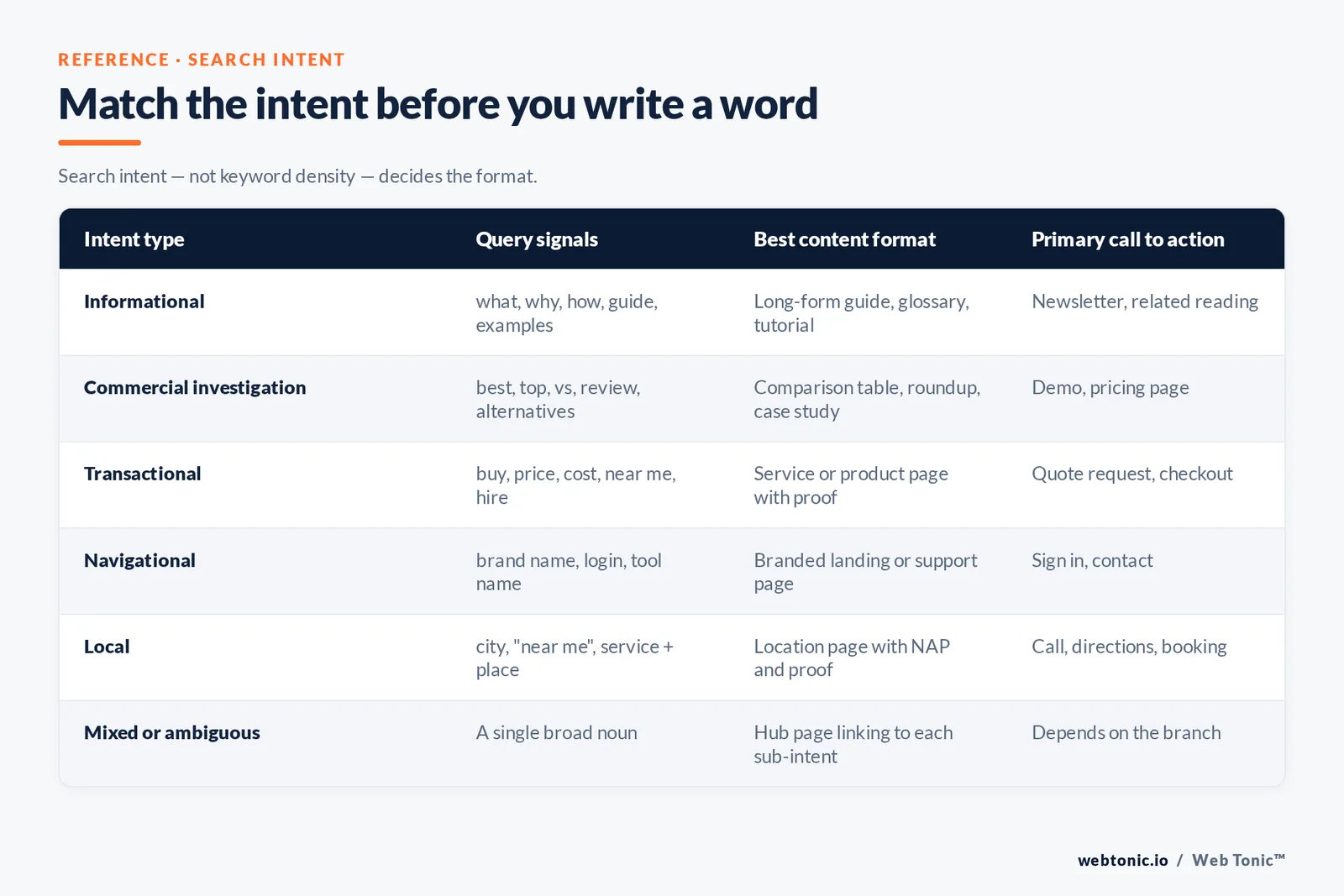
| Intent type | Query signals | Best content format | Primary call to action |
|---|---|---|---|
| Informational | what, why, how, guide, examples | Long-form guide, glossary, tutorial | Newsletter, related reading |
| Commercial investigation | best, top, vs, review, alternatives | Comparison table, roundup, case study | Demo, pricing page |
| Transactional | buy, price, cost, near me, hire | Service or product page with proof | Quote request, checkout |
| Navigational | brand name, login, tool name | Branded landing or support page | Sign in, contact |
| Local | city, "near me", service + place | Location page with NAP and proof | Call, directions, booking |
| Mixed or ambiguous | Single broad noun | Hub page linking to each sub-intent | Depends on the branch |
Step 2 — Read the SERP before you write
The current results page is the clearest brief you will ever get. Open the top ten results and record the dominant format, the typical depth, the subtopics everyone covers, and the SERP features present — People Also Ask, video, a shopping carousel, a map pack. If nine of ten results are comparison tables, a 3,000-word essay will not rank no matter how good it is.
Look for the gap as well as the pattern. Missing original data, outdated figures, no pricing detail, no downloadable template — those are the openings. A page that matches the format and adds one thing nobody else has is the reliable recipe.
Step 3 — Outline for scanning, then write
Write the outline as questions, one per H2, in the order a reader would ask them. Then answer each question in the first two sentences under its heading. This is not a stylistic preference: Nielsen Norman Group's foundational reading study found that 79% of users scan pages rather than read them word by word, and that rewriting a page to be concise and scannable improved measured usability by 124%.
Practical structure rules that follow from that: paragraphs of two to four sentences, one idea each; a table wherever you are comparing more than two things; bolded specifics rather than bolded adjectives; a short definition paragraph directly under the H2 that a snippet could lift verbatim; and an FAQ block for the sub-questions that do not deserve their own section.
On length, be honest about why. Orbit Media's annual blogger survey puts the average post at 1,333 words and about 3.5 hours of work, with roughly 21% of bloggers reporting strong results. Longer posts correlate with better outcomes in that data, but the causal driver is coverage of the topic — length is the symptom, not the treatment.
Step 4 — On-page optimisation without keyword stuffing
Optimisation is mostly a checklist, and it takes about 20 minutes per page once the draft is done.
| Element | Practical rule | Common mistake |
|---|---|---|
| Title tag | Primary keyword near the front, ~50–60 characters, one clear benefit | Keyword repeated twice, brand first |
| Meta description | 120–158 characters, written as ad copy for the click | Left blank or duplicated site-wide |
| H1 | One per page, matching the promise of the title | Multiple H1s or a decorative H1 |
| URL slug | Short, lowercase, hyphenated, keyword-bearing | Dates, IDs and stop words |
| First 100 words | State the answer and use the primary term once | A 200-word throat-clearing intro |
| Subheadings | Question-shaped, covering the cluster's variants | Clever headings that hide the topic |
| Internal links | 3–8 descriptive-anchor links to related pages | "Click here" anchors, orphaned pages |
| Images | Descriptive alt text, compressed, explicit dimensions | Keyword-stuffed alt text |
| Structured data | Article plus FAQPage where genuinely applicable | Marking up content that is not on the page |
| Freshness | Review every 6–12 months and update the data | Changing the date without changing the page |
Two of those deserve extra attention. Titles are rewritten by Google far more often than writers expect, and its title link documentation confirms there is no fixed length limit on the element itself — the display is what truncates. Moz's title tag reference is the practical companion for writing to the visible space. And internal links are the single most under-used lever: they distribute authority, define topical relationships, and cost nothing. Just never rebuild a site-wide linking pattern casually — that is a structural decision, and our data intelligence practice models it before anything ships.
Step 5 — Demonstrate experience and expertise
Quality raters assess whether a page shows genuine experience, expertise, authoritativeness and trust. You cannot fake those signals with a byline, but you can build them deliberately: name the author with real credentials, cite primary sources rather than other blogs, include original data or screenshots from work you actually did, show dates, and state the limits of what you know.
The cheapest credible upgrade is original evidence. One internal benchmark, one anonymised client result, or one small survey lifts a page above the recycled consensus that fills most SERPs. Moz's beginner's guide and Backlinko's on-page reference are useful baselines, but a page that only restates them has no reason to outrank them.
Step 6 — Common SEO writing mistakes
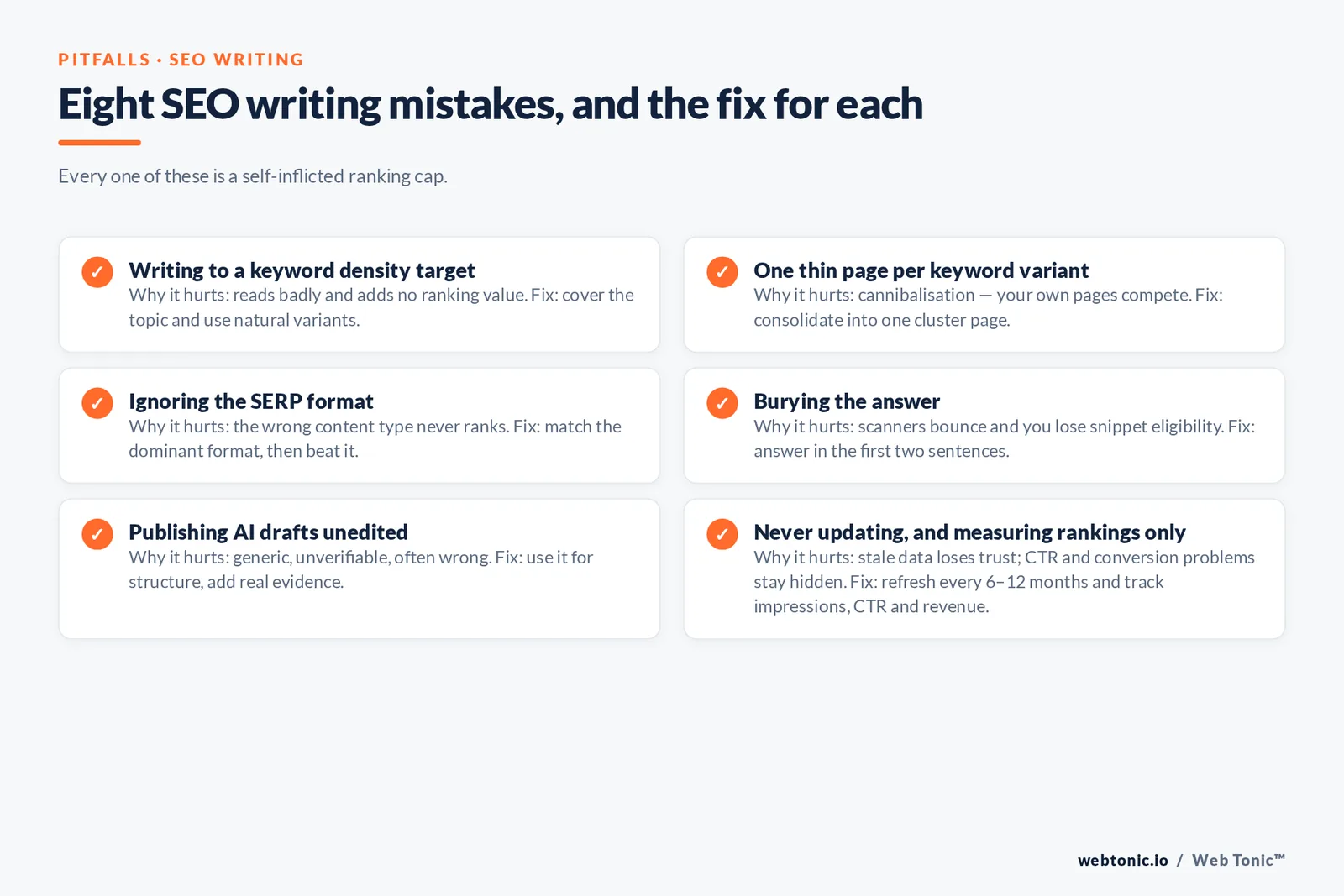
| Mistake | Why it hurts | Fix |
|---|---|---|
| Writing to a keyword density target | Reads badly, adds no ranking value | Cover the topic; use natural variants |
| One thin page per keyword variant | Cannibalisation — your own pages compete | Consolidate into one cluster page |
| Ignoring the SERP format | Wrong content type never ranks | Match the dominant format, then beat it |
| Burying the answer | Scanners bounce; no snippet eligibility | Answer in the first two sentences |
| Publishing AI drafts unedited | Generic, unverifiable, often wrong | Use it for structure; add real evidence |
| No internal links from new posts | Page is orphaned and slow to index | Link from 3 existing relevant pages |
| Never updating | Stale data loses trust and rankings | A refresh cycle every 6–12 months |
| Measuring rankings only | Hides CTR and conversion problems | Track impressions, CTR and revenue too |
Step 7 — Tools worth using
Tooling is a small part of SEO content writing, but the right stack removes guesswork. Search Console is non-negotiable and free; it is the only source of your own query data. Google Trends handles seasonality. A keyword tool supplies volume and difficulty. A writing assistant or semantic scorer checks topical coverage against what ranking pages contain — useful as a checklist, dangerous as a target, because optimising to a score rather than a reader produces exactly the padded prose Google's guidance warns about.
Add a plagiarism and fact-check pass, a readability check, and an image compressor, and the stack is complete. Everything else is workflow. Editorial reference libraries like Content Marketing Institute's articles and Semrush's SEO writing guidance are worth a monthly skim to stay current.
How SEO content writing changes by business type
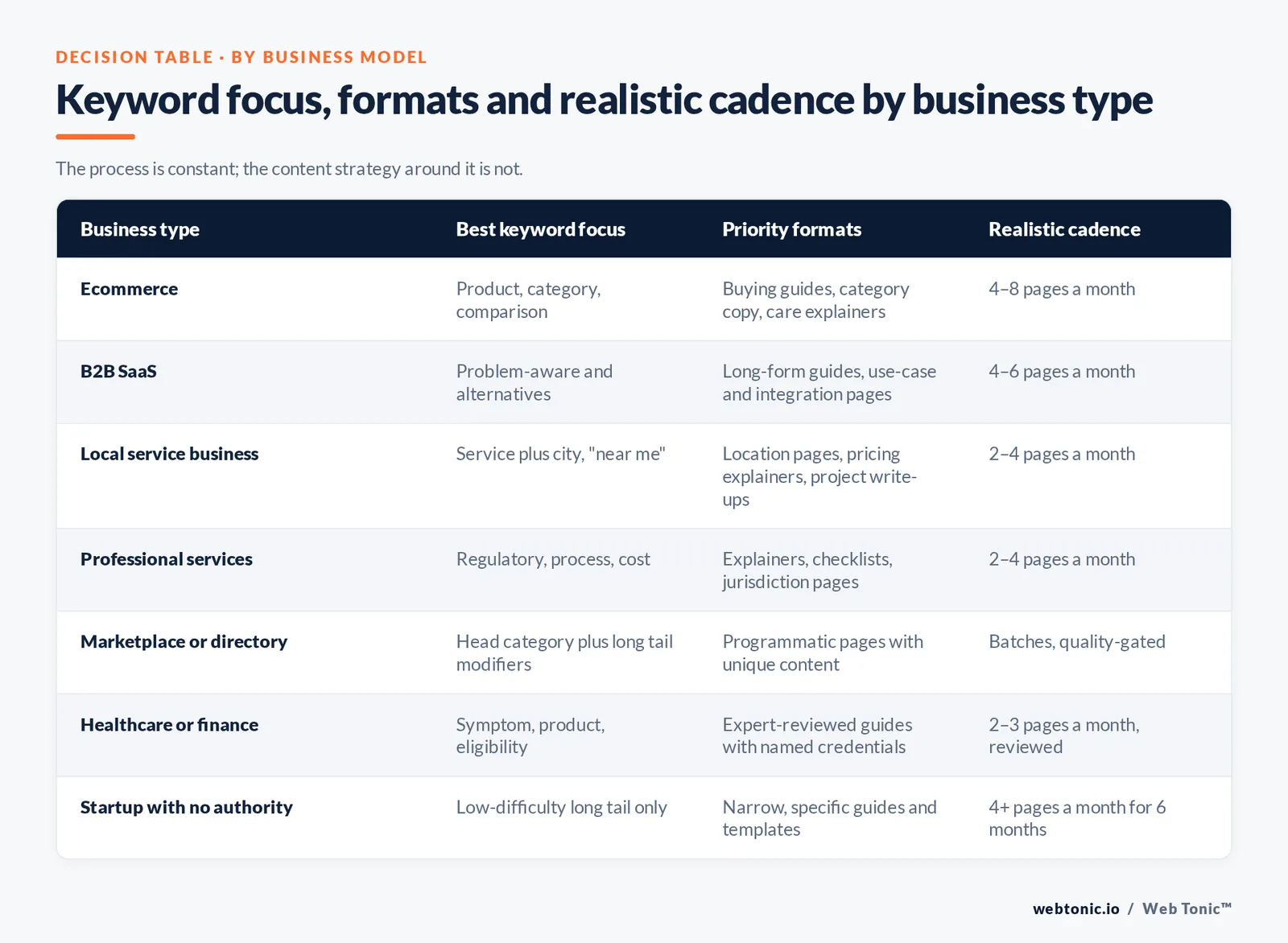
The process is constant; the content strategy around it is not. What a target audience needs from a page depends on how the business sells, so the best keyword mix, page format and publishing cadence differ sharply between an ecommerce catalogue and a B2B software company.
| Business type | Best keyword focus | Priority content formats | Realistic cadence |
|---|---|---|---|
| Ecommerce | Product, category and comparison keywords | Buying guides, category copy, size and care explainers | 4–8 pages a month |
| B2B SaaS | Problem-aware and alternatives keywords | Long-form guides, use-case pages, integration pages | 4–6 pages a month |
| Local service business | Service plus city, "near me" queries | Location pages, pricing explainers, project write-ups | 2–4 pages a month |
| Professional services | Regulatory, process and cost keywords | Explainers, checklists, jurisdiction pages | 2–4 pages a month |
| Marketplace or directory | Head category plus long tail modifiers | Programmatic pages with genuine unique content | Batches, quality-gated |
| Publisher or media | Trending and evergreen informational queries | News, explainers, evergreen hubs | Daily to weekly |
| Healthcare or finance | Symptom, product and eligibility queries | Expert-reviewed guides with named credentials | 2–3 pages a month, reviewed |
| Startup with no authority | Low-difficulty long tail only | Narrow, specific guides and templates | 4+ pages a month for 6 months |
Two rules cut across all of them. First, a new website should not chase head terms: pick the long tail, win it, and let topical authority accumulate before attempting a competitive keyword. Second, regulated industries need a named expert reviewer on every page, because the trust signals search engines look for are exactly the ones a generic freelance draft lacks.
In-house writer, freelancer or SEO content writing services?
The choice is about which parts of the workflow you want to own. Keyword strategy, intent mapping and internal linking are the parts that compound; drafting is the part that scales with money.
| Model | Typical monthly cost | Strengths | Watch out for |
|---|---|---|---|
| In-house content writer | Full salary | Product depth, fast iteration, brand voice | Limited SEO strategy and technical support |
| Freelance SEO content writer | Per-article rates | Flexible volume, subject specialists | No ownership of strategy or measurement |
| Content agency | Retainer | Volume and process | Generic output if briefs are thin |
| Full-service SEO agency | Higher retainer | Strategy, technical work and writing joined up | Cost; insist on reporting to revenue |
| AI-assisted in-house pod | Tools plus one editor | Highest throughput per dollar | Quality collapse without a real editor |
Whichever model you pick, keep the keyword strategy and the internal linking map on your side of the table. Those two assets are what a competitor cannot copy, and they are the reason two businesses publishing identical volumes of content end up with completely different organic traffic a year later. If you want that mapped before you commission a single article, our team can scope it — start a conversation.
Step 8 — Measure what the content did
Give a new page 3–6 months before judging it, then read four numbers together. Impressions tell you whether Google understood the topic. Average position tells you whether you are competitive. Click-through rate at a known position tells you whether the title and description are doing their job — a page at position 5 with a weak CTR is a title problem, not a ranking problem. Conversions, including assisted ones, tell you whether the traffic was the right traffic.
Then act on the pattern. High impressions and low position means the page is too thin for the topic. Good position and low CTR means rewrite the title. Good traffic and no conversions means the intent match was commercial and your page is informational, or the call to action is missing. That diagnostic loop is what turns a blog into a channel, and it is how our growth marketing team runs content programmes; more worked examples live on the Web Tonic blog.
FAQ
What is SEO content writing in simple terms?
It is writing a page that answers a specific search query so well that a search engine has a reason to rank it and a reader has a reason to stay. In practice it means researching the keywords and questions people actually type, checking what the current top results look like, writing a clear and well-structured answer, and optimising the title, headings, internal links and images so the page is easy to interpret.
How many times should a keyword appear in an article?
There is no correct number, and no threshold Google rewards. Use the primary keyword in the title, the H1, the first 100 words, one or two subheadings and the URL, then write naturally and let synonyms and related terms appear where they fit. Repeating a phrase to hit a density figure makes the copy worse and can trip spam signals. Coverage of the topic matters far more than repetition of the term.
How long should an SEO article be?
As long as the topic requires, which the ranking pages will tell you. Orbit Media's survey puts the average blog post at about 1,333 words, but a product comparison may need 800 words and a definitive guide 3,000. Check the depth of the current top ten, cover every subtopic they cover, add something they do not have, and stop. Padding to reach a word count reliably lowers quality.
Which tools help most with SEO content writing?
Google Search Console first, because it is the only free source of your own impression and query data. Google Trends for seasonality and direction. A keyword research tool for volume and difficulty. A semantic or topical coverage checker to confirm you have not missed important subtopics. Use scoring tools as a checklist before publishing, never as the thing you write toward.
Can AI write SEO content?
It can produce structure, outlines and first drafts quickly, and that is a genuine time saving. What it cannot supply is first-hand experience, verified original data, or a point of view a reader could not get from the other nine results. Google evaluates the page, not the method, so AI-assisted content ranks when a human adds evidence, checks every fact and cuts the generic filler — and fails when it is published untouched.
How do I know if my SEO content is working?
Track four things in Search Console and analytics over a three to six month window: impressions, average position, click-through rate and conversions. Rising impressions with a poor position means the page needs more depth. A good position with a poor click-through rate is a title and description problem. Traffic without conversions usually means an intent mismatch between the query and the offer on the page.
Sources
Google Search Central, creating helpful content, SEO starter guide and title link documentation · Google Ads Help, responsive search ads · Google Trends · Nielsen Norman Group, how users read on the web (79% scan, +124% measured usability) · Orbit Media Studios, annual blogger survey (1,333-word average, ~3.5 hours, 21% reporting strong results) · Moz, Beginner's Guide to SEO and title tag reference · Backlinko, on-page SEO guide · Ahrefs, long tail keyword research · Content Marketing Institute · Semrush, SEO writing. All sources accessed August 2026.