Table of contents
Most content that fails to rank isn't badly written. It's written for the wrong question. A beautifully crafted article that answers something nobody searched for, or answers the right question in a way search engines can't parse, loses to a rougher piece on a competitor's website that matches search intent exactly, regardless of how much time went into either one.
Writing SEO content is the skill of closing that gap: giving readers and search engines the same clear, well-structured answer at the same time. This guide walks through the process step by step, from keyword research to publishing, with the real 2026 benchmarks behind each decision.
Key Takeaways
- The average first-page Google result runs about 1,447 words, but length is a byproduct of thoroughness, not a target to hit on its own.
- Content cited in AI Overviews averages just 1,282 words, and 53.4 percent of AI-cited pages are under 1,000 words, meaning padding a draft to hit a word count does nothing for AI visibility.
- Search intent match matters more than keyword density. Content that answers the wrong version of a question won't rank no matter how well-optimized it is.
- Every SEO-friendly article needs the same load-bearing elements: a primary keyword in the title and H1, a direct answer up top, internal links, alt text on images, and a clear CTA.
- Content over 3,000 words earns 77.2 percent more backlinks than content under 1,000 words, which is why pillar pages and short answers serve different goals.
- Tools like Ahrefs, Clearscope, Google Keyword Planner, and Google Trends each solve a different part of the content writing process, research, optimization, or validation, not all three at once.
What Makes Content "SEO Content"?
SEO content is any piece of writing built to satisfy both a reader's search intent and the technical signals search engines use to understand and rank a page. Some people call this discipline SEO writing rather than SEO content writing; it's the same skill either way. That's also the entire premise of search engine optimization as a field: satisfying readers and a search engine well enough to earn durable search engine rankings rather than a one-time spike in traffic.
That dual audience, human and machine, is what trips up most content writing advice. Writing purely for readers can skip signals search engines need to categorize the page correctly. Writing purely for algorithms produces stiff, keyword-stuffed articles that readers bounce from immediately. Effective SEO content does both at once: a primary keyword placed naturally, a structure that's easy to scan, and depth that actually satisfies the question being asked.
Content sits at the center of most digital marketing programs because it keeps working long after a campaign budget runs out, provided it fits into a documented content strategy rather than getting published at random.
Anatomy of an SEO-Optimized Article
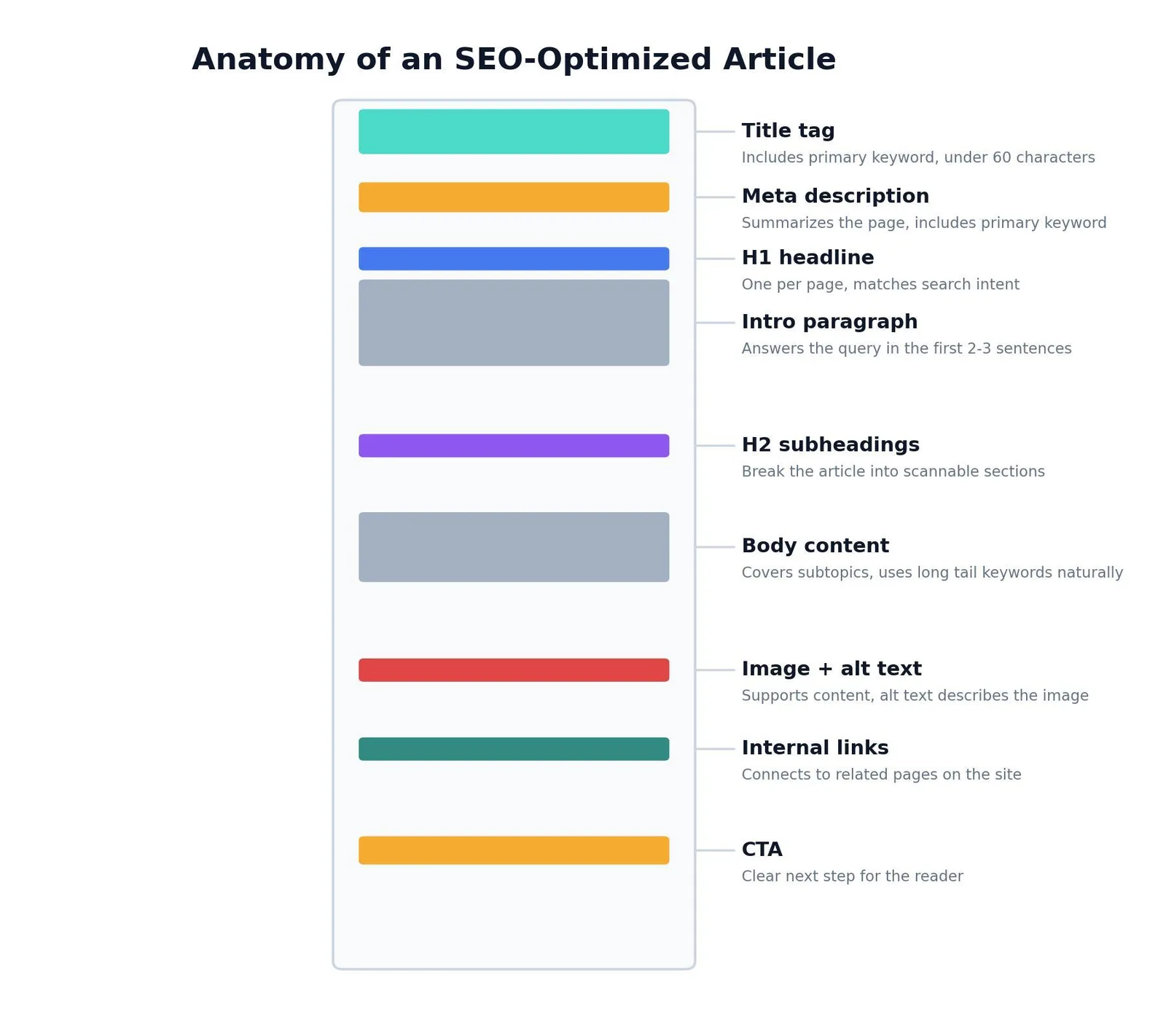
Every piece of ranking content shares the same load-bearing parts. The title tag and meta description are what a searcher sees before they click, so both need the primary keyword and a reason to choose this result over the next one. The H1 matches the page to the query. The intro answers the question immediately, not after three paragraphs of setup. H2 subheadings break the body into scannable sections, each covering one subtopic. Image alt text and internal links aren't decoration, they help search engines understand what the page covers and how it connects to the rest of the site. A CTA at the end gives the reader somewhere to go once they've gotten their answer.
How Long Should SEO Content Actually Be?
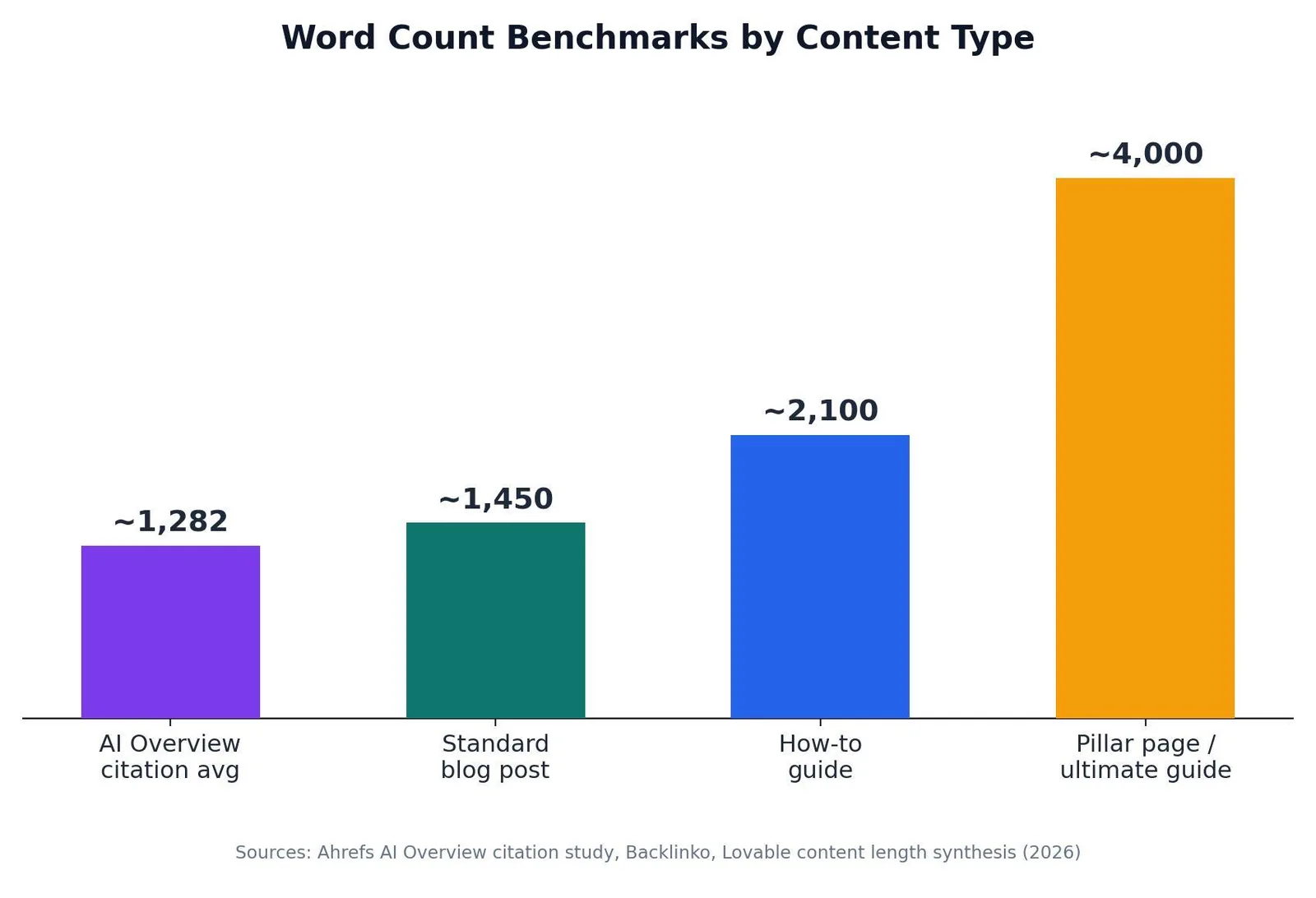
Word count advice online is a mess of contradictions because the right answer depends entirely on the format. Backlinko's analysis of 11.8 million Google search results puts the average first-page result at roughly 1,447 words. Standard blog posts tend to land in a similar 1,400 to 1,500 word range, how-to guides need more room, typically 1,700 to 2,500 words, to walk through steps properly, and pillar pages or ultimate guides often run 3,000 to 5,000 words to establish topical authority on a broad subject.
The AI search angle changes the calculus further. Ahrefs analyzed over 560,000 AI Overviews and found the average word count of cited pages was just 1,282, with 53.4 percent of cited pages under 1,000 words. The correlation between length and AI citation was effectively zero. A tightly focused 800-word answer can out-compete a padded 3,000-word article for AEO (answer engine optimization) visibility, even while the longer piece wins on traditional backlink accumulation: Backlinko's separate analysis of 912 million blog posts found content over 3,000 words earns 77.2 percent more backlinks on average.
Word Count Benchmarks by Format
| Format | Typical Word Count | Best For |
|---|---|---|
| AI Overview citation | ~1,282 words (53.4% under 1,000) | Direct answers to specific questions |
| Standard blog post | 1,400-1,500 words | Timely topics, standard informational queries |
| How-to guide | 1,700-2,500 words | Step-by-step instructional content |
| Pillar page / ultimate guide | 3,000-5,000+ words | Establishing topical authority, competing for high-volume keywords |
The practical approach: check what's currently ranking for the target keyword, match or slightly exceed that depth, and stop once the question is genuinely answered. Padding past that point helps neither readers nor rankings.
The 6 Pillars of SEO-Friendly Content
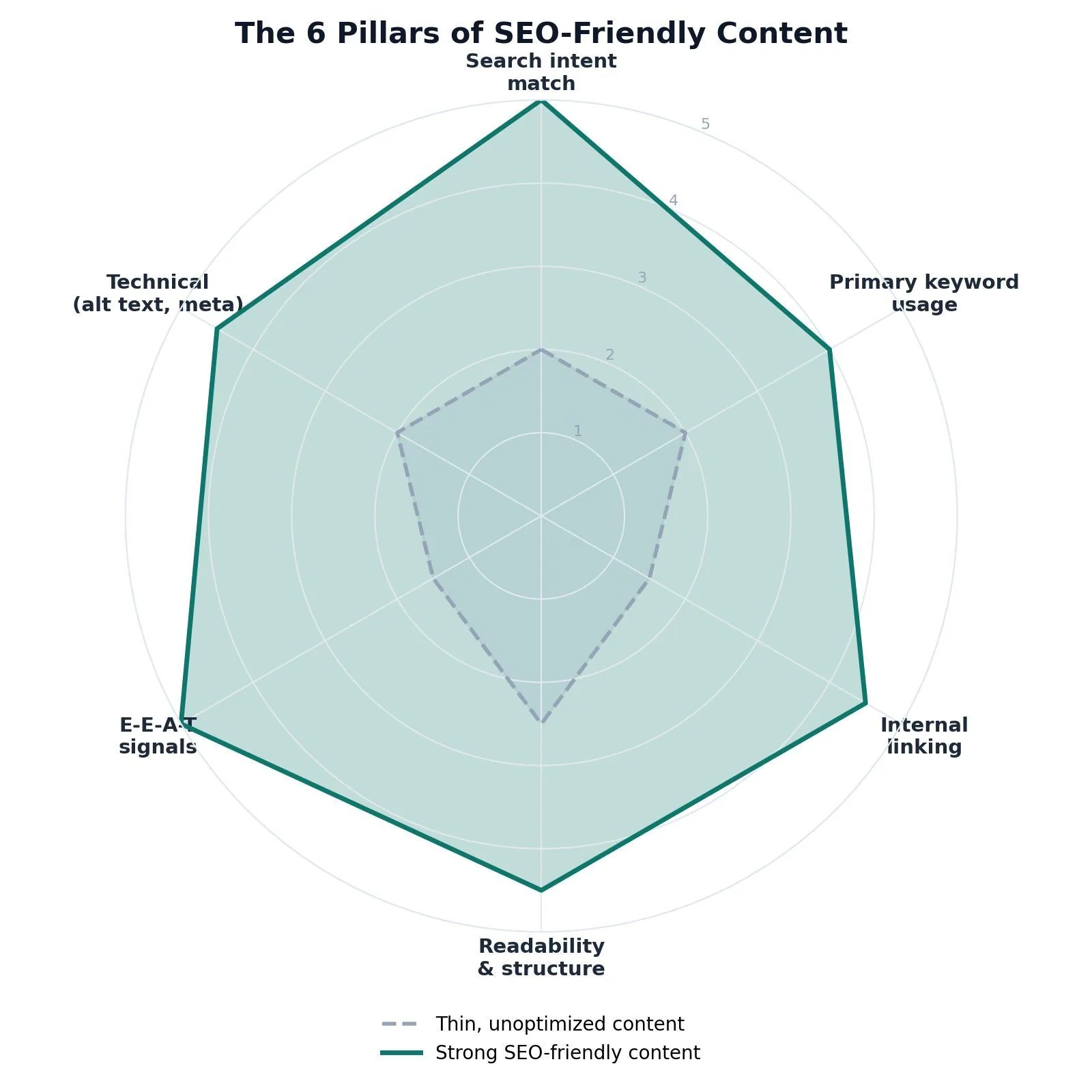
Strong SEO content performs well across six dimensions at once: matching search intent, using the primary keyword naturally rather than stuffing it, linking internally to related pages, staying readable with short paragraphs and clear structure, demonstrating E-E-A-T (experience, expertise, authority, trust) as defined in Google's own Search Quality Rater Guidelines, and covering the technical basics like alt text and meta descriptions. Thin content usually scores low across all six at once rather than failing on just one, which is why a single fix, like adding more keywords, rarely rescues a weak page. A page that scores well on readability and structure also tends to deliver a better user experience, which is part of why the two are so closely correlated in practice.
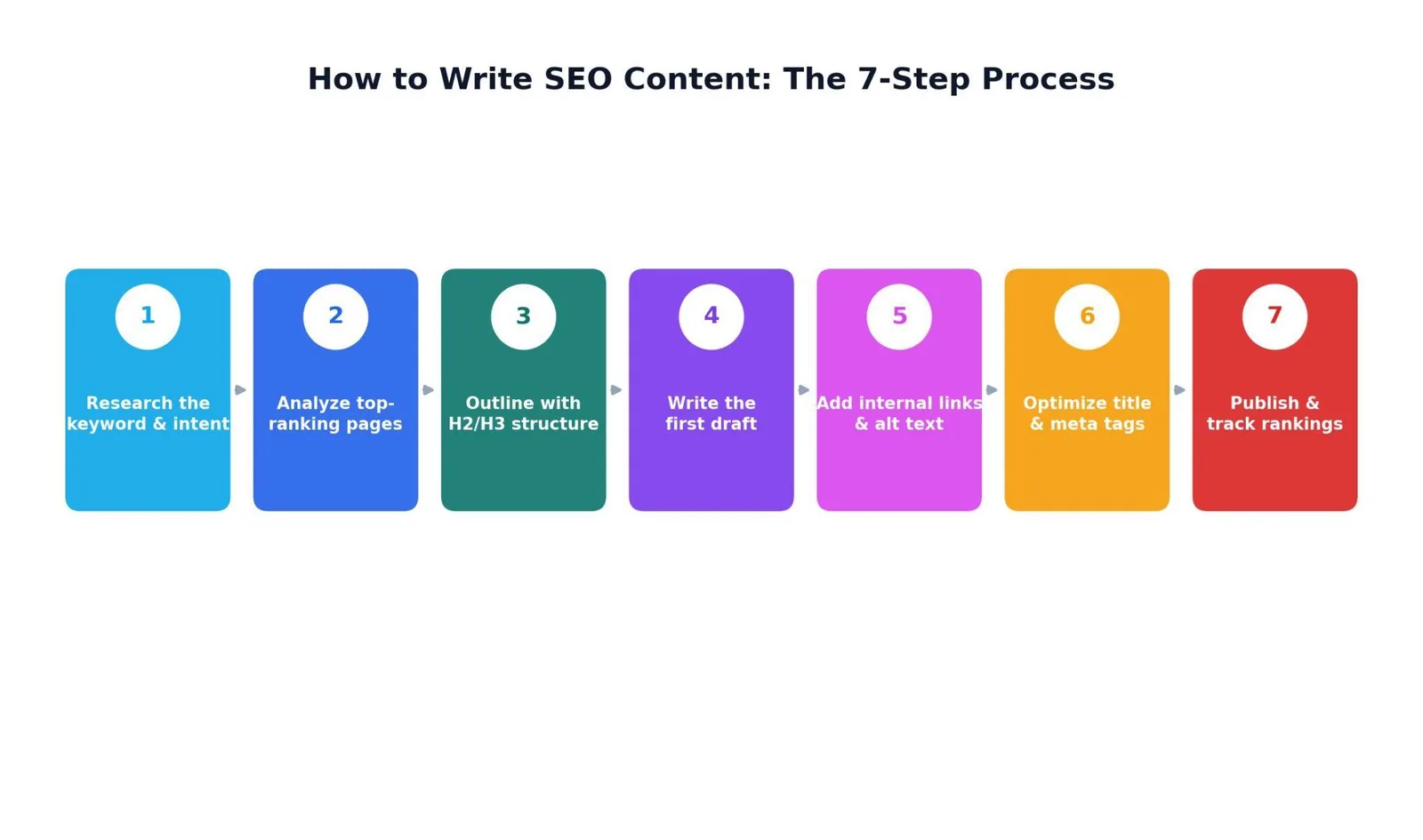
Step 1: Research the keyword and its search intent
Before writing a single sentence, confirm what Google actually returns for the target keyword. Google Keyword Planner and Google Trends show volume and momentum, but the real signal is what type of content currently ranks, a blog post, a product page, a video, since that tells you what format Google believes satisfies this user intent.
Step 2: Analyze the top-ranking pages
Open the current top five results and note what they cover, what they miss, and roughly how long they run. This step defines the competitive bar the new article needs to clear, not by copying structure, but by covering every subtopic those pages address and ideally one they don't. Part of that competitive gap comes from domain authority rather than content quality alone, so don't assume a page outranking this one is necessarily better written, it may simply be sitting on an older, more trusted site.
Step 3: Outline with a clear H2/H3 structure
A solid outline prevents the two most common failures in SEO content writing: rambling structure that's hard for readers to scan, and missing subtopics that a competitor's page covers and this one doesn't. Each H2 should map to a distinct subtopic, not just a rephrased version of the primary keyword.
Step 4: Write the first draft around search intent
Answer the core question in the first few sentences, then use the outline to fill in supporting depth. Long tail keywords and related terms should appear naturally as the topic is actually explained, not inserted mechanically after the fact.
Step 5: Add internal links and image alt text
Every SEO content writer should treat internal linking as part of the writing process, not an afterthought bolted on before publishing. Link to genuinely related pages, and write alt text that describes the image rather than repeating the primary keyword for its own sake. Publishing through a clean CMS setup makes this step far less error-prone, since most modern platforms prompt for alt text and internal link suggestions automatically.
Step 6: Optimize the title tag and meta description
The title tag should include the primary keyword and stay under roughly 60 characters. The meta description won't directly affect rankings, but it directly affects click-through rate, which indirectly does. Well-written meta descriptions across a whole site also compound, since a consistent style builds recognizable brand presence in the search results over time.
Step 7: Publish and track performance
Google Search Console and Google Analytics show whether the page is actually ranking and converting once it's live. User generated content like comments and reviews on the published piece can also feed future updates to the page.
SEO content tool
Is your draft ready to publish?
Check off what your draft already does. Your score updates as you go.
0 of 5
Check off items above to see if this draft is ready to publish.
SEO Content Tools Compared
| Tool | Best For | Starting Price (USD) | Key Feature |
|---|---|---|---|
| Google Keyword Planner | Keyword volume and search trends | Free | Direct-from-Google search volume data |
| Google Trends | Spotting rising topics and seasonality | Free | Real-time trend and interest-over-time data |
| Ahrefs | Competitive keyword and backlink research | From $29/month (Starter plan) | Deep keyword difficulty and competitor analysis |
| Clearscope | Content optimization and topic coverage grading | From $129/month (Essentials plan) | Real-time content grading against top-ranking pages |
Most content marketing teams don't need all four running simultaneously. Google Keyword Planner and Google Trends cover early research for free; Ahrefs or Clearscope earn their cost once a team is publishing consistently enough to need ongoing optimization support.
Common SEO Content Writing Mistakes
The most common one is writing for the wrong search intent. An article that thoroughly explains a topic when the searcher wanted a quick, direct answer, or the reverse, won't satisfy the query no matter how well it's optimized elsewhere.
Unnatural keyword stuffing throughout the article is a close second. It reads poorly to actual readers and hasn't helped rankings in years, since search engines platforms are sophisticated enough to understand a topic through natural language and related terms without needing the exact phrase repeated constantly.
Internal links get skipped just as often, which treats every page as an island. Pages with strong internal linking consistently outperform orphaned pages with no connection to the rest of the site.
Word count treated as the goal rather than a byproduct of thoroughness rounds out the list, and it produces exactly the padded, unfocused content that both readers and AI Overviews increasingly skip over.
Frequently Asked Questions
How is writing for AI search different from writing for Google rankings?
Both reward clear, well-structured answers, but AEO places even more weight on being directly quotable. AI systems like Google's Gemini and Perplexity summarize an answer rather than list links to choose from, so short, precise answers to specific questions perform well for AI citation even when they'd be too brief to compete for a broad, competitive Google ranking.
Do I need to use LSI keywords?
LSI (latent semantic indexing) as a specific technical mechanism isn't how modern search engines process language today. Google's own announcement of its BERT model explains that Search instead evaluates the full context of a query, considering the words before and after a term rather than matching isolated keywords. The underlying advice still holds: covering a topic using natural, varied, related language helps search engines understand context better than repeating one exact phrase.
How many keywords should one piece of content target?
One clear primary keyword per page, supported by several related terms and long tail keywords that come up naturally while covering the topic thoroughly. Targeting too many unrelated primary terms on one page usually means none of them get covered well enough to rank.
Does AI-assisted writing hurt SEO rankings?
Not inherently. The meaningful difference is human editing and expertise layered on top, not whether AI assisted the first draft. Content that skips that editorial layer entirely tends to underperform purely human-written content over time, while AI-assisted, human-edited content can match human-only performance while getting written faster.
The Bottom Line on Writing SEO Content
The best SEO content answers the actual question, in a structure both readers and search engines can follow, at a depth that matches what the topic actually requires. Length, keyword density, and technical polish only matter insofar as they serve that one goal. Everything in this guide, research, structure, optimization, exists to get there.
Start with the search intent behind your next target keyword, not the word count. Confirm what's actually ranking, outline against it, and write until the question is answered. That's the whole system.
More from Web Tonic: growth marketing services, data & analytics.
Sources: backlinko.com · ahrefs.com · guidelines.raterhub.com · blog.google