Table of contents

Every marketing team eventually hits the same wall: rankings stall, competitors keep showing up for searches you don't, and nobody can say exactly why. A content gap analysis is how you find the answer. It compares what your site covers against what's already ranking for your target keywords, then turns that comparison into a clear list of what to create, update, or fix next.
This guide covers what a content gap is, a ready-to-use content gap analysis template, and the step-by-step process for running the analysis yourself: competitors, keywords, tools, and all.
Key Takeaways
- A content gap is any keyword, topic, or search intent your competitors rank for that your site doesn't cover, or covers poorly.
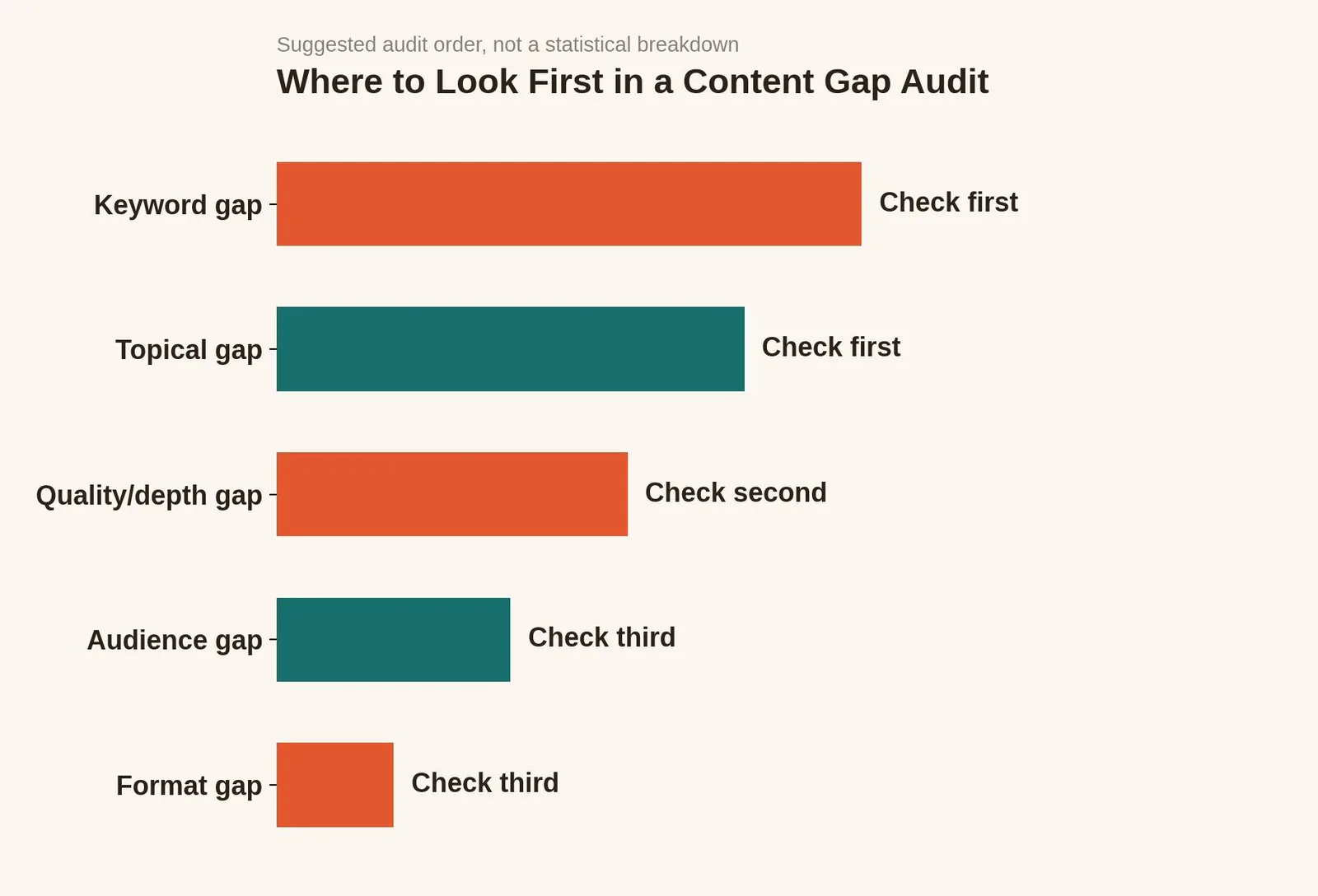
- Keyword gaps make up the largest share of findings in most audits, but topical, quality, audience, and format gaps matter too.
- Google Search Console is the fastest, free starting point: its Queries report shows exactly which searches already bring you impressions without clicks.
- Tools like Ahrefs, Semrush, and even the free Google Keyword Planner can surface competitor keywords you're missing in minutes.
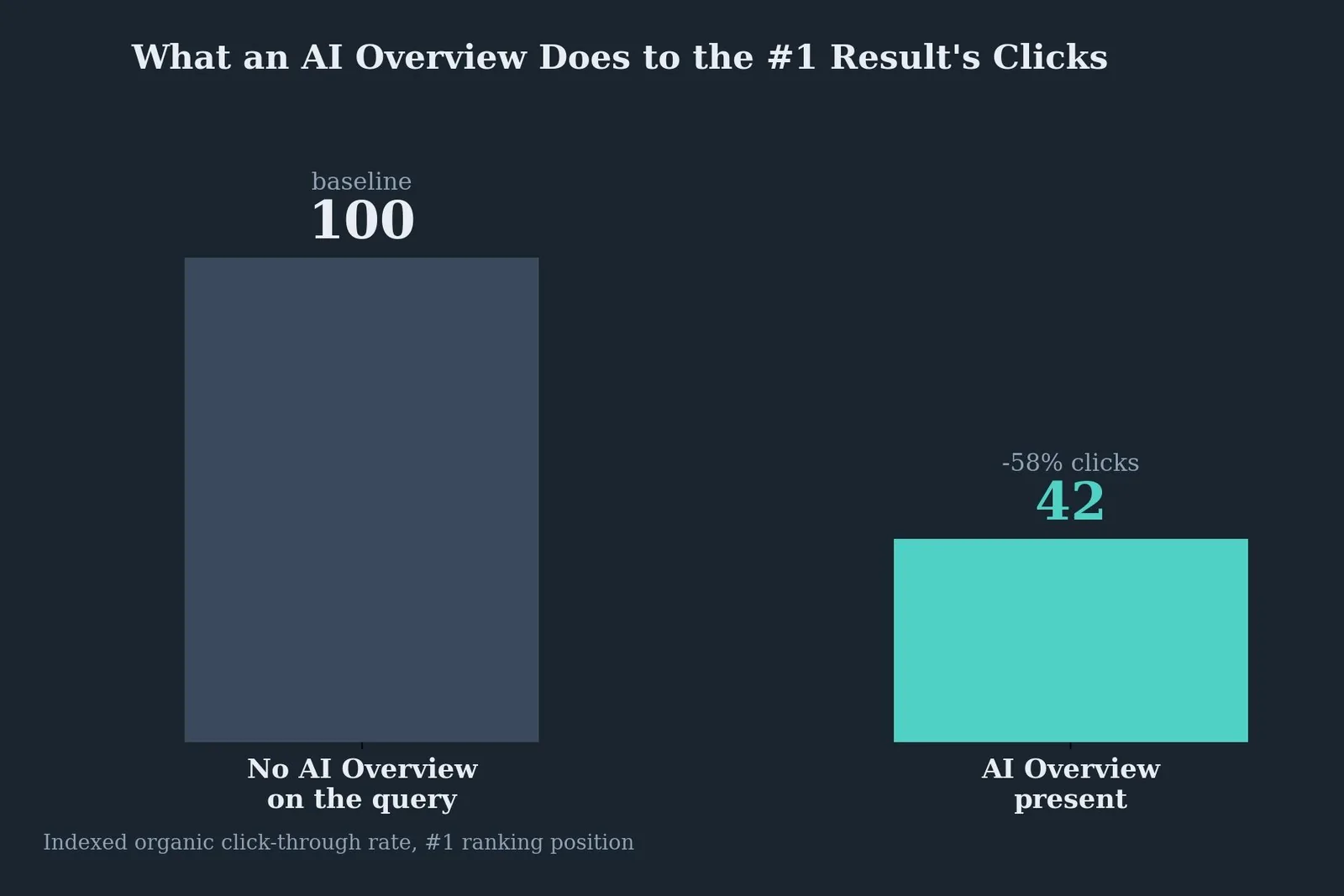
- When an AI Overview appears on a query, clicks to the number one organic result drop by 58 percent, which makes SERP feature ownership part of any modern gap analysis.
- Not every gap is worth closing. Prioritize by search volume, intent, and how many competitors already dominate the term before committing content production time.
What Is a Content Gap Analysis?
A content gap analysis is the process of comparing your existing content against your competitors' content and your audience's actual search behavior to find topics, keywords, and questions you aren't covering, or aren't covering well enough to rank. The output is a prioritized set of pages to create or update, based on real search demand, not a vague list of ideas. Clearscope's guide to content gap analysis frames this the same way: uncovering opportunities to create new, valuable content that attracts more organic traffic and improves overall SEO performance.
SEO's payoff compounds over time. Web Tonic's own research found it can deliver up to 700% ROI over 1-3 years, with organic leads closing at a far higher rate than traditional outbound outreach. A missed content gap adds up against numbers like that.
Every keyword a competitor ranks for and you don't represents traffic, and eventually revenue, going somewhere else. A content gap analysis template gives that comparison a repeatable structure so it isn't reinvented from scratch every quarter.
A good gap analysis helps find opportunities that a plain content marketing calendar would miss entirely, because it starts from what your target audience is already searching for rather than what your team feels like writing next. Folding the findings into your broader content strategy, instead of treating them as a one-off list, turns a single content gap analysis content plan into a repeatable content gap analysis keyword pipeline your team can run every quarter. Creating content from that pipeline outperforms content built on instinct, and catching underperforming content early will help you decide what to update instead of what to write from zero.
Types of Content Gaps
Not every content gap looks the same, and the fix depends on which type you're dealing with. AirOps categorizes these into six types, including two newer ones worth watching: AI-visibility gaps (ranking in Google but never surfacing in ChatGPT or Gemini answers) and content-freshness gaps (pages that decay and lose AI citations over time).
Keyword gaps are the easiest to spot: search terms your competitors rank for that you don't target at all. A keyword gap tool will surface these in minutes, which is usually the first thing teams find.
Broader than that are topical gaps, entire subtopics or themes your site never addresses even if you rank for a few related terms. Brafton's guide notes that a content audit is the objective, data-backed foundation for spotting this kind of gap before you ever touch a keyword tool, which is why closing topical gaps builds authority across a whole content cluster, not just one page.
Then there's the gap you already have a page for. Quality or depth gaps happen when that page is thin, outdated, or simply less useful than what's ranking above you, so the fix isn't a new page, it's a better one.
Audience gaps work differently: your content only speaks to part of your target audience, covering beginners well but ignoring advanced users, say, or one industry vertical but not another. Mapping these audience content gaps against your buyer personas before you create content for a new segment keeps the roadmap focused on your readers' actual pain points instead of guesswork.
And the one people forget: format gaps. Your competitor answers the same query with a comparison table, an embedded calculator, or a video. Your text-only page can't compete on page experience alone.
The Content Gap Analysis Template
Use the structure below as your working template. Each row represents one identified gap; fill it in as you work through your competitor and keyword research.
Table 1: Content Gap Analysis Template
| Target keyword / topic | Search intent | Gap type | Competitors ranking | Priority | Action |
|---|---|---|---|---|---|
| "content gap analysis template" | Informational | Format gap | 3 | High | Create pillar page with template + interactive tool |
| [your keyword] | Commercial | Keyword gap | 2 | High | New page |
| [your keyword] | Informational | Quality gap | 4 | Medium | Update existing page, add depth |
| [your keyword] | Transactional | Audience gap | 1 | High | New page targeting underserved segment |
| [your keyword] | Informational | Topical gap | 5 | Low | Add to backlog, monitor demand |
Copy this structure into a spreadsheet before you start, one row per gap. That gives you a working content gap analysis template that scales to however many competitors and keywords your audit covers.
How to Run a Content Gap Analysis, Step by Step
Step 1: Audit Your Existing Content
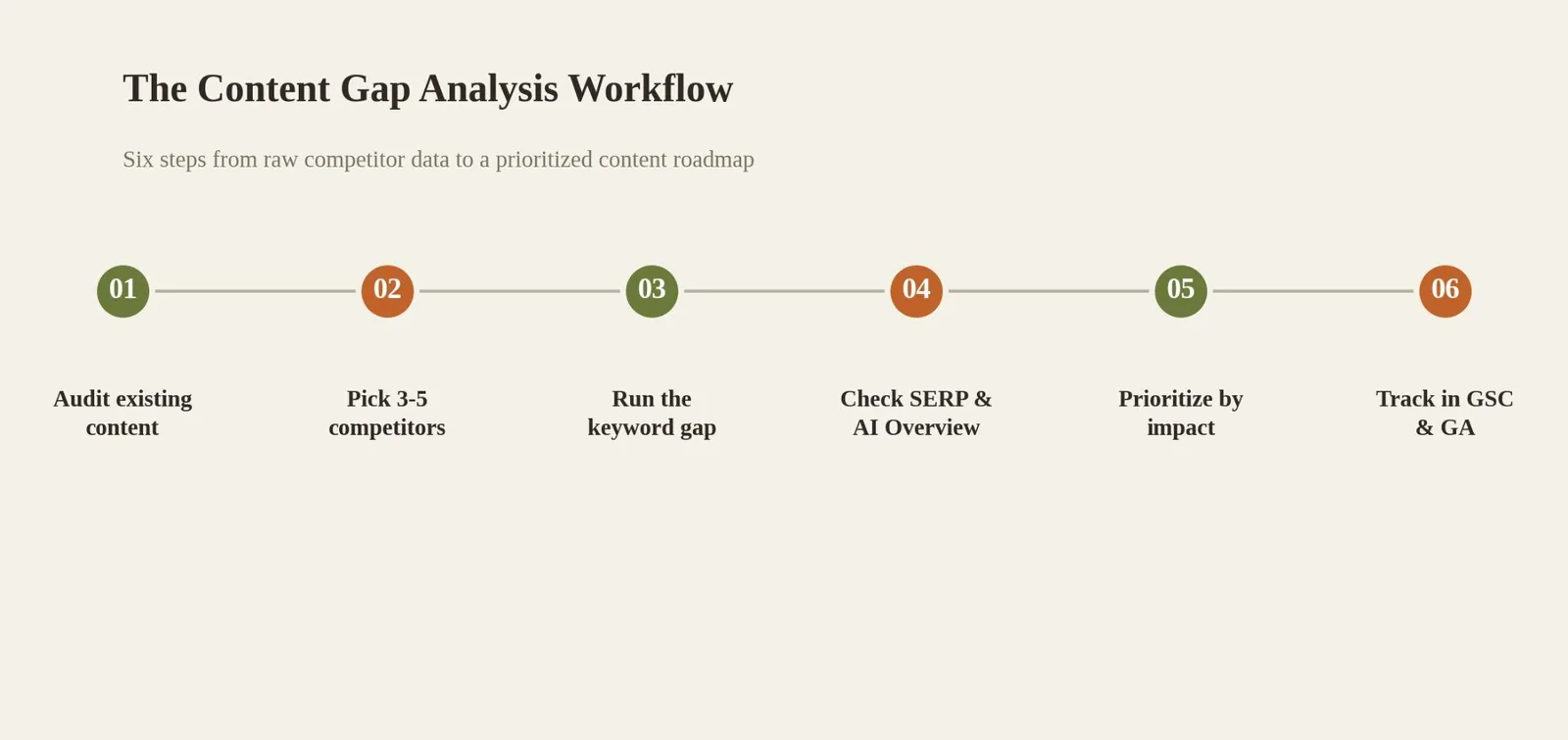
Know what you already have before comparing yourself to anyone else. Export the Queries report from Google Search Console to see which searches are already generating impressions for your pages, then cross-reference it with Google Analytics to see which of those pages actually convert. This first-party data sits at the center of any credible audit, according to Search Engine Land's gap analysis framework, since it reflects what Google already associates with your site.
Step 2: Identify Your Real Competitors
List the sites that consistently rank for the keywords you're targeting, not just the businesses you consider direct competitors. Three to five is usually enough for a useful comparison without the analysis becoming unmanageable.
Step 3: Run the Keyword Gap
A dedicated keyword gap tool earns its keep here. Ahrefs' Content Gap feature and Semrush's Keyword Gap tool both let you enter your domain plus several competitor domains and instantly see which keywords they rank for that you don't. If budget is tight, Google Keyword Planner still works for basic volume and competition data; it just won't show you competitors' rank the way a paid tool will.
Step 4: Check SERP Features and AI Visibility
A keyword gap covers more than the ten blue links now. Look at who owns the featured snippet, who dominates the "People Also Ask" box, and whether an AI Overview appears for the query. Ahrefs' own December 2025 study found that when an AI Overview is present, clicks on the number one organic result drop by 58 percent, so raw keyword volume matters less than it used to.
Step 5: Prioritize by Impact, Not Volume Alone
A high-volume informational keyword competing against five entrenched competitors is often worth less than a lower-volume commercial term with only one or two competitors ranking. Score each gap on intent, competition, and realistic traffic potential. Search volume alone isn't a reliable prioritization signal.
Step 6: Track Results in Search Console and Analytics
Once new or updated content is published, monitor it in Google Search Console and Google Analytics over the following weeks to confirm impressions, clicks, and conversions are actually moving. Orbit Media's own annual blogger survey found that marketers who update old posts are about twice as likely to report "strong results" than those who don't. That's a solid argument for closing the loop instead of publishing and moving on.
Content Gap Analysis Tools Compared
Different budgets call for different tools. Here's how the main options stack up for finding a content gap.
Table 2: Content Gap Analysis Tools Compared
| Tool | Best for | Competitor comparison | Cost |
|---|---|---|---|
| Google Search Console | First-party query and impression data | No | Free |
| Google Keyword Planner | Basic keyword volume and competition | No | Free |
| Ahrefs Content Gap | Multi-competitor keyword gaps at scale | Yes, up to several domains | Paid |
| Semrush Keyword Gap | Keyword gap plus intent labeling | Yes, up to four domains | Paid |
| Clearscope / MarketMuse | Semantic and on-page content depth gaps | Partial | Paid |
A 2026 Ahrefs study of newly published pages found that only 1.74 percent of new pages reach the top 10 within their first year. Closing a gap on paper doesn't guarantee it closes in the rankings; the follow-through matters as much as the find.
Where AI Tools Fit Into a Modern Content Gap Analysis
Search behavior has expanded beyond Google's search bar. People now ask Gemini or ChatGPT the same research questions they used to type into search, and some of your audience is surfacing content gaps in Reddit threads and community forums long before those questions ever become a tracked keyword. 12AM Agency's 2026 guide confirms AI has accelerated gap discovery: tools now use semantic analysis to flag subtopics your existing content is missing, and you can prompt conversational AI like Gemini or ChatGPT directly to surface those questions. A modern content gap analysis treats these as legitimate signals alongside Google Search Console and Google Analytics data.
Common Content Gap Analysis Mistakes to Avoid
Chasing volume without checking search intent tops the list. A five-thousand-search informational keyword with no path to conversion often isn't worth the production time a targeted commercial term would take.
Treating a content gap as only a "missing keyword" problem is another. Sometimes the gap is depth, a downloadable template, or an interactive tool your competitor has and you don't, not a page you haven't written yet.
Skipping Google Search Console because you already pay for Ahrefs or Semrush costs teams real opportunities too. Semrush's own guide found nearly 90 percent of pages ChatGPT cited in one study sat outside Google's top 20 organic results, so first-party and AI-visibility signals don't always agree.
Running a content gap analysis once and never again wastes the work, since content decays and competitors keep publishing. Search Engine Land's intent-gap methodology treats this as an ongoing scoring exercise rather than a one-time audit, for exactly that reason. Most teams get the most value from revisiting the exercise quarterly.
Content gap tool
Which content gap should you fix first?
Answer three quick questions about the gap you found. We'll score how urgently it's worth your team's time.
Answer the questions above
Your priority score will appear here once all three are answered.
Frequently Asked Questions
How Often Should I Run a Content Gap Analysis?
Quarterly is a reasonable default for most sites, though larger or fast-moving industries may benefit from a lighter monthly check on the highest-priority keywords. The goal is catching new competitor content and search behavior shifts before they cost you meaningful traffic.
Is Google Search Console Enough on Its Own?
Google Search Console shows what's already happening on your own site: which pages get impressions, clicks, and at what position. It has no visibility into competitor content, though. Pairing it with a keyword gap tool like Ahrefs or Semrush, or even the free Google Keyword Planner for basic volume data, gives you both halves of the picture.
What's the Difference Between a Content Gap and a Keyword Gap?
A keyword gap is one type of content gap: a search term competitors rank for that you don't target at all. Content gaps also include topical gaps, quality gaps, audience gaps, and format gaps, none of which a keyword tool alone will surface.
Do AI Overviews Change How I Should Prioritize Gaps?
Yes. An AI Overview appearing on a query can cut clicks to the top organic result by more than half, so a keyword's raw search volume matters less than whether you can realistically earn visibility within or alongside that AI Overview once you rank.
How Many Competitors Should I Include in the Analysis?
Three to five is the practical range for most teams. Fewer risks missing real opportunities; more usually adds noise without adding useful new gaps to act on.
The Bottom Line on Closing Your Content Gaps
Treat a content gap analysis as a habit, not a one-time project. Audit what you have, compare it honestly against what's actually ranking, prioritize by real impact instead of raw volume, and track whether the content you publish actually closes the gap you set out to fix. Teams that repeat this process quarterly consistently outpace competitors who publish on instinct alone.
Start with just one query where you know a competitor outranks you. Run it through the steps above, then use the template to turn that single comparison into your next quarter's content roadmap.
Ready to Close Your Content Gaps?
Finding the gaps is only half the work. Producing content that actually closes them, at the depth and quality it takes to outrank what's already there, is where most in-house teams run out of time. Web Tonic's growth marketing team handles the keyword research, content production, and technical SEO needed to act on a content gap analysis at scale, so the roadmap you build doesn't just sit in a spreadsheet.
More from Web Tonic: growth marketing services, data & analytics.
Sources: clearscope.io · airops.com · brafton.com · searchengineland.com · ahrefs.com · orbitmedia.com · 12amagency.com · semrush.com