Table of contents

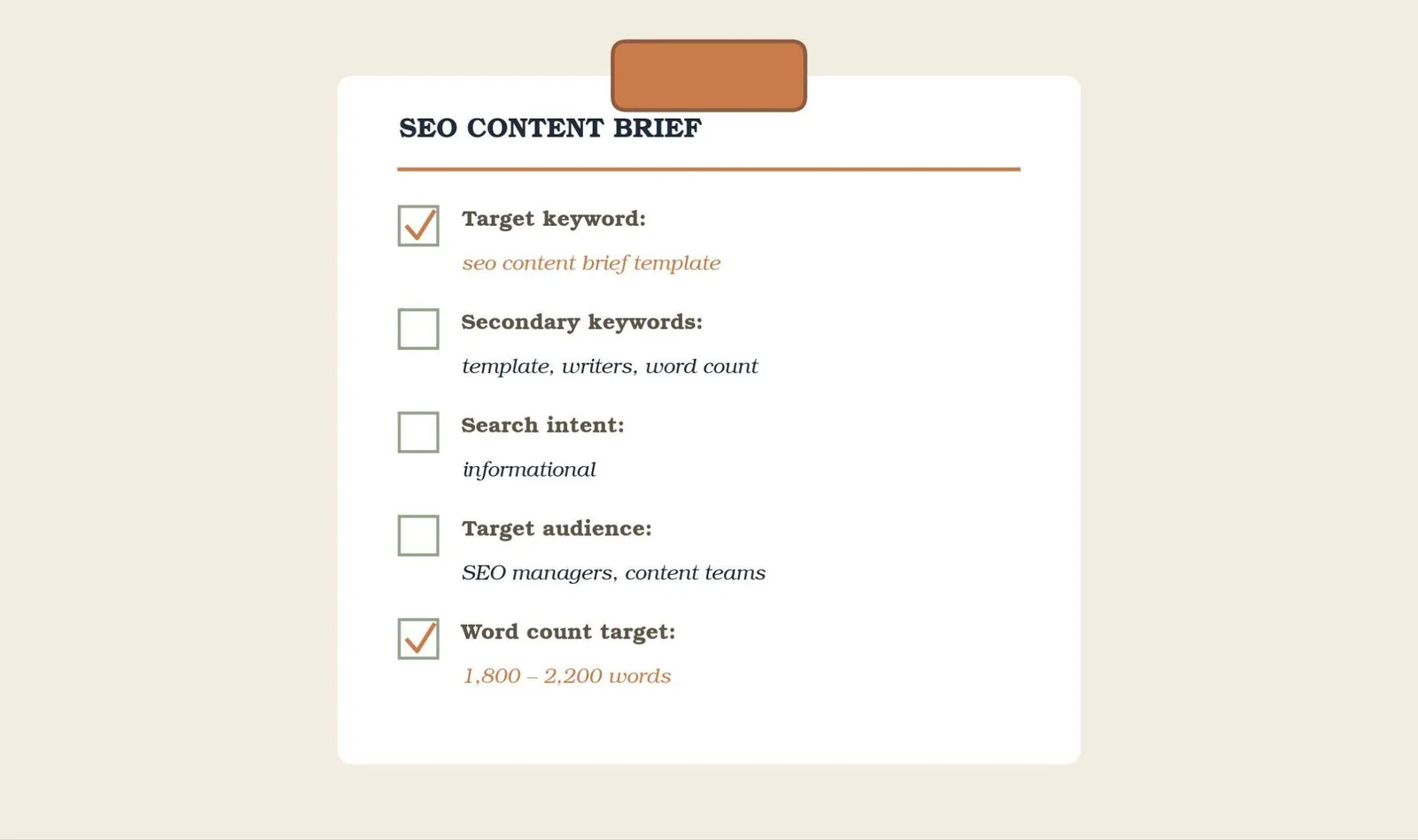
A writer who gets a keyword and a deadline will guess at everything else: who the article is for, what search intent it needs to satisfy, how long it should run, where it should link. An SEO content brief exists to remove that guesswork, turning a vague assignment into something a writer can create from directly, per Digital Applied's 2026 writer-and-AI handoff framework — closer to a transcription job than an open-ended brief.
This template covers what to include in an SEO content brief, why skipping this step costs more time than it saves, and a ready-to-copy structure you can start using on your next article.
Key Takeaways
- 82.7% of content teams rely on a written content brief to guide writers before drafting begins, according to Semrush research cited by TheStacc's 2026 SEO content template guide.
- A good brief locks in the target keyword, secondary keywords, search intent, target audience, word count target, internal links, and a CTA before a single word of the draft gets written.
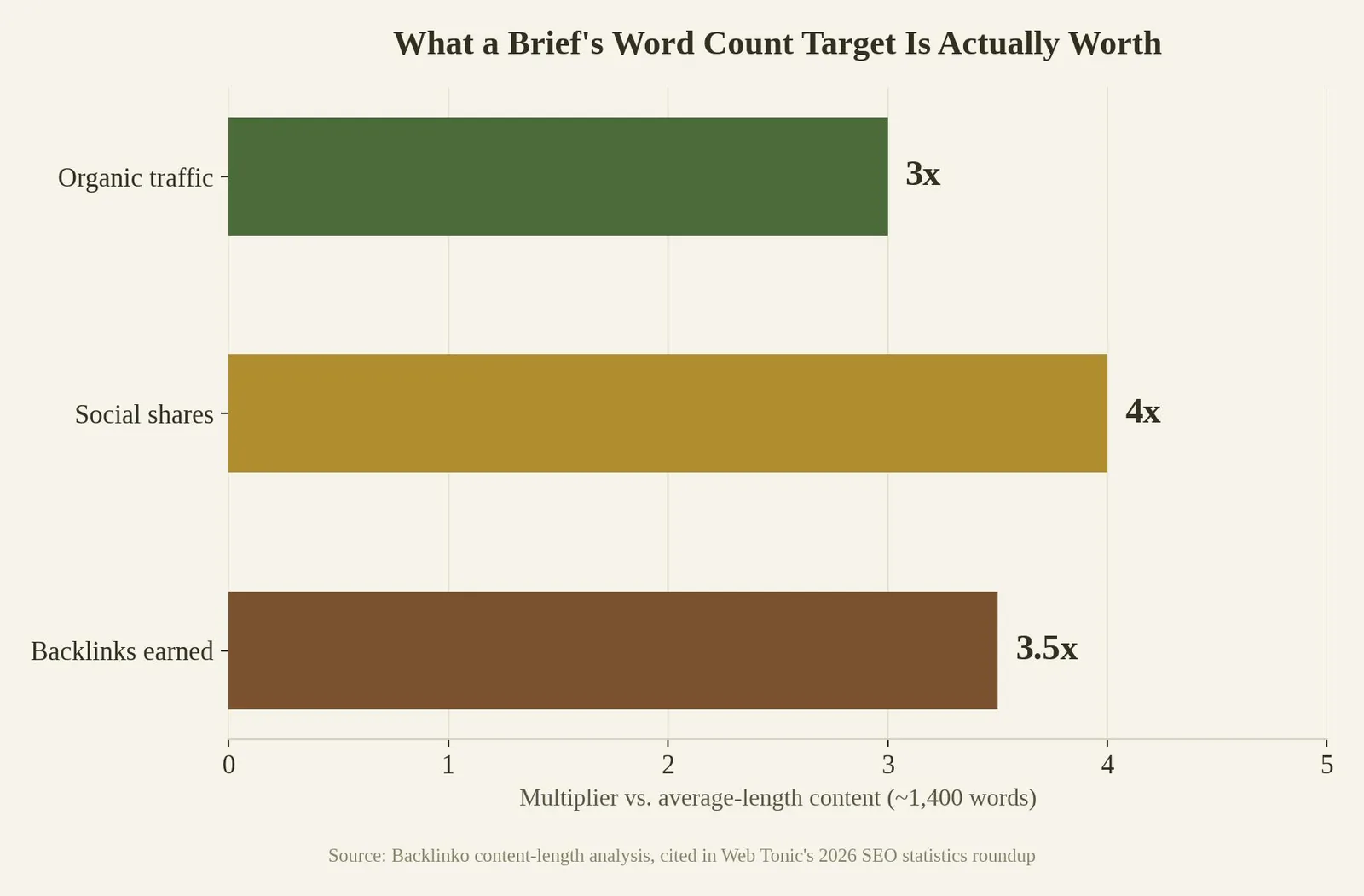
- Content over 3,000 words earns roughly 3x more organic traffic, 4x more social shares, and 3.5x more backlinks than average-length content around 1,400 words — exactly why a word count target belongs in the brief, not left to guesswork.
- A specific word count target beats a vague one. "The top 3 competitors average 1,900 words, target 2,200" gives a writer something to aim at; "write 2,000 words" doesn't.
- Tools like Ahrefs, Content Harmony, and Clearscope can automate parts of brief creation, but none of them replace a human decision about angle and audience.
- The most common brief failure isn't a missing field — it's an overloaded one. A keyword list with 40 terms tells a writer nothing; one primary keyword and a few supporting terms does.
What Is an SEO Content Brief?
An SEO content brief is a document that outlines the target keyword, search intent, audience, structure, and on-page requirements a piece of content needs before a writer starts drafting. It differs from a general content marketing brief, which might focus on brand voice or engagement goals instead. An SEO brief has one job: making sure a piece of content can compete in search results, which means translating keyword research and SERP analysis into instructions a writer can actually act on.
A brief with real substance turns drafting into something close to transcription. A topic name and a rough word count does the opposite — it pushes every decision downstream, where fixing it costs far more time in revision than settling it upfront would have.
Why Content Briefs Matter
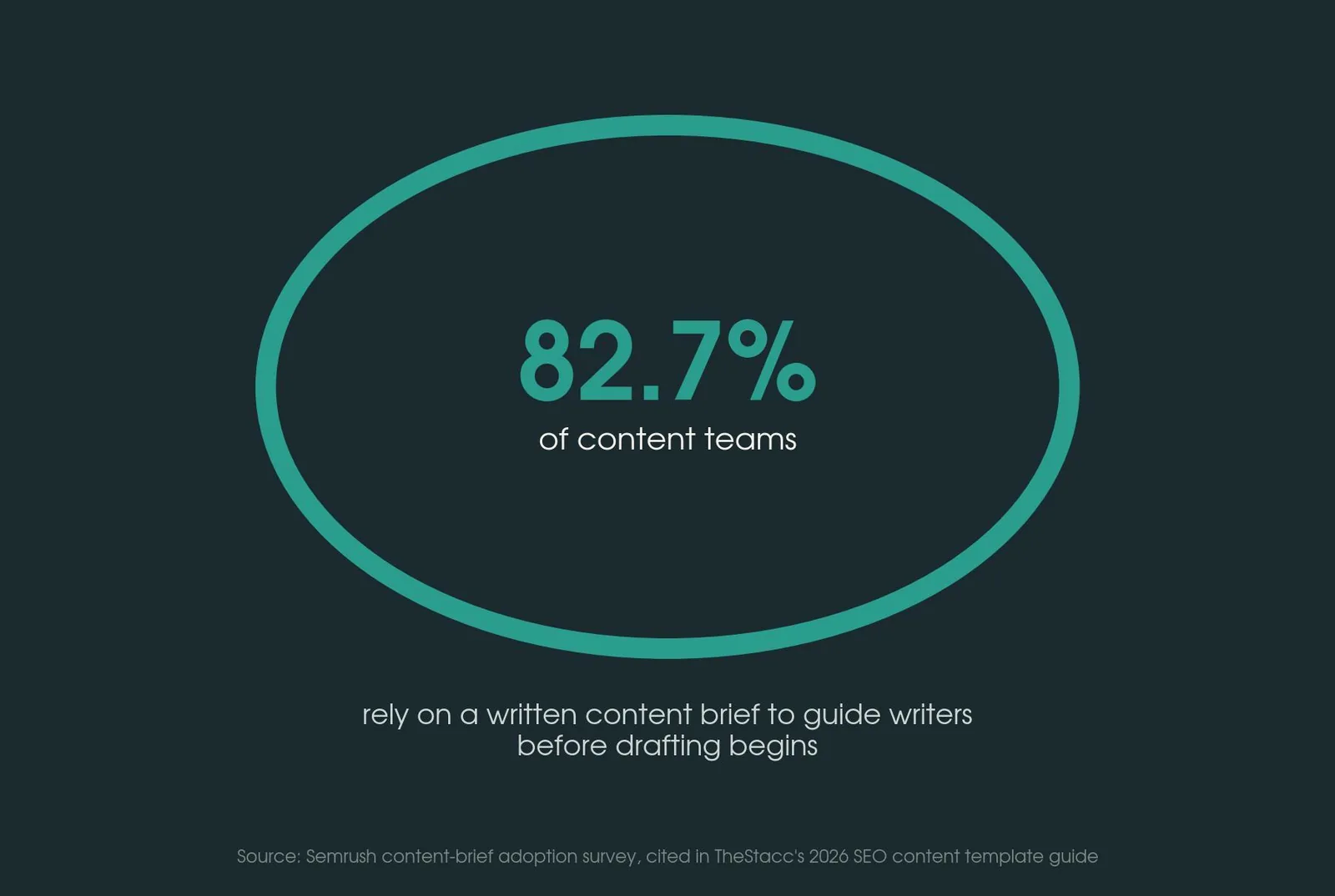
The gap between briefed and unbriefed content shows up fastest in revision cycles. A writer handed only a keyword and a deadline has to guess the intent, the audience, the proof standard, and the internal link path. Every wrong guess means another round of edits. A content brief settles those questions before the first sentence gets written, which is why 82.7% of content teams already build their workflow around one.
Word count is a good example of why specificity matters more than the brief simply existing. Backlinko's content-length analysis, cited in Web Tonic's own 2026 SEO statistics roundup, found that content over 3,000 words generates roughly 3x more traffic, 4x more social shares, and 3.5x more backlinks than average-length content around 1,400 words. A brief that just says "make it long" wastes that data. A brief that says "the top 3 ranking pages average 1,900 words, target 2,200" gives the writer a concrete target tied to a real competitive reason.
That same brief becomes your measurement baseline once the piece is live. Checking Google Analytics and Search Console against the word count, intent, and audience the brief specified is how you find out whether the guess was right, not just whether the draft got published.
What a Good Brief Actually Includes
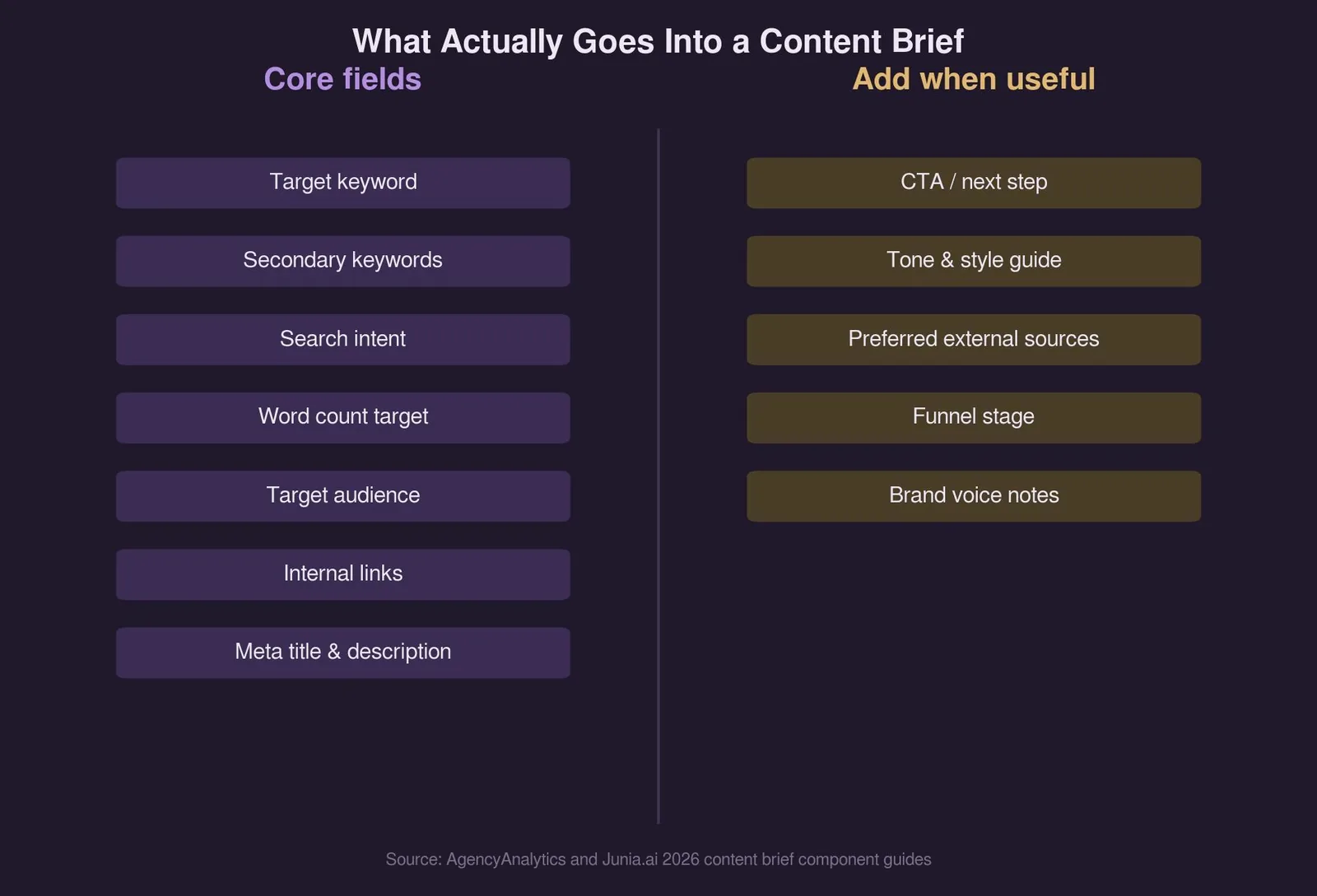
Every SEO content brief needs a core set of fields, according to AgencyAnalytics' content brief guide:
- Target keyword — the single primary term this piece needs to rank for
- Secondary keywords — a short, curated list of supporting terms with the same intent, not a 40-term keyword dump
- Search intent — informational, commercial, transactional, or navigational, so the writer knows whether to explain, compare, or sell
- Word count target — ideally tied to a specific competitive reason, not a round number picked at random
- Target audience — who's actually reading this, beyond the keyword alone
- Internal links — the destination URL, anchor text, and placement reasoning decided before drafting, not sprinkled in during a final pass
- Meta title and description — drafted alongside the brief so the writer understands how the piece will actually appear in search
A second tier of fields gets added when the content type calls for it: a CTA or next step, tone and style guidance, preferred external sources, funnel stage, and brand voice notes. None of these are wrong to skip on a simple piece. They earn their place when the topic actually needs them.
SEO Content Brief Templates: Manual vs. Tool-Assisted
Building a brief by hand in Google Docs works for any team. Keyword and content research tools can speed up the research stage considerably, though. Here's how the common options compare:
| Method | Cost (USD) | Best for | Limitation |
|---|---|---|---|
| Manual (Google Docs template) | Free | Any team size, full control over structure | SERP and competitor research done entirely by hand |
| Ahrefs | $29–$1,499/month depending on tier | Teams that already use Ahrefs for keyword research | Not purpose-built for brief generation specifically |
| Content Harmony | From $99/month (unlimited briefs, Standard tier) | Agencies running many briefs with SME collaboration needs | Adds a dedicated tool and workflow to learn |
| Clearscope | From ~$170/user/month (Standard tier) | Teams that want term-coverage scoring alongside the brief | Higher price point per seat |
⚠️ Pricing note: all four figures above should be checked against each vendor's current pricing page before this goes live. SaaS pricing shifts often — Ahrefs alone restructured its entire tier lineup in January 2026, which is exactly the kind of thing that goes stale between when this is written and when it's published.
A 2026 comparison of these platforms makes the more important point: the difference between them is mostly about where your team's bottleneck actually sits — research speed, term scoring, or collaboration — not which one writes a better brief on its own. None of them remove the need for a human decision about angle.
Try It Yourself: Content Brief Generator
Fill in the fields below, generate a starter brief, then download or copy it straight into Google Docs.
Brief Generator
Build a starter content brief in 30 seconds
Fill in the fields below, generate the brief, then copy it into Google Docs and fill in the SERP notes and outline.
How to Use This Template Step by Step
Step 1: Confirm the keyword and the intent
Decide what the reader actually wants when they type this search query, before anything else. A keyword that looks informational can behave commercially, and getting this wrong sends the whole brief in the wrong direction.
Step 2: Analyze what's already ranking
Pull the top 5-10 results for the target keyword and note their word count, format, and the subtopics they cover. This isn't about copying competitors. It's about finding what they're missing.
Step 3: Draft the outline with notes, not just headings
A heading alone is often too vague for a writer to act on. As Junia.ai's brief framework recommends, add a line under each H2 explaining what that section needs to accomplish, not just what it's called.
Step 4: Plan internal links before drafting begins
Decide the destination URL, anchor text, and placement reasoning for each internal link ahead of time. Links planned in advance support the reader's next step. Links added at the end usually just fill space.
Step 5: Add writer instructions and a final checklist
Tone, formatting notes, claims to avoid, and a CTA close out the brief. A short checklist — intent is clear, outline covers the topic, links are relevant — gives the writer and editor the same bar to check against before publishing.
Common Mistakes When Writing Content Briefs
Handing a writer a keyword list with 40 terms and no prioritization is one of the most common failures. As Junia.ai's brief framework puts it, a list that long tells a writer nothing about what actually matters, so the piece ends up either keyword-stuffed or thin on the terms that count.
Writing an outline of headings with no notes underneath is a close second. "Benefits" tells a writer nothing about which benefits, in what order, or why they matter to this specific target audience.
Skipping the SERP research step and briefing from assumption alone routinely produces content that duplicates what's already ranking instead of improving on it. That defeats the purpose of writing something new at all.
And leaving internal links for a final pass rather than planning them into the brief means they get added wherever there's room, not where they'd actually help the reader move to a logical next step.
Frequently Asked Questions
How long should an SEO content brief be?
Most effective briefs run one to three pages, per Averi's content brief template resource — long enough to transfer the strategic context a writer needs, short enough that they'll actually read the whole thing before starting.
Do I need an SEO background to write a content brief?
Not necessarily. A content strategist who understands keyword research, search intent, and basic SERP analysis can write an effective brief. Technical elements like schema markup can be handled later, during review.
Should every piece of content get a full brief?
Every piece targeting a specific search keyword benefits from at least the core fields: keyword, intent, word count, internal links. Simpler pieces can skip the second-tier fields like funnel stage or preferred sources.
Can AI tools write the content brief for me?
AI-assisted tools can speed up the research and first-draft stage significantly. The angle, audience judgment, and competitive differentiation still benefit from a human decision, though, not just automated SERP scraping.
What's the difference between a content brief and a content outline?
A brief is the full strategic document: keyword, intent, audience, links, CTA. An outline is just the heading structure, usually one section inside the larger brief rather than a replacement for it.
The Bottom Line on SEO Content Briefs
A content brief isn't an extra process for its own sake. It's where the decisions that actually determine whether a piece ranks get made before the writing starts, instead of negotiated for the first time in a revision round. Build the core fields into a repeatable template, adjust the second tier based on content type, and the draft that comes back the first time will need far less rework than one built from a keyword and a deadline alone.
Start with the template above on your next brief, even in its simplest form. A rough version used consistently beats a perfect one that only exists in theory.
More from Web Tonic: growth marketing services, data & analytics.
Sources: digitalapplied.com · thestacc.com · agencyanalytics.com · cited.so · junia.ai · resources.averi.ai