



Table of contents
Key Takeaways
- Google maintains 89.57% global search market share but faces unprecedented competition from AI-powered alternatives like ChatGPT, which now captures 17% of digital queries—the company's first sustained market share decline below 90% since 2015.
- Zero-click searches represent 60% of all queries in 2026, with AI Overviews reducing clicks by 58% and AI Mode searches ending without clicks 93% of the time, fundamentally changing how businesses measure SEO success.
- Mobile devices account for 62.73% of global web traffic, with 92.3% of internet users accessing the web via mobile phones, making mobile optimization non-negotiable for competitive visibility and user retention.
- SEO delivers up to 700% ROI over 1-3 years when properly executed, with organic leads achieving 14.6% close rates compared to just 1.7% for traditional outbound marketing methods across most industries.
- Backlinks remain critical despite algorithm evolution, with top-ranking pages having 3.8x more backlinks than lower positions, though quality from authoritative sources has eclipsed quantity in determining ranking impact.
- Voice search has stabilized at 20.5% of global search activity with 8.4 billion voice assistants in use, requiring content optimization for conversational queries and featured snippet positions to capture this growing segment.
- Content over 3,000 words generates 77.2% more backlinks than shorter content while attracting 3x more traffic and 4x more social shares, though length without substance provides no ranking benefit.
- AI integration has become standard in SEO workflows, with 61% of marketers using AI tools to reduce manual task time by up to 50%, though 64.48% prioritize accuracy over all other AI tool factors.
- Local search drives 46% of all Google queries, with 88% of local smartphone searches resulting in store visits or calls within 24 hours, making local SEO optimization particularly valuable for businesses serving specific geographic markets.
- For businesses seeking to maximize their organic search performance in this rapidly evolving landscape, partnering with an experienced agency that understands both traditional SEO fundamentals and emerging AI search optimization can accelerate results while avoiding costly strategic missteps.
What Is SEO?
Search Engine Optimization (SEO) is the practice of improving website visibility in search engine results through technical optimization, content strategy, and authority building. According to Statista's global search market research, Google maintains approximately 90% of the worldwide search market in 2026.
This makes SEO optimization essential for any business seeking online visibility.
The practice encompasses three core pillars: technical SEO (site architecture, page speed, mobile optimization), on-page SEO (content quality, keyword research, meta data), and off-page SEO (backlinks, domain authority, brand signals). These elements work together to signal relevance and trustworthiness to search algorithms that determine which pages deserve top rankings. Modern SEO professionals rely on specialized SEO tools to track performance metrics and implement best practices across these pillars.
For mid-market and enterprise businesses, SEO represents far more than simple rankings. It functions as a measurable acquisition channel that delivers up to 700% ROI when executed strategically over time, and organic search accounts for nearly 47% of all website traffic according to SE Ranking's 2025 analysis, which positions it as the second-highest traffic channel after direct visits and ahead of paid advertising, social media marketing, and email marketing combined.
The shift toward AI-powered search interfaces, zero-click results, and conversational queries means businesses must adapt their SEO strategies based on current data rather than outdated assumptions. Google's market share dipped below 90% for the first time since 2015. AI-powered alternatives now capture 17% of global queries.
The search landscape is experiencing its most significant transformation in decades.
Critical SEO Statistics Shaping 2026 Strategy
Google's Evolving Dominance
Google processes approximately 5.9 trillion searches annually in 2025, translating to roughly 16.4 billion searches per day.
But the company's grip on the search market is showing subtle yet significant erosion.
StatCounter Global Stats data reveals Google's global market share fell to 89.57% in mid-2025. This marks the first sustained period below 90% since 2015.
The breakdown varies considerably by device and region:
| Device Type | Google Market Share | Primary Competitor | Competitor Share |
|---|---|---|---|
| Mobile | 94.6% | Yahoo | 2.5% |
| Desktop | 82.2% | Bing | 10.3% |
| Tablet | 78.4% | Bing | 17.6% |
Microsoft's Bing has emerged as the primary beneficiary of Google's decline, growing its desktop presence by 151% over the past decade, and the integration of AI capabilities through Microsoft Copilot has positioned Bing to capture 4.31% of global search traffic in 2026, with particularly strong performance in desktop environments where it commands over 10% market share, which represents a significant achievement considering Google's historically dominant position and the network effects that typically prevent market share erosion in search.

The AI Search Revolution
AI-powered search alternatives represent the most disruptive force in 2026. First Page Sage's market analysis shows ChatGPT now commands 17% of all digital queries globally.
That's nearly one in five searches.
An Adobe Express survey found that 77% of Americans use ChatGPT as a search engine, with 24% turning to it before Google for certain queries. Combined traffic to AI platforms like ChatGPT and Perplexity surged 225% from 2024 to 2025, according to SE Ranking research. This represents a fourfold increase in just one year, changing how users discover information online. The rise of generative ai tools has fundamentally altered content creation workflows and search behaviour patterns across all industries.
The question isn't whether AI search will continue growing—the question is how quickly traditional search adapts to maintain relevance.
Regional Search Variations
Google's dominance is not uniform across global markets. The company maintains near-total control in developing markets, achieving 97% market share in Africa and 95% in South America.
But several regions have established alternative search ecosystems.
China? Baidu leads with 85.48% market share. Google is essentially absent. Russia tells a similar story, where Yandex commands 60% of search traffic, having grown 640% over the past decade. South Korea presents another exception: Google captures only 43% of searches against entrenched local competitors.
The United States shows Google's weakest performance among major Western markets, with its share falling from 88% to 85.28% between September 2024 and 2025.
What connects these exceptions? Strong local alternatives launched before Google established dominance, regulatory environments that favored domestic companies, and search algorithms optimized for local language nuances that Google struggled to match.
Search Behaviour and User Engagement Statistics
The Zero-Click Search Phenomenon
The most significant shift in search behaviour is the dramatic rise of zero-click searches, where users find their answers directly on the results page.
In 2026, approximately 60% of all searches end without a click.
Semrush's analysis of AI Mode reveals 93% of AI Mode searches end without clicks, more than double the 43% rate for traditional AI Overviews, which creates a paradox: businesses need visibility in results that don't generate clicks, yet that visibility drives authority signals that improve rankings for queries that do generate clicks.
Click-Through Rate Distribution
When users do click, distribution is heavily concentrated at the top.
First Page Sage's 2025 CTR study shows position 1 captures 39.8% of clicks, position 2 gets 18.7%, and position 3 receives 10.2%.
The top organic result is 10 times more likely to receive a click than a page ranking tenth. Rankings matter. Visibility matters more. Reaching the first page of google remains the primary objective for most marketing strategies, as organic search results beyond page one receive less than 1% of total clicks.
Search Query Patterns
Search queries continue evolving toward longer, conversational phrases.
34.71% of Google queries contain four or more words. 92.42% of all searches receive fewer than ten monthly searches, indicating vast long-tail demand.
Here's a striking figure: 15% of daily Google searches are entirely new queries never searched before. Every day. New questions.
Mobile, Voice, and Local Search Dominance
Mobile Search Supremacy
Mobile devices account for 62.73% of global web traffic. 92.3% of internet users access the web via mobile phones.
Mobile-first optimization is non-negotiable.
Poorly performing mobile pages lose 60% of potential audience, and conversion happens fast: 88% of consumers who conduct local smartphone searches visit or call a business within 24 hours, which means the window between search and action has collapsed to less than a day for most local queries, fundamentally changing how businesses should think about the customer journey and attribution modelling for SEO efforts. Google's Core Web Vitals prioritize user experience metrics including page speed, interactivity, and visual stability, while video content continues to dominate engagement with 87% of businesses reporting positive ROI from video marketing.
Voice Search Adoption
Voice search has stabilized at approximately 20.5% of global search activity. DemandSage research shows 8.4 billion voice assistants are in use globally, with 157 million expected users in the United States by 2026.
That's more voice assistants than people on Earth.
Voice search results load in 4.6 seconds on average (52% faster than standard results), and queries average 29 words in length with question modifiers like "how," "what," and "where," which explains why content optimized for featured snippets performs disproportionately well in voice search since voice assistants prioritize concise, direct answers that can be read aloud naturally. Effective voice search optimization requires focusing on conversational long-tail keywords and question-based content that matches natural speech patterns.
Local Search Critical Mass
Local search drives 46% of all Google queries. 97% of consumers read online reviews for local businesses, 88% of smart speaker users perform local searches weekly, and 78% of location-based mobile searches result in offline purchases.
The SEO Works' 2026 data shows 88% of consumers trust businesses more when owners respond to all reviews. These local SEO statistics demonstrate the critical importance of location-based optimization for businesses with physical presence.
For brick-and-mortar businesses, this raises a critical question: if nearly half of all searches have local intent and most convert within 24 hours, why do only 64% of small businesses claim their Google Business Profile?
Common Misconceptions About SEO in 2026
Misconception 1: SEO is dead because of AI search
Many marketers have prematurely declared SEO obsolete due to AI-powered search interfaces.
This fundamentally misunderstands how AI search actually functions.
AI systems like ChatGPT, Perplexity, and Google's AI Overviews don't generate answers from thin air. They cite and reference existing web content. Despite concerns from SEO professionals across the seo industry, the underlying principles remain remarkably consistent.
Position Digital's analysis found that 76.1% of URLs cited in AI Overviews also rank in Google's top 10 traditional search results, which reveals an unexpected pattern: the same SEO fundamentals that drive traditional rankings also determine AI citation eligibility, meaning businesses don't need to choose between optimizing for traditional search or AI search because the ranking factors largely overlap. Websites with higher organic traffic receive more mentions in AI Overviews and Perplexity, with a strong correlation between traditional SEO success and AI visibility. SEO now serves dual purposes: driving traditional clicks and establishing authority for AI citations.
AI search has created new optimization opportunities. Content that demonstrates expertise, uses definite language, maintains high entity density, and provides balanced fact-opinion perspectives earns more AI citations according to Growth Memo's February 2026 research.
Misconception 2: Backlinks no longer matter for rankings
Despite periodic claims that backlinks have lost relevance, the data tells a different story.
Multiple 2025-2026 studies confirm backlinks remain a foundational ranking signal.
Pages ranking #1 have 3.8 times more backlinks than positions 2-10. Top-ranking pages have 3.2 times more referring domains on average.
Here's the stark reality: 94-95% of web pages have zero backlinks. They're virtually invisible. Long-form content over 3,000 words? It earns 77.2% more backlinks than shorter content.
Quality has eclipsed quantity. SE Ranking's survey found 94% of link builders believe quality matters more than quantity. Low-quality, spammy links can now actively harm rankings, while authoritative, relevant links from trusted domains continue driving significant ranking improvements. Strategic link building remains essential for competitive niches, with the average cost for quality backlinks reaching $361 in 2026.
Misconception 3: Content length doesn't affect rankings
While Google has stated that content length itself isn't a direct ranking factor, the statistics reveal a clear correlation between comprehensive content and search performance.
Backlinko's analysis demonstrates this pattern clearly.
First-page organic results contain an average of 1,447 words. Content over 3,000 words generates 3x more traffic than average-length content. Long-form articles earn 4x more social shares than shorter pieces. Comprehensive content attracts 3.5x more backlinks.
Longer content typically covers topics more thoroughly, satisfies search intent completely, and provides more opportunities for ranking across multiple related queries, which explains why comprehensive guides consistently outperform brief overviews even when both target the same primary keyword. Content that comprehensively answers the user's question and anticipated follow-up questions naturally requires more depth.
Length without substance provides no value. Content must be genuinely useful, well-structured, and aligned with search intent to benefit from additional depth.
Why Zero-Click Dominance Doesn't Mean SEO Is Dying
The narrative that zero-click searches spell doom for SEO misreads the underlying economics.
While 60% of searches end without clicks in 2026, the remaining 40% of searches that generate clicks are increasingly high-intent, high-value interactions.
Semrush's 2025 engagement quality research reveals that visitors arriving from traditional organic search spend significantly more time on-site and demonstrate higher conversion rates than those from paid channels, which creates a counterintuitive opportunity: businesses that accept lower click volumes but optimize for user quality often achieve better ROI than those chasing higher click counts from less qualified traffic. The zero-click phenomenon acts as a qualification filter. Users who click through after seeing AI summaries or featured snippets have already confirmed the content's relevance to their needs.
AI citation data shows that appearing in AI Overviews actually increases click-through rates for the cited sources according to research across 7,800+ queries. Brand awareness and authority building from AI citations create indirect traffic gains. Sites appearing in AI summaries see improved rankings, which drives clicks for related queries where AI summaries don't appear.
Businesses should optimize for both traditional rankings and AI citation eligibility. The zero-click phenomenon has increased the importance of comprehensive topic coverage that makes your content the authoritative source AI systems reference.
The Compounding Returns Gap Between SEO and Paid Advertising
Most businesses dramatically underestimate the long-term value differential between organic search and paid advertising. They evaluate both channels using short-term metrics.
The economic data reveals a timing arbitrage that favors patient investors in SEO.
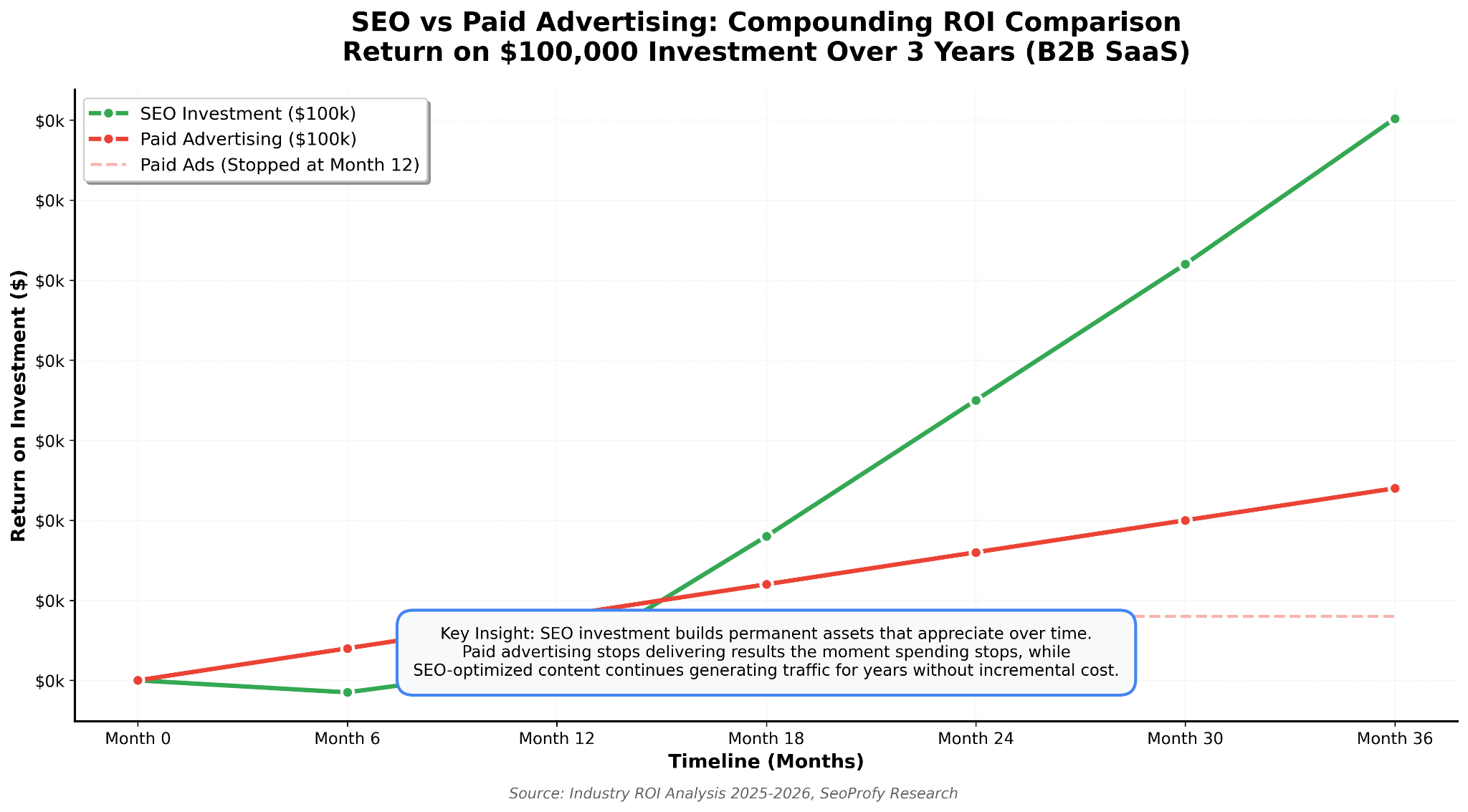
Industry ROI analysis from 2025-2026 shows SEO typically requires 6-12 months to achieve positive ROI, but delivers 702% returns for B2B SaaS companies over 1-3 years compared to paid search's 200-300% returns over the same period.
The divergence stems from compounding effects. Each new piece of optimized content can rank for multiple queries, earn backlinks that boost other pages, and continues generating traffic for years without incremental cost, which creates a portfolio effect where the value of your SEO investment increases exponentially rather than linearly as each piece of content amplifies the performance of previous content through internal linking, topical authority signals, and domain-wide ranking improvements.
Paid advertising stops delivering results the moment you stop paying. A campaign generating $100,000 in revenue this year will generate zero next year without continued investment. That same $100,000 invested in SEO builds assets that appreciate.
Top-ranking content from 2023 still drives traffic in 2026. The domain authority built over years makes each subsequent optimization effort more effective.
The 14.6% close rate for organic leads versus 1.7% for outbound methods reflects a fundamental difference in user psychology: search captures active problem-solving, while ads interrupt passive browsing. Businesses that allocate 70-80% of digital marketing budgets to paid channels are essentially choosing expensive, temporary visibility over permanent, compounding assets.
Real-World Examples and Case Studies
B2B SaaS Performance
B2B SaaS companies demonstrate particularly strong SEO results. HubSpot's 2024 marketing data showed 57% of B2B marketers identify SEO as their most effective digital channel, with B2B SaaS achieving 702% ROI over 1-3 years.
Original research publication drives 18.7% traffic increases for companies that invest in creating authoritative data.
The pattern holds across industries: companies that publish original research, comprehensive guides, and data-driven insights consistently outperform those relying solely on promotional content or thin how-to articles. Analyzing google search results and proprietary SEO data enables businesses to identify content gaps and opportunities for competitive advantage.
E-Commerce Results
Incremys data shows 43% of e-commerce traffic comes from Google organic search. Adding customer reviews doubles conversion rates on product pages. Embedding product videos multiplies conversion probability by 53x.
Schema markup for products, reviews, and offers dramatically improves CTR in rich results.
Local Business Impact
Local businesses achieve immediate measurable results through Google Business Profile optimization, location-specific content, and review management. Complete profiles with 250+ photos, consistent NAP data, and active review responses convert searchers into customers.
The statistics confirm 88% of local smartphone searchers visit or call within 24 hours.
Frequently Asked Questions
What percentage of searches result in website clicks in 2026?
Approximately 40% of searches result in clicks to websites in 2026, meaning 60% are zero-click searches where users find answers directly on search result pages. AI Mode searches have even lower click rates, with 93% ending without clicks. When users do click, the top position captures 39.8% of clicks, demonstrating that ranking still matters significantly for traffic generation.
How long does SEO take to show results?
Most businesses see initial SEO results within 3-6 months, with positive ROI typically achieved in 6-12 months. Backlinks typically take 2-6 weeks to impact rankings. The compounding effect means SEO delivers stronger returns in year two and beyond as authority builds. Businesses should plan for 12-18 month timelines for substantial organic visibility in competitive industries.
Are backlinks still important for SEO rankings?
Yes, backlinks remain a foundational ranking signal. Pages ranking #1 have 3.8 times more backlinks than lower positions, and 94-95% of web pages have zero backlinks. Quality now matters far more than quantity. The average cost for quality backlinks reached $361 in 2026, reflecting their continued value.
How does voice search affect SEO strategy?
Voice search, used by 20.5% of global users, requires optimization for conversational, question-based queries. Key optimizations include targeting featured snippet positions, creating content that answers specific questions clearly, and optimizing for local intent since 58% of voice searches seek local information.
What's the most cost-effective SEO investment for small businesses?
Content marketing delivers the highest return for small businesses. Creating comprehensive, helpful content naturally attracts backlinks and ranks for long-tail queries. High-ROI tactics include optimizing Google Business Profile for local visibility, publishing original research, and building location-specific service pages. 74% of small businesses investing in SEO spend an average of $497 monthly. Consistent blog posts help business owners establish their online presence and demonstrate expertise in their respective fields.


