



Table of contents
Teams that use documented promotional plans are 356% more likely to report success, per CoSchedule. Here is the complete framework to build a promotional plan that drives measurable results.
Key Takeaways
- Marketers who document their promotional strategy are 356% more likely to report campaign success versus those without a written plan, per CoSchedule's research across 3,000+ marketing teams.
- The average marketing team wastes 26% of its budget on activities not aligned with strategic objectives — a gap that a structured promotional template eliminates.
- Companies using the SOSTAC framework (Situation, Objectives, Strategy, Tactics, Action, Control) for promotional planning see 30–40% faster campaign launches because every stakeholder knows their role before work begins.
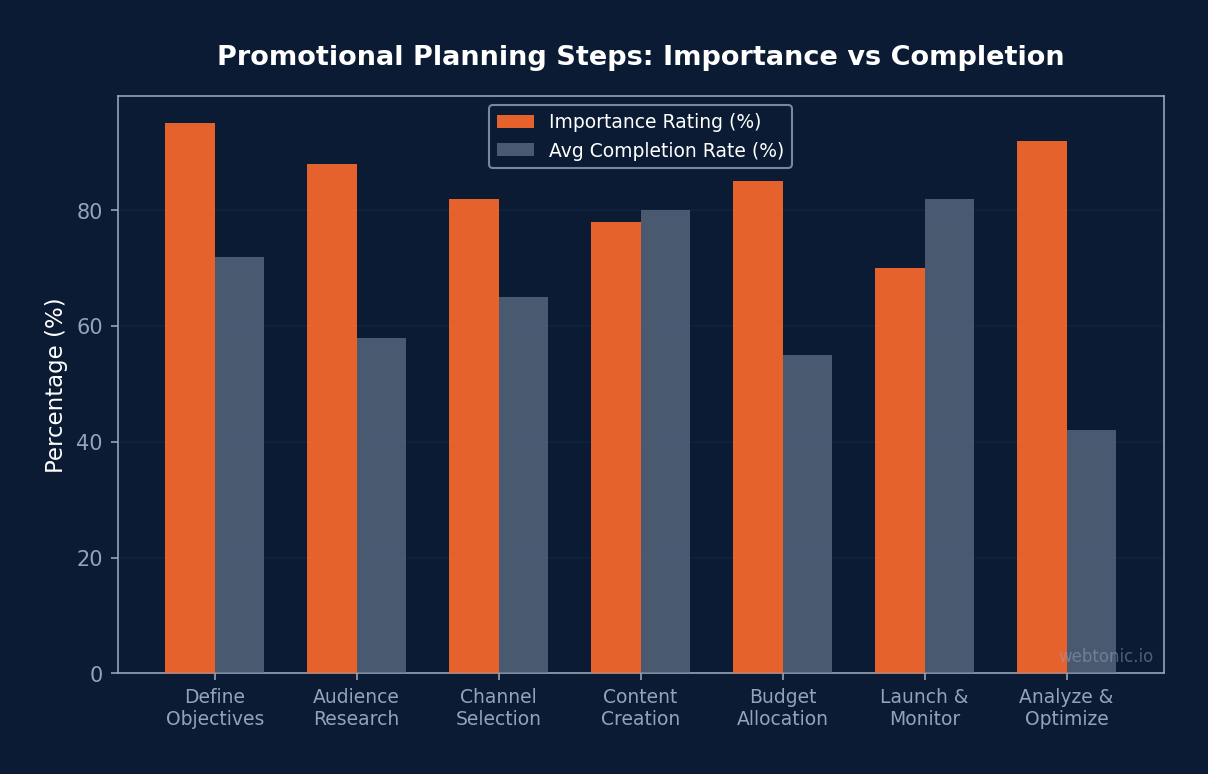
- Only 42% of marketing teams complete post-campaign analysis — the single biggest missed opportunity for improving future promotional performance.
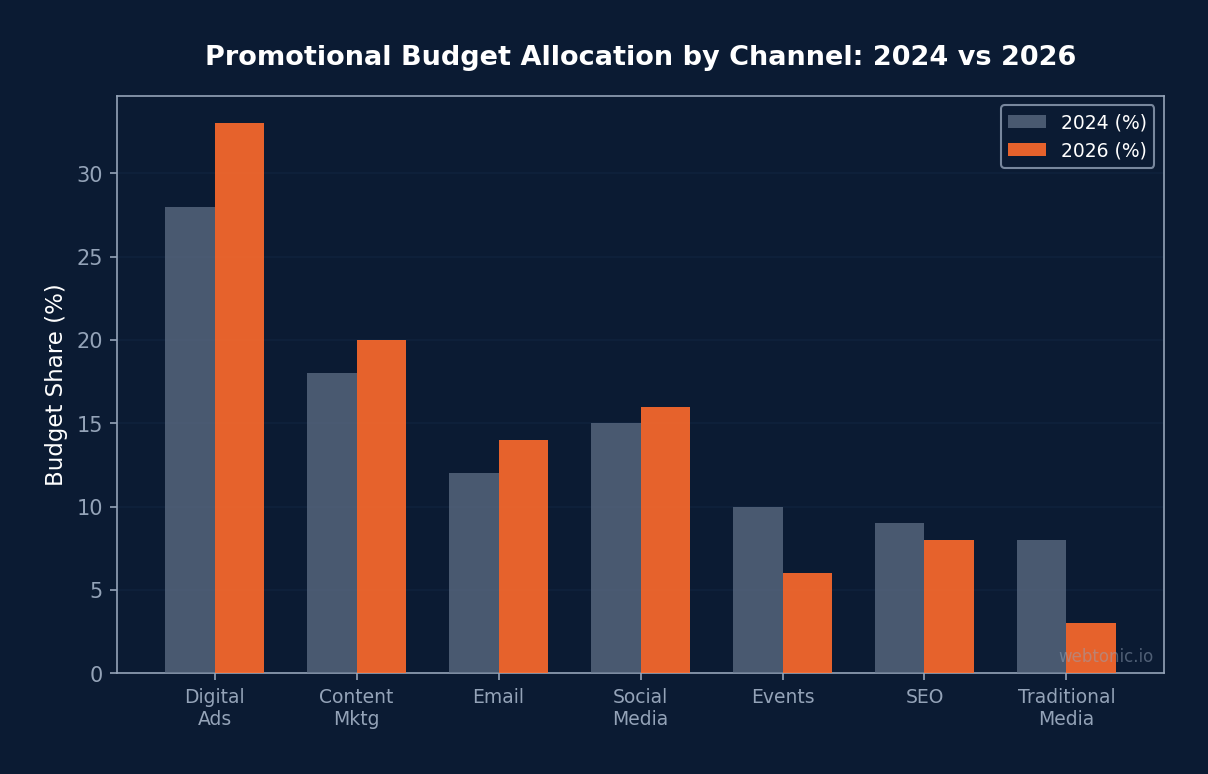
- Digital ad spending now commands 33% of promotional budgets in 2026, up from 28% in 2024, making channel allocation the most consequential section of any promotional planning template.
A promotional planning template is a structured document that maps out every component of a marketing campaign — from objectives and target audiences to channels, budgets, timelines, and success metrics. Without one, teams default to ad-hoc execution where campaigns launch without clear goals, budget decisions happen reactively, and nobody can answer the question "did this actually work?" after the promotion ends. Whether you are coordinating a product launch across multiple marketing channels or planning a seasonal sale, the template is the difference between organized execution and expensive guesswork.
What a Promotional Planning Template Includes
An effective promotional planning template covers seven core sections. Skip any one of them and you create a gap that surfaces mid-campaign when it is too late to fix without burning budget or delaying timelines.
| Section | What It Covers | Why It Matters |
|---|---|---|
| Campaign Objectives | SMART goals tied to revenue, leads, or awareness metrics | Without measurable targets, success is undefined and budget requests are impossible to justify |
| Target Audience | Buyer personas, segments, geographic focus, behavioral triggers | Determines messaging, channel selection, and creative direction for the entire campaign |
| Channel Strategy | Platform selection, paid vs organic mix, cross-channel sequencing | Digital ads consume 33% of budgets — misallocation here costs the most |
| Budget Allocation | Per-channel spend, production costs, contingency reserve | 26% of marketing budgets go to misaligned activities without clear allocation |
| Timeline & Milestones | Launch dates, creative deadlines, approval workflows, review points | Prevents the compressed timelines that force teams to skip testing and optimization |
| Team Roles & Responsibilities | RACI matrix, approval authority, escalation paths | Eliminates the bottleneck where everyone assumes someone else is handling a task |
| KPIs & Measurement Plan | Primary and secondary metrics, tracking setup, reporting cadence | Only 42% of teams do post-campaign analysis — measurement planning forces accountability |
According to Prooflytics, plans that fail to get approved at the budget meeting usually skip the Situation analysis (jumping straight to tactics) or skip the Control section (no measurement plan). Both omissions make the request impossible to evaluate, which is why CFOs reject them.
How To Create a Promotional Plan Step by Step
Building a promotional plan from scratch can feel overwhelming when you are staring at a blank document. The SOSTAC framework — Situation, Objectives, Strategy, Tactics, Action, Control — provides the most proven structure. Here is each step with the specific questions your template needs to answer.
Step 1: Situation Analysis. Before planning where you want to go, document where you are. Audit your current marketing performance, competitive landscape, and market conditions. What campaigns ran in the past quarter? What worked and what did not? What is your market share? A thorough situation analysis prevents the number-one planning mistake: building strategy on assumptions instead of data.
Step 2: Define SMART Objectives. Every promotional plan needs objectives that are Specific, Measurable, Achievable, Relevant, and Time-bound. "Increase brand awareness" is not an objective — "Generate 5,000 qualified leads from the Q3 product launch campaign by September 30" is. According to Monday.com's promotion strategy guide, campaigns with specific numeric targets outperform vague-goal campaigns by 2.7x in ROI because teams can optimize toward a defined endpoint.
Step 3: Identify Your Target Audience. Map out your buyer personas with enough detail to inform channel selection and messaging. This includes demographics, psychographics, pain points, buying triggers, and preferred platforms. The same promotion will perform completely differently when targeted at a 25-year-old Instagram user versus a 50-year-old LinkedIn executive — and your template should specify which segment each campaign element serves.
Step 4: Build Your Channel Strategy. Select the marketing channels that match your audience's behavior and your budget constraints. The 2026 promotional budget landscape has shifted significantly — digital advertising now takes 33% of total marketing spend, up from 28% in 2024, while traditional media has dropped to just 3% of average allocations. Your template should map each channel to a specific campaign objective.
Step 5: Set Your Budget. Allocate budget across channels, production costs, and a 10–15% contingency reserve for mid-campaign optimization. The biggest budgeting mistake is allocating evenly across channels instead of weighting toward high-performers. Use historical data to identify which channels deliver the lowest cost per acquisition, then allocate proportionally.
Step 6: Create Your Timeline. Build a promotional calendar with specific dates for creative production, approvals, launch, optimization checkpoints, and wrap-up. According to Monday.com's campaign template guide, the most effective timelines include buffer days between approval stages because compressed timelines force teams to skip A/B testing and launch with untested creative.
Step 7: Define Measurement and Control. Specify your primary KPIs, secondary metrics, tracking tools, and reporting schedule before the campaign launches. This is the section most teams skip — and it is the reason only 42% of marketing teams complete post-campaign analysis. Without pre-defined metrics, there is no standard to measure against.
Promotional Planning Template Sections Breakdown
Each section of your promotional planning template should follow a standardized format that makes it easy for team members to fill in, review, and update. Here is what each section looks like in practice, with the fields that matter most for campaign execution.
Campaign brief section: This is the one-page summary that stakeholders reference most often. It includes the campaign name, objective, target audience summary, primary channel, launch date, total budget, and the single most important KPI. Think of it as the "elevator pitch" for your entire promotional plan — if someone only reads this section, they should understand what you are doing and why.
Audience profiling section: Go beyond basic demographics. Document your audience's online behavior patterns, content consumption habits, peak engagement times, and purchase decision timeline. For example, a B2B SaaS company might note that their target audience is most active on LinkedIn between 8–10 AM on Tuesdays and Wednesdays, reads long-form content before making purchase decisions, and typically involves 3–5 stakeholders in the buying process.

Content and creative section: Map every creative asset to a channel and a campaign phase. A typical promotional campaign requires 15–25 unique creative assets across channels — ad copy variations, email templates, social media posts, landing pages, and banner ads. Your template should track each asset's status (brief, in production, review, approved, live) with assigned owners and deadlines.
| Campaign Phase | Duration | Key Activities | Creative Assets Needed |
|---|---|---|---|
| Pre-Launch | 2–4 weeks | Audience research, creative production, tracking setup, team alignment | Landing page, ad creatives, email sequences, social teasers |
| Launch Week | 1 week | Campaign go-live, initial monitoring, rapid creative swaps if needed | Launch emails, social announcements, press materials |
| Optimization | 2–6 weeks | A/B testing, budget reallocation, audience refinement, content refreshes | Test variations, refreshed ads, retargeting creatives |
| Wrap-Up | 1 week | Final reporting, ROI calculation, team retrospective, learnings documentation | Report deck, case study assets, stakeholder summary |
Types of Promotional Plans and When To Use Them
Not every promotion needs the same template depth. Matching the planning complexity to the campaign scale prevents both over-planning (which delays launch) and under-planning (which wastes budget). Here are the main types of promotional plans and the contexts where each works best.
Seasonal promotion plan: Used for recurring events like Black Friday, holiday sales, or back-to-school campaigns. These plans are the most template-friendly because the structure repeats annually. The key differentiator from year to year is the competitive landscape analysis — what worked last year may not work this year if competitors have shifted their strategy. Seasonal promotions typically run 2–6 weeks and require 4–8 weeks of lead time for creative production and media buying.
Product launch plan: The highest-stakes promotional plan because first impressions drive 60–70% of a product's lifetime sales trajectory. Launch plans require the most detailed audience segmentation because you need to sequence messaging differently for early adopters, mainstream buyers, and late-majority audiences. These plans typically span 8–12 weeks from pre-launch teaser phase through post-launch follow-up.
Brand awareness campaign plan: Focuses on reach and frequency rather than immediate conversions. These plans prioritize creative quality and emotional resonance over direct response tactics. Measurement is more nuanced — you are tracking brand lift, share of voice, and unaided recall rather than cost per lead.
Sales promotion plan: Discount-driven campaigns with clear revenue targets. These are the simplest to template because the mechanics are straightforward: offer, duration, channels, budget. The risk is over-discounting, which trains customers to wait for sales. Effective sales promotion plans include a post-promotion pricing recovery strategy that rebuilds margin within 30 days.
Content marketing promotion plan: Promotes content assets (ebooks, webinars, reports) as lead generation tools. These plans differ from product promotions because the conversion path is longer — the content is the top-of-funnel entry point, not the sale itself. Success metrics focus on lead quality and pipeline contribution rather than direct revenue.
Common Promotional Planning Mistakes
After reviewing hundreds of promotional plans across industries, these are the mistakes that consistently undermine campaign performance — and the specific fixes for each one.
Mistake 1: Starting with tactics instead of strategy. Teams jump to "let's run Facebook ads" before defining who they are targeting, what they want those people to do, and how they will measure success. According to Prooflytics, plans that skip situation analysis fail to get budget approval 3x more often than those that start with data.
Mistake 2: No contingency budget. Every promotional campaign encounters unexpected costs — a creative that underperforms and needs replacement, a channel that requires more spend to hit targets, or a competitor that launches a countering promotion. Without a 10–15% contingency reserve, teams either overspend their approved budget or miss opportunities because they have no flexibility.
Mistake 3: Unclear ownership. When three people think someone else is handling the email sequence, the email sequence does not get done. Use a RACI matrix (Responsible, Accountable, Consulted, Informed) for every deliverable in the plan. This single addition eliminates the "I thought you were doing that" conversations that derail timelines.

Mistake 4: Treating all channels equally. Allocating $5,000 to each of four channels is the easiest budgeting approach and the worst-performing one. Historical data almost always shows that one or two channels deliver 60–80% of your results. Weight your budget toward proven performers and use smaller allocations for experimental channels.
Mistake 5: No post-campaign review process. The promotional plan's most valuable output is not the campaign itself — it is the learnings that improve the next campaign. Teams that conduct structured post-campaign reviews improve campaign ROI by 15–25% in subsequent promotions because they stop repeating the same mistakes.
Tools for Promotional Planning
The best promotional planning template is only as useful as the tool you use to manage it. Here are the platforms that support collaborative promotional planning at different budget levels, from free options to enterprise solutions.
Spreadsheets (Google Sheets / Excel): Still the most popular tool for promotional planning because of zero cost and universal familiarity. Best for small teams running 1–5 promotions per quarter. The limitation is that spreadsheets cannot send notifications, automate status updates, or provide real-time dashboards without significant manual effort.
Project management platforms (Monday.com, Asana, Trello): According to Monday.com, project management platforms reduce campaign launch time by 20–30% because they automate task dependencies, deadline reminders, and approval workflows. Best for mid-size teams running 5–15 promotions per quarter.
Marketing management platforms (HubSpot, CoSchedule, Wrike): These platforms combine promotional planning with execution tools — email automation, social publishing, and analytics dashboards integrated into the same workflow. Best for teams with $50K+ monthly marketing budgets that need tight planning-to-execution alignment. According to Semrush, the most effective marketing plans combine documented strategy with real-time performance dashboards.
Enterprise marketing resource management (Allocadia, Uptempo): Purpose-built for large organizations managing $1M+ annual marketing budgets across multiple business units. These platforms add budget governance, compliance workflows, and executive-level reporting on top of campaign planning. Read the Web Tonic blog for detailed tool comparisons and recommendations.
Related reading
- Fractional CMO Tooling and Template Checklist
- AI Marketing Advisory / AI Readiness — Tooling & Template Checklist
- Growth Advisory Tooling and Template Checklist
- Marketing Strategy Consulting services at Web Tonic
Frequently Asked Questions
What is a promotional planning template?
A promotional planning template is a structured document that organizes every component of a marketing campaign into a repeatable format. It typically includes sections for campaign objectives, target audience profiles, channel strategy, budget allocation, timelines, team responsibilities, and measurement KPIs. The template ensures nothing is overlooked during planning and provides a consistent framework that teams can use across multiple promotions without starting from scratch each time.
How do I create a promotional plan from scratch?
Start with the SOSTAC framework: Situation (where you are now), Objectives (where you want to go), Strategy (how you will get there), Tactics (specific activities), Action (who does what and when), and Control (how you will measure success). Begin by auditing your current marketing performance and competitive landscape, then define SMART goals, identify your target audience segments, select your channels based on audience behavior, allocate budget proportionally to proven channels, build a timeline with buffer days, and set up your measurement plan before launching.
What are the 7 Ps of a marketing plan?
The 7 Ps of marketing are Product, Price, Place, Promotion, People, Process, and Physical Evidence. In a promotional planning context, these translate to: what you are promoting (Product), at what cost or discount level (Price), through which channels (Place), with what messaging and creative (Promotion), involving which team members and target audiences (People), following what workflow and approval process (Process), and supported by what tangible proof points like testimonials or case studies (Physical Evidence).
How far in advance should you plan a promotion?
The lead time depends on the campaign complexity. Simple sales promotions need 2–4 weeks of planning. Product launches require 8–12 weeks from strategy through execution. Seasonal campaigns like Black Friday should begin planning 3–4 months in advance to secure media placements and complete creative production. The rule of thumb is to allow twice as much planning time as you think you need — compressed timelines force teams to skip testing, which is the single biggest driver of campaign underperformance.
What makes a promotional plan successful?
Successful promotional plans share three characteristics: they start with data-driven situation analysis instead of assumptions, they define specific measurable objectives before selecting tactics, and they include a structured post-campaign review process. Teams that document their promotional strategy are 356% more likely to report campaign success. The most common differentiator between high-performing and low-performing plans is the measurement section — teams that define KPIs before launch and conduct post-campaign analysis improve their ROI by 15–25% on each subsequent campaign.
Sources
Prooflytics — Annual Marketing Plan Template 2026
Monday.com — Marketing Campaign Template: Plan & Execute Campaigns
Monday.com — Promotion Strategy: Build Campaigns That Drive Results
CoSchedule — Marketing Statistics: Strategy Documentation Data
Gartner — CMO Spend Survey: Marketing Budget Benchmarks
HubSpot — Marketing Statistics: Planning & ROI Data


