Table of contents

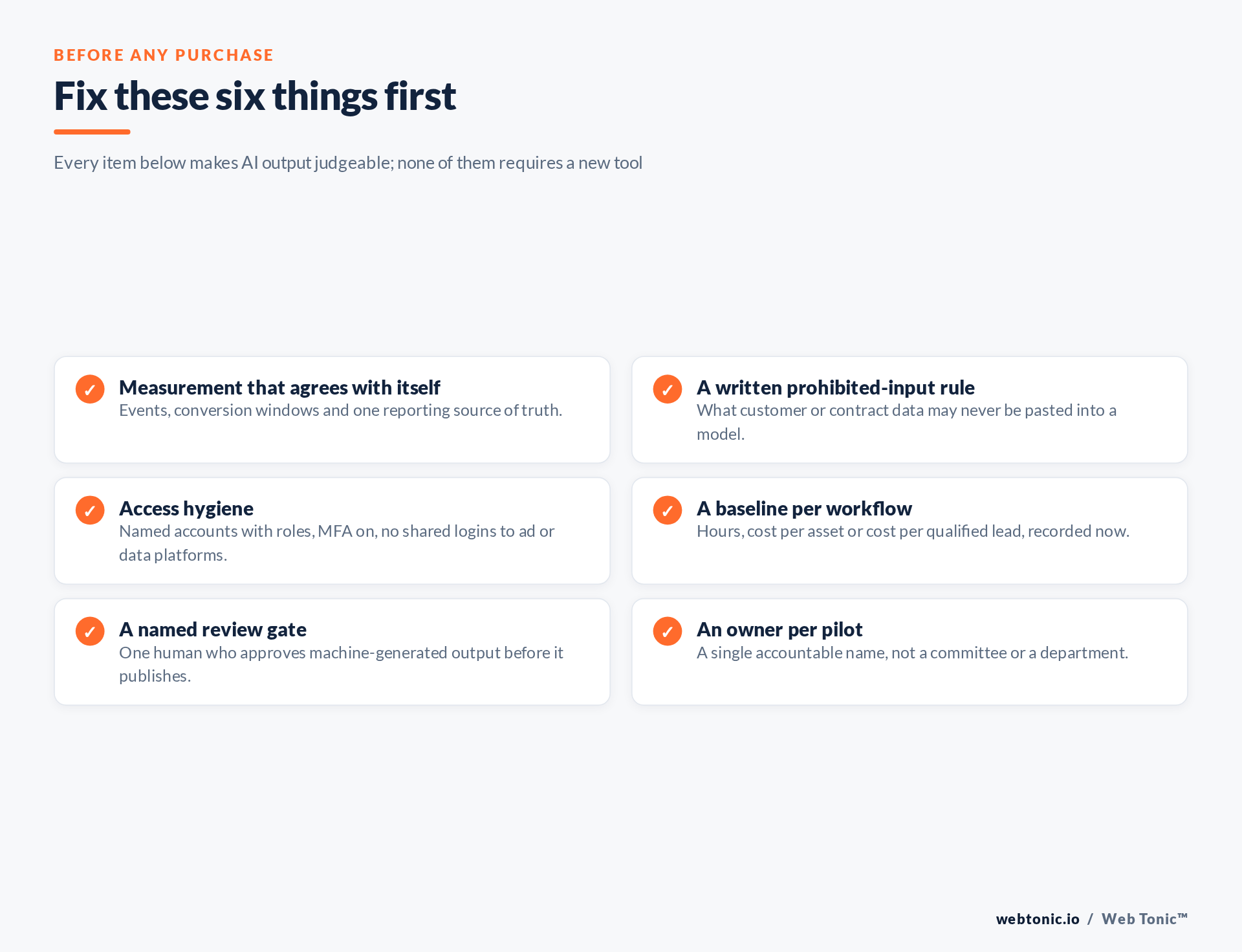
Quick answer: Before buying AI marketing tooling, fix six things: measurement that agrees with itself, a written prohibited-input rule, access hygiene, a baseline per workflow, a named human review gate, and one accountable owner per pilot.
Last verified: 2026-09-13
The stack is rarely the constraint
Most teams asking an AI marketing consultant which tools to buy already own more capability than they use. The constraint is usually that nobody can prove what a workflow costs today, so no result can be judged tomorrow. Buying software first converts a measurement problem into a subscription.
Work the checklist below before any purchase order. None of it requires new licences, and all of it survives whichever vendor wins the category next year.
Make measurement agree with itself
Start with the numbers you will use to judge pilots. Confirm your event configuration matches what the business believes it counts, and check the conversion windows behind any paid figure you plan to quote. Two systems disagreeing by a third is enough to make every pilot argument unresolvable.
Then pick one reporting source of truth per metric and write it down. This is ordinary analytics and conversion tracking hygiene, and it is the highest-return work in an AI readiness assessment.
Write the data rule before the first prompt
One paragraph, agreed once: which categories of customer, employee and contract data may never be sent to a third-party model, and which systems are in scope. Where personal data is involved, name the lawful basis under regimes such as GDPR, and check guidance from the European Data Protection Board if you operate in the EU.
Govern against a published framework rather than instinct. The NIST AI Risk Management Framework gives the govern-map-measure-manage shape, and the EU AI Act framework tells you which uses carry extra obligations.
Fix access hygiene while you are in there
Named accounts with appropriate roles, no shared logins, and multi-factor authentication on every ad, analytics and CMS platform. NIST SP 800-63 sets the reference for authentication assurance, and CISA is blunt about how much MFA prevents.
This matters more once automation is writing to live systems. An agent acting through a shared login is an incident waiting for an audit.
Templates are the cheap part everyone skips
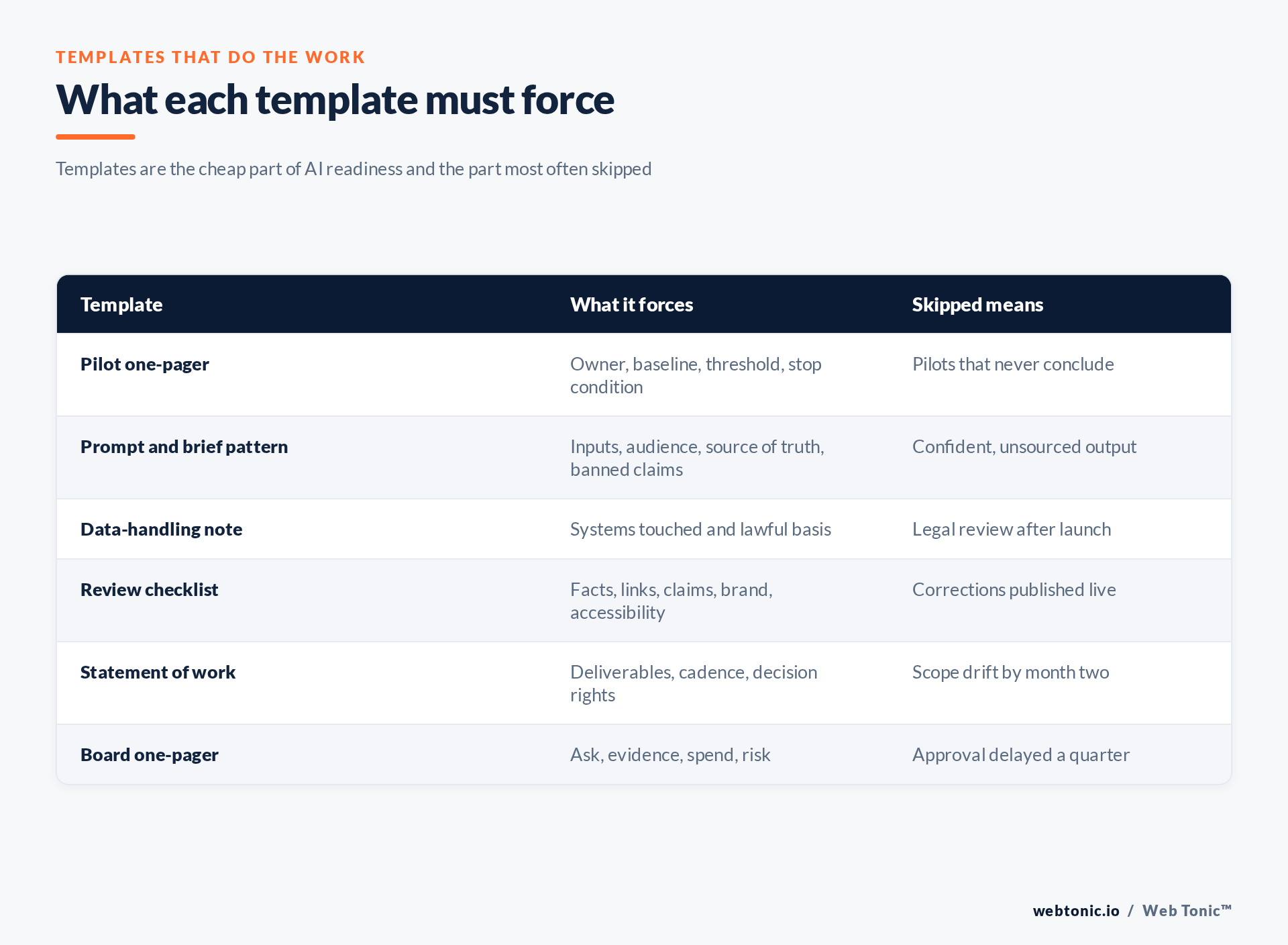
Six documents carry an AI marketing consulting engagement: a pilot one-pager, a prompt-and-brief pattern, a data-handling note, a review checklist, a statement of work, and a board one-pager. Each one exists to force a decision that otherwise gets deferred.
The review checklist earns its place fastest. Google's guidance on people-first content is clear that publishing at scale without a quality gate is a losing trade, so the checklist covers facts, links, claims, brand voice and accessibility before anything goes live.
| Checklist item | Proof it is actually done | Pilot that fails without it |
|---|---|---|
| Measurement agrees | One named source of truth per metric, in writing | Any efficiency or CPL claim |
| Data rule | A one-paragraph prohibited-input rule, circulated | Personalisation and CRM work |
| Access hygiene | Named accounts, roles reviewed, MFA enforced | Anything writing to live platforms |
| Baselines | A recorded before number per workflow | All of them, silently |
| Review gate | A named editor and blocking criteria | Content and creative volume plays |
| Pilot owner | One name per pilot on the one-pager | Cross-team automation |
Only then look at tooling
Buy against a workflow you have already baselined, on the shortest commitment available, and prefer tools that write into systems you already own. Where marketing automation is involved, check what the platform does with your data before you check what it can generate.
Keep purchases inside the existing marketing plan and judge them on the same scorecard metrics as everything else. Third-party seat and platform prices for this category vary widely, from low double-digit monthly seats to enterprise contracts in the five figures; get quotes against your own scoped workflow rather than a category average, and we quote our own work only after scoping.
What goes wrong
The failure mode: tooling arrives before baselines. Six weeks later the pilot cannot be judged, the renewal is already inside its notice period, and the honest answer to "did it work?" is that nobody can say.
Second failure mode: no review gate. Output publishes unedited, a factual error reaches a client-facing page, and the programme loses its licence to operate internally regardless of the efficiency gain.
Third: templates that describe instead of forcing. A pilot one-pager without a stop condition is a status document. Related checklists live in the help library; delivery sits under growth marketing and data intelligence.
Frequently Asked Questions
Do we need new tools to start?
Usually not. The first useful pilots run on tooling you already pay for, which is exactly what makes their results interpretable.
How long does this checklist take?
Two to three weeks in most teams, and the measurement item accounts for most of it. Access hygiene and the data rule are days of work, not weeks.
Who owns the prohibited-input rule?
Whoever can refuse on legal or brand grounds, with the marketing owner accountable for enforcing it in day-to-day work.
What if leadership wants to buy first?
Agree to the purchase on the shortest cancellable term and record the baseline in the same week. That preserves the decision without losing the evidence.
Sources: NIST AI RMF, NIST SP 800-63; CISA on MFA; European Commission, AI Act framework; GDPR, EDPB; GA4 events, Google Ads conversion windows, Google helpful content guidance; Statement of work, Marketing automation (Wikipedia). Verified 2026-09-13.