



Table of contents
Quick answer: A growth advisory engagement needs six artefacts — an evidence pack, a dated constraint statement, a decision log, a measurement map, a one-page board template and a review calendar — plus one tool per category, not one tool per idea.
Last verified: 2026-09-05
Tooling is not the work
The most common way to lose the first month of a growth strategy consultant engagement is to spend it choosing software. New dashboards get built, a warehouse gets scoped, and the constraint that the engagement exists to fix goes unexamined while everyone admires the pipes.
The rule that holds up across engagements is simple: use whatever the company already has until it demonstrably blocks a decision. Then replace exactly that one thing. A revenue growth plan is judged on decisions taken, and no board has ever been persuaded by the elegance of a data stack.
The six artefacts
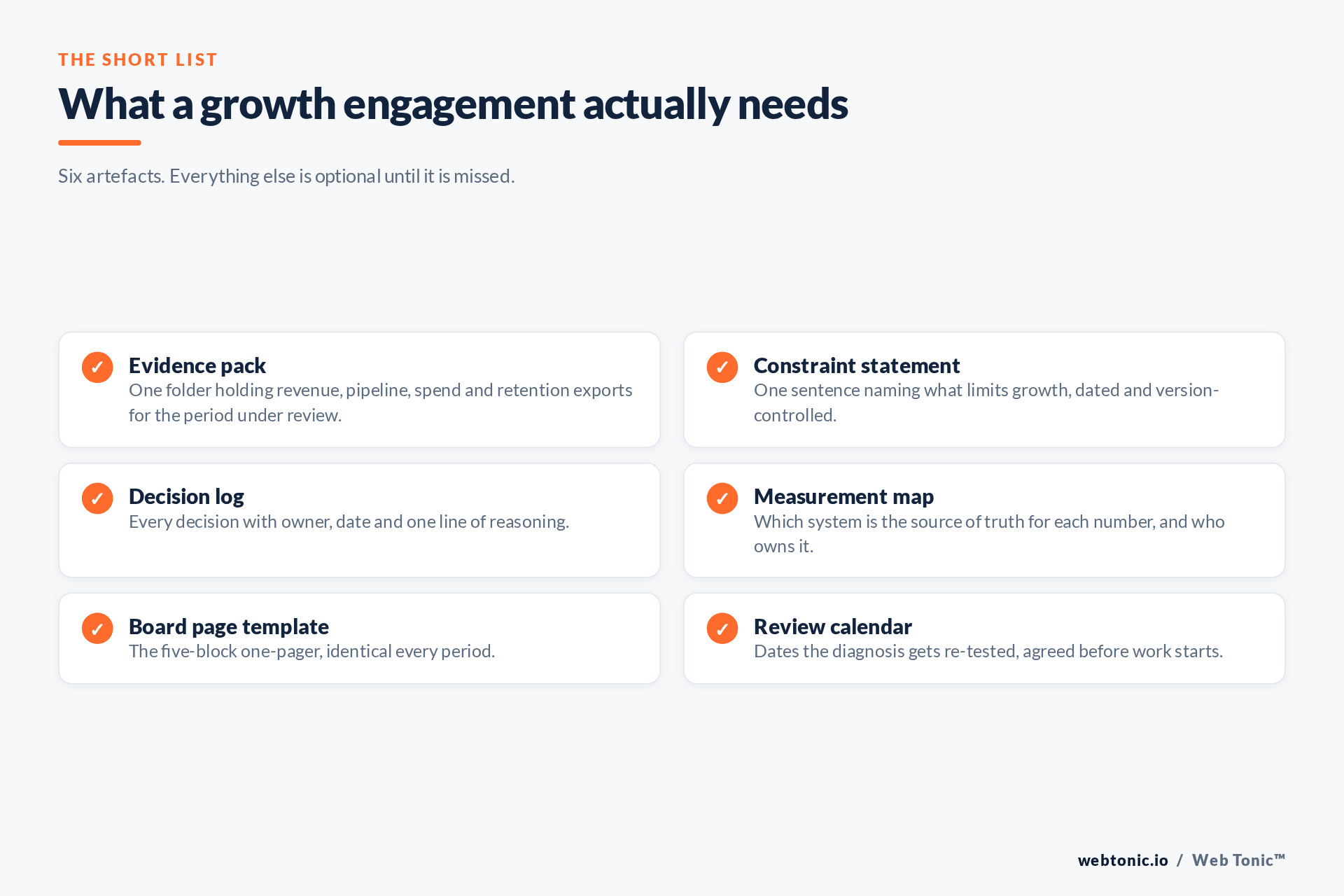
The evidence pack. One folder, one period, holding revenue by segment, pipeline and win rate by source, channel spend against outcomes, closed-lost reasons and retention. Exports, not links: a link re-queried three months later returns different numbers and destroys the audit trail.
The constraint statement. One sentence, dated, saying what limits growth. Version it. Two dated sentences six months apart are the clearest record of whether the engagement learned anything.
The decision log. Every decision with an owner, a date and one line of reasoning. This is the artefact that survives staff turnover and the one that makes a renewal conversation short.
The measurement map. For each number that matters, the system that is its source of truth and the person who owns it. Where two systems disagree, the map records which one wins. Most reporting arguments are really unresolved map questions.
The board page template. The five-block one-pager, identical every period, so a reader can compare two months without re-learning a layout.
The review calendar. The dates the diagnosis gets re-tested, agreed before work starts, so a review is never read as a reaction to bad news.
Tool categories, not tool brands
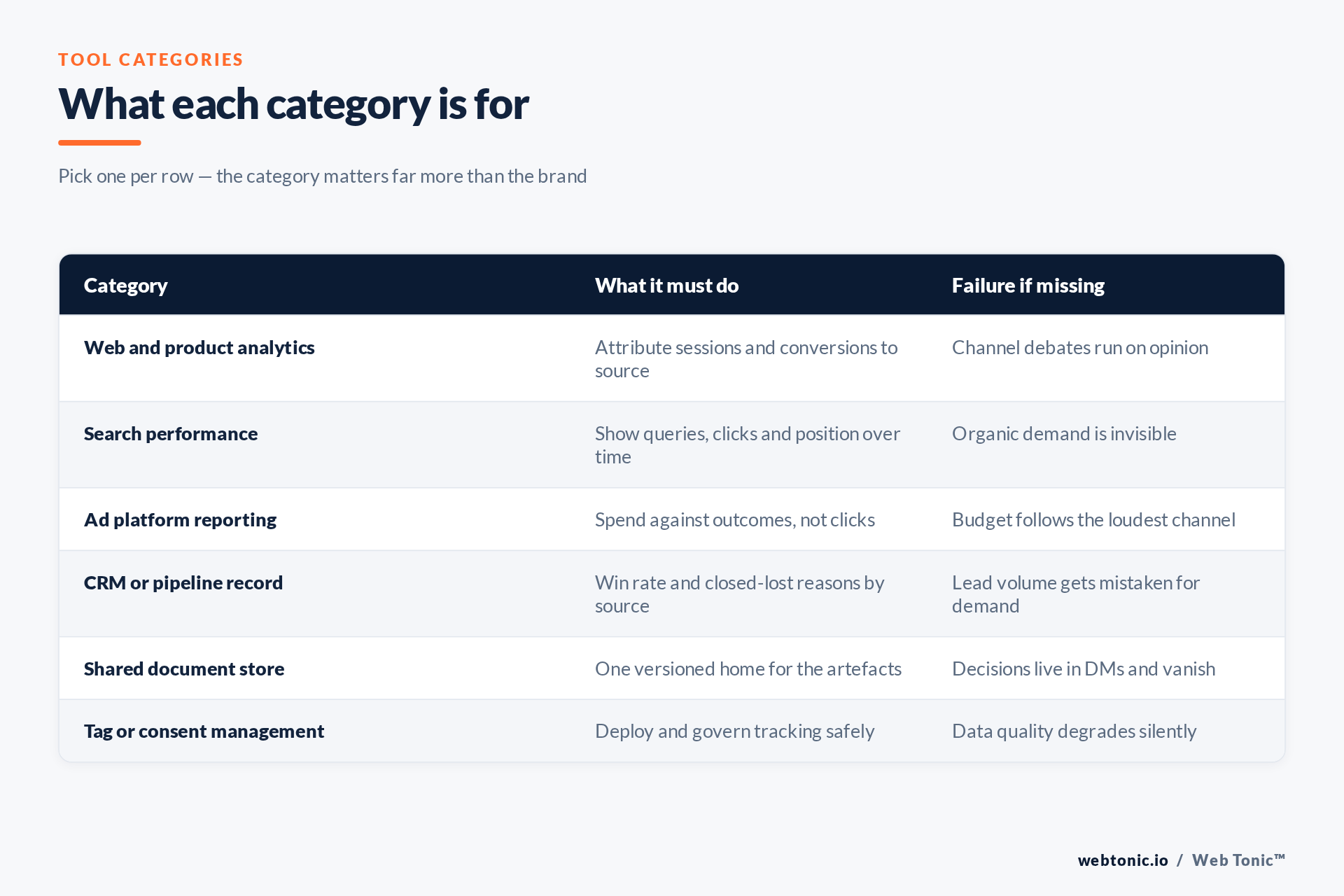
Six categories cover almost every engagement: web and product analytics, search performance, ad platform reporting, a CRM or pipeline record, a shared document store, and tag or consent management. One tool per category. The brand matters much less than whether someone in the company can be named as its owner.
Where the stack is genuinely thin, the highest-value additions are usually the free first-party ones: a properly configured analytics property, a verified Search Console account, and a tag setup with consent handled correctly. Those three close most measurement gaps before anyone has to buy anything.
What the market charges, and why we are not quoting it
Advisory and consulting rates vary enormously by market, seniority and scope — published market commentary spans independent operators charging by the day at one end and global firms billing by the week at the other, and any single figure quoted out of that range is misleading. Treat any number you read, including in vendor marketing, as a market observation rather than a quote.
The practical guidance: price the engagement against the decisions it will unblock, not against hours. If you want a figure for your own situation, ask for a scoped quote rather than a rate card — the scope is what determines the number, and a rate without a scope is not comparable to anything.
| Template | Length | Who owns it |
|---|---|---|
| Evidence pack index | One page | Consultant |
| Constraint statement | One sentence, dated | Consultant, signed off by CEO |
| Decision log | One row per decision | Consultant |
| Measurement map | One row per metric | Client analytics owner |
| Board page | One page, five blocks | Consultant |
| Scope and statement of work | Two to three pages | Both parties |
Access, before anything else
Half of the first week is usually lost to permissions. Request read access to analytics, search, every ad account, the CRM and the tag manager in a single message on day one, named by property and account ID, and say what each is for. Access requested one system at a time takes a fortnight.
Ask for read-only unless a change is agreed in writing. It removes an entire category of argument later, and it is the same discipline our analytics and conversion tracking work runs on. Where tracking turns out to be the constraint, that becomes a scoped piece of work in its own right rather than something absorbed silently into advisory hours — see data intelligence.
What goes wrong
The failure mode: the stack becomes the deliverable. Two months in there is a beautiful dashboard, no dated constraint statement and no decision log. The engagement can show effort but cannot show judgement, and the renewal conversation is about tooling rather than results.
The second failure mode is templates nobody owns. A decision log with no named owner stops being updated in week three, which is worse than never starting one because people still believe it is current. Assign every artefact a person, not a team.
The third is duplicating a category. Two analytics tools reporting different numbers guarantees that every meeting begins by reconciling them, and the reconciliation is never anyone's job. Pick one per category, write it in the measurement map, and turn off the other. More reading sits in the help library.
Related reading
- AI Marketing Advisory / AI Readiness — Tooling & Template Checklist
- Growth Consulting Statistics: Adoption and Tooling in 2026
- Marketing Audit / Growth Audit — Tooling & Template Checklist
- Marketing Strategy Consulting services at Web Tonic
Frequently Asked Questions
What tools does a growth advisory engagement actually need?
One per category: web analytics, search performance, ad platform reporting, a CRM or pipeline record, a shared document store, and tag or consent management. Use what the company already has until it blocks a decision.
Which templates matter most?
The dated constraint statement and the decision log. Between them they record what you believed and what you did about it, which is the whole audit trail of an advisory engagement.
Should we build a data warehouse first?
Rarely. Build one when a specific decision cannot be made without it. Warehouse projects started before a constraint is agreed tend to consume the first quarter and answer questions nobody asked.
How much does growth consulting cost?
Published market rates span a very wide range by seniority, market and scope, so a single figure is not meaningful. Ask for a scoped quote — the scope determines the number.
Sources: Statement of work, Key performance indicator, Marketing plan (Wikipedia); Google Analytics Help; Search Console Help; Google tag platform consent documentation. Verified 2026-09-05.


