



Table of contents
Quick answer: A fractional CMO checklist has three parts: access (ads, analytics, CRM, CMS, billing), context (four quarters of revenue, targets, the current plan), and six templates — statement of work, 90-day plan, channel one-pagers, decision log, board pack, measurement definitions.
Last verified: 2026-09-04
Why the checklist matters more part-time
A full-time hire can afford a slow start. They will be in the building for years, so a fortnight spent gathering logins and reading old decks disappears into the noise. A part-time CMO on two days a month cannot: the same fortnight is a meaningful share of the entire engagement, and it is the share the client remembers.
So the checklist exists to compress discovery. Everything below is either something you cannot start without, or something you will otherwise rebuild badly under time pressure later. The point of standardising it is not tidiness, it is that marketing leadership delivered in short bursts only compounds when each burst starts where the last one stopped.
Part one — access
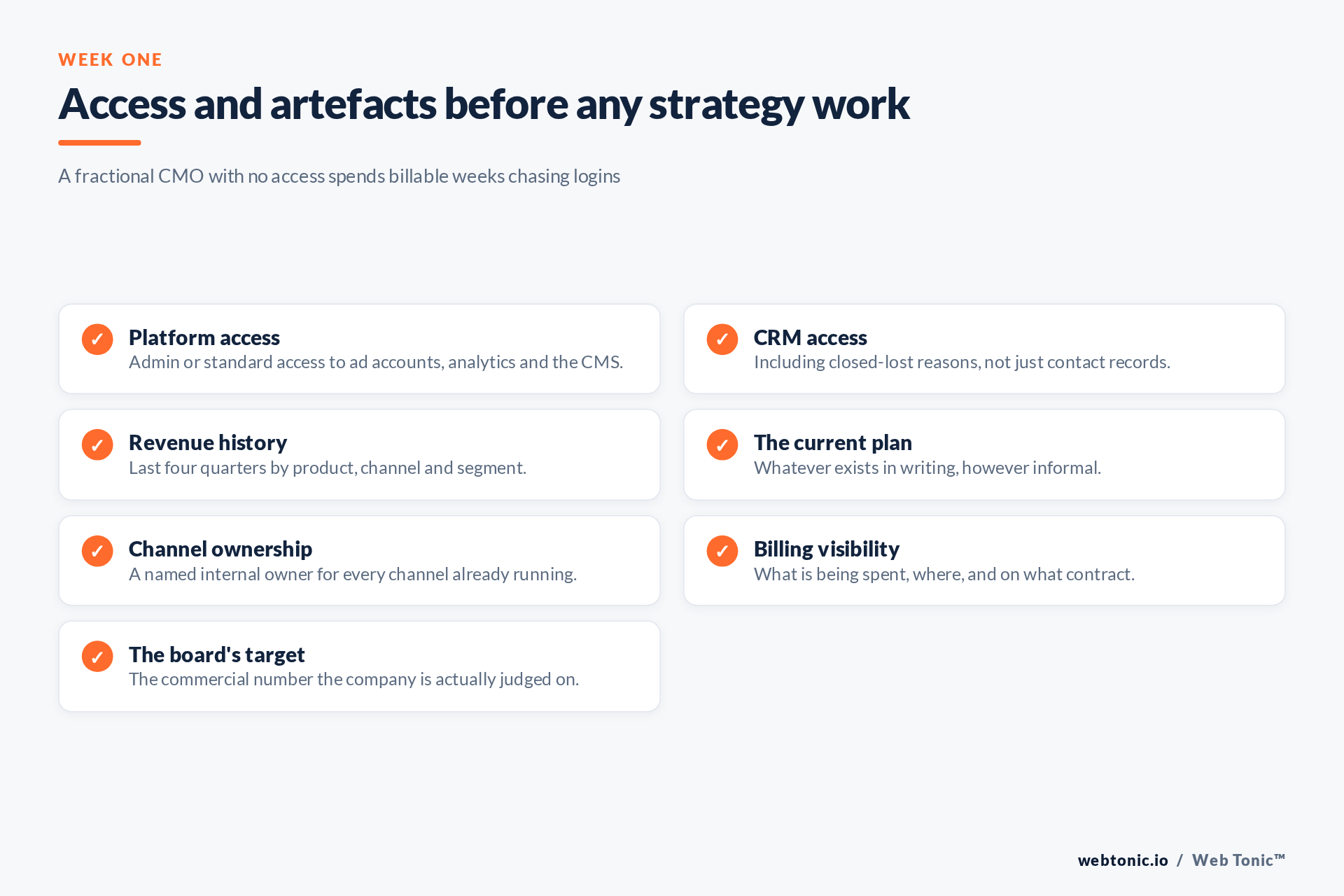
Ask for access before the kickoff call, not during it. The list is short and boring: advertising accounts, web analytics, the CMS, the CRM, and enough billing visibility to see what is actually being spent. Request the standard permission level rather than owner rights wherever the platform supports it — most do, and it removes an objection that otherwise stalls the whole request.
The CRM matters most, and it is the one most often skipped. Campaign data tells you what happened before the form fill; only the CRM tells you what happened after, including closed-lost reasons. An engagement that never sees pipeline outcomes ends up optimising for lead volume by default, which is how marketing and sales end up disagreeing about the same quarter.
Where access has to run through an agency or a partner, agree the mechanism in writing: which entity holds the account, who can revoke, and what happens at the end of the engagement. This is the same hygiene we apply to our own analytics and conversion tracking handovers, and it prevents the ugliest version of a bad ending — a client locked out of their own history.
Part two — context
Three documents, ideally before day one. Four quarters of revenue split by product, channel and segment. The commercial target the board holds the company to, stated as the board states it. And the current marketing plan, however informal — if none exists in writing, that absence is itself the first finding, and it is common enough that a written marketing plan is often the engagement's first real deliverable.
Add one conversation that is not a document: fifteen minutes each with the people who talk to customers. Sales, support, and whoever answers the inbox. This is a compressed version of voice-of-the-customer research, and it consistently surfaces objections that no dashboard contains.
Part three — the six templates
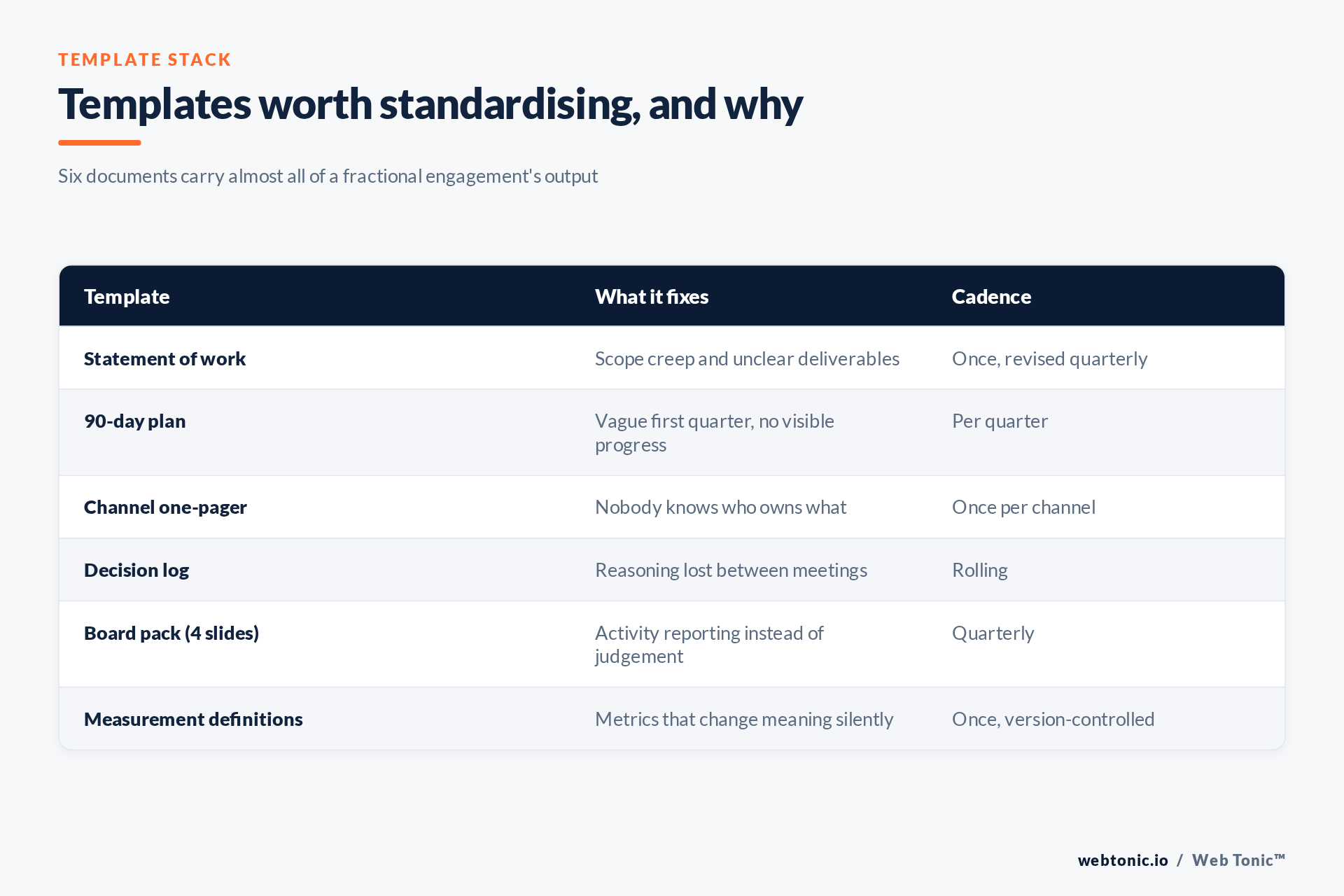
The template stack is deliberately small. Each one exists because a specific failure keeps recurring across engagements.
The statement of work names the outcome, the decision rights, and what is explicitly out of scope. A statement of work that lists only activities invites an interim marketing director to be measured on attendance.
The 90-day plan converts the scope into three visible milestones. Anything that cannot be finished inside a quarter belongs in the plan as a sequenced step rather than an ambition.
Channel one-pagers state, per live channel: the objective, the owner, the budget, the measurement, and the decision that would cause you to stop. Most accounts we inherit fail on the last line — there is no agreed condition under which anything gets switched off.
The decision log is a rolling list of what was decided and why. It is the cheapest artefact here and the most valuable in month five, when someone asks why prospecting budget moved.
The board pack is four slides: the outcome number, the decisions, what changed the plan, and the ask. It exists because the default board update drifts into activity reporting.
Measurement definitions pin down what each headline metric means and where it comes from. Keep it version-controlled. Metrics that change definition silently destroy trust faster than bad numbers do, which is why frameworks like key performance indicators and OKRs insist on a stated calculation.
Tooling: what to leave alone
The instinct on arrival is to replace the stack. Resist it for at least a quarter. New tools consume the client's time, not just yours, and a migration in month one buys a reputation as an expensive source of admin.
Only three tooling problems justify early action: no reliable analytics, no CRM record of outcomes, and no single place where the plan lives. Everything else can wait for evidence. Where tracking genuinely is broken, fix measurement before strategy — our server-side tracking and data intelligence notes cover the order of operations, and the rest of the library covers the individual failures.
| Timing | Do this | Not this |
|---|---|---|
| Before day one | Access requests, revenue history, targets | Tool demos |
| Week one | Customer-facing interviews, channel one-pagers | A rebrand conversation |
| Weeks two to four | Measurement definitions, 90-day plan | Replacing the CRM |
| Quarter two | Tooling changes backed by evidence | Tooling changes backed by preference |
What it costs to get this wrong
Fractional engagements are priced across a wide band in the open market — public directories and freelance marketplaces show senior interim marketing leadership advertised anywhere from roughly US$3,000 to US$20,000 a month depending on days committed, seniority and market, and the spread is genuinely that wide. The number matters less than what it buys: at the low end you are buying a few days of judgement, and days spent chasing logins are days not spent on the plan. For a scoped quote against your own situation, talk to us about the engagement rather than a rate card.
The failure mode: the checklist gets treated as onboarding paperwork and half-completed. Access arrives in fragments over six weeks, the revenue history never appears, and the first plan is built on the client's self-description rather than their data. That plan is usually plausible and quietly wrong, and because it is plausible nobody catches it until the quarter ends.
The second failure mode is template inflation. Six documents become sixteen, the engagement starts producing documentation about documentation, and the client — reasonably — starts asking what they are paying for. If a template has not been read by anyone in two cycles, delete it.
Related reading
- Growth Advisory Tooling and Template Checklist
- Marketing Strategy Consulting: Tooling and Template Checklist
- Marketing Audit / Growth Audit — Tooling & Template Checklist
- Fractional CMO services at Web Tonic
Frequently Asked Questions
What access does a fractional CMO actually need?
Advertising accounts, web analytics, the CMS, the CRM including closed-lost data, and enough billing visibility to see committed spend. Standard permissions are usually sufficient; owner rights rarely are necessary.
Should a fractional CMO change the marketing tools?
Not in the first quarter, unless analytics is unreliable, outcomes are not recorded in a CRM, or the plan has no single home. Migrations consume client time and delay the work they were hired for.
How long before a fractional CMO produces something?
A 90-day plan inside the first three to four weeks is a reasonable expectation, assuming access arrived on time. If access is still incomplete at week three, that is the status update.
Is a statement of work necessary for a part-time engagement?
Especially for a part-time engagement. It is the only place decision rights and out-of-scope work get stated, and ambiguity costs proportionally more when the days are few.
Sources: Statement of work, Marketing plan, Voice of the customer, KPI, OKR (Wikipedia); MIT Sloan Management Review; Harvard Business Review, The Trouble with CMOs. Market rate ranges are third-party observations, not Web Tonic rates. Verified 2026-09-04.


