Table of contents


A product page has one job that's harder than it sounds: convince a search engine it deserves to rank, and convince a human it deserves a click and a purchase, on the same page, at the same time. Most product pages are built for one audience or the other. The ones that rank and convert are built for both.
Product page SEO is the practice of optimizing an individual product page, its title, URL, images, descriptions, and structured data, so it ranks for the terms shoppers actually search and gives visitors what they need to buy once they arrive. It sits at the intersection of technical SEO and conversion optimization, which is exactly why so many product pages fail at it: the technical team owns page speed and schema, the content team owns descriptions, and no one owns the whole page.
Key Takeaways
- A product page that loads in 1 second converts at roughly 3x the rate of one that takes 5 seconds, and every 100ms of added load time costs measurable conversions, so page speed is a product page SEO issue, not just a developer's problem. (Hupen Design, Digital Applied)
- Product schema markup that generates rich results — star ratings, price, and availability shown directly in Google search — typically lifts click-through rate by around 30% compared to a standard text listing. (2Point Agency)
- Product pages with 5 or more images convert roughly 60% higher than pages with a single image, and visitors who interact with on-page reviews convert at roughly double the rate of those who don't. (Kissmetrics, PowerReviews)
- Well-optimized product titles and file names help both search engines and users: a file named "red-leather-handbag-front-view.jpg" with descriptive alt text does more SEO and accessibility work than "IMG_4471.jpg" ever will.
- Google's own Search Central documentation confirms product structured data isn't a ranking factor by itself, but it is a requirement for rich results, and Google Search Console is the only reliable way to confirm your schema is actually valid and live. (Google Search Central)
- User-generated content consistently outperforms brand-only content on trust signals, which is why UGC belongs on the product page itself, not just in a separate reviews tab.
What Product Page SEO Actually Covers
A single product page has to satisfy several different jobs at once: a clear, keyword-relevant title, a URL structure search engines and users can both read, a product description that answers real questions, images with proper alt text, and enough technical performance that none of the above matters less than it should. Across a full catalog, products that share a category should share the same page structure, since consistency is one of the best practices that scales without extra effort per page. Internal links from category pages, related-product modules, and breadcrumb navigation all pass authority down to individual product pages, and a page with no internal links pointing to it is harder for search engines to find at all. Skipping any one of these elements doesn't just cost rankings, it costs the sale search engines already sent you.
How Product Page SEO Elements Compare
| Element | Best practice length / format | What it's for |
|---|---|---|
| Title tag | Under 60 characters, product name first | What appears as the clickable headline in Google search results |
| Meta description | Under 160 characters | The summary snippet under the title; doesn't affect rankings directly but drives click-through |
| URL | Short, descriptive, lowercase, hyphens not underscores | Helps search engines and users understand the page before they click |
| Image alt text | Descriptive, includes the product name naturally | Helps search engines understand images; critical for accessibility |
| Product schema | JSON-LD, includes name, image, price, availability | Enables rich results: star ratings, price, and stock status in search |
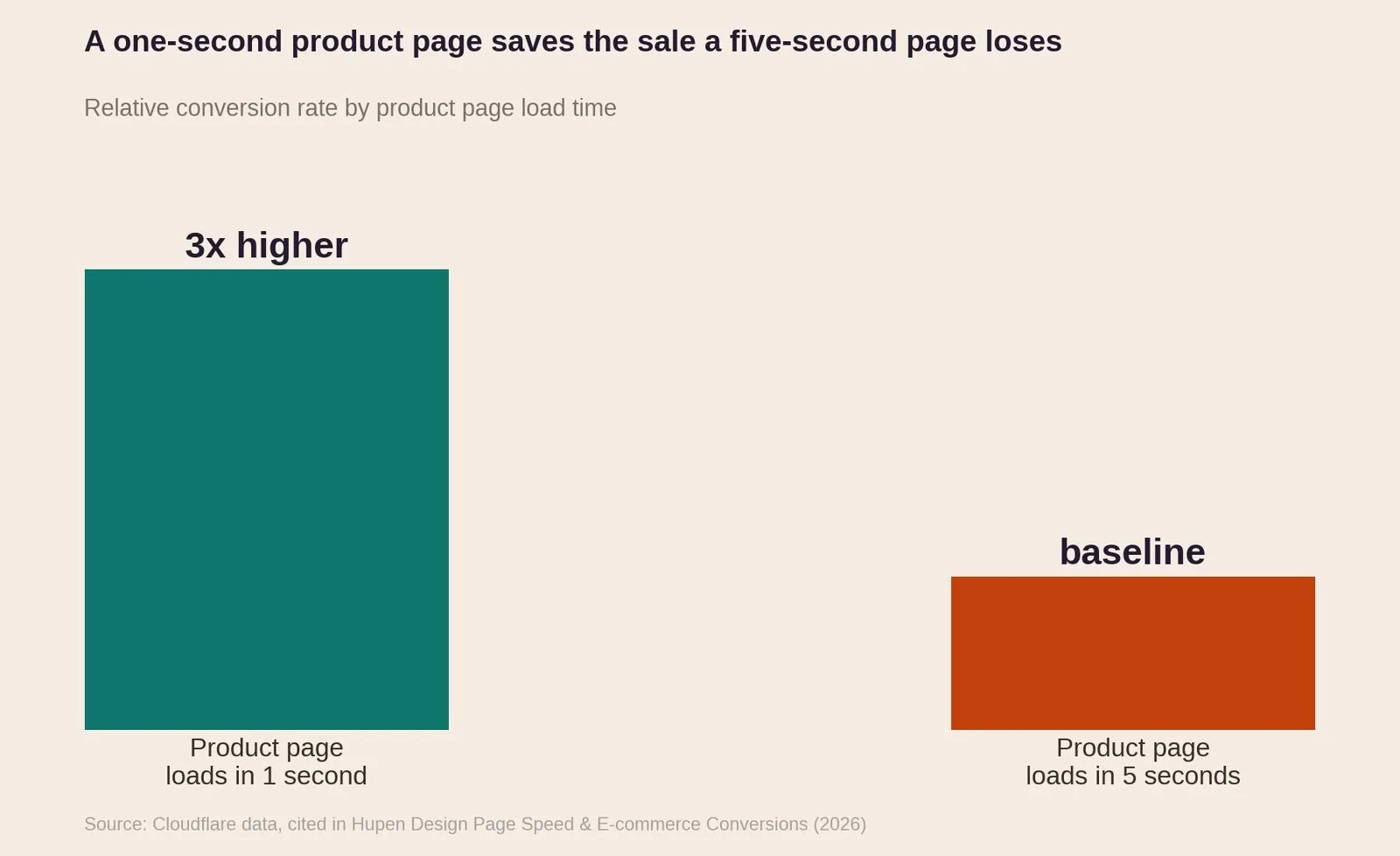
Page speed belongs on this list even though it isn't content. A product page that loads in 1 second converts at roughly 3x the rate of an identical page that takes 5 seconds (Hupen Design), and separate research puts the cost of every additional 100 milliseconds at around 1% of conversions (Digital Applied). Google has treated page speed as part of its Page Experience ranking signal since Core Web Vitals launched, so a slow product page is fighting search engines and visitors' patience at the same time — for example, a page that's still loading full-resolution product images the moment a visitor tries to scroll.
Writing Product Titles, Descriptions, and URLs That Work
Product names should match how users search for an item, not the way an internal SKU sheet reads. "Trailhead Pro Waterproof Hiking Boot" beats a model number every time a real user, not an internal system, is the one searching. Structured data should include product identifiers like SKU or GTIN where available, alongside name, price, and availability. Product descriptions earn their keep when they answer the questions a visitor actually has: material, sizing, care instructions, what's included — rather than repeating marketing adjectives that don't help search engines or users decide.
Good URL structure keeps things simple: /boots/trailhead-pro-waterproof rather than a URL built from category IDs and query strings. Search engines can technically crawl either one, but a clean URL gives both search engines and users a readable signal about what the page contains before anyone clicks.
Product page SEO tool
Title tag & meta description checker
Type your product page title and description below to see a live SERP preview and length check.
Product Images, Alt Text, and File Names
Images do more selling than most product pages give them credit for. 83% of shoppers say product images are extremely influential in their purchase decision (ConvertCart), and Baymard Institute research finds that 56% of shoppers immediately explore product images the moment they land on a product page (via GenAIEmbed). Product pages with 5 or more images, showing multiple angles, scale, and context, convert roughly 60% higher than pages with a single image (Kissmetrics). High quality images reduce the uncertainty that keeps online shoppers from buying something they can't physically hold, and that uncertainty is the single biggest reason a visitor abandons a product page without converting.
Every image also needs descriptive alt text and a real file name. Alt text should describe the image the way you'd describe it to someone who can't see it, naturally including the product name, not a keyword-stuffed list. File names matter more than most SEO checklists admit: a descriptive file name like "red-leather-handbag-front-view.jpg" gives search engines and image search a genuine content signal that a generic camera-generated file name never will.
Product Schema Markup and Rich Results
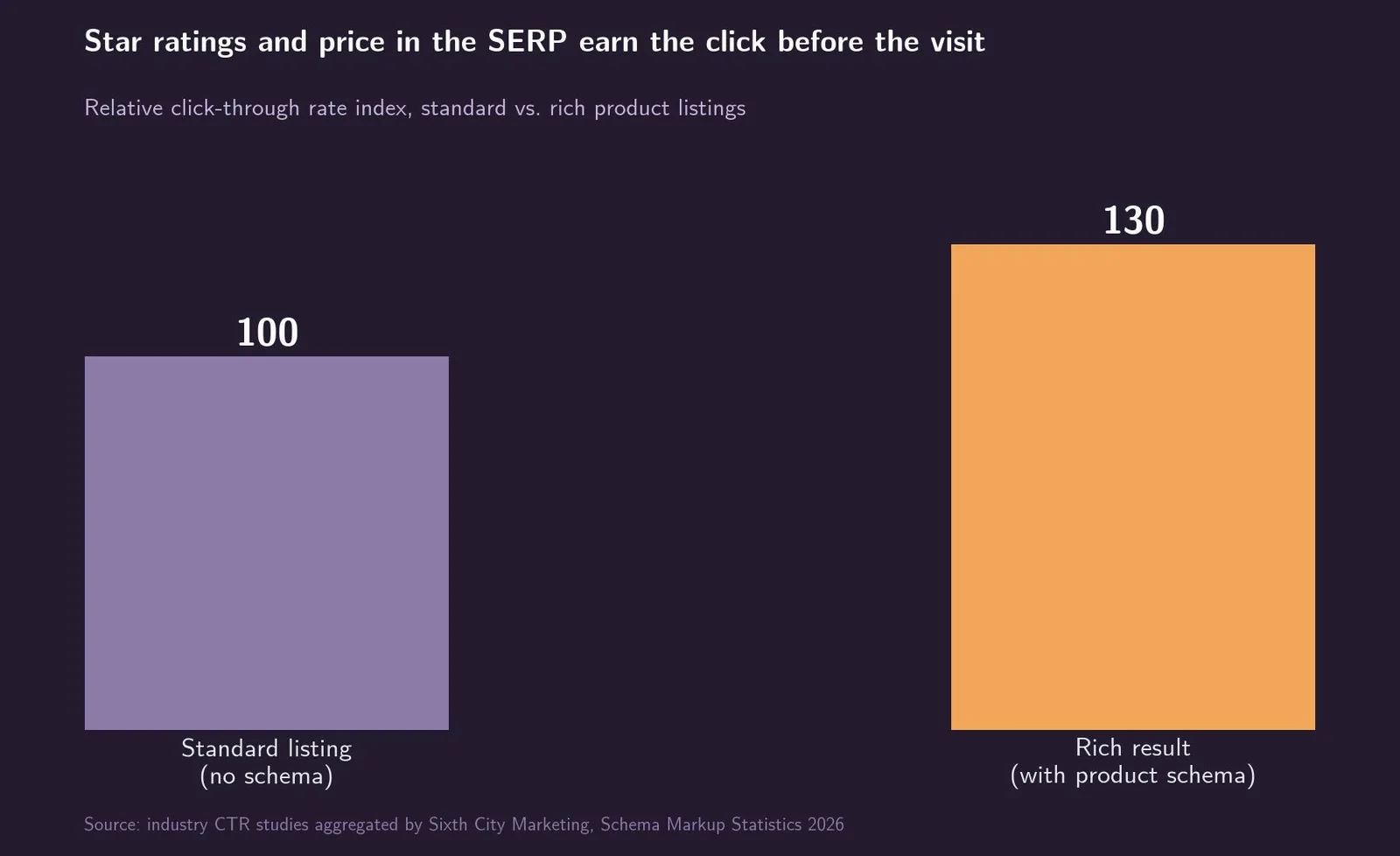
Schema markup is the structured data that tells search engines exactly what's on a product page: name, price, availability, and review data, so Google can display it directly in search results as a rich result. Product schema that successfully generates rich results — star ratings, current price, and stock status — typically lifts click-through rate by around 30% over a standard listing (2Point Agency). Google's own case studies show individual results can run considerably higher: Nestlé measured an 82% higher CTR on rich-result pages, and Rotten Tomatoes measured 25% higher CTR across 100,000 pages (Google Search Central).
How Product Schema Types Compare
| Schema type | What it enables in search | Priority for product pages |
|---|---|---|
| Product | Name, image, price, and availability shown in the listing | Required baseline for every product page |
| Review / AggregateRating | Star ratings displayed under the listing | High: directly tied to CTR lift |
| Offer | Price, currency, and stock status | High: required alongside Product schema |
| BreadcrumbList | Category path shown instead of a raw URL | Medium: improves clarity, not conversion-critical |
Google itself has been explicit about this: structured data doesn't move rankings on its own. What it does is make a page eligible for rich results, and that eligibility isn't automatic (Google Search Central). Use Google's Rich Results Test to confirm markup validates, then track actual performance in Google Search Console, since that's the only place that shows whether a rich result is genuinely appearing in search and how it's performing.
Reviews and User-Generated Content on the Product Page
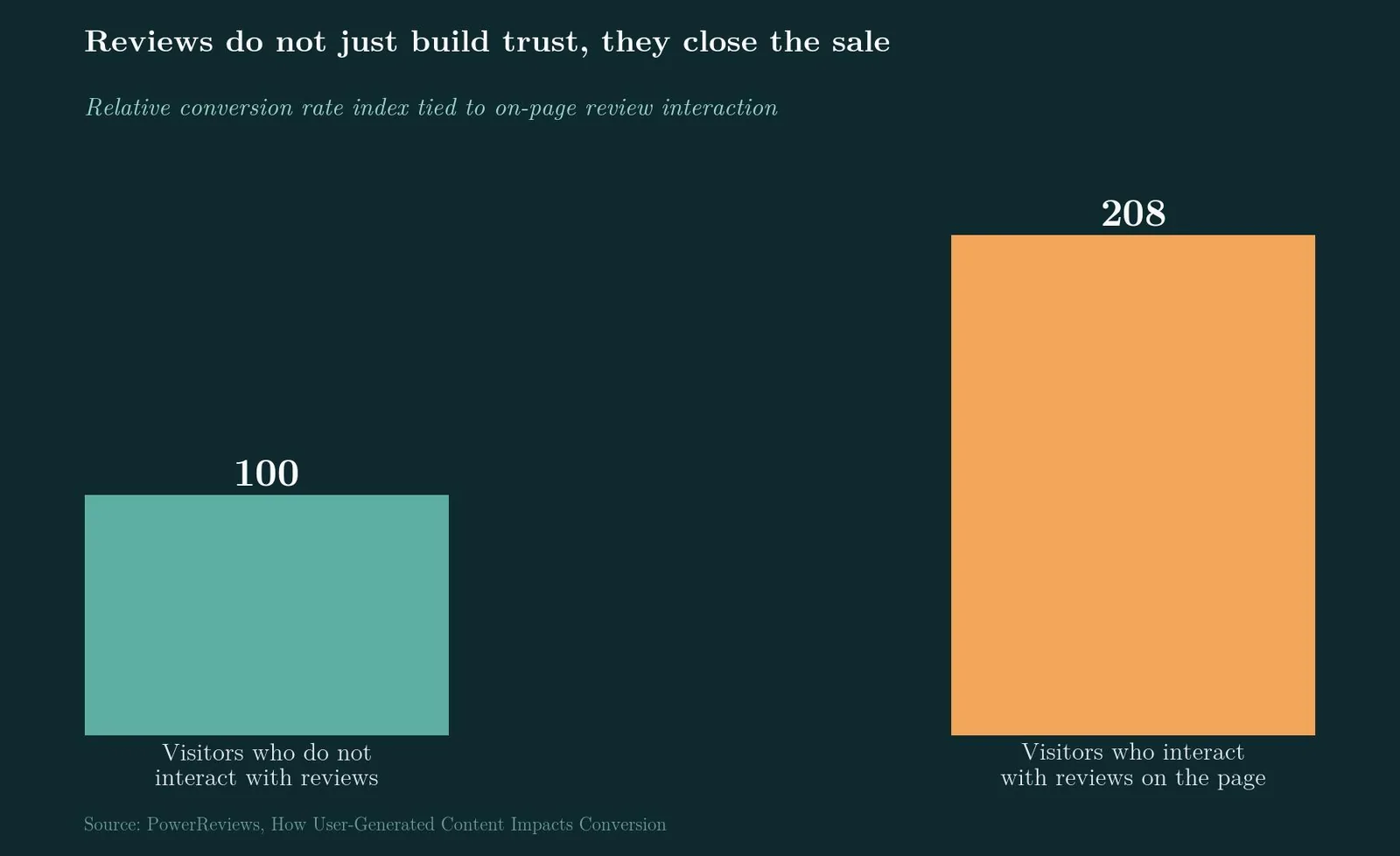
Visitors who interact with on-page reviews convert at roughly double the rate of visitors who don't (PowerReviews), which makes reviews one of the highest-leverage elements on the entire page, not a nice-to-have tab buried below the fold. User-generated content (UGC) — customer photos, video, and Q&A answers — consistently earns more trust than brand-produced content alone, because it comes from someone with nothing to sell.
Putting UGC to work on a product page means more than embedding a star rating. Customer photos need the same alt text and file name treatment as professional images. Q&A sections should stay visible near the top of the page, not several scrolls down, since a visitor with an unanswered question rarely scrolls far enough to find the answer before leaving.
Common Product Page SEO Mistakes
The most common mistake is treating the product description as a place to repeat the title with different adjectives, wasting the one part of the page that's fully under a marketer's control.
Page speed gets ignored just as often, usually until it becomes a ranking problem. Product pages carry more images and more third-party scripts than almost any other page type, which makes them the most likely page on a site to fail Core Web Vitals if no one is watching. Poorly loaded CSS is a common, overlooked cause of the layout shift that tanks a page's CLS score, since images and price blocks jump around as styles finish loading.
Schema is where a subtler mistake shows up: markup that doesn't match what's actually visible on the page risks losing the rich result entirely rather than earning one, and Google Search Console's Enhancements reports will flag the mismatch if anyone checks.
Hiding reviews and UGC below the fold undercuts the page's strongest trust signal. Visitors who never scroll far enough to see social proof convert at the baseline rate, not the higher rate reviews are capable of producing.
Frequently Asked Questions
What's the most important element of product page SEO? There isn't one single most important element; title tags, product schema, image optimization, and page speed all compound together. A product page that gets one of these right but ignores the others still underperforms.
Does schema markup directly improve rankings? No. Structured data doesn't influence rankings directly, according to Google's own guidance. Its job is making a page eligible for rich results like star ratings and price — and those rich results are what measurably improve click-through rate.
How many product images should a product page have? Five or more images covering multiple angles, scale, and real-world context is the point where conversion lift becomes significant, according to product page conversion research. More context generally helps as long as page speed doesn't suffer.
Do reviews actually affect SEO, or just conversion? Both. Review schema can generate star-rating rich results that improve click-through rate directly, and the on-page trust signal reviews improve the conversion rate of the traffic a page already earns.
What should a product page URL look like? Short, descriptive, and readable: lowercase words separated by hyphens, ideally close to the page's root category, rather than a URL built from internal IDs or session parameters.
Where to Start With Product Page SEO
Product page SEO rewards fixing the foundation before chasing new tactics: fast load times, a clean URL, an accurate title, real images with real alt text, valid product schema, and visible reviews. None of these individually will fix a product page, but skipping any one of them quietly caps how well the rest can perform.
Start with the product pages that already get the most traffic. Run each one through Google's Rich Results Test, check Core Web Vitals in Search Console, and confirm images have genuine alt text and file names before investing in anything more advanced.
More from Web Tonic: growth marketing services, data & analytics.
Sources: huppen.com.np · digitalapplied.com · 2pointagency.com · kissmetrics.io · powerreviews.com · developers.google.com · convertcart.com · genaiembed.ai