Table of contents

A blog post targets someone who wants information. A product page targets someone who wants to solve a specific problem right now, with their card already half out of their pocket. That distinction changes everything about how a product page should be built: the keywords it targets, the schema it needs, and how Google's crawlers and its AI systems each evaluate it. Ecommerce product page SEO is the discipline of optimizing that page for all three audiences at once: the search engine, the AI answer engine, and the actual buyer.
This guide breaks down what genuinely moves rankings and clicks on a product page in 2026, what structured data can and can't do, and the specific mistakes that quietly cap a page's performance.
Key takeaways
- Structured data is not a direct Google ranking signal. What Product schema does is make a page eligible for rich results, star ratings, price, and availability shown in the SERP, which can lift click-through rates by roughly 35%.
- Google AI Overviews appeared in about 14% of shopping queries as of March 2026, up sharply from 2.1% in November 2025.
- Google fully retired FAQ rich results as of May 7, 2026 — including for the government and health sites that briefly kept them after a 2023 restriction. FAQPage markup is still valid to leave in place, but there's no rich-result upside left to chase for any site.
- Displaying even a handful of reviews can lift conversion by up to 270% compared to a product with none, with the effect climbing to 380% for higher-priced items.
- Organic search converts at an average of 2.8% for ecommerce sites, meaningfully higher than most social channels, making product page SEO one of the highest-ROI levers a store has.
The 5-layer framework for a product page that actually works
A product page has to satisfy five layers at once, and skipping any one caps what the others can achieve, according to Artzen's SEO for Ecommerce Product Pages guide:
- Technical foundation. Crawlable, fast, mobile-friendly, and free of duplicate content issues. Nothing else matters without this.
- Relevance signals. Title tag, H1, URL, and meta description all need to align with what buyers actually search.
- Content depth. Unique descriptions, specifications, size guides, and FAQs, the layer that separates a store from every competitor selling the same item with the manufacturer's copy-pasted description.
- Trust signals. Reviews, ratings, return policy, and clear brand identity.
- Rich results visibility. Structured data that unlocks star ratings, pricing, and availability directly in the search result.
Structured data lifts clicks, not rankings
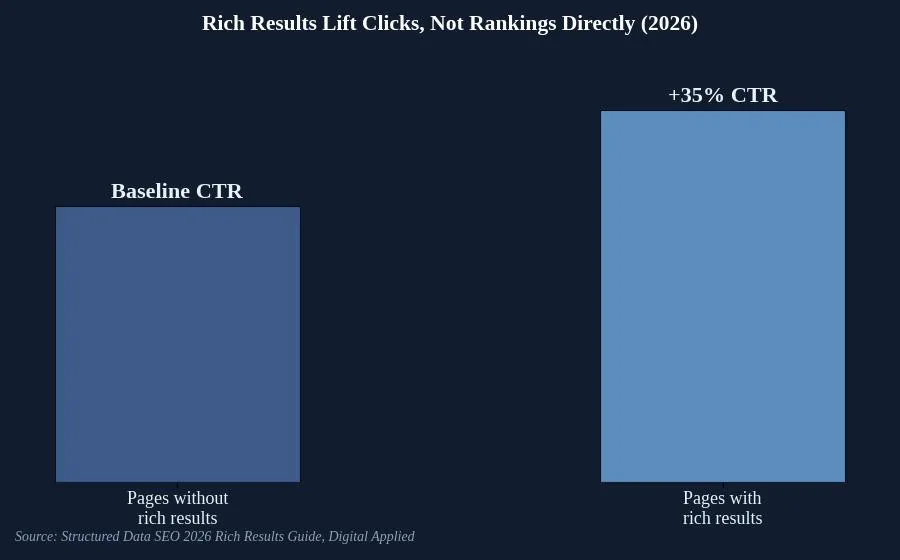
This is the single most misunderstood part of product page SEO. Product schema is not a ranking factor. Google does not rank a page higher simply because it carries correct structured data. What schema does is make a page eligible for rich results, and those rich results are what drive the actual performance gain, according to the Ecommerce Product-Page SEO 2026 Optimization Guide.
Pages with structured data earn roughly 35% higher CTR from rich results, and that CTR advantage can compound into ranking improvements over time as Google's systems register that more users are choosing the result. Structured Data SEO 2026: Rich Results Guide has the full breakdown. Xenara's 2026 analysis of product schema puts the real-world range even wider: 20-60% CTR lift on the same ranking position once rich results go live, depending on how complete the implementation is.
The required fields for a basic merchant listing are name, image, and offers (price, currency, and availability), according to SEOClarity's guide to Product schema for ecommerce SEO. But the 2026 ceiling is higher: stores that also include GTIN/MPN, complete review data, and detailed offer properties see meaningfully stronger rich-result eligibility and AI citation rates than stores shipping the bare minimum, per 1Digital Agency's 2026 Ecommerce SEO Ranking Factors analysis.
Comparing schema completeness levels
| Schema level | Fields included | Rich result eligibility | Typical CTR impact |
|---|---|---|---|
| Minimal (platform default) | name, image, price | Often incomplete or rejected | Little to none |
| Required (Google baseline) | name, image, offers (price, currency, availability) | Basic rich results | Moderate lift |
| Complete (2026 best practice) | + GTIN/MPN, brand, SKU, AggregateRating, individual reviews | Full merchant listing + AI citation eligibility | Up to 35%+ lift |
Figures reflect 2026 industry benchmarks; actual CTR impact varies by category, competition, and existing ranking position.
Why AI Overviews change the content bar
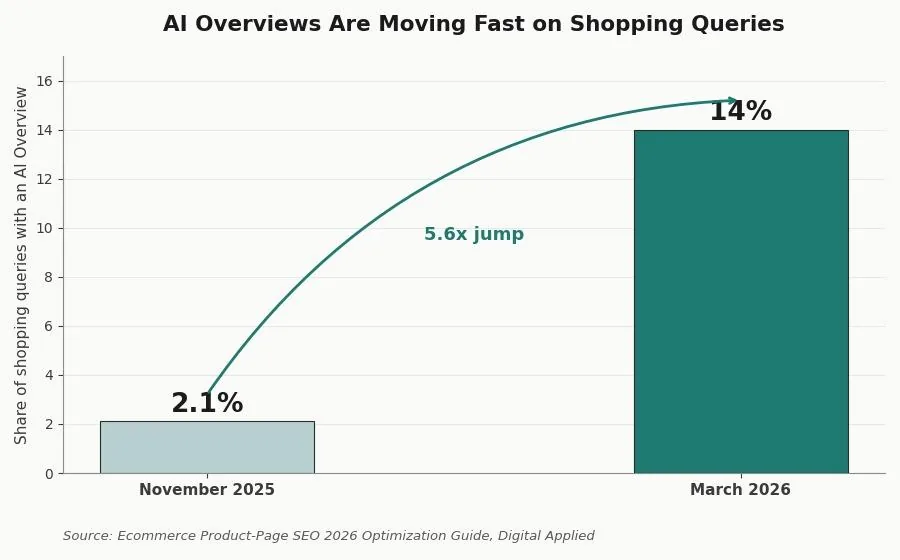
Google AI Overviews appeared in roughly 14% of shopping queries as of March 2026, up from 2.1% in November 2025, a jump the Ecommerce Product-Page SEO 2026 Optimization Guide clocks at 5.6x in just four months. AI Overviews cite specific sources, and vague marketing language rarely makes the cut. Specific, factual, directly answerable content does.
FAQ content earns its keep here, even though the schema around it doesn't do what it used to. Google restricted FAQPage rich results to government and health sites back in 2023, then removed the rich result entirely for every site as of May 7, 2026. FAQPage markup is still a valid schema type and safe to leave in place, but there's no SERP display benefit left to chase for any ecommerce store, since Google has confirmed the rich result itself is gone. A genuine, clearly-written FAQ section still earns its place, though: it keeps feeding Google's People Also Ask results and can still be cited directly by AI systems, independent of whether the schema wrapper is there at all.
Reviews: the trust signal that also converts
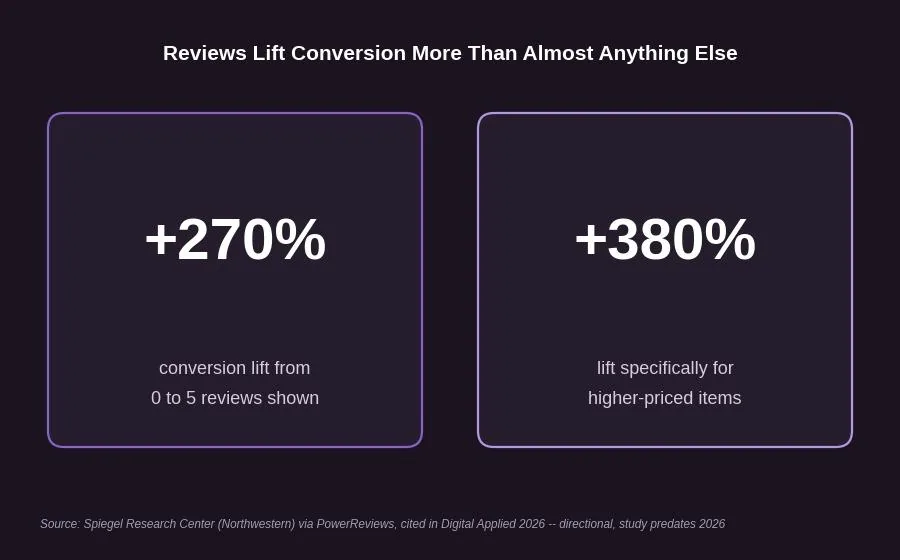
Reviews do double duty on a product page. They're a trust signal for the buyer and an entity signal for search engines and AI systems alike. Displaying even a small number of reviews produces an outsized effect: conversion can lift by up to 270% compared to a product with zero reviews shown, climbing to 380% for higher-priced items, according to the Spiegel Research Center study at Northwestern, cited in Digital Applied's 2026 review collection framework. Worth noting: that specific study predates 2026, so treat the exact percentages as a directional anchor rather than a fresh benchmark, though newer vendor data reinforces the same underlying pattern.
Practical takeaways for a product page:
- Display real reviews on the page itself, not just an aggregate star rating.
- Prioritize getting every product past zero reviews quickly. The steepest conversion gain happens in that first jump, not from accumulating hundreds more.
- Implement AggregateRating and individual Review schema alongside Product schema so the star rating actually shows up in the SERP.
Product page SEO tool
How healthy is your product page?
Check off what's already in place on a typical product page. This covers the fundamentals that actually move rankings and clicks.
Page health score
0/100
Check off each item as you confirm it.
Common product page SEO mistakes
- Copying manufacturer descriptions verbatim. A March 2026 Google core update reportedly demoted pages that rephrased manufacturer feeds with minimal added insight. Unique descriptions need to answer who the product is for, what problem it solves, and what it's typically paired with.
- Deleting discontinued product pages. This destroys accumulated link equity. Redirect to a relevant replacement instead.
- Keyword stuffing in descriptions. Google's systems detect unnatural repetition, and buyers leave immediately when they spot it.
- Uploading unoptimized images. Large file sizes inflate load time scores and quietly hurt mobile performance and Google Images traffic.
- Skipping alt text. Every image without alt text is both a missed ranking signal and an accessibility failure.
- Client-side-rendered schema. Googlebot handles it better than it used to, but still misses an estimated 5-10% of client-rendered structured data. Server-rendered JSON-LD is the safest implementation.
Frequently asked questions
Does adding Product schema directly improve my Google ranking?
No, not directly. Schema makes a page eligible for rich results (star ratings, price, availability shown in the SERP), and those rich results improve click-through rate, which can indirectly support rankings over time. Treat schema as a CTR and eligibility lever, not a ranking shortcut.
Can I use FAQPage schema on my ecommerce product pages?
You can leave it in place if you already have it; Google has said unused structured data doesn't cause problems. But as of May 2026, Google removed the FAQPage rich result entirely, for every site type, including the government and health sites that briefly kept it after 2023. There's no rich-result upside left to chase. Focus on genuine, clearly-written FAQ content instead, since that's what still feeds AI citation and People Also Ask, independent of the schema markup.
How long should a unique product description be?
There's no fixed word count, but thin descriptions under 100 words are a common flag for duplicate or low-value content. A description that clearly answers who the product is for, what it solves, and what it pairs with tends to outperform arbitrary length targets.
Do reviews actually affect SEO, or just conversion?
Both. Reviews are one of the strongest conversion levers on a product page, and structured review data also feeds the entity and trust signals that search engines and AI systems use to evaluate a page's credibility.
Is client-side rendered schema good enough in 2026?
It's improved but still risky. Googlebot renders JavaScript more reliably than in past years, but an estimated 5-10% of client-rendered structured data still gets missed. Server-rendered JSON-LD remains the most reliable implementation.
Turning product pages into your highest-ROI asset
Ecommerce product page SEO isn't about picking one tactic and hoping it carries the page. It's about stacking the technical foundation, relevance signals, unique content, trust signals, and structured data together, because each layer's impact compounds with the others rather than replacing them. The stores treating product pages as the sum of all five, rather than betting everything on schema alone or content alone, are the ones converting the organic traffic they already have instead of quietly losing it to a thinner competitor page one click away.
More from Web Tonic: growth marketing services, data & analytics, performance creative.
Sources: artzen.io · digitalapplied.com · xenara.ai · seoclarity.net · 1digitalagency.com