Table of contents

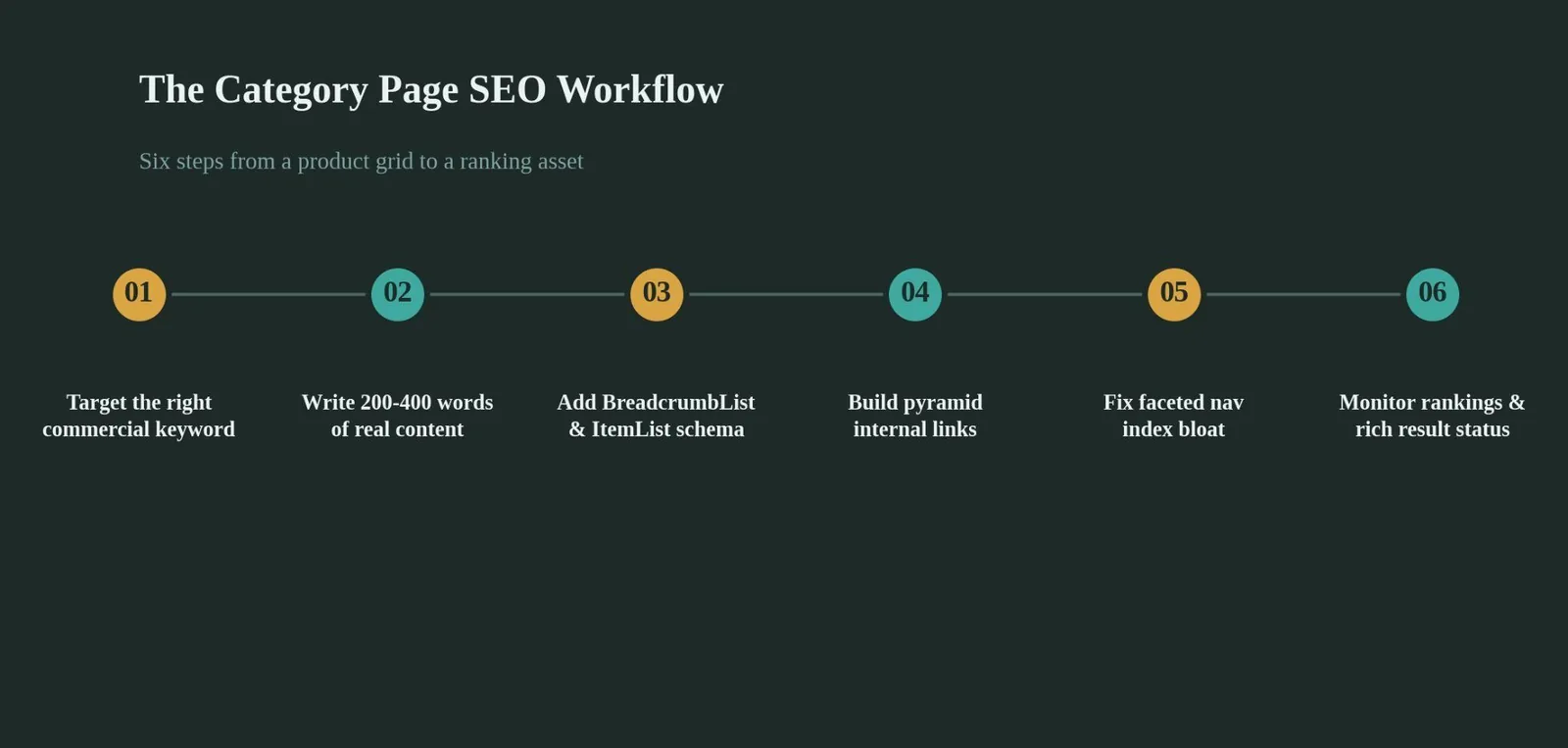
Most ecommerce sites pour their SEO effort into product pages and treat category pages as an afterthought, a product grid with a title on top. That's backwards. Category pages typically capture the broad, high-volume searches people run before they've picked a specific product, which means they're often the highest-leverage pages on the entire site. This guide covers what actually makes a category page rank in 2026.
Key Takeaways
- Category pages typically generate 3 to 5 times more organic revenue than individual product pages, since they rank for high-volume head terms and capture users earlier in the buying journey.
- Faceted navigation is the most common crawl budget killer on ecommerce sites; a single category can generate millions of near-duplicate filter URLs without proper handling.
- Google's own John Mueller has confirmed that category pages with nothing but a product grid and no supporting content are genuinely difficult for Google to rank, and 200 to 400 words is a reasonable target.
- Structured data, specifically BreadcrumbList and ItemList schema, belongs on category pages; Product and AggregateRating schema does not and should stay on individual product pages only.
- Internal linking that flows in a pyramid structure, from homepage to top-level categories to subcategories to products, is one of the highest-leverage SEO activities available to an ecommerce site.
- Rich results enabled by structured data increase organic click-through rate by roughly 30% on average compared to standard blue-link results.
What Is Category Page SEO?
Category page SEO is the practice of optimizing the pages on an ecommerce site that organize products into groups, sometimes called Product Listing Pages (PLPs) or Category Landing Pages (CLPs), so they rank for the broad, commercial-intent searches people run before narrowing to a specific product. A page like "men's running shoes" is a category page; "Nike Air Zoom Pegasus 41" is a product page, and the two need very different SEO treatment.
Large retailers like Asos and Apple rely heavily on category-level architecture precisely because it scales: a handful of well-built ecommerce category templates can organize thousands of individual products without bespoke work on every single one. A clear hierarchy helps users and search engines understand page purpose faster than a flat list of unsorted products, whether the retailer operates in the U.S. or globally, and that's true whether you call it a best practice or just common sense. Good category page SEO and good user experience reinforce each other: content that helps users decide between options also gives search engines the context needed to understand relevance for a broader product category. Often the same long tail research that surfaces a keyword opportunity also surfaces the exact question shoppers have.
The distinction matters because search intent differs by query specificity. A broad term like "women's boots" or "gaming monitors" signals browsing and comparison, exactly what a category page delivers, while a long, specific query like a particular model number and size is better served by a single product page with a strong schema. Google's algorithm reads that difference and displays listing pages ahead of product pages for the broad terms, which is exactly why category pages deserve real SEO investment rather than being treated as index pages that exist only to link elsewhere.
Why Category Pages Deserve Priority
Well-optimized category pages typically generate 3 to 5 times more organic revenue than individual product pages, because they rank for high-volume head terms and capture shoppers earlier in the journey, before they've committed to one specific item. Organic search itself drives a substantial share of total ecommerce traffic, more than paid ads, email, or social combined for many stores, which makes the category layer a genuinely high-stakes piece of site architecture rather than a formality.
On-Page Content: What Google Actually Wants
Google's John Mueller has explained directly that category pages with nothing but a product grid and links, with no other content at all, are genuinely difficult for Google to rank, since there's little for Google's systems to work with beyond the products themselves. That's the reason to add real content. But Mueller has also warned against the opposite extreme: a page with a product grid on top and what amounts to a full article dumped below it, which can confuse Google's systems trying to determine the page's actual intent. The practical target most SEOs converge on is 200 to 400 words: enough to genuinely help a user decide whether this is the right category, without turning the page into a blog post with a product grid attached.
Content that works here answers real buying questions specific to the category, not generic brand history. One of the more visible examples of overcorrection is eBay, whose category pages have historically carried over 1,000 words of text at the bottom, far more than the page actually needs. A page for "waterproof hiking boots" benefits from a few sentences on what waterproofing actually means for that product type, not three paragraphs on the history of hiking as a sport.
Structured Data for Category Pages

Three schema types matter most for a category page. BreadcrumbList reinforces the site's hierarchy in Google's index and can display as a breadcrumb trail directly in search results. ItemList tells Google the page contains a list of products rather than a single item, and pairing it with CollectionPage schema confirms the page's primary purpose is a product collection, not an article. Product schema and AggregateRating, by contrast, belong exclusively on individual product pages; applying review or rating markup to a page that lists many products isn't supported and should be avoided entirely.
Faceted Navigation Without the SEO Damage

Faceted navigation, the filters that let shoppers narrow by size, color, price, and brand, is a genuinely useful UX pattern that can quietly generate millions of near-duplicate URLs if left unmanaged, draining crawl budget that should go toward pages actually worth indexing. The fix isn't blocking every filter combination; it's deciding which ones carry real search demand and deserve to be indexed, and canonicalizing or blocking the rest.
A single facet with genuine search volume behind it, "red leather sofas" for example, can justify its own indexable page. A combination of three or four filters stacked together almost never has enough search demand to justify indexing and should be noindexed or blocked outright. Sort order and pagination parameters carry no unique keyword value and belong in robots.txt, not the index.
Internal Linking: The Pyramid Structure
Category pages function as nodes in an internal linking network, receiving authority from the pages above them and distributing it to the pages below. Every product in a category grid should be linked through both its image and its title, and related categories should cross-link to each other: a Men's Outerwear category linking to Men's Jackets, Men's Coats, and Winter Accessories, for instance.
Google's John Mueller has specifically recommended linking to a category page whenever multiple products in that category exist, so that Google's crawlers can recognize the category page's importance within the site. This kind of parent-to-child linking builds what's often called a pyramid structure, and it's one of the more reliable ways to make sure no category becomes an orphaned page with no incoming authority.
URL Structure and Common Mistakes
Optimal URL structure keeps things lowercase, descriptive, and free of unnecessary words like a literal "/category" folder name. A URL like /mattresses reads better to both users and search engines than /category/4521, and Google's own John Mueller has confirmed keywords in URL subfolders function as a ranking signal, not just a cosmetic choice.
Category Page SEO Checklist
Table 1: Category Page SEO Checklist
| Element | What to check | Priority |
|---|---|---|
| Title tag & H1 | Includes the primary commercial keyword naturally | High |
| On-page content | 200-400 words, genuinely helpful, not keyword-stuffed | High |
| Structured data | BreadcrumbList + ItemList/CollectionPage present and valid | High |
| Internal links | Every product linked; related categories cross-linked | High |
| Faceted navigation | High-demand facets indexed, the rest noindexed or blocked | Medium |
| URL structure | Lowercase, descriptive, no unnecessary folder names | Medium |
Common Mistakes on Category Pages
A product grid with a title and nothing else, leaving Google very little to understand about the page's actual topic.
A wall of text dumped below the product grid purely to hit a word count, which can confuse Google's read on the page's actual intent.
Faceted navigation left completely unmanaged, generating tens of thousands of near-duplicate URLs that quietly drain crawl budgets.
Product or Review schema mistakenly applied to a category page instead of the individual product pages it belongs on.
Category pages missing from primary navigation and internal links entirely, leaving them functioning as orphaned pages despite decent content.
Category Page Tools and Costs
Screaming Frog's single-user license runs £199/year, roughly $279 USD, a flat annual fee rather than a monthly subscription.
Table 2: Tools for Auditing Category Pages
| Tool | What it checks | Cost (USD) |
|---|---|---|
| Google Search Console | Indexing status, Rich Results errors, query performance | Free |
| Google's Rich Results Test | Validates BreadcrumbList and ItemList schema | Free |
| Screaming Frog | Crawls faceted navigation to find duplicate/thin URLs | Free up to 500 URLs, ~$279/year for a single unlimited license |
| Ahrefs or Semrush | Tracks category page rankings and keyword opportunities | From $129/month (Ahrefs Lite) or ~$140/month (Semrush Pro) |
Faceted navigation tool
Should this filter combination be indexed?
Answer three quick questions about a specific filter or facet on your category pages.
Answer the questions above
Your recommendation will appear here once all three are answered.
Frequently Asked Questions
What's the Difference Between a PLP and a CLP?
PLP (Product Listing Page) and CLP (Category Landing Page) are largely interchangeable terms for the same thing: a page that organizes multiple products into a browsable group, as opposed to a single product page.
How Much Content Should a Category Page Have?
Roughly 200 to 400 words is the range most SEOs converge on: enough to genuinely help a shopper and give Google real context, without reading like an article bolted onto a product grid.
Does Faceted Navigation Always Hurt SEO?
Not if it's managed properly. The UX benefit for shoppers is real; the SEO risk comes specifically from unmanaged filter combinations generating near-duplicate indexed pages, which canonical tags, noindex directives, and robots.txt handle when applied deliberately.
Should Category Pages Use Product Schema?
No. Product and AggregateRating schema are built for individual product pages. Category pages should use BreadcrumbList and ItemList, paired with CollectionPage, instead.
Why Do Category Pages Often Outrank Product Pages for Broad Keywords?
Because broad commercial queries like "women's boots" signal browsing and comparison intent, which a category page satisfies directly. Product pages win only for narrow, specific queries like an exact model and size.
The Bottom Line on Category Page SEO
Category page SEO comes down to giving Google real content to work with, the right schema, clean internal links, and faceted navigation that doesn't drown the site in near-duplicate URLs. It's a checklist most sites simply never run, mainly because category pages don't feel as glamorous as product pages or blog content.
Pick your highest-traffic category page, check it against the table above, and fix whatever's missing first. That single page audit usually reveals the same gaps repeated across dozens of other categories on the same site.
Ready to Turn Category Pages Into Real Ranking Assets?
Category page SEO touches content, schema, internal linking, and faceted navigation all at once, which is exactly why most ecommerce teams never get around to fixing it properly. Web Tonic's growth marketing team builds category page optimization into every ecommerce SEO engagement, so the pages driving the most potential revenue actually get the technical and content work they need.
More from Web Tonic: growth marketing services, data & analytics.
Sources: digitalapplied.com · gofishdigital.com · hypotenuse.ai · ahrefs.com · neotype.ai · keytomic.com · siteguru.co · semrush.com · checkthat.ai