Table of contents

A product description is the block of copy on a product page and in your feed that answers what an item is, who it suits, what it is made of and what happens after you buy. It has two readers — a shopper deciding, and a machine indexing — and the good ones serve both without padding.
Key Takeaways
- Baymard's benchmark of 155+ retailers finds only 48% of desktop and 38% of mobile product pages rate "decent" or better, so copy quality is still a live advantage.
- The documented average cart abandonment rate across 50 studies is 70.22%, and 40% of abandoners blame unexpected extra costs — facts your copy can pre-empt.
- Google's feed spec allows 1–5,000 characters of description, and longer text is truncated with a warning rather than rejected.
- Feeds now have a dedicated attribute for AI-written copy: mark it trained_algorithmic_media instead of hiding it in the standard field.
- Nielsen Norman Group's guidelines, drawn from research across 49 ecommerce sites, list a concise, informative description as a must-have, alongside price, options and availability.
- Shoppers scan rather than read, so the working format is 1 short lead paragraph plus 4–6 scannable lines, not a wall of adjectives.
- Our 12-block template and 9 worked rewrites below can be lifted straight into a content brief.
The 12 blocks a complete description contains
Treat the field as a structure, not an essay. Rule 1 — if a block cannot be filled with a fact, delete the block rather than filling it with adjectives. Nielsen Norman Group's product page guidelines put it bluntly: users are not looking for marketing fluff, but for a solid account of what the item does.
| Block | What goes in it | Length | Skip it when |
|---|---|---|---|
| 1. Plain name | What the thing is, in the words a shopper uses | 1 line | Never |
| 2. Lead benefit | The single outcome the buyer is paying for | 1 sentence | Never |
| 3. Who it suits | The use case or buyer type | 1 line | Truly universal items |
| 4. Materials or build | Fabric, alloy, ingredients, components | 1–2 lines | Digital products |
| 5. Measurements | Dimensions, weight, capacity, fit | Table row | Non-physical goods |
| 6. In-use detail | How it behaves after a month of use | 1–2 lines | Consumables |
| 7. Compatibility | What it works with, what it does not | 1 line | Standalone items |
| 8. Care | Washing, storage, service interval | 1 line | Single-use items |
| 9. What is in the box | Parts, accessories, quantities | 1 line | Single-item packs |
| 10. Costs and delivery cues | Anything that becomes a surprise at checkout | 1 line | Never |
| 11. Proof | Test result, certification, warranty length | 1 line | No verifiable proof exists |
| 12. Next step | The action the page wants | Button text | Never |
Nine rewrites, side by side
Every pair below fixes one specific failure. Fact 1 — 9 of the 10 most common weaknesses are removable in under 30 minutes per page, because they are structural, not creative.
| Weak version | Why it fails | Rewritten | Technique used |
|---|---|---|---|
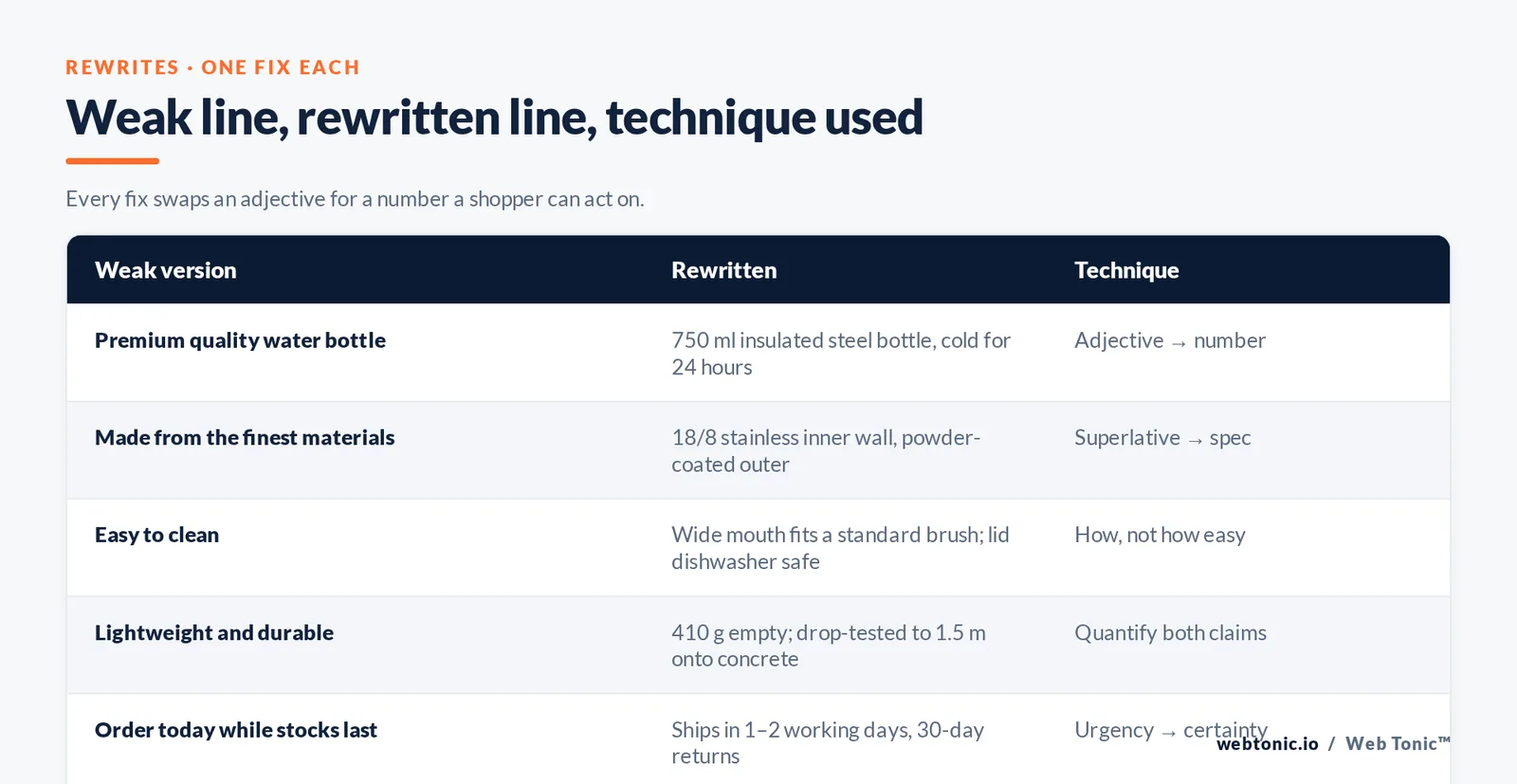
| Premium quality water bottle | No fact a shopper can act on | 750 ml insulated steel bottle, keeps drinks cold for 24 hours | Swap the adjective for the number |
| Perfect for everyone | No buyer can see themselves | Sized for a cycling bottle cage; too tall for most car cup holders | Name the fit and the misfit |
| Made from the finest materials | Unverifiable claim | 18/8 stainless steel inner wall, powder-coated outer | Replace superlative with spec |
| Elegant design that turns heads | Describes the marketer, not the object | Matte finish that hides fingerprints between washes | Describe observable behaviour |
| Easy to clean | Effort claim with no method | Wide mouth fits a standard bottle brush; lid is dishwasher safe | Say how, not how easy |
| Lightweight and durable | Two claims cancelling out | 410 g empty; drop-tested to 1.5 m onto concrete | Quantify both |
| Order today while stocks last | Pressure without information | Ships in 1–2 working days, returns accepted for 30 days | Replace urgency with certainty |
| See product specifications below | Delegates the work to the shopper | Fits bottle cages 73–75 mm wide | Pull the deciding number up |
| The last bottle you will ever need | Unfalsifiable promise | 5-year warranty on the vacuum seal | Trade the promise for a term |
What abandonment data says your copy should pre-empt
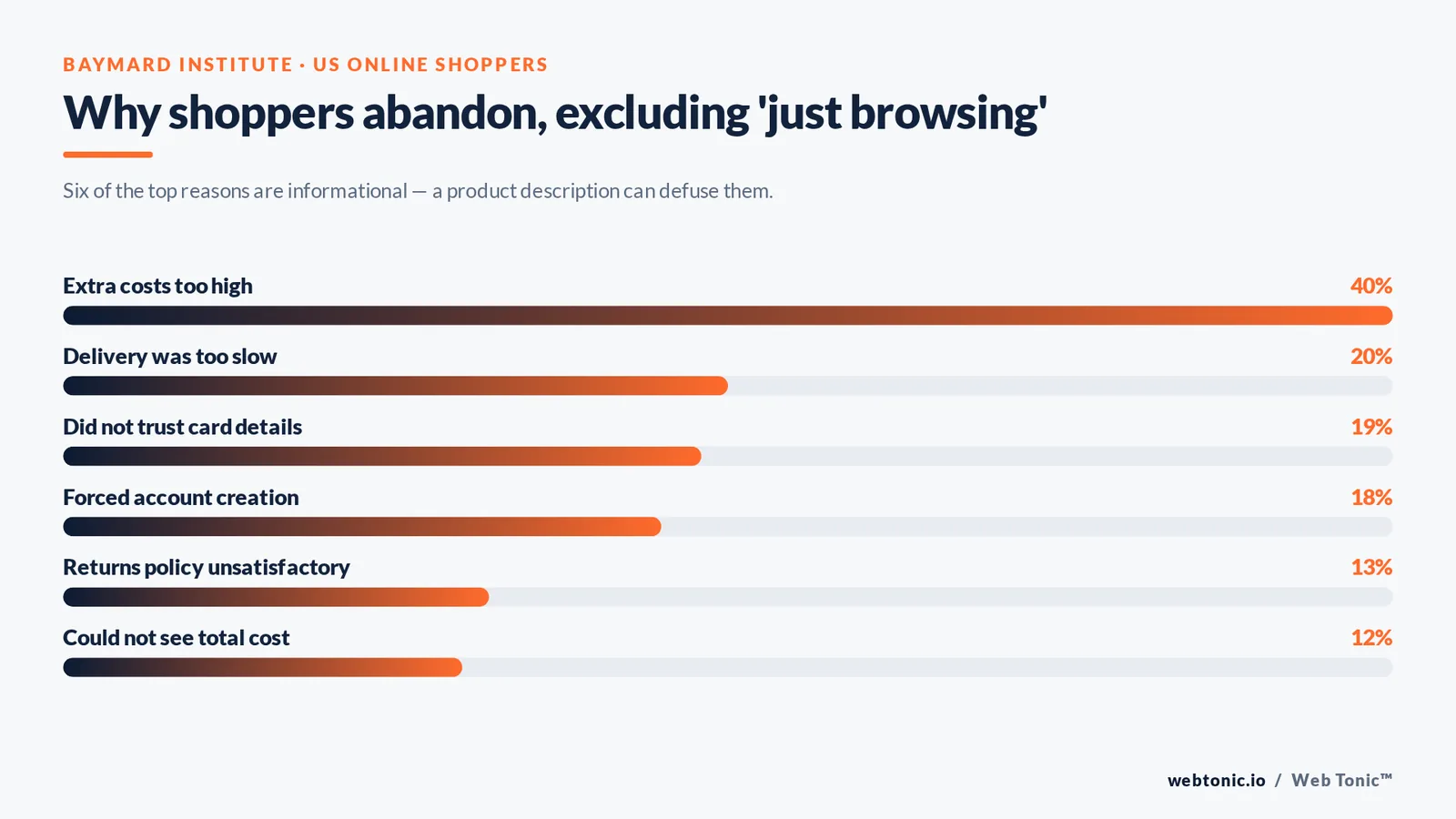
Baymard's aggregation of 50 studies puts the documented average abandonment rate at 70.22%. Excluding shoppers who were simply browsing, the ranked reasons are largely informational — which means a product page can defuse several of them before a cart even exists.
| Reason for abandoning | Share of abandoners | Line to add to the description | Where it goes |
|---|---|---|---|
| Extra costs too high | 40% | Delivery cost or free-shipping threshold | Costs and delivery cues |
| Delivery was too slow | 20% | Dispatch window in working days | Costs and delivery cues |
| Did not trust the site with card details | 19% | Warranty and returns terms | Proof |
| Forced account creation | 18% | Guest checkout note | Next step |
| Returns policy unsatisfactory | 13% | Return window and who pays postage | Proof |
| Could not calculate total up front | 12% | Price per unit or per use | Lead benefit |
Limit 1 — a page that hides a $12 delivery fee until checkout is buying its own abandonment. Baymard's 2026 product page benchmark adds the wider picture: 52% of desktop and 62% of mobile product pages score mediocre or worse, and 57% of sites still hide size options inside a drop-down.
Format for scanning, not reading
Nielsen Norman Group's research on how people read online is decades old and still ignored: visitors scan, pick words and move. Rule 2 — 1 short lead paragraph, then 4 to 6 scannable lines outperforms one dense block of the same word count.
| Element | Working spec | Common mistake | Test |
|---|---|---|---|
| Lead paragraph | 2 sentences, under 45 words | Opening with brand history | Cover it up: is the benefit still visible? |
| Scannable lines | 4–6, one fact each | Six lines repeating the same claim | Read only the first 3 words of each |
| Sub-headed detail | Materials, sizing, care | One undifferentiated wall | Can a shopper jump to sizing? |
| Numbers | Real units, not ranges where a number exists | Approximately, up to, as much as | Could a rival print the same line? |
| Sentence length | Mostly under 20 words | Clause stacking | Read aloud in one breath |
| Total length | 70–200 words on the page | Feed text pasted onto the page | Does every line change a decision? |
The feed is a separate deliverable
Page copy and feed copy have different consumers. Google's description attribute specification allows 1 to 5,000 characters, truncates anything longer with a warning, and asks you to describe only the item itself. The companion title attribute spec governs the line shoppers actually see first.
| Field | Limit or rule | What belongs there | What gets you disapproved |
|---|---|---|---|
| Feed description | 1–5,000 characters | Features, technical specs, visual attributes | Promotional text and store policies |
| Feed title | Short, front-loaded | Brand, item, key variant | Keyword stuffing and all caps |
| AI-written feed copy | Mark digital_source_type | trained_algorithmic_media value | Passing generated text as default |
| Page description | No platform limit | The 12 blocks above | Copy pasted from the manufacturer |
| Structured data | Product schema | Price, availability, review data | Marking up data not on the page |
Fact 2 — 1 attribute now separates human copy from generated copy: Google's structured description sub-attribute takes trained_algorithmic_media when generative AI wrote the text. Declare it. If you sell through marketplaces too, Amazon publishes its own listing content guidance, and the rules differ enough that one text rarely satisfies both.
Search visibility without keyword stuffing
Two Google documents settle most arguments here. The Product structured data reference defines what you can mark up, and the helpful content guidance is explicit that pages should be written for people first. Trap 1 — 1 repeated phrase in 6 places is the fastest way to make a page read like a feed dump.
| Placement | What to put there | Why it earns visibility | Failure mode |
|---|---|---|---|
| Page title | Item plus key variant | Matches how people phrase the search | Model number only |
| First 45 words | The deciding fact | Often the snippet source | Brand mission statement |
| Sub-heads | Sizing, materials, care | Answers long-tail questions | Cute headings with no nouns |
| Specification table | Real units | Wins comparison queries | Free-text spec paragraph |
| Image alt text | What the photo shows | Accessibility and image search | Repeated keyword string |
| Product schema | Price, availability, reviews | Enables rich results | Marking up absent data |
Alt text is a real deliverable, not an afterthought — the W3C images tutorial covers when a photo needs description and when it is decorative. If your team is rebuilding templates at the same time, our web development group handles the page-level side of that work.
Features versus benefits, mapped for six product types
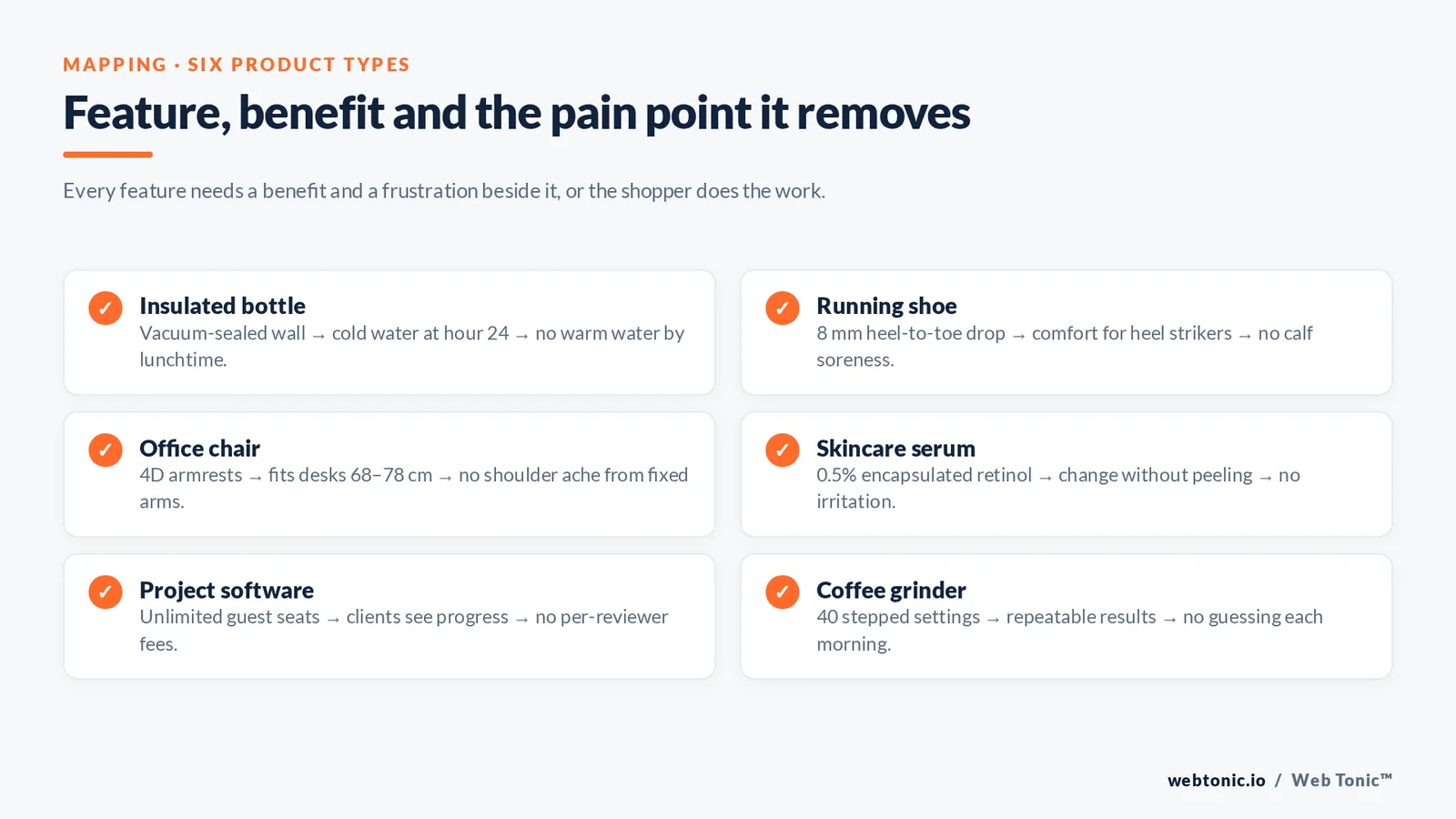
Most weak product copy lists features and hopes the customer does the translation. Rule 4 — every feature needs a benefit and a pain point beside it, because the benefit is what the shopper is buying and the pain point is why they searched. These six examples show the mapping on real product categories.
| Product type | Feature | Benefit for the customer | Pain point it removes | Selling point to lead with |
|---|---|---|---|---|
| Insulated bottle | Vacuum-sealed steel wall | Cold water at hour 24 of a shift | Warm water by lunchtime | 24-hour cold retention |
| Running shoe | 8 mm heel-to-toe drop | Comfortable for heel strikers | Calf soreness on long runs | Drop measured, not guessed |
| Office chair | 4D adjustable armrests | Fits desks from 68 to 78 cm | Shoulder ache from fixed arms | Adjusts to your desk, not the reverse |
| Skincare serum | 0.5% encapsulated retinol | Visible change without peeling | Irritation from stronger formulas | A starter strength that lasts |
| Project software | Unlimited free guest seats | Clients see progress without a licence | Paying per external reviewer | Free seats for clients |
| Coffee grinder | 40 stepped grind settings | Repeatable results across brew methods | Guessing the setting each morning | Same grind every time |
The pattern generalises: Fact 3 — 1 feature, 1 benefit, 1 removed frustration per line gives you copy that a customer can act on and a search engine can index. It also gives merchandising a checkable brief, which matters far more than a clever adjective when 500 products are waiting.
Writing for a target audience instead of an average shopper
The same product sells to several audiences, and each one reads for different details. Limit 3 — 1 description can serve at most 2 audiences before it becomes generic; beyond that, use variant pages or a comparison block. The language, the proof and the examples all shift.
| Target audience | What they read first | Language that works | Proof they want | What to cut |
|---|---|---|---|---|
| First-time buyer | What it is and whether it fits | Plain, no jargon | Return window | Model numbers |
| Experienced enthusiast | Specifications | Precise technical terms | Independent test data | Basic explanations |
| Gift buyer | Sizing and presentation | Warm, concrete | Exchange policy | Care instructions |
| Business or bulk buyer | Availability and total cost | Direct, commercial | Lead times, warranty | Lifestyle framing |
| Replacement buyer | Compatibility | Model-specific | Fit list | Brand story |
A useful discipline: write the description, then read it as each audience and mark the line that answers their first question. If a segment has no line, the page will lose them. Teams that do this well keep a shared vocabulary sheet — banned words, preferred verbs, unit conventions — so brand voice survives across hundreds of pages and several writers.
SEO keywords, tools and generators: what actually helps
Keyword work on a product page is mostly about matching the words shoppers use to the words on your website, then getting out of the way. Trap 9 — 1 keyword repeated 8 times reads worse and ranks no better than the same keyword used twice in the right places. Free tools help you find the phrasing; they do not write the page.
| Tool or tactic | What it is good for | How to use it well | Where teams go wrong |
|---|---|---|---|
| Keyword research tool | Finding the words customers search | Pick 1 head phrase, 3 long-tail variants | Chasing volume over intent |
| Search Console query report | Seeing what your website already ranks for | Add missing questions as sub-heads | Ignoring impressions with no clicks |
| Site search log | The exact phrasing your shoppers use | Rename product attributes to match | Treating it as noise |
| Competitor page review | Spotting missing detail, not copying text | List their specs, beat their depth | Lifting the description wholesale |
| AI description generator | A first draft from a spec sheet | Verify every number, then rewrite | Publishing the draft unedited |
| Free readability checker | Catching long sentences | Target mostly under 20 words | Optimising for a score, not a reader |
Fact 4 — 4 phrases is usually the full keyword brief for one page: the head phrase in the title and first sentence, and three long-tail variants earning their place in a sub-head, a specification row or a genuine question. Anything more and you are writing for the machine at the expense of the customer experience, which the search guidelines specifically discourage.
Voice, claims and the legal line
Brand voice lives in verb choice and specificity, not in exclamation marks. Rule 3 — 1 claim, 1 substantiation is the standard the US Federal Trade Commission applies; its endorsement guidance also covers reviews and testimonials you republish on the page.
| Claim you want to make | What you need on file | Safer phrasing | Risk if unsupported |
|---|---|---|---|
| Best in class | A cited comparative test | Independently tested against 4 rivals | Comparative advertising complaint |
| Eco-friendly | Certification or measured data | Recycled content: 62% by weight | Greenwashing scrutiny |
| Clinically proven | A study you can name | Tested in a 12-week trial of 84 users | Regulatory action |
| Customers love it | Real, unedited reviews | 4.6 average from 1,200 verified reviews | Endorsement rules breach |
| Lasts a lifetime | A warranty term | Lifetime warranty on the frame | Unfair claim |
Retail brands writing at volume usually need a shared vocabulary sheet before a word count target. A tone that survives 500 pages is built from banned words, preferred verbs and unit conventions. That is the same discipline our performance creative team applies to ad copy.
What the best examples have in common
Look at the retailers whose pages convert and the same seven habits keep appearing. Fact 5 — 7 habits explain most of the gap between a great product page and an average one, and none of them require a bigger marketing budget. Each habit below is easy to copy without copying anyone's text.
| Habit in the best examples | What it looks like | Why potential customers respond | How to learn it fast |
|---|---|---|---|
| Leads with the deciding fact | The number that ends the comparison | Saves the shopper a second search | Read your top 10 pages and move 1 line up |
| Names the trade-off | States what the item is not good for | Signals honesty, cuts returns | Add 1 honest limitation per page |
| Uses real units | Grams, millimetres, hours, percentages | Nothing left to interpret | Ban approximate wording |
| Writes selling points as bullets | 4–6 lines, 1 benefit each | Matches how people scan | Convert your densest paragraph |
| Answers the top 3 questions | Sizing, compatibility, care | Removes the reason to leave | Mine your support inbox |
| Shows proof, not praise | Warranty terms, test results, review counts | High trust with no adjectives | Replace 1 superlative per page |
| Keeps SEO keywords light | Head phrase twice, variants in sub-heads | Reads like a human wrote it | Count the repetitions |
The last habit is the one most teams get wrong in both directions: some pages have no keywords at all and never surface for the phrases their own customers use, while others repeat the same head phrase until the copy reads like a feed dump. Rule 5 — 2 uses of the head phrase and 3 supporting variants is the whole SEO brief for a product page; the rest of your search benefits come from having genuinely useful detail that nobody else bothered to write down. If you want a working example, take one product you know well, write the 12 blocks from memory, then check how many of your live pages contain those facts. The gap is usually the entire project.
A production workflow for 500 pages
At scale the bottleneck is source data, not writing. Limit 2 — a writer with no spec sheet produces 100% adjectives, so the spec extraction step is non-negotiable.
| Step | Owner | Output | Quality gate |
|---|---|---|---|
| Step 1 — Spec extraction | Merchandising | One row per item with 12 fields | No blank material or size cells |
| Step 2 — Template selection | Content lead | Category template chosen | Template matches product type |
| Step 3 — Drafting | Writer or generation | Page copy plus feed copy | Every claim traced to a spec |
| Step 4 — Source declaration | Content ops | digital_source_type set | AI text is labelled in the feed |
| Step 5 — Legal pass | Compliance | Claims list with evidence | 1 substantiation per claim |
| Step 6 — Publish and measure | Ecommerce | Live page, 30-day baseline | Add-to-cart rate tracked |
Shopify's own writing guide is a reasonable starting brief for merchandising teams; pair it with the revenue framing in our guide to increasing online sales, and browse the rest of the Web Tonic blog for the analytics side.
Six mistakes that quietly cost conversions
Trap 2 — reusing the manufacturer's text on 40 pages gives you 40 pages identical to every rival stocking the same item, and nothing to rank with.
| Mistake | How it shows up | Cost | Fix |
|---|---|---|---|
| Trap 3 — Feed text on the page | Comma-separated specs as prose | Bounce on mobile | Write 2 versions |
| Trap 4 — No sizing detail | Returns above category average | Return shipping and restocking | Add measured dimensions |
| Trap 5 — Hidden costs | Abandonment spikes at checkout | Up to 40% of abandoners | State delivery terms early |
| Trap 6 — Adjective stacking | 6 claims, 0 numbers | Low trust, weak snippets | 1 fact per line |
| Trap 7 — Unlabelled generated copy | Feed warnings | Disapproval risk | Set the source attribute |
| Trap 8 — No owner | Copy last touched 3 years ago | Slow decay in visibility | Quarterly review cycle |
If you want a second read on a live catalogue before you commission 500 rewrites, get in touch — a 20-page sample usually shows the pattern.

FAQ
How long should a product description be?
On the page, 70 to 200 words is enough for most categories: a two-sentence lead plus four to six scannable lines. In the feed you have room for up to 5,000 characters, and Google truncates anything longer with a warning. Length is not the goal; one decision-changing fact per line is.
Can I use the same text on my site and in my product feed?
You can, but you should not. Feed text is meant to describe features, specifications and visual attributes without promotional language or store policies, while page copy has to persuade a human. Two short versions beat one compromise.
Is AI-generated product copy allowed?
Yes, provided it is accurate and labelled where the platform asks. Google's structured description attribute takes a trained_algorithmic_media value specifically for generative output. The judgement work — verifying specs, checking claims, choosing what to leave out — still belongs to a person.
What is the single highest-impact edit?
Replacing the first sentence. Most pages open with brand or category filler, and the fact that decides the purchase is buried in line four. Move it up, then delete whatever the filler was doing.
How do I know the rewrite worked?
Track add-to-cart rate and return rate per page over a 30-day baseline before and after. Better copy usually lifts add-to-cart first and reduces returns second, because the shopper knew what they were buying.
Sources
Nielsen Norman Group — UX guidelines for ecommerce product pages; how users read on the web. Baymard Institute — cart abandonment rate statistics (50 studies) and the 2026 product page UX benchmark. Google Merchant Center Help — description and structured description; title and structured title. Google Search Central — Product structured data; creating helpful content. Amazon Seller Central — listing content guidance. W3C Web Accessibility Initiative — images tutorial. US Federal Trade Commission — endorsement guides FAQ. Shopify — writing product descriptions. All figures retrieved August 2026.