Table of contents
A well-built bundle lifts average order value by adding units and relevance, not by cutting price - and the 2026 data from Salesforce, Bain, Harvard Business Review and SubSummit all point the same direction: the bundles that hold their margin are the ones priced around what the customer values, not around the discount.
Key Takeaways
- Global digital traffic grew 18% in Q2 2026 while order volume grew only 1%.
- Cart abandonment sits at 82% across the same period.
- Units per order, not price, drives most AOV growth in the Salesforce data.
- Chili's flat-priced bundle lifted sales 31% without a deep discount, per Harvard Business Review.
- Bundling softens price competition rather than starting it, per Bain's modelling.
- Mixed bundling beats pure bundling when customers value items differently.
- Four major retail memberships create about USD 1.6 billion in consumer surplus, per the Brattle Group.
- Consumers rarely react negatively to added features inside a paid bundle.
- Annual bundled plans earn 50-60% more revenue per user than month-to-month, per SubSummit.
- Win-back campaigns already account for 1 in 4 new subscription sign-ups.
- Pause-before-cancel usage is up 337% as bundlers fight churn with flexibility.
- Social-driven visits grew 29% in Q2 2026, widening the audience for a bundle offer.
- 82% of subscribers say frictionless cancellation makes them more likely to subscribe in the first place.
- First-mover bundlers hold a structural advantage once a category starts bundling.
- A bundle's margin should still beat your best single-item margin in that cart.
The gap bundling is being asked to close
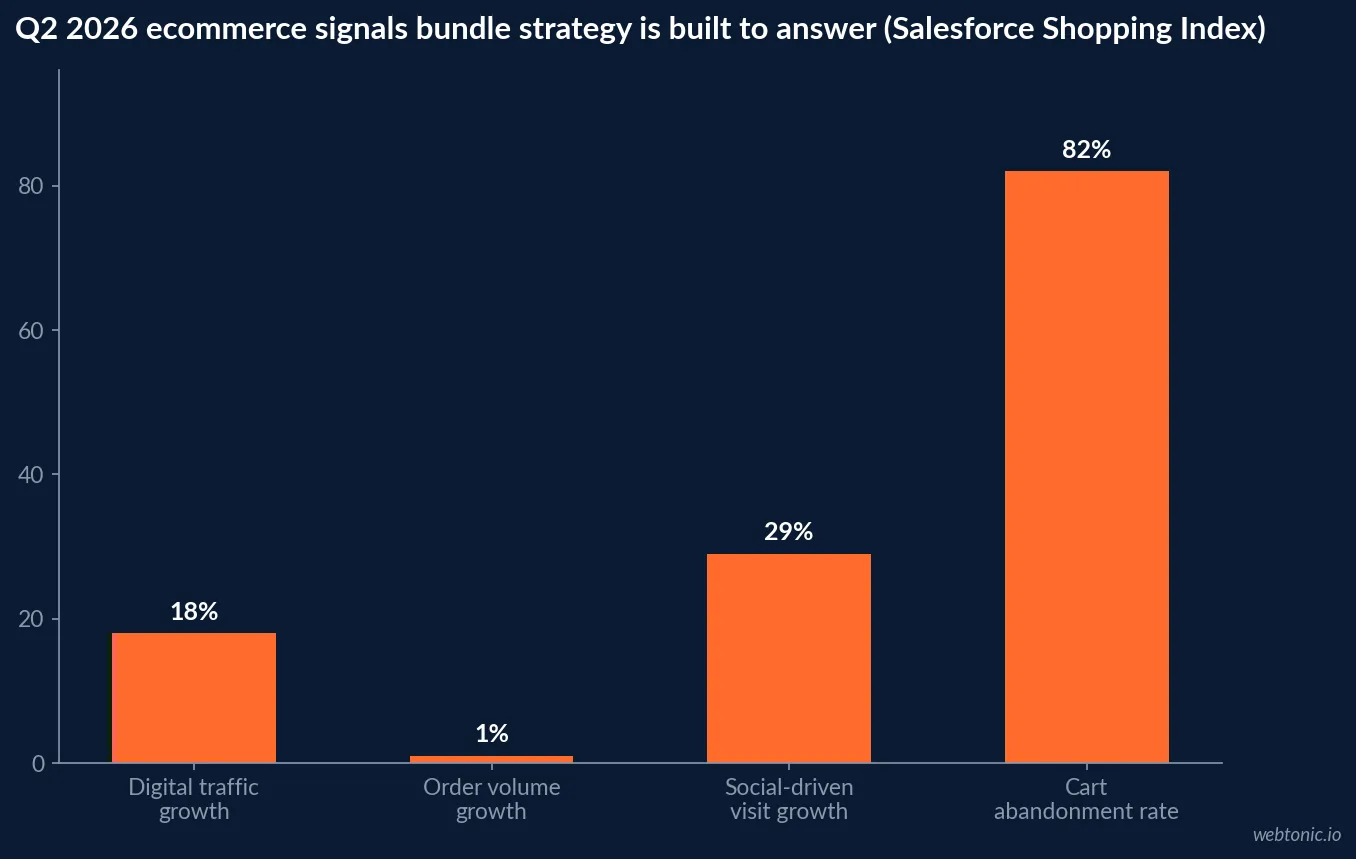
The 2026 traffic and order data explain why bundling is back on the roadmap. The Salesforce Shopping Index reports global digital traffic up 18% in Q2 2026 while order volume grew barely 1%, mobile commands three-quarters of traffic, social drove 29% more ecommerce visits, and cart abandonment sits at 82%. Getting a click is no longer the same as closing a sale, and a bundle is one of the few levers that raises revenue per visit without raising acquisition spend.
The mechanism is specific. Salesforce's own revenue-growth breakdown attributes most order-value movement to units per order (+1.9%) rather than price changes, which is exactly what a well-built bundle produces: one more relevant item added to a cart that was already converting.
| 2026 signal | Figure | Source | What it means for a bundle offer |
|---|---|---|---|
| Digital traffic growth, Q2 2026 | 18% | Salesforce Shopping Index | More eyeballs, same conversion problem |
| Order volume growth, Q2 2026 | 1% | Salesforce Shopping Index | Traffic is not converting to orders on its own |
| Cart abandonment | 82% | Salesforce Shopping Index | The last screen is where a bundle offer earns its keep |
| AOV growth from units per order | 1.9% | Salesforce Quest for Growth | Bundles that add a unit, not a discount, drive this |
| Social-driven visit growth | 29% | Salesforce Shopping Index | A wider top of funnel for a bundle to convert |
Discount-led versus value-add-led bundles
Harvard Business Review's 2025 piece "It's Time to Try Bundled Pricing" makes a case most bundling playbooks skip: not every bundle needs to be cheaper. Chili's "3 For Me" set-price meal bundle reversed years of stagnation and drove a 31% sales increase with record stock performance, built on simplified choice and perceived value rather than a steep markdown. The article's framework splits bundles into two lanes - discount-led and value-add-led - and warns that many executives default to the first when the second protects margin just as well.
Convenience, exclusive perks and a simpler decision are all currencies a bundle can trade in besides price. A bundle that removes a decision (which size, which flavor, which accessory) can lift conversion even at full price, because the friction it removes was the actual barrier, not the ticket price.
| Bundle lane | What it trades on | Example in the data | Margin risk |
|---|---|---|---|
| Discount-led | Lower per-unit price for more units | Ecommerce mix-and-match kits | High - margin erodes with discount depth |
| Value-add-led | Convenience, perks, simpler choice | Chili's "3 For Me", set-price meal bundle | Low - price holds, perceived value rises |
| Retention-led | Commitment for a lower recurring rate | Annual subscription bundles | Medium - revenue per user rises, churn risk shifts |
| Category-defense | Match a rival's bundle before they own the category | First-mover bundlers in a price war | Variable - depends on rival's next move |
Why bundling beats a price war
The game-theory case for bundling comes from a working paper by Bain & Company's Araz Khodabakhshian with INSEAD and UCLA Anderson researchers, covered by the UCLA Anderson Review. Modelling two firms competing on price, the paper finds that if one company bundles, the other is consistently better off not bundling and competing on a single component instead - and that bundling is always the more profitable strategy for whoever moves first. The authors are blunt about the intent: "Bundling is essentially used to soften price competition or to create barriers to entry."
The paper also distinguishes pure bundling (package only, no à la carte) from mixed bundling (components sold separately or together at a discount). Mixed bundling wins when customers place different values on different pieces - which describes most real product catalogs - while pure bundling only works cleanly when a company is willing to cede the single-component market to a rival entirely. Bain's older analysis of the "battle of the bundle" in telecom found the same trap in reverse: bundles built around price discounts alone rarely earn durable loyalty, because the only customers who respond to a pure discount are the ones most willing to leave for the next discount.
Bundling for retention, not just for one bigger cart
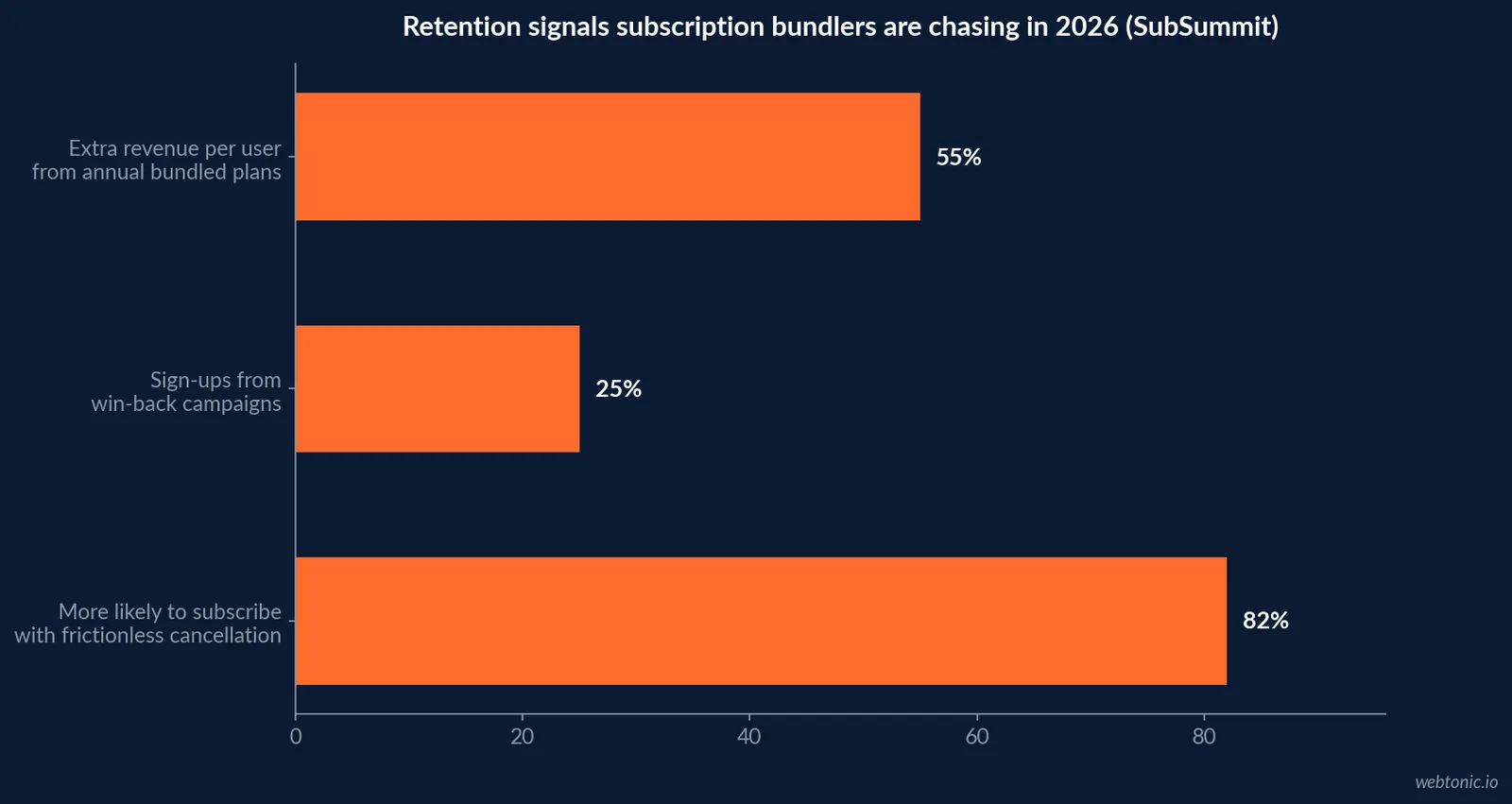
Subscription and recurring-revenue brands are leaning on bundling differently: to keep a customer, not just to grow one order. SubSummit's 2026 State of the Subscription Box Industry report finds pause-before-cancel usage up 337% year over year, annual plan holders generating 50-60% more revenue per user than monthly plans, and win-back campaigns already accounting for 1 in 4 new sign-ups. Crucially, 82% of consumers say they are more likely to subscribe in the first place when cancellation is frictionless - flexibility, not lock-in, is what makes a bundled plan feel safe to join.
That reframes what a "bundle" is for a recurring-revenue brand: not a bigger box, but a bigger commitment made cheaper to enter and easier to pause. The operators treating the FTC's click-to-cancel rule as a conversion tool rather than a compliance cost are the ones compounding that advantage.
| Retention metric (2026) | Figure | Source | Why it matters for bundling |
|---|---|---|---|
| Pause-before-cancel usage, YoY | +337% | SubSummit | Flexibility inside the bundle, not exit, is the safety valve |
| Annual vs. monthly plan revenue per user | +50-60% | SubSummit | The bundle's real ROI shows up in retention, not order 1 |
| Sign-ups from win-back campaigns | 25% | SubSummit | A lapsed bundle customer is cheaper to re-win than acquire new |
| More likely to subscribe with frictionless cancel | 82% | SubSummit | Easy exit is a conversion lever for the bundle itself |
How much surplus a bundle actually creates
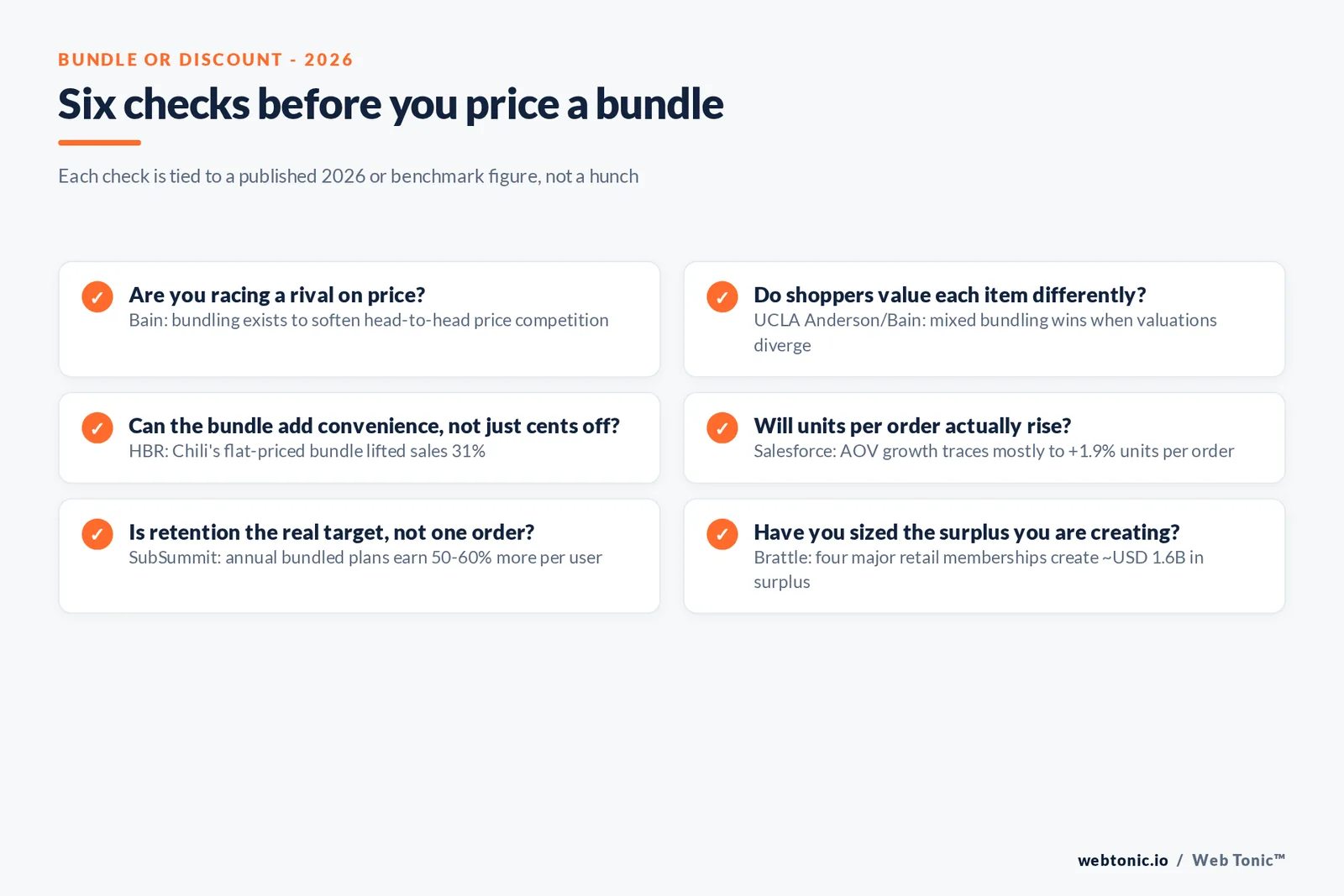
The clearest evidence that bundled features earn their keep with real customers, rather than just looking good on a pricing page, comes from the Brattle Group's 2024 survey of paid retail memberships at four major US retailers. Surveying 1,001 participants on how they value bundled membership features, Brattle finds consumers typically enjoy the added benefits and rarely react negatively to a feature's inclusion, even when they do not use it. The total market-wide consumer surplus across the four memberships studied comes out to roughly USD 1.6 billion - a number that only exists because the bundle's components were relevant enough to be worth carrying, not because the price was cut.
The academic literature backs the mechanism. A peer-reviewed study in Marketing Science on the handheld gaming market found that mixed bundling dominates both pure bundling and pure components on hardware and software revenue, and that removing a bundle can cause customers who previously bought it to delay their next purchase entirely - evidence that a bundle, once established, becomes its own product in the customer's mind.
| Evidence source | Sample / method | Headline finding | Year |
|---|---|---|---|
| Brattle Group | 1,001-consumer survey, 4 retail memberships | ~USD 1.6B in market-wide consumer surplus | 2024 |
| Bain / INSEAD / UCLA working paper | Two-firm price-competition model | Bundling is always the more profitable first move | 2020 (via UCLA Anderson Review) |
| Marketing Science journal | Handheld video-game market model | Mixed bundling beats pure bundling and pure components | 2013 |
| Harvard Business Review | Case studies across food, insurance, entertainment, sports | Value-add bundles grow revenue without deep discounts | 2025 |
The pricing lever bundling actually pulls
McKinsey's framework for revenue-growth pricing strategies places bundling alongside introductory offers and subscription pricing as a lever to increase revenue per customer, not just per transaction - and warns that success requires holding profitability, keeping churn low and managing acquisition cost at the same time a bundle is scaled. Bain's separate research on SKU and portfolio complexity, published as "Focused products", found that companies with the least complex product and service offerings grow almost three times as fast as high-complexity companies - a reminder that a bundle should simplify the shelf, not just add another SKU to it.
Put together, the throughline across every source here is the same: bundle around relevance and convenience first, use discount depth as the last lever, and measure the bundle on retained revenue per user, not only on the AOV of the order it was first sold in.
Building and measuring the bundle
Our growth marketing practice builds bundle offers from co-purchase and repeat-purchase data rather than guesswork, and our data and analytics team instruments the retained-revenue metrics - not just the AOV bump - that decide whether a bundle is a pricing win or a margin leak six months later. If bundling is on your 2026 roadmap, talk to us before you set the discount depth.
Frequently Asked Questions
Does product bundling actually raise average order value?
Yes, but the mechanism matters more than the headline number. Salesforce's Shopping Index attributes most 2026 AOV growth to a 1.9% rise in units per order rather than price increases, and Harvard Business Review's account of Chili's flat-priced "3 For Me" bundle credits a 31% sales increase to perceived value, not a deep discount. A bundle that only cuts price protects margin the least; a bundle that adds a second unit or a convenience protects it the most.
Should a bundle be priced as a discount or as an added-value package?
Harvard Business Review's 2025 framework splits bundles into discount-led and value-add-led, and argues many executives default to discounting when a convenience, exclusive perk or experience enhancement would protect margin just as well. Bain's academic-adjacent modelling of pure versus mixed bundling adds a second rule: bundle by discount only when your rival is also bundling, otherwise you are giving away margin nobody asked for.
Is a bundle better for new-customer conversion or for retention?
The data splits the two use cases. SubSummit's 2026 subscription industry report finds annual bundled plans generate 50-60% more revenue per user than month-to-month, and that win-back campaigns already account for 1 in 4 new sign-ups, which points to bundling as a retention lever first. For net-new conversion, the Uniqodo-style discount data on single-item coupons still outperforms a multi-item bundle offer on raw click-through, so the two tactics are complements, not substitutes.
How many products should go into a bundle?
Published research does not converge on a fixed number, but it converges on a principle: value comes from complementary items the customer would have bought anyway, not from stuffing the cart. The Brattle Group's 2024 survey of four major retail memberships found consumers rarely react negatively to added features inside a bundle, which suggests the ceiling is set by relevance, not quantity.
What is the biggest mistake brands make when they bundle?
Discounting so aggressively that the bundle wins on AOV but loses on margin per order. The practical test from the retail data is simple: the bundle's total margin dollars should still exceed the margin you would have earned on your best-selling single item in that cart, or the bundle is a volume tactic wearing a pricing strategy's clothes.
Sources
Salesforce - 2026 Holiday Predictions / Shopping Index
Salesforce - Quest for Growth, revenue-growth analysis
Harvard Business Review - It's Time to Try Bundled Pricing (2025)
UCLA Anderson Review - Avoiding Direct Price Competition: Bundling and Unbundling
The Brattle Group - Unraveling the Bundled Benefits of Retail Memberships (2024)
SubSummit - State of the Subscription Box Industry 2026
Marketing Science - The Dynamic Effects of Bundling as a Product Strategy
McKinsey - Understanding Your Options: Proven Pricing Strategies
Bain & Company - Focused Products