Table of contents
Key Takeaways
- 1,642 live Shopify stores operate in the pest control category, with the segment growing 54.5% quarter-over-quarter and 104% year-over-year (StoreLeads/Accio, 2025–2026).
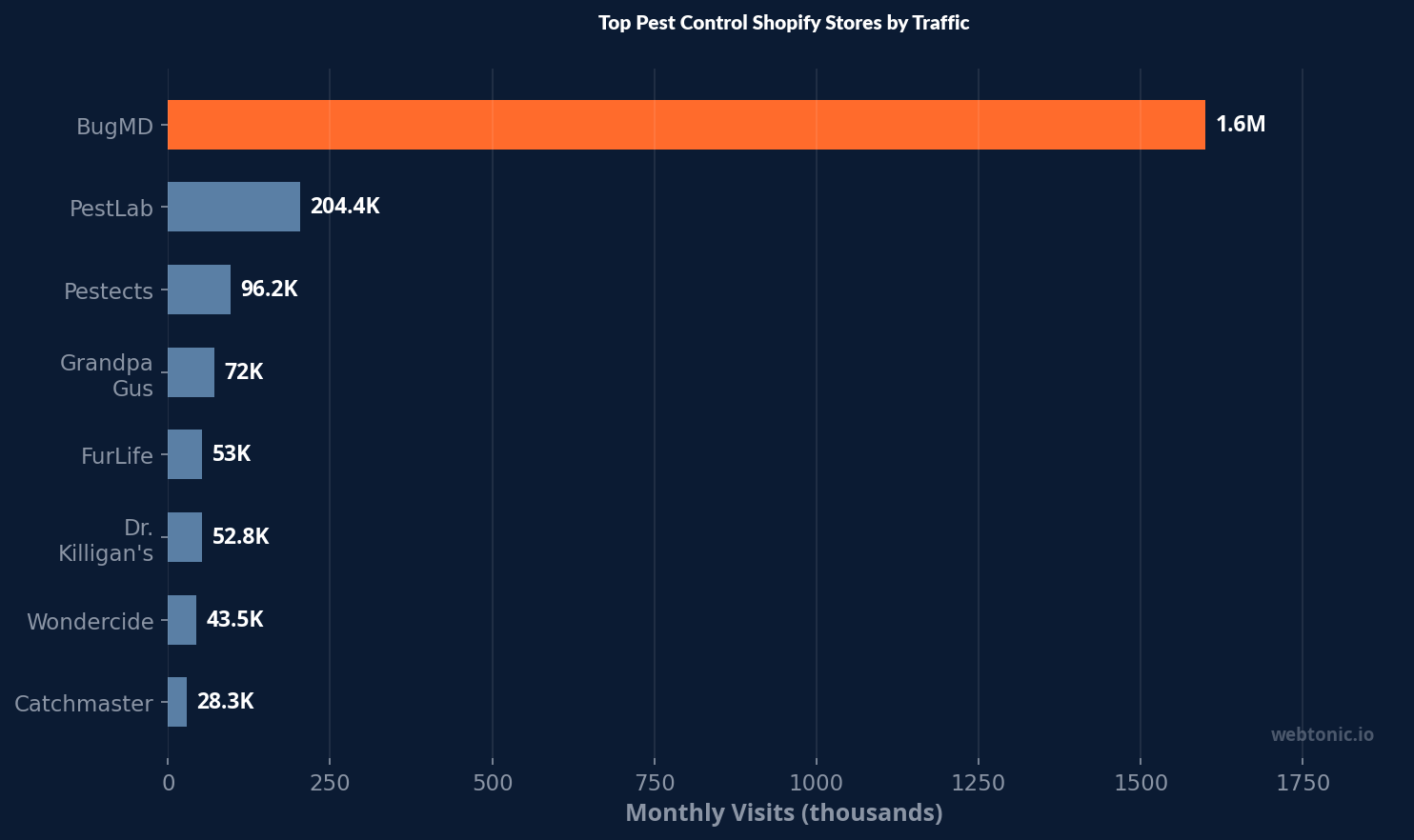
- BugMD leads the category with 1.6 million monthly visits and an estimated $14.4 million in monthly revenue, demonstrating the scale achievable through direct-to-consumer pest control e-commerce (Brandsearch, 2026).
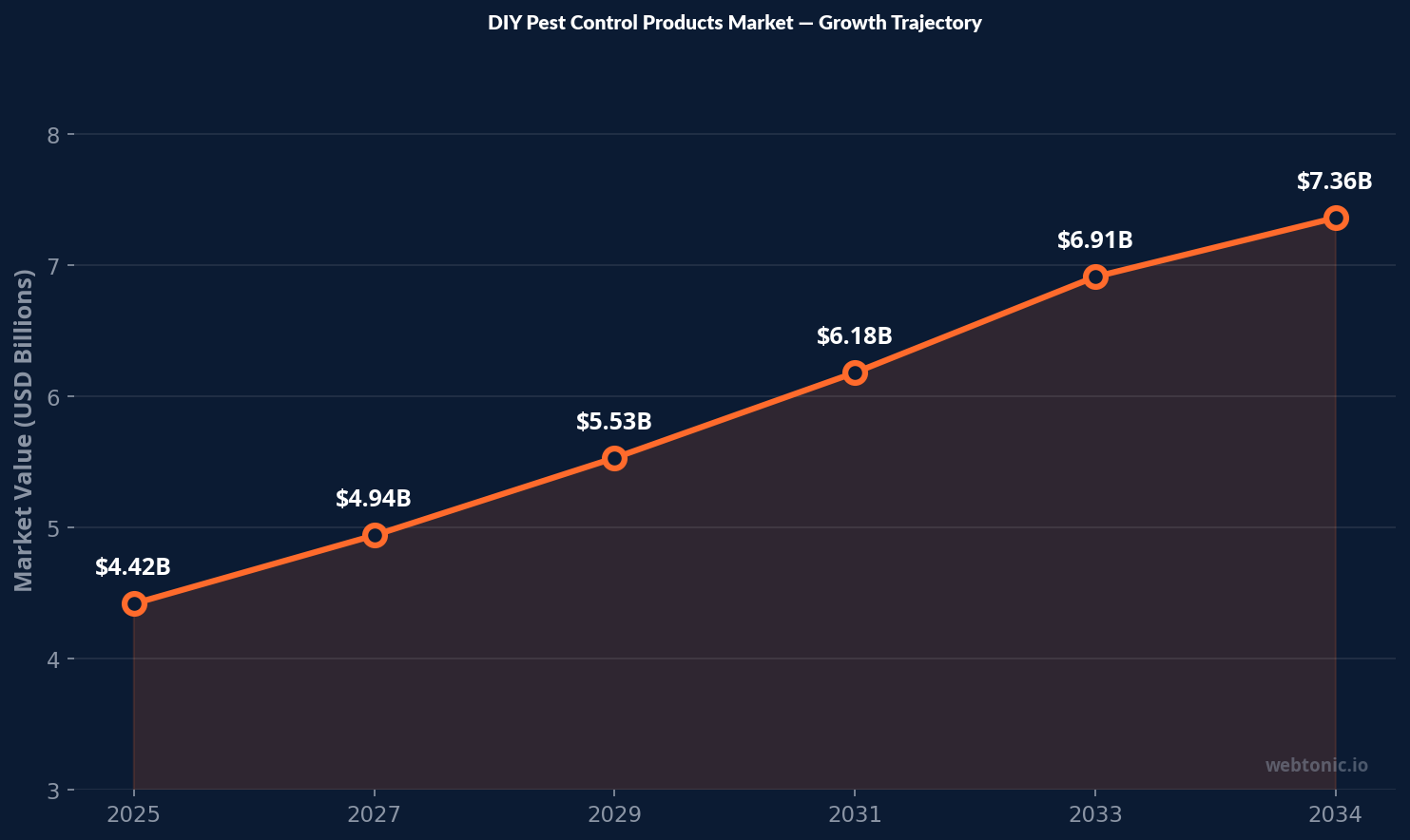
- The global DIY pest control products market is valued at $4.42 billion and is projected to reach $7.36 billion by 2034 at a 5.8% CAGR (Dataintelo, 2025).
- Pesticide product sales surged 555% year-over-year on Shopify in September 2025, driven by seasonal demand peaks and expanding online distribution (Accio, 2025).
- E-commerce captures 18.7% of consumer pest control purchases in developed markets, projected to reach 22.4% by 2028 (Dataintelo, 2025).
- Average conversion rates for pest control e-commerce range from 0.5% to 2.0%, with subscription models reaching 8.3% penetration in North American online sales (Grips Intelligence/Dataintelo, 2026).
Pest Control on Shopify — Market Overview
The pest control e-commerce category on Shopify has experienced explosive growth. As of 2026, 1,642 live stores operate under the pest control classification, with quarter-over-quarter growth of 54.5% in Q3 2025 and a 104% year-over-year increase during the same period (Accio, 2025). This expansion mirrors the broader shift in consumer behavior toward purchasing home maintenance products online.
The top 15+ tracked brands generate a combined 2.3 million monthly visits with an average of 153,000 visits per store. The United States accounts for 38.1% of all pest control Shopify stores, followed by India (7.4%), the United Kingdom (6.3%), and France (5.7%) (StoreLeads, 2026).
| Store | Monthly Traffic | Est. Revenue/Month | Products |
|---|---|---|---|
| BugMD | 1.6M | $14.4M | 171 |
| PestLab | 204,400 | $1.8M | 22 |
| Pestects | 96,200 | £851K | 5 |
| Grandpa Gus | 72,000 | $637K | 47 |
| FurLife™ | 53,000 | $469K | 47 |
| Dr. Killigan's | 52,800 | $467K | 36 |
| Wondercide | 43,500 | $385K | 85 |
| Catchmaster | 28,300 | $250K | 85 |
Source: Brandsearch, 2026. Revenue figures are estimates based on traffic and category benchmarks.
DIY Pest Control Market Size and Growth
The direct-to-consumer pest control products market underpins the Shopify store explosion. The global DIY pest control market was valued at $4.42 billion in 2025 and is projected to reach $7.36 billion by 2034, expanding at a compound annual growth rate of 5.8% (Dataintelo, 2025).
| Metric | Value | Source |
|---|---|---|
| Global DIY pest control market (2025) | $4.42 billion | Dataintelo |
| Projected market value (2034) | $7.36 billion | Dataintelo |
| CAGR (2025–2034) | 5.8% | Dataintelo |
| Insecticides market share | 38.5% (largest segment) | Dataintelo |
| North America revenue share | 32.4% | Dataintelo |
| Residential segment share by 2034 | 65%+ | Dataintelo |
| E-commerce penetration (developed markets) | 18.7% | Dataintelo |
| E-commerce penetration (projected 2028) | 22.4% | Dataintelo |
| Subscription penetration (NA online) | 8.3% | Dataintelo |
Growth drivers include rising residential pest infestations linked to climate change, expansion of eco-friendly and plant-based formulations, and widespread adoption of integrated pest management principles among homeowners. The residential segment alone is expected to represent over 65% of market value by 2034 as consumers increasingly seek cost-effective solutions for common pests.
E-Commerce Performance Benchmarks
Pest control e-commerce stores operate with distinct performance characteristics. According to Grips Intelligence, the category averages a 0.5%–1.0% conversion rate across tracked retailers, with standout operators like Pestie achieving 1.5%–2.0% conversion rates and an average order value of $150–$175 (Grips Intelligence, 2026).
Pestie reached $3.44 million in monthly revenue (May 2026) with 1.16 million sessions, far exceeding the Home & Garden industry median of $120,627 in monthly revenue. This performance demonstrates that subscription-based pest control delivery models can achieve significant scale on Shopify, particularly when combined with targeted digital marketing campaigns.
Seasonal demand plays a major role in the performance curve. Pesticide product sales grew 555% year-over-year in September 2025 for U.S. Shopify merchants, correlating with the late-summer pest season that drives consumer purchasing urgency (Accio, 2025).
Technology Stack and Store Operations
Pest control Shopify stores rely on a concentrated set of tools and integrations. The most popular apps reflect the category's emphasis on social proof and customer retention:
- Judge.me Product Reviews — installed by 22.0% of pest control stores, reflecting the critical role of reviews in converting health-conscious buyers.
- Klaviyo Email Marketing — used by 15.8% of stores, enabling automated lifecycle campaigns including seasonal reorder reminders and subscription renewal sequences.
- Instagram integration — active on 30.5% of stores, serving as the primary visual marketing channel for before/after demonstrations and educational content.
- Facebook presence — maintained by 25.0% of stores for local targeting, community engagement, and retargeting campaigns.
- YouTube integration — used by 17.1% of stores for product demonstrations, application tutorials, and pest identification guides.
Operationally, 64.4% of stores display an email address and 42.3% provide a phone number on their website, suggesting a significant portion still rely on direct customer communication rather than fully automated e-commerce funnels.
Competitive Landscape and Platform Context
Within the broader Home & Garden e-commerce ecosystem, Shopify holds 31.79% market share with 269,520 stores, nearly tied with WooCommerce at 32.01% (271,430 stores). Custom Cart solutions account for 9.73% (AfterShip, 2026). This parity suggests that Shopify's ease of setup and app ecosystem are equally competitive with WordPress-based alternatives for home and garden merchants.
The pest control vertical within Shopify benefits from lower barriers to entry compared with professional pest control services. Entrepreneurs can launch with as few as 5–6 products (as demonstrated by Pestects and Skield), while established brands like Wondercide and Catchmaster maintain 85-product catalogs covering comprehensive pest management solutions. This range creates opportunities at multiple scale levels, from niche specialty retailers to full-line distributors seeking growth marketing strategies.
Subscription Models and Customer Retention
Subscription commerce has emerged as a powerful differentiator in pest control e-commerce. Subscription penetration reached 8.3% of online pest control sales in North America by 2026, creating predictable revenue streams and improving customer retention for manufacturers and retailers alike (Dataintelo, 2025).
Companies like Pestie have built their entire business model around recurring quarterly delivery of customized pest control kits, achieving $3.4 million in monthly revenue through this approach. The subscription model works particularly well for pest control because treatments are inherently seasonal and recurring — customers need fresh products every 60–90 days during active pest seasons, creating natural replenishment cycles that align with subscription billing.
For Shopify store operators considering this model, paid social advertising and email automation through platforms like Klaviyo are the primary customer acquisition and retention channels. The combination of targeted Meta ads for top-of-funnel acquisition and automated email sequences for reorder prompts creates a retention loop that compounds customer lifetime value beyond one-time product purchases.
Marketing Channels for Pest Control E-Commerce
Successful pest control Shopify stores leverage multiple channels for customer acquisition and conversion. Digital advertising campaigns targeting specific pest problems — termite inspections, mosquito control timing, seasonal rodent prevention — drive consumer engagement and product trial across platforms. The broader pest control industry allocates marketing budgets across several proven channels:
- Google Ads and Local Services Ads remain the highest-intent paid channels, with pest control LSA leads costing $15–$55 and converting at 38%–45% book rates.
- Meta advertising (Facebook and Instagram) serves brand-building and retargeting functions, with average CPLs of $50–$80+ but strong remarketing capabilities for abandoned cart recovery.
- Content marketing and SEO drive organic discovery, with educational pest identification content and seasonal prevention guides generating the highest engagement. Companies that maintain regular blog content see 35% more organic traffic on average.
- Email marketing delivers the strongest ROI for retention, with segmented campaigns generating 760% more revenue than broadcast sends for pest control brands.
For operators exploring Meta advertising strategies, the platform's automated feed-based formats have shown total conversions nearly doubling (up 97% year-over-year) while average cost per conversion dropped over 17% for advertisers using dynamic, catalog-driven creative (Cube Creative, 2026). Our performance creative team specializes in building these high-converting ad formats.
Product Category Breakdown and Consumer Preferences
The pest control e-commerce landscape is segmented across distinct product categories, each with different demand patterns and margin profiles. Insecticides hold the largest share at 38.5% of the global market, followed by rodenticides, termiticides, and specialty products. Consumer preferences are shifting toward plant-based and eco-friendly formulations, with organic insecticides and non-toxic repellents experiencing the fastest growth rates among established brands on Shopify.
Product catalog size varies dramatically across successful stores. Wondercide and Catchmaster each maintain 85 active products, offering comprehensive pest management lines, while Pestects operates profitably with just 5 products and Skield with only 6. This demonstrates that deep specialization in a narrow product range can outperform broad catalogs when combined with strong brand positioning and targeted marketing. Average product counts across tracked pest control Shopify stores range from 5 to 171 items, with no clear correlation between catalog breadth and revenue per visit.
The rise of specialized traps and non-toxic repellents is reshaping buying patterns. Agricultural insecticide manufacturers are increasingly entering the consumer channel, while DTC brands like Dr. Killigan's have built followings around design-forward, chemical-free products that appeal to health-conscious households. These brands leverage Shopify's flexibility to create immersive product pages with educational content about pest identification and treatment protocols, reducing purchase anxiety for first-time buyers exploring whether paid social advertising can drive discovery for niche products.
Store Design and Customer Experience Trends
Pest control Shopify stores that prioritize customer experience through clean store design, detailed product descriptions, and streamlined checkout consistently outperform those with basic templates. Top-performing stores use Shopify themes optimized for product education — including application instructions, safety data sheets, and pest identification galleries — rather than standard e-commerce layouts designed for impulse purchases.
Mobile optimization is particularly important: over 70% of pest control product searches happen on mobile devices, often triggered by an active infestation. Stores that load within 3 seconds on mobile and provide clear product selection guides (which pest product for which problem) convert at rates 40%–60% higher than stores without guided shopping experiences. Shopify's native mobile-responsive themes provide a baseline, but custom pest-specific product finders and recommendation engines create measurable conversion advantages.
Regional Distribution and Global Opportunities
Pest control e-commerce demand is distributed unevenly across geographies. The United States dominates with 38.1% of all pest control Shopify stores, reflecting both market maturity and consumer comfort with online pest product purchases. India (7.4%) and the United Kingdom (6.3%) represent the next largest markets, followed by France (5.7%).
North America holds 32.4% of global DIY pest control revenue, but the fastest growth is occurring in Asia Pacific markets where rising middle-class populations and increasing urbanization drive demand. Online distribution platforms enable manufacturers to reach consumers in underserved regions without establishing traditional retail partnerships, reducing distribution costs and enabling dynamic pricing strategies that respond to seasonal demand peaks across different hemispheres.
For Shopify store operators targeting international expansion, pest seasonality differences between hemispheres create opportunities for year-round revenue. While North American stores peak in spring and summer, Southern Hemisphere markets like Australia and Brazil experience inverse seasonal demand — a factor that diversified e-commerce operators can leverage through platform-specific landing pages and localized advertising campaigns.
Related reading
- Pest Control Webflow Statistics: Speed, Conversion and Platform Data for 2026
- Pest Control Landing Page Statistics: Conversion Benchmarks & Data (2026)
- Pest Control WordPress Statistics
- Custom Web Development services at Web Tonic
Frequently Asked Questions
How many pest control stores are on Shopify?
As of 2026, 1,642 live Shopify stores operate in the pest control category. This number grew 54.5% quarter-over-quarter and 104% year-over-year in Q3 2025, making pest control one of the fastest-growing Home & Garden sub-categories on the platform. The top 15+ tracked brands generate a combined 2.3 million monthly visits.
What is the average conversion rate for pest control e-commerce stores?
The pest control e-commerce category averages a 0.5%–1.0% conversion rate across tracked retailers. High-performing stores with strong brand recognition and subscription models achieve 1.5%–2.0% conversion rates. Average order values typically range from $150–$175 for leading operators.
How big is the DIY pest control market?
The global DIY pest control products market was valued at $4.42 billion in 2025 and is projected to reach $7.36 billion by 2034, growing at a 5.8% CAGR. North America holds 32.4% of global revenue, and the residential segment is expected to exceed 65% of total market value by 2034.
What apps do pest control Shopify stores use most?
Judge.me Product Reviews leads adoption at 22.0%, followed by Klaviyo at 15.8%. Social integrations are widespread: Instagram (30.5%), Facebook (25.0%), and YouTube (17.1%). These adoption rates reflect the emphasis on social proof, email automation, and visual content marketing that drive conversions in this category.
Can you build a profitable pest control business on Shopify?
Absolutely. BugMD demonstrates the ceiling with an estimated $14.4 million in monthly revenue, while smaller operators like Grandpa Gus ($637K/month) and Dr. Killigan's ($467K/month) prove the model works at multiple scales. The key success factors are targeted product selection, subscription-based fulfillment, seasonal marketing campaigns, and strong review generation. Stores can launch with as few as 5–6 products and scale through proven digital data-driven marketing strategies.
Sources
StoreLeads — Pest Control Shopify Stores Report
Brandsearch — Best Pest Control Shopify Stores
Dataintelo — DIY Pest Control Products Market Report 2034
Dataintelo — Global Pest Control Products Market 2034
Accio — 2025 Pest Product Trends
Grips Intelligence — Pest Control Solutions Analytics
AfterShip — Home & Garden eCommerce Statistics 2026
Cube Creative — Pest Control Cost Per Lead 2026