



Table of contents
Key Takeaways
- WordPress powers 41.2% of all websites globally and 59.2% of sites with a known CMS, making it the dominant platform for pest control businesses building their online presence (W3Techs, July 2026).
- Pest control website conversion rates average just 2% to 4%, meaning 96 to 98 out of every 100 visitors leave without making contact — proper optimization can push top performers to 7-10%+ (First Page Sage / Cube Creative).
- 64% of pest control website traffic comes from mobile devices, yet mobile converts at only 2.2-2.8% versus desktop's 3.2-4.3%, revealing a massive gap for growth-focused WordPress site owners (Cube Creative, 2026).
- Every additional second of page load time costs approximately 4.42% of conversions, and sites loading in 1 second convert at 3x the rate of sites loading in 5 seconds (Cube Creative / Google).
- 48% of pest control leads come from organic search traffic, which closes at a 14-22% rate — making SEO-optimized WordPress sites the highest-ROI acquisition channel (Marketing LTB, 2026).
- 78% of local mobile searches convert within 24 hours, underscoring why a fast, mobile-first WordPress site with clickable phone numbers is essential for pest control lead generation.
WordPress remains the foundation of most pest control company websites in 2026, but having a site and having one that generates leads are two different things. The statistics below reveal where the gaps are — page speed, mobile optimization, conversion rates — and what the data says about closing them.
Pest Control Website Performance at a Glance
| Metric | Value | Source |
|---|---|---|
| WordPress global market share (all sites) | 41.2% | W3Techs, July 2026 |
| WordPress share of known CMS sites | 59.2% | W3Techs, July 2026 |
| Avg. pest control website conversion rate | 2%-4% | First Page Sage / Cube Creative |
| Top-performing site conversion rate | 7%-10%+ | Cube Creative, 2026 |
| Mobile traffic share (pest control) | 64% | Cube Creative, 2026 |
| Emergency searches from mobile | 68% | Cube Creative, 2026 |
| Leads from organic search | 48% | Marketing LTB, 2026 |
| Website bounce rate (industry avg.) | 47% | Marketing LTB, 2026 |
CMS Market Share and WordPress Dominance
WordPress's 41.2% share of all websites reflects its dominance in home services. With thousands of themes, booking plugins, and SEO tools built for service businesses, WordPress remains the default choice for pest control companies building their digital presence.
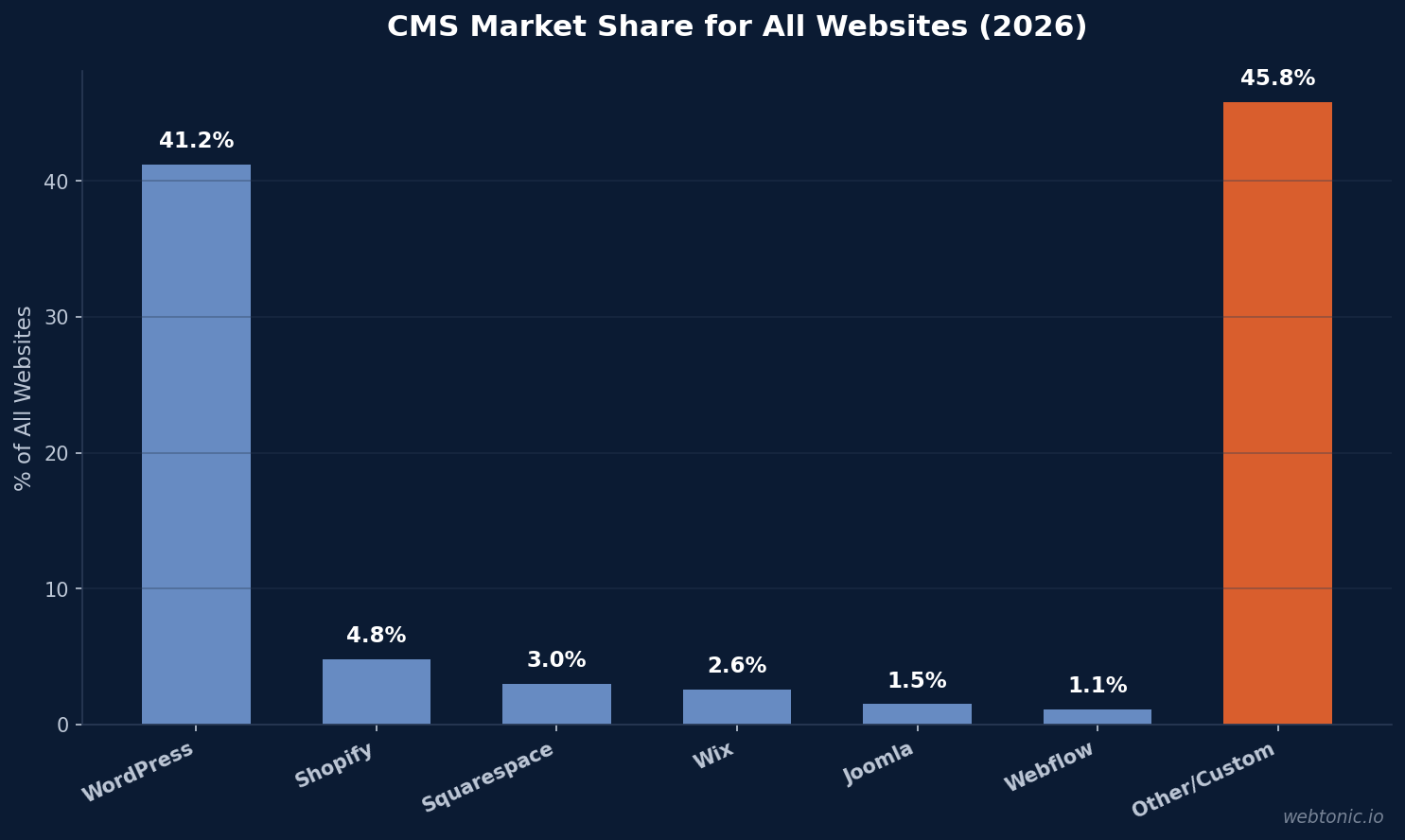
A direct comparison of WordPress, Squarespace, and Wix for pest control businesses found WordPress offers the most flexibility for multi-service companies needing separate service pages, pricing structures, and booking systems — though it requires more technical knowledge to maintain.
Page Speed Impact on Pest Control Conversions
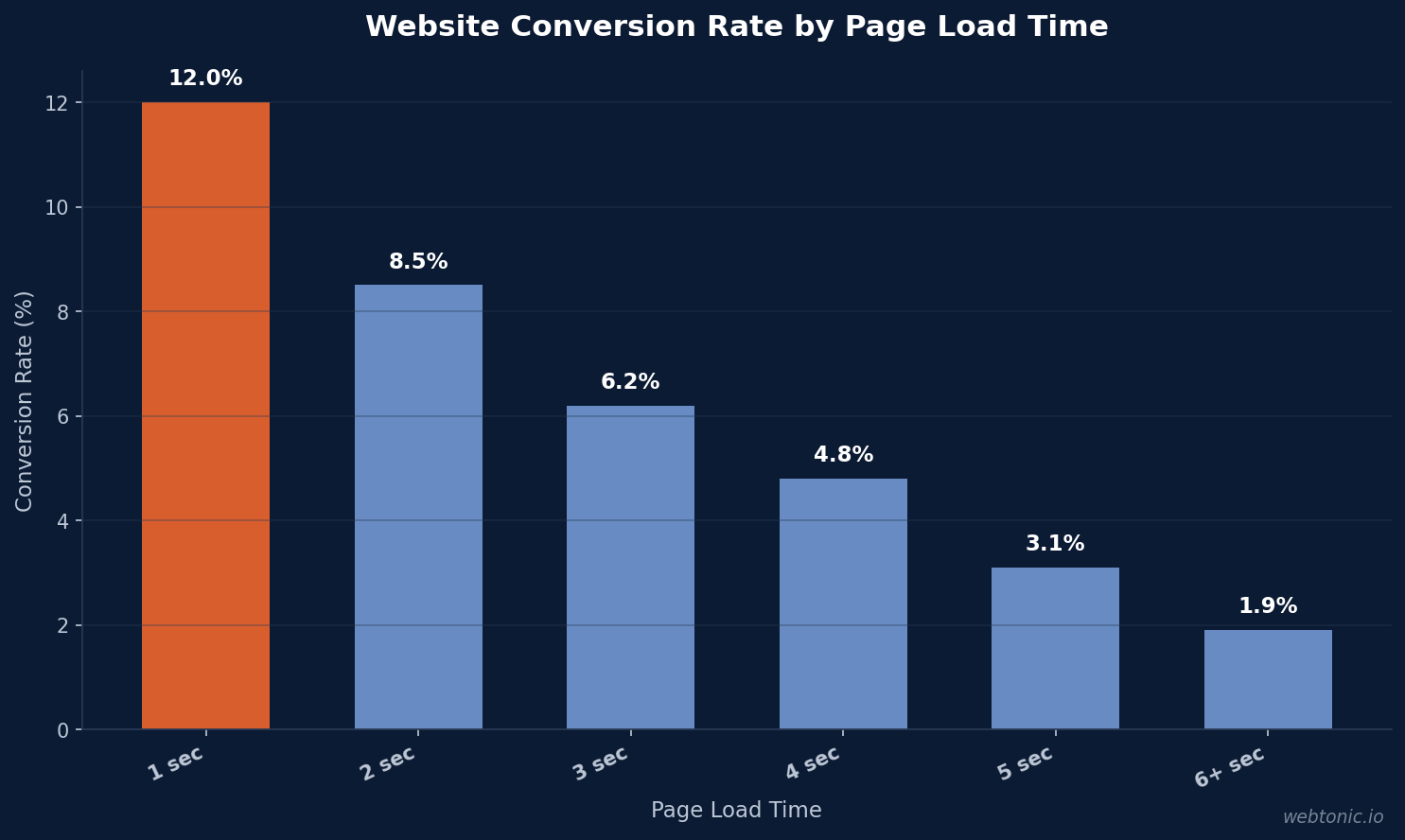
Speed is the most overlooked conversion lever for WordPress pest control sites. Sites loading in 1 second convert at 3x the rate of sites loading in 5 seconds, and every additional second costs approximately 4.42% of conversions (Cube Creative, 2026). For a pest control company generating 500 monthly visitors, the difference between a 2-second and 5-second load time means 15-20 lost leads per month.
53% of mobile users abandon sites that take more than 3 seconds to load (PipelineOn, 2026), and 80% of mobile sites are slower than Google's recommended threshold (Marketing LTB). WordPress sites are particularly vulnerable to speed issues from unoptimized plugins, oversized hero images, and shared hosting environments.
Mobile Optimization Gap in Pest Control
84% of all local pest control searches happen on mobile devices, according to local search data compiled by Cube Creative. Despite this, mobile conversion rates average just 2.2-2.8% compared to desktop's 3.2-4.3% — nearly half the performance.
This mobile conversion gap represents massive revenue leakage. Cube Creative estimates that pest control companies ignoring mobile optimization lose approximately $47,000 per year in potential revenue. The fix is straightforward: clickable phone numbers, sticky call bars, sub-3-second load times, and thumb-friendly forms.
| Metric | Mobile | Desktop | Gap |
|---|---|---|---|
| Conversion Rate | 2.2%-2.8% | 3.2%-4.3% | ~45% lower on mobile |
| Traffic Share | 64% | 36% | Mobile dominates |
| Emergency Search Share | 68% | 32% | 2x more emergency intent |
| Bounce Rate (Home Services) | 51.2% | 38% | +13 percentage points |
| 24h Conversion (Local Search) | 78% | ~50% | +28 pp higher intent |
WordPress SEO and Lead Generation Benchmarks
48% of pest control leads originate from organic search traffic, making SEO the single largest lead channel (Marketing LTB, 2026). Those organic leads close at a 14-22% rate. WordPress's plugin ecosystem — Yoast, Rank Math, Schema Pro — gives pest control companies the tools to optimize every page for search visibility without developer intervention.
53% of pest control traffic comes from local SEO pages (Marketing LTB), and 68% of leads originate from local search results. WordPress sites with dedicated location pages, optimized Google Business Profile integration, and local schema markup consistently outperform competitors relying on a single homepage.
FAQ pages on WordPress pest control sites reduce bounce rate by 19%, while seasonal landing pages outperform general pages by 41%. A/B testing through WordPress plugins like Elementor Pro improves conversions by an additional 20%, creating compounding returns when paired with a structured search advertising approach (Marketing LTB, 2026).
Live chat functionality added to WordPress pest control sites increases engagement by 26%, and companies responding to leads within 5 minutes see 2.5x higher conversion rates (Marketing LTB). Conversely, 58% of pest control leads are lost due to slow response time, making automated chat widgets and instant callback tools essential WordPress additions for operators who cannot staff phones 24/7. Paid ads still generate 35% of total leads on average, but the organic channel's superior close rate makes WordPress SEO optimization the higher-leverage investment for most pest control businesses.
Essential WordPress Plugins for Pest Control Websites
WordPress's plugin ecosystem is its biggest competitive advantage for pest control operators. The right stack transforms a basic brochure site into a lead generation machine. Based on industry data and adoption patterns, these are the categories that matter most:
| Plugin Category | Top Options | Impact on Performance | Typical Cost |
|---|---|---|---|
| SEO Optimization | Yoast SEO, Rank Math | 48% of leads come from organic — proper on-page SEO is non-negotiable | Free-$99/yr |
| Page Speed / Caching | WP Rocket, LiteSpeed Cache | 4.42% conversion lift per second of load time reduction | Free-$59/yr |
| Online Booking | Bookly, Amelia, WPForms | 20% more conversions from embedded scheduling vs. phone-only | $0-$189/yr |
| Schema / Structured Data | Schema Pro, Rank Math | Featured snippet eligibility and rich results in local search | Free-$79/yr |
| Analytics / Tracking | WP Statistics, MonsterInsights | GDPR-compliant visitor tracking without external dependencies | Free-$200/yr |
| Image Optimization | ShortPixel, Imagify | 53% of users leave slow sites — compressed images are critical | Free-$10/mo |
WP Statistics alone has been downloaded over 10 million times, providing a GDPR-compliant, cookie-free alternative to Google Analytics that stores all data directly in the WordPress database. For pest control businesses concerned about privacy compliance, this eliminates the need for third-party tracking accounts while still providing visitor data, referral sources, and campaign analytics capabilities.
WordPress Hosting Costs and Technical Considerations
WordPress hosting for pest control sites ranges from $4-$10/month on shared plans to $20-$60/month for premium managed hosting on providers like SiteGround or Kinsta. Add a professional theme ($40-$100), booking plugins ($60-$180/year), and SEO tools, and the total first-year investment runs $500-$1,500 for a properly optimized setup.
This compares favorably to Squarespace ($16-$49/month) and Wix ($17-$36/month) for businesses needing multi-location pages, custom booking flows, and advanced SEO control. The tradeoff is maintenance: WordPress requires regular plugin updates, security patching, and occasional conflict resolution that managed platforms handle automatically.
WordPress Security and Maintenance for Pest Control Sites
WordPress's open-source architecture means pest control businesses need to actively manage security — a consideration that closed platforms like Squarespace handle automatically. The tradeoff is worth it for the flexibility, but operators must budget time and resources for ongoing maintenance.
Key maintenance tasks include weekly plugin and theme updates (outdated plugins are the leading attack vector for WordPress sites), daily automated backups via plugins like UpdraftPlus or BlogVault, and SSL certificate verification ensuring all pages load over HTTPS. Google Chrome flags non-HTTPS sites as "Not Secure," which immediately erodes trust for pest control visitors researching emergency services. A compromised or insecure WordPress site can lose its search rankings entirely, undoing months of SEO work and costing the business thousands in lost leads.
For pest control companies running WordPress, the most cost-effective approach is managed hosting (SiteGround, Kinsta, or WP Engine) that handles server-level security, automatic updates, and staging environments. This shifts the maintenance burden from the business owner to the hosting provider, reducing the total cost of WordPress ownership to comparable levels with Squarespace or Wix while retaining the platform's superior customization capabilities.
WordPress Optimization Checklist for Pest Control Sites
- Achieve sub-3-second page load times. Use a caching plugin (WP Rocket, LiteSpeed Cache), compress images with ShortPixel or Imagify, and choose managed hosting over bargain shared plans.
- Build dedicated service-area pages. Each city or service zone needs its own WordPress page with local schema, unique content, and a Google Maps embed to capture the 68% of leads from local search.
- Install a click-to-call sticky bar. Mobile visitors in pest emergencies need one-tap access to your phone number. A sticky bottom bar lifts mobile conversions 20-40% (PipelineOn, 2026).
- Add FAQ pages to every service category. They reduce bounce rate by 19% and strengthen featured snippet eligibility for question-based queries.
- Run Core Web Vitals audits monthly. Google uses page speed, visual stability, and interaction responsiveness as ranking factors. WordPress's PageSpeed Insights integration makes this a 5-minute task.
- Use structured data plugins. LocalBusiness, Service, and FAQ schema markup via Rank Math or Schema Pro without touching code.
Pest Control vs. Other Home Services: Website Performance
| Metric | Pest Control | HVAC | Plumbing | Roofing |
|---|---|---|---|---|
| Avg. Website Conv. Rate | 2%-4% | 2%-3% | 3%-5% | 2%-4% |
| Top-Performer Conv. Rate | 7%-10%+ | 10%-12% | 8%-10% | 6%-8% |
| Mobile Traffic Share | 64% | 70%+ | 65% | 60% |
| Avg. Bounce Rate | 47% | 45% | 44% | 48% |
| Organic Lead Share | 48% | 42% | 45% | 40% |
| Avg. CPL (Paid Search) | $45-$80 | $45 | $52 | $79-$187 |
FAQ
What is the average conversion rate for pest control WordPress websites?
Pest control websites average 2% to 4% conversion rate, meaning 96 to 98 out of every 100 visitors leave without contacting the business. Top-performing sites with proper mobile optimization and clear CTAs reach 7% to 10% or higher.
How does page speed affect pest control website leads?
Every additional second of page load time costs approximately 4.42% of conversions. Sites loading in 1 second convert at 3x the rate of sites loading in 5 seconds. A 3-second speed improvement can recover 15 to 20 lost leads per month for a site with 500 monthly visitors.
Is WordPress the best CMS for pest control companies?
WordPress powers 41.2% of all websites and offers the most flexibility for pest control businesses needing multi-location pages, booking integrations, and advanced SEO plugins. It requires more technical maintenance than Squarespace or Wix but provides greater customization.
What percentage of pest control traffic comes from mobile?
64% of pest control website traffic comes from mobile devices, and 84% of local pest control searches happen on mobile. Mobile conversion rates average just 2.2% to 2.8% compared to desktop's 3.2% to 4.3%, indicating a significant optimization opportunity.
How much does a WordPress website cost for pest control?
A properly optimized WordPress pest control site costs $500 to $1,500 in the first year, including hosting ($4 to $60 per month), a professional theme ($40 to $100), booking plugins ($60 to $180 per year), and SEO tools.
Sources
W3Techs — WordPress Usage Statistics July 2026
Cube Creative — Pest Control Website Design Guide
Cube Creative — Mobile Optimization for Pest Control
Marketing LTB — Pest Control Marketing Statistics 2026
PipelineOn — Home Services Web Design
LondonPestsControl — WordPress vs Squarespace vs Wix
BlakSheep Creative — Pest Control Conversion Optimization
NPMA — Pest Control Industry Fact Sheet 2026


