



Table of contents
Pest control landing pages convert at 5.4 % on average across the commercial segment, but dedicated PPC pages built for a single service routinely hit 12–30 % — a gap that translates directly into booked jobs and revenue per ad dollar. Below you will find every conversion, speed, and form-design benchmark a pest control operator needs to evaluate (and improve) their page performance in 2026.
Key Takeaways
- 5.4 % median landing page conversion rate for commercial pest control (Benchmarketing 2026 cohort).
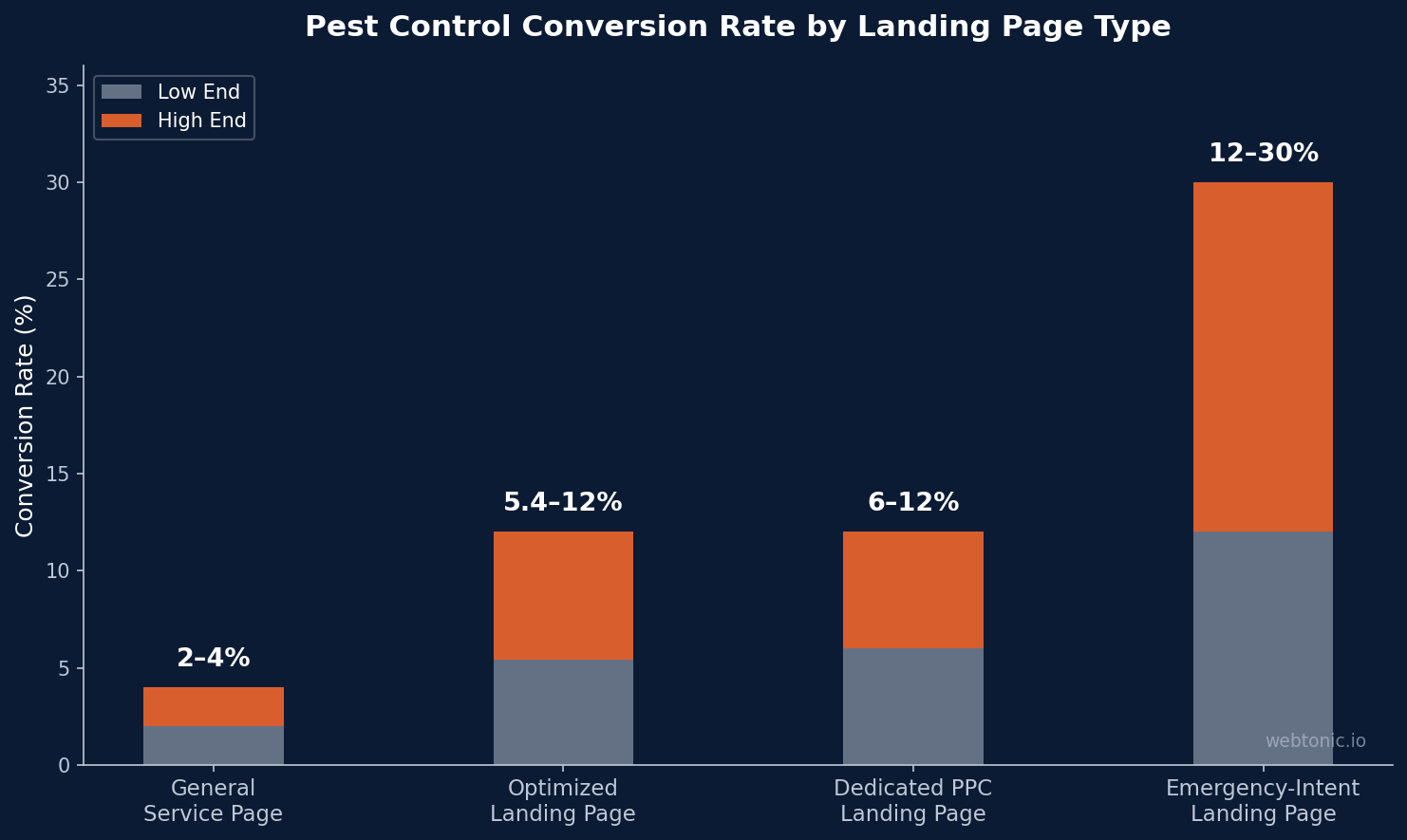
- 12–30 % conversion rate for dedicated PPC landing pages vs. 2–4 % for general service pages (Cube Creative).
- 67.9 % average web-form abandonment rate — each field beyond three cuts completion by 5–10 % (Baymard Institute).
- 53 % of mobile users bounce if a page takes longer than 3 seconds to load (Google/Cube Creative).
- Q2 generates 26.4 % of annual pest control revenue — the highest-intent conversion window (Cube Creative).
- 54 % of homeowners choose a provider within 4 hours of their first search (Verlua / Briostack).
- Pest control CPL averages $28, ranging from $12 to $50 depending on market and channel (WatsonCo).
- 35 % more form submissions on websites with online scheduling vs. those without (Hook Agency / Verlua).
Pest Control Landing Page Benchmarks at a Glance
The table below compiles cross-source medians and ranges so operators can benchmark their own pages against the industry.
| Metric | Average / Median | Top Performers | Source |
|---|---|---|---|
| Landing Page Conv. Rate | 5.4 % | 12–20 % | Benchmarketing |
| PPC Landing Page Conv. Rate | 6–12 % | 12–30 % | Cube Creative / MarketingLTB |
| Home Services Median Conv. | 6.7 % | 17.6 % (P75) / 25 %+ (P90) | Unbounce / Barham |
| Form Abandonment Rate | 67.9 % | < 40 % (optimized) | Baymard Institute |
| Mobile Bounce (>3 s load) | 53 % | < 20 % (<1.5 s) | |
| Cost Per Lead (Pest Control) | $28 | $12–$50 range | WatsonCo |
| Click-to-Call Rate (Mobile) | 3–5 % | 8–15 % | WatsonCo |
Conversion Rate Breakdown by Page Type
Not all pest control web pages convert equally. Dedicated landing pages with zero navigation and a single call-to-action focus achieve 12–30 % conversion rates, while general service pages average only 2–4 % (Cube Creative). That difference is not marginal — it is the difference between four booked jobs per 500 visits and sixty.
Emergency-intent pages perform even better. Queries such as "wasp nest removal today" or "mice in walls" carry immediate purchase intent, and pages built specifically for those searches convert at higher rates than general pest control landing pages because the visitor has already decided to buy (Authority Specialist). Seasonal alignment amplifies the effect: spring landing pages outperform general pages by 41 % when matched to pest biology cycles (MarketingLTB).
Across all home services, the conversion rate distribution follows a steep power curve. The median home services conversion rate sits at 6.7 %, but the top 25 % of performers reach 17.6 % and the top 10 % exceed 25 % (Barham Marketing / Unbounce). Pest control sits favorably within that distribution because of its high-urgency, short-cycle nature — homeowners dealing with an active infestation convert fast.
Form Design and Abandonment Statistics
Form friction is the single largest controllable conversion killer on pest control landing pages. The average web-form abandonment rate is 67.9 %, and B2C lead-capture forms perform worse than most other categories (US Tech Automations / Baymard Institute). Each field beyond three reduces completion by 5–10 %, which means a 10-field intake form converts at roughly half the rate of a 4-field version.
The optimal pest control form captures name, phone number, email, and zip code — four fields, 30 seconds to complete (Pest Control Millionaires). Operators who need pest-type or urgency data should add those as dropdown selections rather than free-text fields, and front-load the easiest fields first. Automated SMS confirmation after submission reduces no-shows by 38 %, and pre-visit digital intake cuts another 18 % off no-show rates on top of reminders alone (Klara / AppointmentReminder).
| Form Metric | Benchmark | Source |
|---|---|---|
| Average Form Abandonment | 67.9 % | Baymard Institute 2026 |
| Completion Drop Per Extra Field | 5–10 % | Baymard Institute 2026 |
| Optimal Field Count | 4–6 fields | Cube Creative / PCM |
| SMS Confirmation No-Show Reduction | ~38 % | Klara 2026 |
| Digital Intake No-Show Reduction | ~18 % (additive) | AppointmentReminder 2026 |
| SMS Open Rate | 98 % | Klara 2026 |
Mobile Speed and Its Impact on Conversions
Over 70 % of pest control searches happen on mobile (Verlua), yet many operator sites still fail basic speed thresholds. 53 % of mobile visitors abandon a page that takes more than 3 seconds to load, and every additional second of delay reduces conversions by roughly 20 % (Cube Creative / Google). Pages loading in 1 second convert 3× higher than pages loading in 5 seconds (Barham Marketing).
The mobile conversion gap in home services is significant: mobile conversion rates average 2.5–4 % industry-wide vs. 3–5 % on desktop, but top performers close that gap to 7–10 % on mobile through optimized page weight and single-tap call buttons (WatsonCo). For pest control specifically, click-to-call rates on mobile average 3–5 % but reach 8–15 % for top performers — an action that bypasses form friction entirely.
Pest Control Website Audit Findings (300-Site Study)
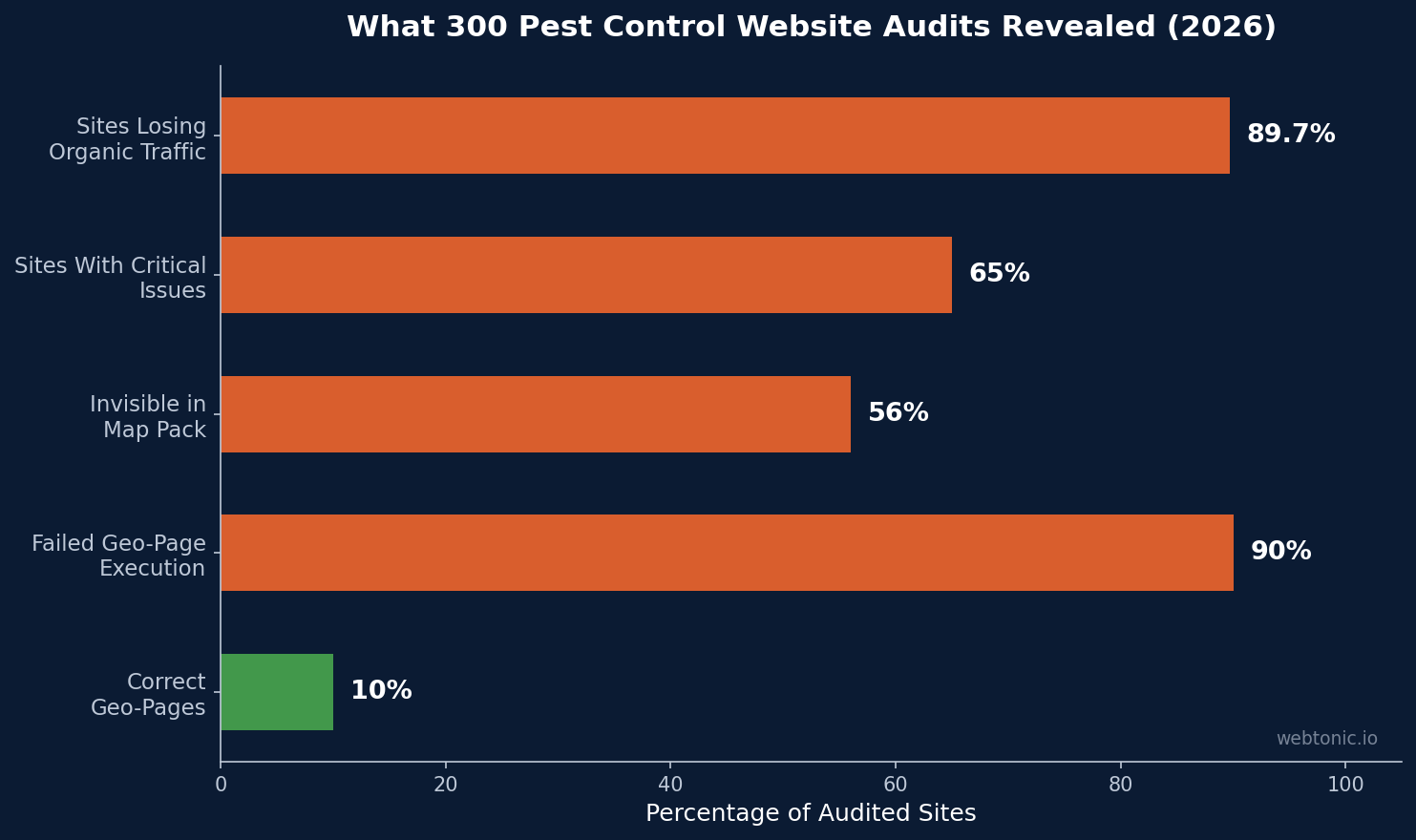
A 2026 field audit of 300 pest control websites across the United States revealed systemic issues that directly suppress landing page performance (Cube Creative):
- 89.7 % of pest control sites are losing organic traffic, with a median decline of 57 % from their previous peak.
- 65 % of the 295 fully audited sites had at least one High or Critical priority issue.
- Of 138 companies that attempted geographic landing pages, only 14 (10 %) executed them correctly. The remaining 124 published broken, orphaned, or thin pages that hurt rankings more than they helped.
- 56 % are invisible in the map pack for their own primary service area.
- Companies without working geo-pages were 4× more likely to have a serious issue elsewhere on their site.
These findings underline a critical point: landing page optimization cannot compensate for structural website problems. Operators should audit their core site health before investing in dedicated PPC landing pages — see our guide on creating an effective Google Ads strategy, or risk sending paid traffic to a fundamentally broken experience.
Seasonal Conversion Patterns
Pest control demand is intensely seasonal, and landing page performance mirrors that cycle. Q2 drives 26.4 % of annual revenue — the highest-intent window of the year (Cube Creative). Search volume for "pest control" peaks in March at 673,000 global monthly searches and dips to 368,000 in December — an 83 % swing (RankPill).
Operators who front-load their campaign budgets and launch spring-specific landing pages before April capture disproportionate market share. Seasonal landing pages outperform general pages by 41 % (MarketingLTB), and message-match — headlines echoing the exact ad language the visitor clicked — further reduces friction and abandonment.
AI-Referred Leads and Channel Performance
A 2026 finding reshaping landing page strategy: calls referred by ChatGPT post a 49 % lead rate — the highest of any marketing channel, roughly 10 points above the cross-channel average (Invoca / PCT Online). AI-driven search is already producing the highest-intent leads pest control companies receive, and those visitors expect the same speed and clarity on landing pages that the AI response provided.
Across channels, plumbing and pest control average 12–15 % conversion rates with sales cycles measured in days, not months (WebFX). The recurring revenue model in pest control (with 70–90 % customer retention rates) amplifies the lifetime value of every converted lead — a single booked job from a landing page can generate $1,620–$3,000+ in customer lifetime value (BaaDigi).
Trust Signals That Drive Conversions
Trust elements on pest control landing pages are not decorative — they directly impact whether a panicked homeowner fills out the form or bounces to the next result. The average consumer calls only 1.3 businesses before making a decision (Cube Creative), so the first page that establishes credibility wins.
| Trust Signal | Impact on Conversions | Implementation Priority |
|---|---|---|
| Google Verified Badge | Increases perceived legitimacy for paid listings | High |
| Star Rating ≥ 4.5 | 20–35 % higher Maps CTR (BrightLocal) | High |
| Real Technician Photos | Higher engagement than stock imagery | Medium |
| License / Certification Display | Reduces bounce on commercial pages | High |
| Same-Day Availability Notice | Captures emergency-intent traffic | High |
| Online Scheduling | 35 % more form submissions (Hook Agency) | Medium |
Landing Page Best Practices for Pest Control Operators
- Build dedicated pages for every paid campaign — never send ad traffic to your homepage. Zero-navigation landing pages with a single CTA convert at 3–8× the rate of general service pages.
- Keep forms to 4 fields maximum (name, phone, email, zip code). Every additional field cuts conversions by 5–10 %. Add pest type as an optional dropdown, not a required field.
- Hit sub-3-second load times on mobile — strip tracking scripts, defer non-essential JavaScript, and compress hero images below 100 KB. Over 70 % of your visitors are on mobile.
- Match headlines to ad copy word-for-word — message match builds cognitive ease and reduces the 67.9 % form abandonment rate.
- Display trust signals above the fold — license numbers, star ratings, "same-day service" badges, and real technician photos.
- Create seasonal variants — spring termite pages, summer mosquito pages, and fall rodent pages outperform year-round generic pages by 41 %.
- Trigger instant SMS confirmation after form submission. Text messages carry a 98 % open rate and reduce no-shows by 38 %.
- A/B test continuously — landing page testing improves conversions by 20 % on average (MarketingLTB). Test hero images, CTA button copy, and form placement quarterly.
Pest Control vs. Other Home Services: Landing Page Comparison
| Trade | Average CPL | Conv. Rate Range | Sales Cycle |
|---|---|---|---|
| Pest Control | $28 | 6–15 % | Same day – 3 days |
| HVAC | $45 | 5–12 % | 1–7 days |
| Plumbing | $45 | 12–15 % | Same day – 2 days |
| Roofing | $70 | 3–8 % | 2–6 weeks |
| General Contractor | $85 | 2–5 % | 4–12 weeks |
| Electrical | $42 | 5–10 % | 1–5 days |
Pest control benefits from a unique combination of low CPL, high urgency, and short sales cycles that make landing page optimization one of the highest-ROI investments in the industry. Operators evaluating their broader growth marketing strategy should prioritize landing page optimization alongside Google Ads management and data intelligence. A $26.1 billion market with over 32,700 competing companies (Verlua / Briostack) means even small conversion rate improvements translate into meaningful market share gains.
Related reading
- Shopify Adoption & ROI in Pest Control: 47+ Key Stats (2026)
- Plumbing Landing Page Statistics: Conversion Rates, CPL & CRO Benchmarks
- What Is a Good Conversion Rate for Landing Pages?
- Landing Page Design services at Web Tonic
FAQ
What is a good conversion rate for a pest control landing page?
The commercial pest control median is 5.4 % (Benchmarketing). Dedicated PPC landing pages targeting a single service should aim for 8–12 %, and top performers with optimized forms and speed regularly exceed 15–20 %. If your page converts below 5 %, start by reducing form fields and improving mobile load time.
How many form fields should a pest control landing page have?
Four fields is the recommended maximum for lead volume: name, phone, email, and zip code. Each additional field beyond three reduces completion by 5–10 % (Baymard Institute). If you need pest type or property details, add them as optional dropdown menus after the core fields.
Does page speed really affect pest control conversions?
Yes — measurably. Pages loading in 1 second convert 3× higher than those loading in 5 seconds. With over 70 % of pest control searches on mobile and 53 % of users abandoning pages that take more than 3 seconds, speed is one of the highest-impact optimizations available.
Should pest control companies use separate landing pages for each service?
Yes. Service-specific and pest-specific landing pages convert significantly better than generic "pest control" pages because they match searcher intent precisely. A visitor searching "termite inspection near me" expects to see termite-specific content, pricing, and trust signals — not a general services overview. Seasonal variants (spring termite, summer mosquito) further boost performance by 41 % over general pages.
What is the average cost per lead for pest control?
Pest control CPL averages $28 across blended channels (Google Ads, LSAs, organic), ranging from $12 to $50 depending on market size and competition (WatsonCo). PPC-specific CPL via Google Ads averages $40–$60, while Local Services Ads can deliver leads at $20–$30 (Cube Creative).
Sources
Benchmarketing — Commercial Pest Control Benchmarks 2026
Cube Creative — Landing Page Optimization for Spring Campaigns
Cube Creative — Two-Thirds of Pest Control Websites Have Critical Issues
Verlua — Pest Control Website Design: The 2026 Guide
WatsonCo — Home Services Marketing Benchmarks 2026
Barham Marketing — 27+ Home Services Conversion Rate Statistics
US Tech Automations — Online Intake Forms for Pest Control 2026
MarketingLTB — Pest Control Marketing Statistics 2026
BaaDigi — Pest Control Marketing Benchmarks 2026
Invoca / PCT Online — Best Leads Now Start in ChatGPT


