Table of contents
No study benchmarks podcast or audio advertising for pest control, so the planning data here comes from the pest season calendar and cross-industry audio measurement. The key timing fact is from Podscribe (vendor data, Q3 2026): podcast incrementality passes the halfway mark only by days 16 to 20 after exposure.
Key Takeaways
- US pest control service revenue reached $13.416 billion in 2025, up 6% (NPMA).
- 85.4% of residential pest revenue is recurring, up from 85.2% in 2024.
- 51.6% of pest firms name ants as the top callback pest.
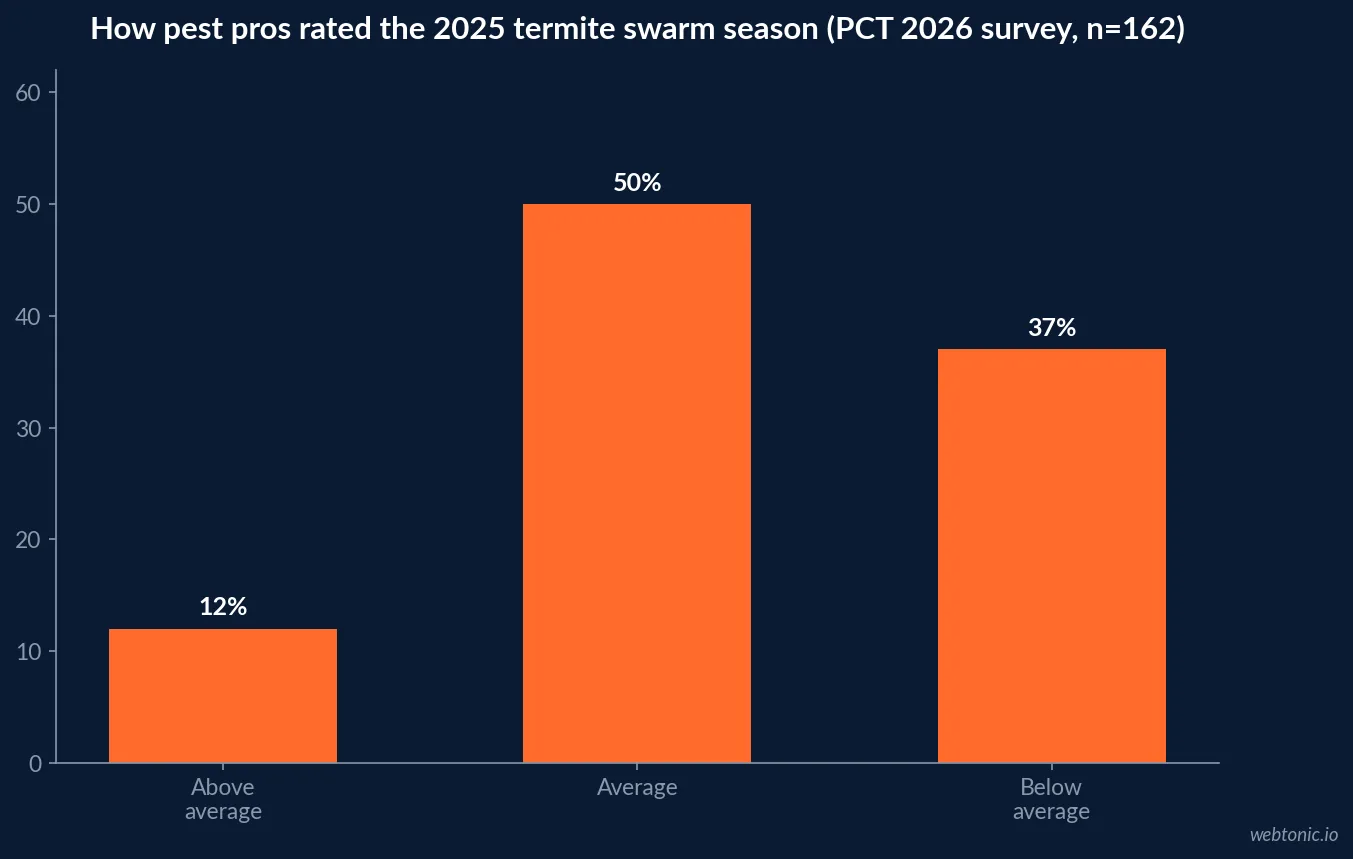
- 12% of pest pros rated the 2025 termite swarm season above average; 50% called it average.
- Podcast incrementality passes halfway by days 16-20 and stays measurable to 60 days.
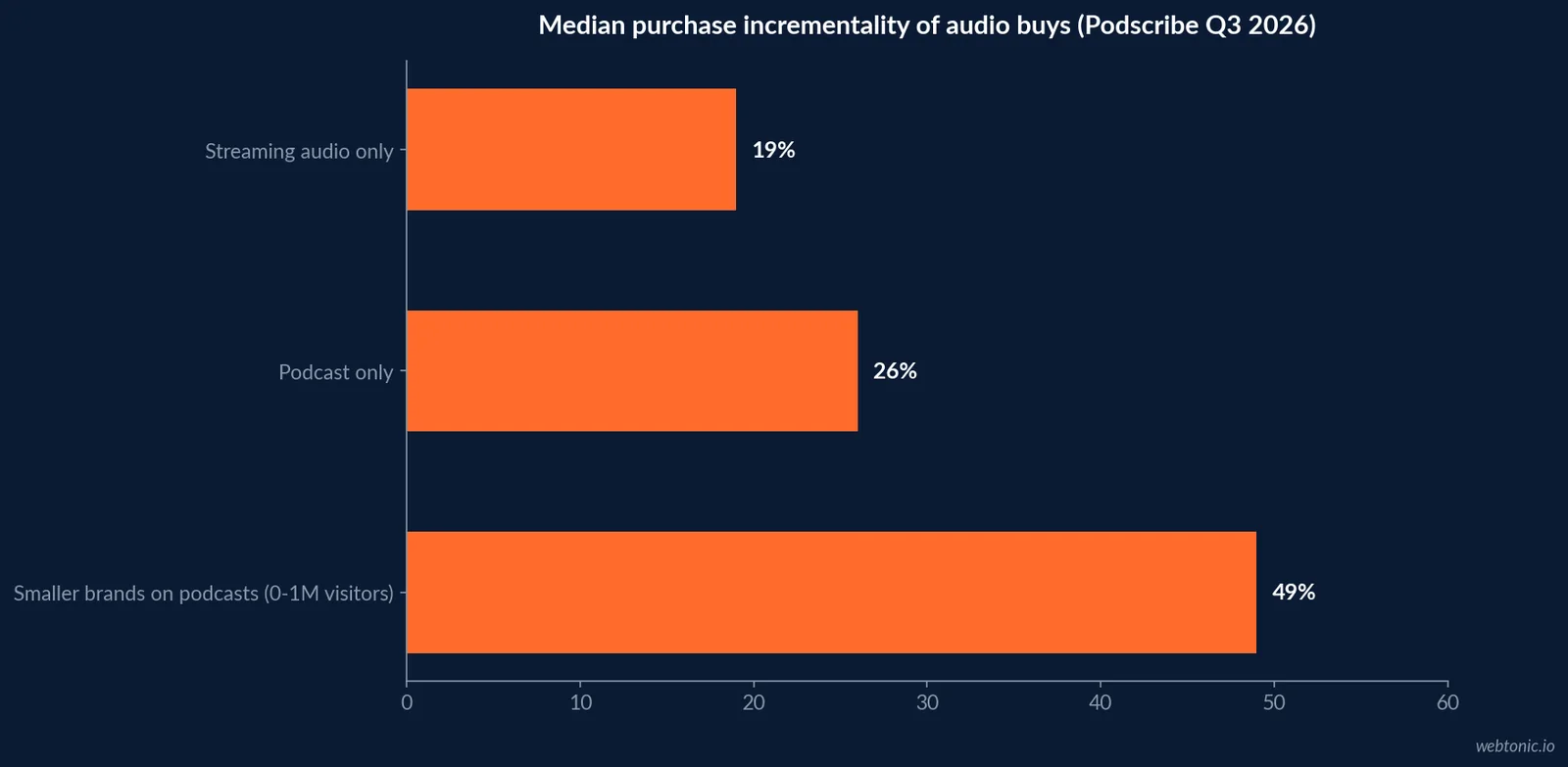
- Smaller brands see 49% incremental lift on podcasts, against 26% overall (Podscribe).
- 1,482 brands advertised on podcasts for the first time in Q4 2025 (Magellan AI).
- 45% of Americans 12+ consume a podcast weekly (Edison, 2026).
- No named dataset publishes a pest control podcast CPM or cost per lead.
Pest Control Audio Planning Data at a Glance
| Planning input | Figure | Source and scope |
|---|---|---|
| US pest control revenue, 2025 | $13.416 billion (+6%) | NPMA / Specialty Consultants |
| Residential customers served, 2025 | 13.29 million | NPMA, 800 firms surveyed |
| Weekly podcast consumers 12+ | 45% (130 million) | Edison Infinite Dial 2026 |
| Podcast incrementality halfway point | Days 16-20 | Podscribe Q3 2026, all industries |
| Median podcast cost per visitor | $10.00 | Podscribe Q3 2026, all industries |
| Home improvement share of podcast revenue | 2.0% (2023) | IAB/PwC |
| Pest control podcast CPM | Not published | No named dataset |
The Industry Behind the Ad Budget
The National Pest Management Association reports that US structural pest control generated $13.416 billion in service revenue in 2025, up from $12.654 billion in 2024, from the 26th edition of Specialty Consultants' industry analysis (800 owners and managers surveyed). There were 16,565 firms, 81.4% of them running one or two locations, and 13.29 million residential customers. Commercial service revenue rose nearly 7.0%.
Two figures shape audio economics. Recurring revenue made up 85.4% of residential revenue, so a new customer is usually a plan, not a single visit. And 36.8% of firms said growth was constrained by too few technicians, a reminder not to buy more demand than crews can serve in peak weeks. Two-thirds (66.8%) expect residential revenue to grow in 2026.
| NPMA 2025 industry indicator | Figure | Audio planning implication |
|---|---|---|
| Service revenue | $13.416 billion (+6%) | A growing category with room for new channels |
| Firms operating | 16,565 | Crowded local markets; differentiation matters |
| Firms with one or two locations | 81.4% | Most buyers need geo-targeted, not national, audio |
| Recurring share of residential revenue | 85.4% | Pitch plans; judge audio on lifetime value |
| Firms constrained by technician shortages | 36.8% | Cap spend to crew capacity in peak weeks |
| Top callback pest | Ants, named by 51.6% | A concrete hook for spring creative |
| Second callback pest | Cockroaches, named by 42.6% | A year-round message for southern markets |
Reading the Season: Bug Barometer and Swarms
NPMA's Spring and Summer 2026 Bug Barometer, released on February 23, 2026, forecast early activity coast to coast: in the Mid-Atlantic and New England, a mild start to winter and a drier spring were expected to bring termites, brown marmorated stink bugs and Asian lady beetles out ahead of schedule, with more ticks and stinging insects as temperatures rise. A forecast released in February gives firms a practical booking trigger.
Real seasons vary. In the PCT 2026 State of the Termite Control Market survey (Readex Research, n=162), 12% of pest professionals rated the 2025 swarm season in their area above average, 50% average and 37% below average.
Who Hears a Pest Control Spot
Homeowners who buy recurring pest plans sit squarely in podcasting's growth ages. Edison Research's Infinite Dial 2026, a national survey of 2,050 Americans 12+ conducted in January 2026, reports record reach on every podcast measure, led by the 35-54 group.
| Podcast reach measure (US 12+, 2026) | Share | Estimated people |
|---|---|---|
| Ever listened to or watched a podcast | 80% | 230 million |
| Consumed a podcast in the last month | 58% | 167 million |
| Consumed a podcast in the last week | 45% | 130 million |
| Monthly consumption, ages 35-54 | 68% | Not stated |
| Monthly online audio listening | 81% | 233 million |
The 35-54 bracket is where homeownership and household spending typically peak, which makes it the natural target for a residential plan offer. These are reach figures only: they describe who can be reached, not how many listeners will book an inspection, and no survey reviewed breaks podcast listening out by homeowner status.
Why Audio Needs a Head Start
Audio response trails exposure. Podscribe measures podcast incrementality, the share of attributed purchases caused by the ads, and finds it crosses the halfway mark by days 16 to 20; streaming audio gets there by days 11 to 15. Both remain measurable out to 60 days. Podscribe's standard windows are 30 days for podcasts and 14 days for streaming.
For a pest firm, that means a podcast flight that starts in the week of the first swarm calls will deliver a large part of its effect after the peak. Starting two to three weeks ahead of the local forecast aligns the response curve with demand. Streaming audio, which responds faster, is the better late-season top-up.
| Timing variable | Podcast | Streaming audio |
|---|---|---|
| Standard conversion window | 30 days | 14 days |
| Incrementality passes halfway | Days 16-20 | Days 11-15 |
| Measurable incrementality | Out to 60 days | Out to 60 days |
| Median purchase incrementality | 26% | 19% |
| Median cost per acquisition | $168 | $204 |
Small Operators and Incremental Lift
Most pest companies are small, and Podscribe's data favours small advertisers. Brands with under one million monthly site visitors saw a median 49% incremental lift from podcasts and 45% from streaming audio, against 26% and 19% across all advertisers, likely because they reach listeners no other channel has touched.
Measurement is the catch. Podscribe finds promo codes and vanity URLs capture only about 24% of conversions, and post-purchase surveys draw a 16% response rate, while pixel attribution captures about 4.2 times more than codes. Pest customers usually phone, so a single-purpose call-tracking number per show, a booking-page pixel and a "how did you hear about us" question at dispatch are the minimum kit. Without them, a small firm will credit audio-driven calls to organic search or to its truck signage, and the incremental lift in the data will never show up in its own reports. Owners should also expect some lag between the ad and the call, in line with the 30-day podcast window described above.
Targeting the Service Area
Pest control is local, so audio reach outside the service area is waste. Libsyn Ads says its network of 1,300-plus shows, with total monthly reach above 35 million listeners, can target by city, state, zip code, DMA and point of interest. Podscribe ranks designated market area as the targeting factor with the largest effect on campaign performance, ahead of recent site visits, household buying power and occupation; time of day and gender rank lowest.
Buy type matters too. Podscribe data (originally published Q2 2026) puts median podcast CPA at $98 for direct show buys, $64 for run-of-network and $74 for programmatic. Geo-targeted buys are usually impression-based rather than whole-episode sponsorships.
What Audio Costs Before Targeting
No pest-specific card exists. The last published marketplace series from Libsyn Ads reported an average 60-second podcast CPM of $21.25 in August 2024, with true crime, sports and fiction shows in the high teens to low 20s. Geographic targeting generally raises the effective CPM. On the market side, Magellan AI (vendor data, 94,422 episodes) reports podcast ad spend up 32% year on year in Q4 2025, 1,482 first-time brands and average ad load up to 8.82% from 8.33%.
| Market signal | Figure | Source |
|---|---|---|
| Podcast ad spend growth, Q4 2025 | +32% year on year | Magellan AI (vendor) |
| First-time podcast advertisers, Q4 2025 | 1,482 brands | Magellan AI |
| Average advertiser ad load, Q4 2025 | 8.82% | Magellan AI |
| Average 60-second CPM, August 2024 | $21.25 | Libsyn Ads (vendor) |
| Home improvement / furnishings share, 2023 | 2.0% of podcast revenue | IAB/PwC |
Radio Rules Versus Podcast Rules
Many pest firms already buy local radio. The FCC's sponsorship identification rule, 47 CFR 73.1212, requires a broadcast station airing paid matter to announce at the time of broadcast that it is sponsored, paid for or furnished, and by whom. That duty sits with the station and applies to broadcast. Podcasts fall outside it; host reads there are governed by the FTC Endorsement Guides, which require disclosure of material connections the audience would not expect.
Host, Announcer or Pre-Produced Spots
Pest firms often reuse radio spots in podcasts. A SiriusXM Media and Signal Hill study (vendor research, four brands) found host-read and announcer-read podcast ads both drove significantly higher unaided recall than pre-produced spots, and that host reads led at the top of the funnel with no statistical difference in lower-funnel scores. A recycled radio spot is the weakest of the three options on recall.
Seasonal Flight Checklist
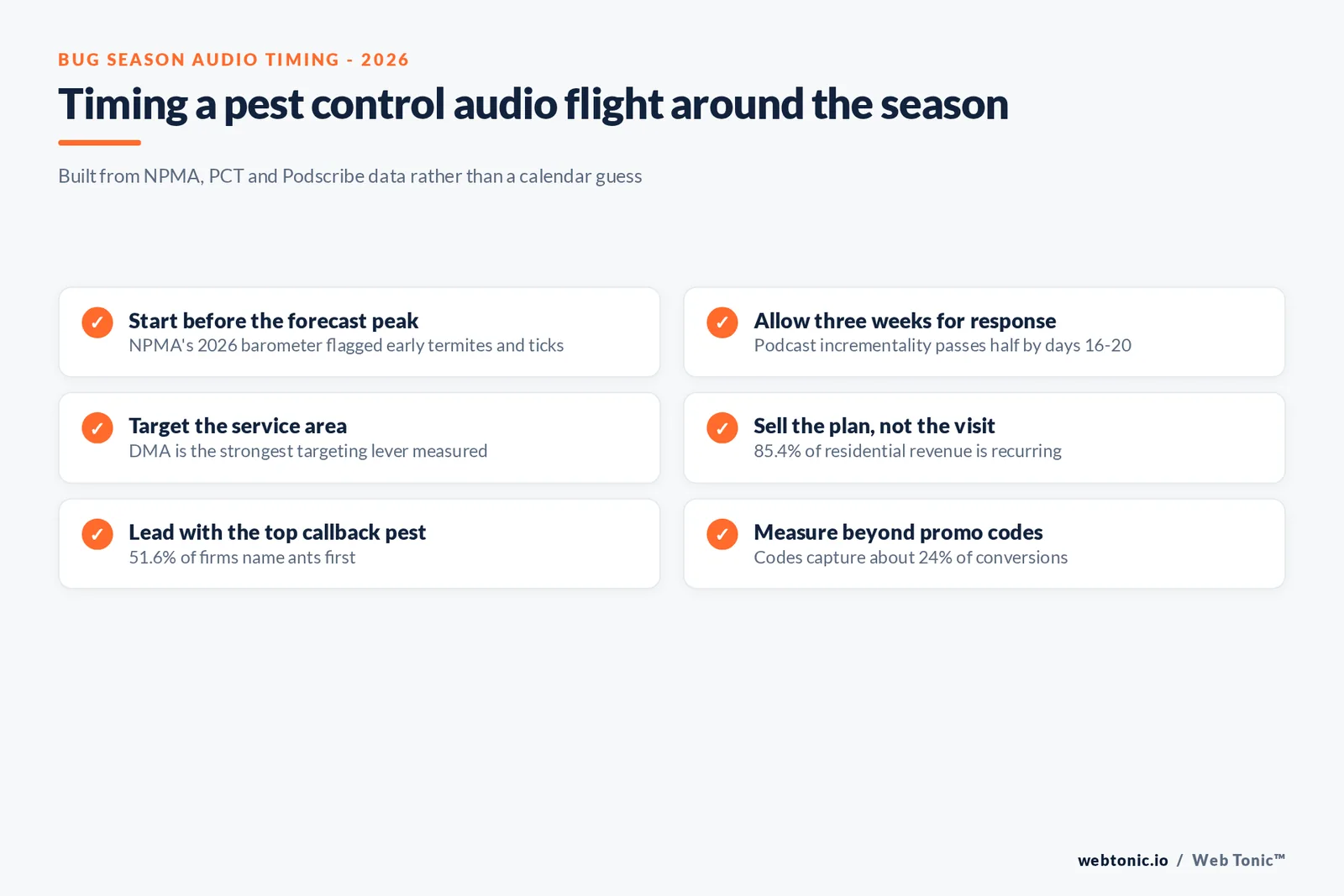
- Book when the February barometer lands, not when calls spike.
- Run podcasts early and streaming audio as a late-season top-up.
- Target by DMA or zip code to match the service area.
- Lead with the pest customers call about most: 51.6% of firms name ants for callbacks.
- Pitch the recurring plan and track with a pixel plus call tracking.
Compare audio with your other channels: pest control Google Ads data, pest control SMS marketing statistics and pest control influencer data. For video-screen reach see our connected TV statistics, or contact Web Tonic.
Frequently Asked Questions
When should a pest control company start podcast ads?
Before the local peak, not during it. Podscribe's Q3 2026 benchmark report finds podcast incrementality crosses the halfway mark only around days 16 to 20 after exposure and stays measurable out to 60 days. A spring flight that starts when swarms appear will deliver much of its response after the rush. NPMA's Spring and Summer 2026 Bug Barometer, released in February, is a practical trigger for booking.
Is there a podcast advertising benchmark for pest control?
No. None of the datasets reviewed publishes a pest control podcast CPM, response rate or cost per lead. The IAB/PwC study does report home improvement and furnishings advertisers at 2.0% of US podcast ad revenue in 2023, which is the nearest home-services category.
Can podcast ads be targeted to a pest company's service area?
Yes, on networks that support it. Libsyn Ads says it can target by city, state, zip code, DMA and point of interest. Podscribe ranks designated market area as the targeting factor with the largest impact on campaign performance in its Q3 2026 report.
Do radio and podcast ads have the same disclosure rules?
No. The FCC sponsorship identification rule, 47 CFR 73.1212, applies to broadcast stations, which must announce that paid matter is sponsored and by whom. Podcasts are not broadcast, so the FTC Endorsement Guides govern host reads.
Is a recurring pest plan worth selling on audio?
The industry economics point that way. NPMA reports recurring revenue made up 85.4% of residential pest control service revenue in 2025, so the value of a new customer usually extends well past the first visit. No study measures audio's effect on plan sign-ups specifically.
Sources
NPMA, U.S. Pest Control Industry Sustains Steady Growth with 6% Increase in 2025
NPMA Spring and Summer 2026 Bug Barometer release
PCT 2026 State of the Termite Control Market (Readex Research)
Podscribe Performance Benchmark Report Q3 2026 (vendor)
Magellan AI Podcast Advertising Benchmarks Q4 2025 (vendor)
Libsyn Ads podcast advertising marketplace (vendor)
Libsyn Ads, August 2024 Podcast Ad Rates (vendor)
Edison Research, The Infinite Dial 2026
IAB/PwC U.S. Podcast Advertising Revenue Study, FY2023
47 CFR 73.1212, sponsorship identification
SiriusXM Media, announcer-read ads study (vendor)