Table of contents
Pest control has a large, recurring audience and almost no creator research of its own: NPMA counts nearly 13.29 million residential customers, while no 2026 influencer survey breaks out the industry. This page uses NPMA demand data plus cross-industry creator data, labelled as such, and does not invent a pest control engagement rate.
Key Takeaways
- US structural pest control revenue reached USD 13.416 billion in 2025, up 6%.
- 16,565 pest control firms operated in 2025; 81.4% run one or two locations.
- Nearly 13.29 million residential customers bought professional service in 2025.
- Recurring revenue is 85.4% of residential revenue, up from 85.2%.
- 51.6% of operators name ants as the top callback pest; cockroaches 42.6%.
- 85% of surveyed homeowners saw pests at home in the prior year (NPMA and Harris, 2021).
- Fake or bot followers are 56.5% of reported creator fraud issues (IMH 2026).
- Only 10.9% of marketers report no fraud or quality issue.
- Skilled Trades creators average USD 309, the highest niche rate on Collabstr.
- Skilled Trades demand rose 103% year on year.
- 100% of enterprise marketers repurpose creator content (Linqia 2026).
- No pest control influencer benchmark exists in the 2026 datasets reviewed.
The industry creators would be selling
NPMA's summary of the 26th Strategic Analysis of the US Structural Pest Control Industry from Specialty Consultants, based on 800 owners and managers, puts 2025 service revenue at USD 13.416 billion, up 6% from USD 12.654 billion. There were 16,565 firms, 81.4% of them running one or two locations, and an estimated 109,384 technicians. 36.8% said a shortage of technicians limited growth, yet 66.8% expected residential revenue to grow in 2026.
For creator marketing, two numbers stand out. The market is local and fragmented, so most buyers are small operators, and 85.4% of residential revenue is recurring, which makes content that keeps customers on a plan as valuable as content that finds new ones.
| NPMA 2025 industry figure | Value | Change or context | Creator marketing read |
|---|---|---|---|
| Structural pest control revenue | USD 13.416 billion | Up 6% from USD 12.654 billion | Growing, competitive local markets |
| Pest control firms | 16,565 | 81.4% run one or two locations | Buyers are mostly small operators |
| Residential customers served | Nearly 13.29 million | 2025 | Large audience for how-to content |
| Recurring share of residential revenue | 85.4% | Up from 85.2% | Retention content earns its keep |
| Firms limited by technician shortage | 36.8% | Labour constraint | Recruiting clips double as brand content |
What homeowners actually see
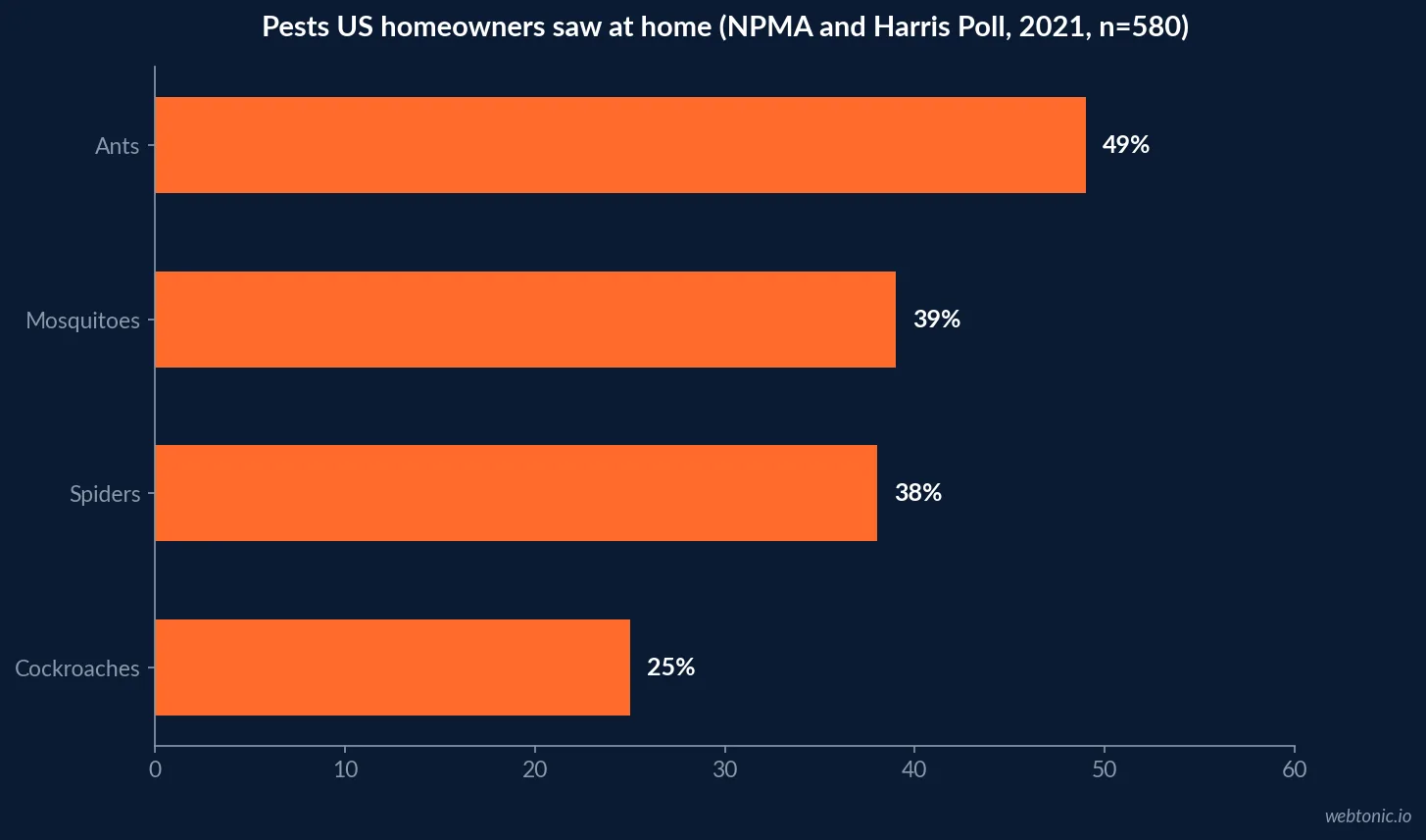
The most recent public NPMA consumer data we could open is a 2021 survey run by The Harris Poll of 580 employed US homeowners with household income of USD 75,000 or more. It is dated and not a probability sample, so treat it as directional: 85% had seen or had trouble with pests at home in the prior year, led by ants at 49%, mosquitoes at 39%, spiders at 38% and cockroaches at 25%. The 2025 operator survey agrees on the leaders from the other side: ants are the top callback pest for 51.6% of operators and cockroaches for 42.6%.
| Pest | Homeowners who saw it (2021, n=580) | Operators naming it top callback (2025) | Creator content angle |
|---|---|---|---|
| Ants | 49% | 51.6% | Identification and why sprays fail |
| Cockroaches | 25% | 42.6% | What an infestation sign looks like |
| Mosquitoes | 39% | Not reported | Yard treatment and standing water |
| Spiders | 38% | Not reported | Harmless vs call-a-pro species |
| Any pest seen | 85% | - | Broad demand for explainers |
What creators in service trades cost
Collabstr's 2026 report has no pest control niche, but it prices expertise. Skilled Trades is the most expensive niche at USD 309 per engagement and the second-fastest growing, with demand up 103%. The report says trade creators fill a knowledge gap with practical, problem-solving content, which is exactly what a good pest explainer does. Across all niches, 80% of collaborations cost under USD 300 and the average UGC campaign is USD 197. A technician filming on the job is cheaper still, but carries the same disclosure and claim duties as a hired creator.
Fraud: the risk that matters more than price
The Influencer Marketing Hub 2026 Benchmark Report asked 600+ marketers which fraud and quality problems they meet. Fake or bot followers account for 56.5% of all reported issues. Inauthentic or templated comments add 10.6% and fake or purchased engagement 10.2%, together 20.8%. Incentivized or undisclosed reviews make up 6.1% and misreported performance metrics 5.4%. Only 10.9% selected none of the above.
For a local exterminator, a bought follower count is doubly useless: even real followers outside the service area cannot book. Ask every creator for audience location data before agreeing a fee.
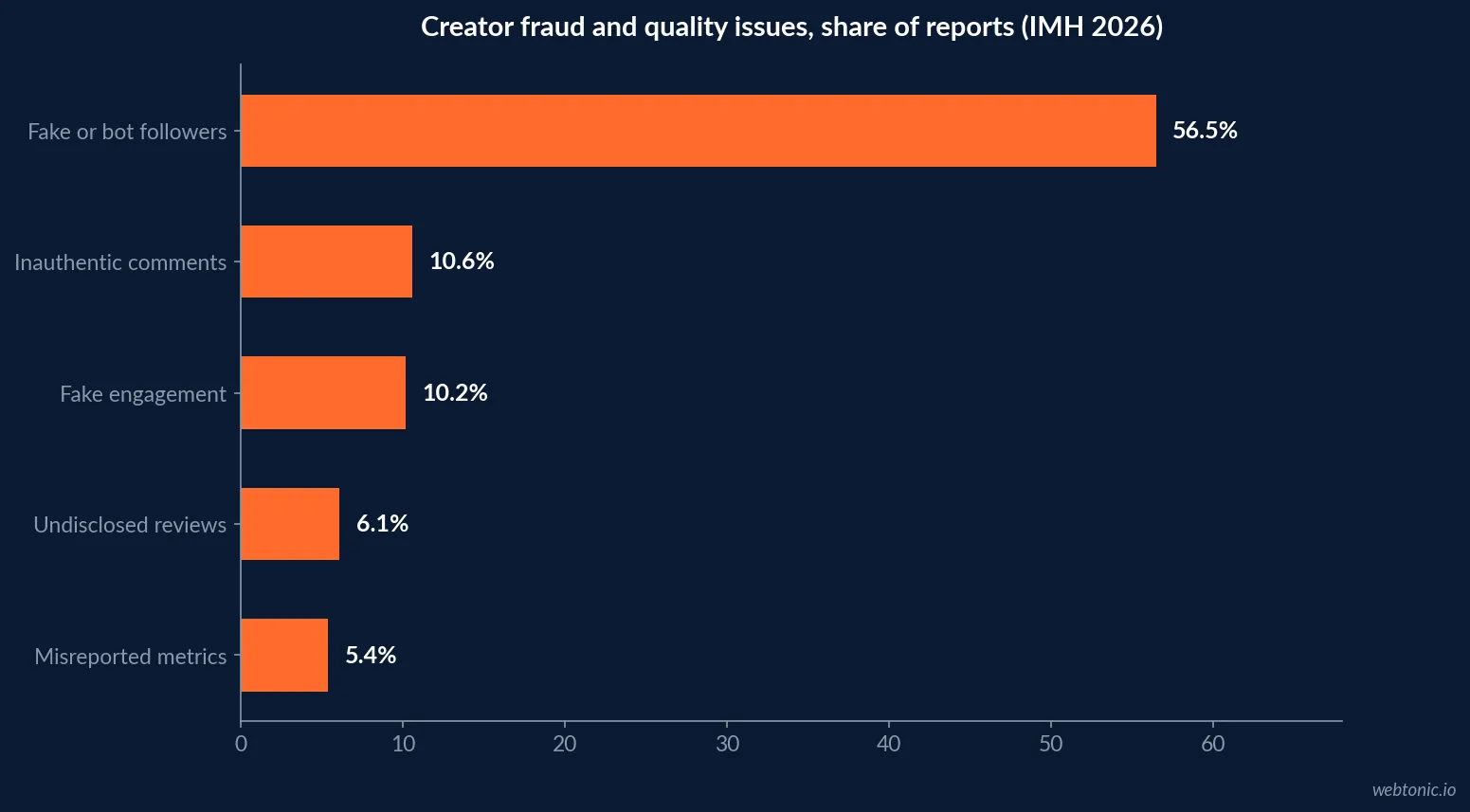
| Issue (IMH 2026, share of reports) | Share | How it shows up | Check before paying |
|---|---|---|---|
| Fake or bot followers | 56.5% | Reach with no local audience | Audience city and region split |
| Inauthentic or templated comments | 10.6% | Generic praise, no questions | Read the comment threads |
| Fake or purchased engagement | 10.2% | Likes out of line with views | Compare engagement across posts |
| Incentivized or undisclosed reviews | 6.1% | Hidden paid endorsements | Require on-screen disclosure |
| Misreported performance metrics | 5.4% | Screenshots that do not match | Ask for native analytics access |
What marketers say is hardest in 2026
The same Influencer Marketing Hub survey ranks the challenges buyers plan around. Rising creator costs lead at 35.4% of selections, followed by fake engagement and authenticity at 12.73%, measuring ROI at 8.70%, platform volatility at 8.07% and attribution at 7.14%. Budget constraints sit at 5.28% and brand safety and compliance at 4.97%. Looking ahead, the top focus area is AI-driven creator matching at 26.89%, ahead of social commerce at 19.33%.
For a pest operator the ranking is a useful warning. Creator prices are rising across the market, fake audiences are the main quality risk, and the measurement problem is real for everyone. A small operator that keeps its roster local, checks audiences and ties every clip to a tracked phone number or booking form avoids most of the problems larger brands report. Compliance ranks low in the survey, but in pest control the product-claim rules covered above make it a bigger issue than the average suggests.
| Challenge (IMH 2026, cross-industry) | Share of selections | Pest operator exposure | Practical response |
|---|---|---|---|
| Rising creator costs | 35.4% | Moderate, local creators are cheaper | Build a technician-led roster |
| Fake engagement and authenticity | 12.73% | High for out-of-area audiences | Check audience location |
| Measuring ROI | 8.70% | Low if calls are tracked | Tracked numbers per creator |
| Platform volatility | 8.07% | Moderate | Own the raw video files |
| Brand safety and compliance | 4.97% | Higher than average | Script safety language |
The words a pest clip should not use
Pest control has a claim rule most industries do not. Federal pesticide labeling regulations at 40 CFR 156.10(a)(5) list, among false or misleading label statements, claims about safety such as 'safe', 'nonpoisonous', 'noninjurious', 'harmless' or 'nontoxic to humans and pets', with or without a qualifier like 'when used as directed', and non-numerical safety comparisons such as 'contains all natural ingredients'. That rule governs product labels, but a creator repeating those words about the products used is still making a safety claim.
The FTC Endorsement Guides, 16 CFR 255.1(d) add that advertisers are liable for misleading or unsubstantiated statements made through endorsements, even when the endorser is not, and should give endorsers guidance. In practice: script the safety language, and let the creator talk about the problem, the process and the result.
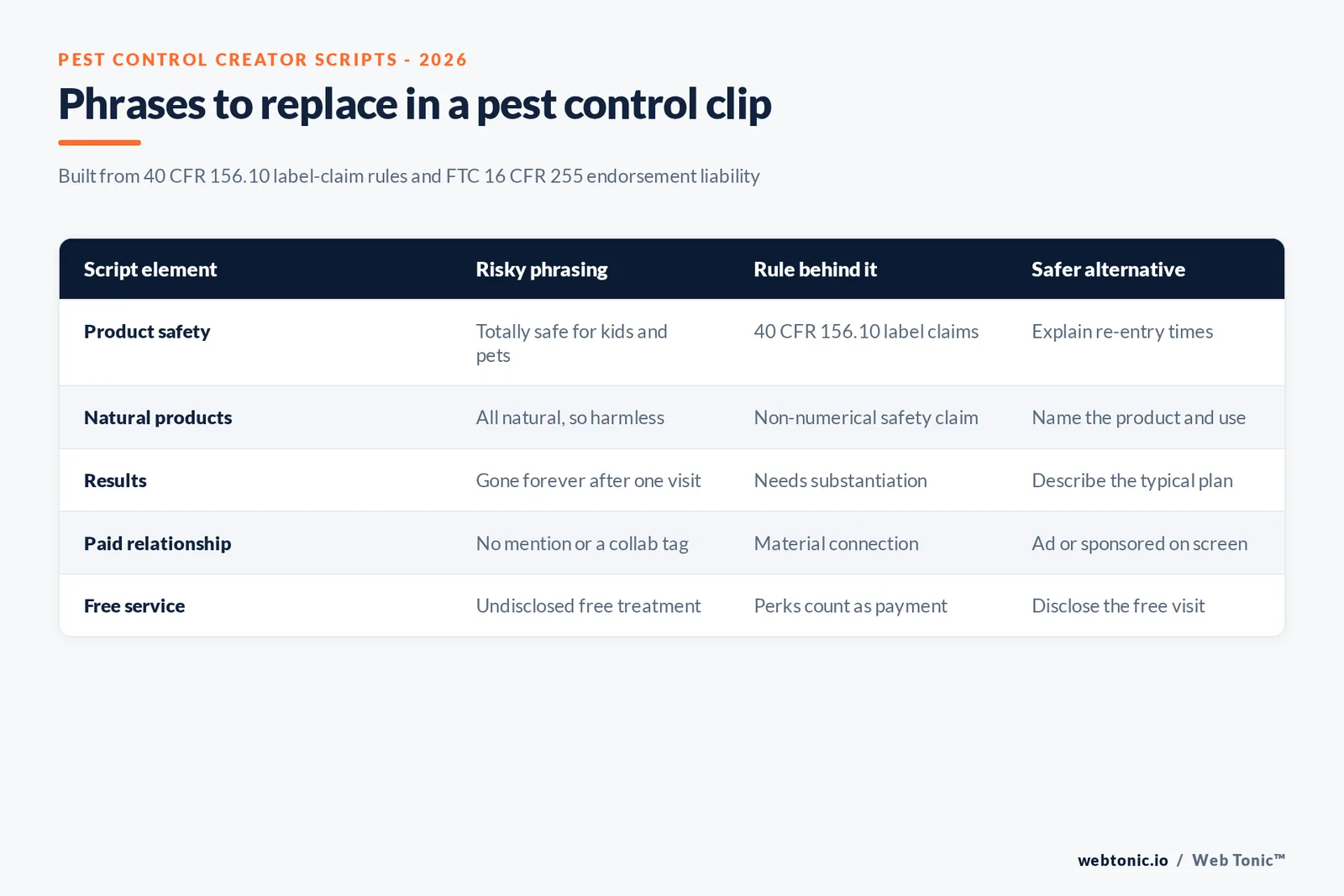
| Script element | Risky phrasing | Why | Safer alternative |
|---|---|---|---|
| Product safety | 'Totally safe for kids and pets' | Listed label claim under 40 CFR 156.10 | Explain re-entry times and precautions |
| Natural products | 'All natural, so harmless' | Non-numerical safety comparison | Name the product and its use |
| Results | 'Gone forever after one visit' | Endorsement claim needs substantiation | Describe the typical treatment plan |
| Paid relationship | No mention, or 'collab' tag | Material connection must be clear | 'Ad' or 'sponsored' in the video |
| Free service | Undisclosed free treatment | Perks count as payment | Disclose the free service |
Disclosure when the creator is a customer
The FTC's endorsement FAQ says that receiving free products or perks with the expectation of promoting them brings a post under the FTC Act. A free quarterly treatment for a homeowner who films the visit is a material connection, and so is a referral credit. Put the disclosure on screen, not only in the caption.
Reuse: why the asset matters more than the post
Linqia's 2026 survey of more than 200 enterprise marketers finds 100% repurposing creator content beyond the creator's own page and 81% saying it outperforms brand-made assets. The Bazaarvoice Shopper Experience Index 2026 found 97% of consumers consult multiple sources before buying. For a pest operator, one strong technician clip can serve the website, the Google profile, paid social and the renewal email. Brands wanting creators on YouTube can use YouTube Creator Partnerships, open to creators in the Partner Program. Our pest control SMS marketing data covers the renewal side, and the influencer marketing statistics hub covers the cross-industry benchmarks.
A seasonal creator plan for an operator
- Spring: ant identification and entry points, matching the top callback pest.
- Summer: mosquito and yard content, when outdoor pests are most visible.
- Autumn: rodent and overwintering pest prevention.
- All year: technician day-in-the-life clips that also support recruiting.
Our performance creative team turns field footage into compliant ads, and you can contact us to plan a first round.
How to judge the test
Measure booked inspections and new recurring plans from creator-led ads, not views. With 85.4% of residential revenue recurring, a creator clip that signs one household onto a plan is worth far more than its view count suggests. If the clip cannot be tied to a booking through a tracked number or form, treat it as brand spend and budget it that way.
Frequently Asked Questions
Do pest control companies use influencer marketing?
Some do, but no survey we found measures how many or what it returns. The 2026 creator datasets from Collabstr, Influencer Marketing Hub and Linqia do not break out pest control. What is measured is the demand: NPMA reports USD 13.416 billion in 2025 structural pest control revenue and nearly 13.29 million residential customers, so the audience for how-to and what-is-this-bug content is large.
What should a pest control creator never say on camera?
Avoid absolute safety claims about products. Federal pesticide labeling rules at 40 CFR 156.10 list claims such as 'safe', 'nonpoisonous', 'harmless' or 'nontoxic to humans and pets' among false or misleading label statements, even with 'when used as directed'. The FTC Endorsement Guides also make the advertiser liable for misleading statements made by its endorsers, so the script matters as much as the creator.
How do I check a pest control influencer is real?
Look at audience quality before reach. In Influencer Marketing Hub's 2026 survey, fake or bot followers made up 56.5% of all reported fraud and quality issues, and inauthentic comments plus fake engagement added another 20.8%. Only 10.9% of respondents reported none of these issues. Ask for audience location data, since a local operator only benefits from followers inside its service area.
Is customer UGC better than paid influencers for an exterminator?
For a local service, customer and technician UGC is often the more practical asset, because it shows the real service area and the real crew. Linqia's 2026 survey finds 81% of enterprise marketers say repurposed creator content outperforms brand-made assets. That is cross-industry evidence, so test it against your own booked inspections.
How much does a pest control UGC video cost?
There is no pest-specific price list. Cross-industry, Collabstr's 2026 data puts the average UGC campaign at USD 197 and shows 80% of collaborations under USD 300. Expertise niches cost more: Skilled Trades creators average USD 309, the highest niche rate on the platform.
Sources
NPMA - US pest control industry grows 6% in 2025
NPMA - Homeowner pest survey with The Harris Poll, 2021
Collabstr - 2026 Influencer Marketing Report
Influencer Marketing Hub - Influencer Marketing Benchmark Report 2026
Linqia - 2026 State of Influencer Marketing
eCFR - 40 CFR 156.10, pesticide labeling requirements
eCFR - 16 CFR Part 255, FTC Endorsement Guides
FTC - Endorsement Guides: What People Are Asking
Bazaarvoice - Shopper Experience Index 2026 press release
YouTube Help - YouTube Creator Partnerships