Table of contents
52% of U.S. homeowners hired a licensed pest control professional in the past year, and a growing share of the reminder, dispatch and follow-up messages that keep those routes full now travel as a text. This page prices the message itself - carrier rate, platform plan, 10DLC fee - and states the consent rule that actually governs sending it in 2026.
Key Takeaways
- Twilio prices outbound U.S. SMS at USD 0.0083 a segment on long codes, before carrier fees.
- GorillaDesk's SMS add-on is a flat USD 5 a month for a local number plus a credit pack.
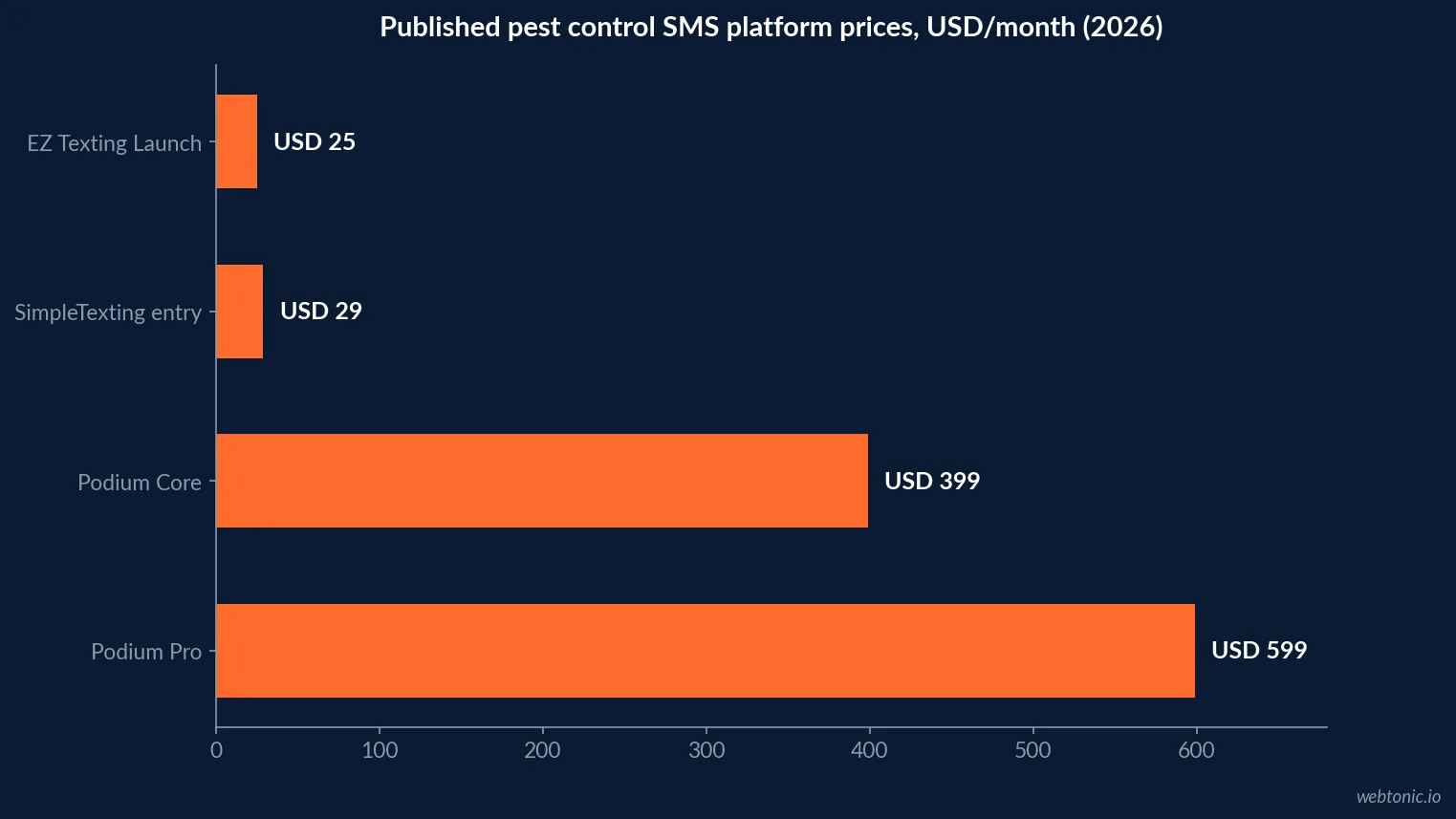
- SimpleTexting's entry plan is USD 29 a month for 500 credits, overage at 5.5 cents each.
- EZ Texting starts at USD 25 a month for 500 credits, overage USD 0.03-0.04 per message.
- Podium's Core plan is USD 399 a month and bundles a USD 5 monthly 10DLC fee.
- Podium's Pro plan is USD 599 a month and adds automatic lead routing.
- Standard A2P 10DLC brand registration is a USD 44 one-time fee on Twilio, plus per-campaign costs.
- The Campaign Registry's own brand fee runs USD 4 to USD 4.50 depending on entity type.
- Monthly 10DLC campaign fees range USD 1.50 to USD 30 by use case, per TCR's fee schedule.
- The FCC's 2023 one-to-one consent rule was VACATED by the 11th Circuit in January 2025.
- TCPA consent requirements under 47 U.S.C. 227 remain in force regardless of that ruling.
- Every text notification must honor a STOP reply per 47 CFR 64.1200.
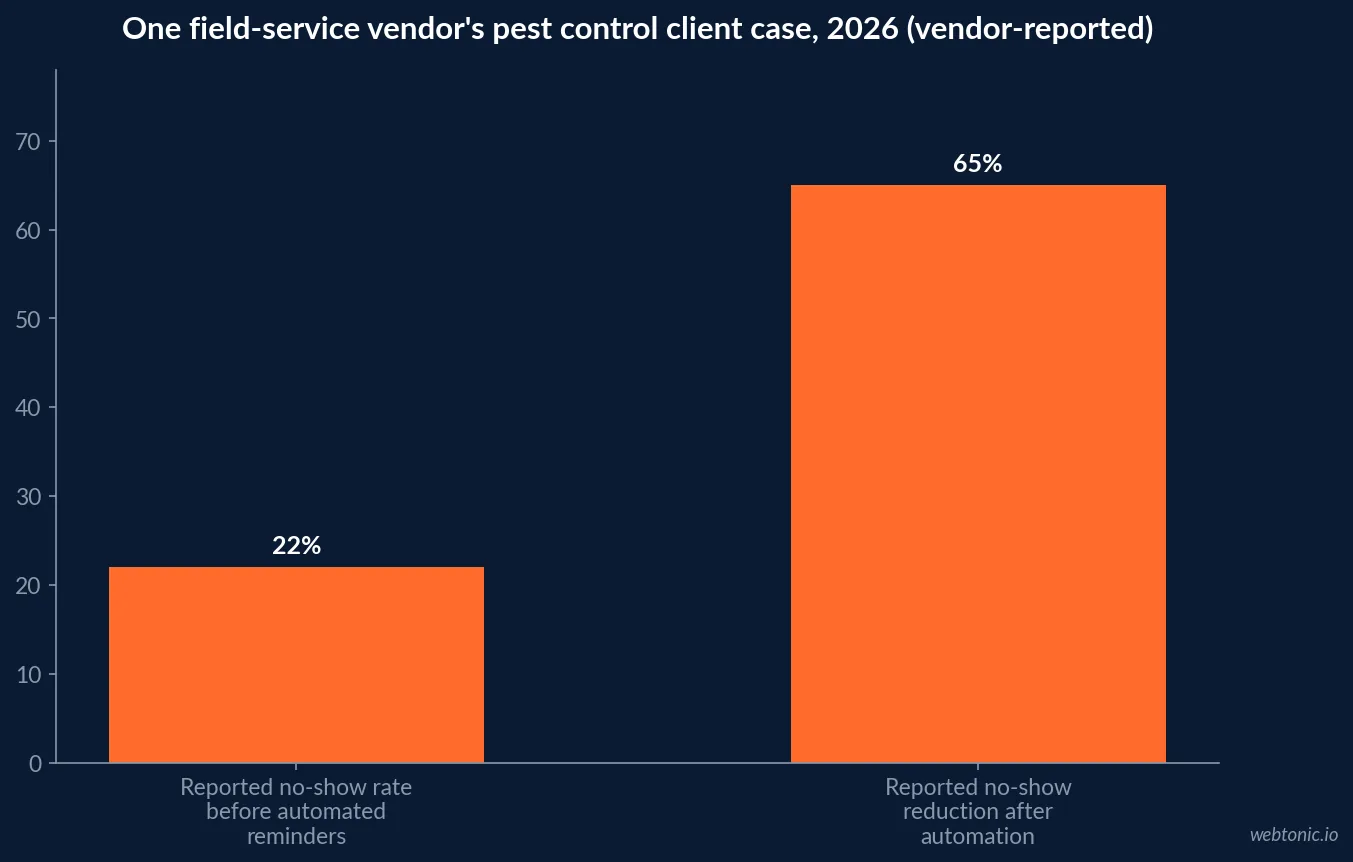
- One vendor's own case study reports a 22% pre-automation no-show rate costing roughly USD 45,000 a month.
- The same vendor case reports no-shows fell from 22% to 12% after automated reminders replaced manual calls (the vendor headlines it as a 65% cut).
- HIPAA does not block appointment reminders - they fall under treatment communications at 45 CFR 164.506.
Why texting entered the pest control stack at all
The demand side has not changed: The Harris Poll's 2026 survey for the National Pest Management Association, fielded among 1,389 U.S. homeowners, found 52% used a licensed pest professional in the past year. What changed is the reminder channel: a route business lives or dies on whether a technician's calendar stays full, and a missed appointment is a lost slot that cannot be resold same-day. Texting is the channel field-service platforms have standardized on to protect that calendar, at a cost that is worth pricing on its own rather than folding into a platform's headline rate.
| Reach signal (2026) | Figure | Source | Relevance to SMS |
|---|---|---|---|
| Homeowners using a pest pro, past year | 52% | Harris Poll / NPMA | The addressable base for reminder and dispatch texts |
| Reported no-show rate before automation (one vendor case) | 22% | Fieldproxy client case study | The problem reminder texts are built to solve |
| Reported monthly revenue at risk from that no-show rate | ~USD 45,000 | Fieldproxy client case study | The number that justifies the line item |
| Reported no-show rate after automated reminders (vendor headline: 65% cut) | 12% (from 22%) | Fieldproxy client case study | A single vendor-reported outcome, not an industry average |
What the message itself costs, at the carrier level
Twilio's own U.S. SMS pricing page lists outbound messages on a long code at USD 0.0083 per segment - inbound is the same rate - with MMS at USD 0.022 outbound. That is the raw carrier price before any platform markup or registration fee, and it is the number every bundled texting plan below is ultimately built on top of.
| Carrier rate (2026, own page) | Outbound SMS | Outbound MMS | Source |
|---|---|---|---|
| Twilio, U.S. long code | USD 0.0083/segment | USD 0.022 | twilio.com/en-us/sms/pricing/us |
| Twilio, U.S. toll-free | USD 0.0083/segment | USD 0.022 | twilio.com/en-us/sms/pricing/us |
| Twilio, U.S. short code | USD 0.0083/segment | USD 0.022 | twilio.com/en-us/sms/pricing/us |
| Klaviyo (legacy credits, US) | 1 credit/segment | 3 credits | Klaviyo Help Center |
What operators actually pay: bundled platform pricing
Almost no pest control operator buys carrier access directly - they buy a platform, and the platform's own pricing page is the number that matters. GorillaDesk bundles SMS as a flat USD 5-a-month add-on for a local number, billed at one credit per 160 characters from a purchased pack. SimpleTexting's own pricing calculator prices its entry tier at USD 29 a month for 500 credits with a USD 10 local-number fee and a one-time USD 4 carrier registration, and bills overage at 5.5 cents per credit. EZ Texting's own page starts its Launch tier at USD 25 a month for 500 monthly credits with overage at USD 0.04, scaling to a Scale tier at USD 125 a month with overage down to USD 0.03.
Reputation-and-messaging platforms built for local service businesses price higher because texting is bundled with review management and call handling. Podium's own pricing data lists Core at USD 399 a month and Pro at USD 599, both bundling texting with review management, call handling and - on Pro - automatic lead routing.
| Platform (own pricing page, 2026) | Entry price | Credits/messages included | Overage |
|---|---|---|---|
| EZ Texting Launch | USD 25/mo (USD 20 billed annually) | 500 monthly credits | USD 0.04/credit |
| SimpleTexting Level 1 | USD 29/mo (USD 39 est. w/ number+fees) | 500 credits | USD 0.055/credit |
| GorillaDesk SMS add-on | USD 5/mo number fee + pack cost | Pack-based, 1 credit/160 chars | Buy another pack |
| Podium Core | USD 399/mo | 250 bulk-message credits/mo | Custom, contact sales |
| Podium Pro | USD 599/mo | 500 bulk-message credits/mo | Custom, contact sales |
10DLC registration: the fee every bulk sender pays once, then monthly
US carriers require Application-to-Person 10-digit long code (A2P 10DLC) registration before a business can send bulk texts reliably. Twilio's own 10DLC page lists standard registration at a USD 44 one-time brand fee plus USD 15 per campaign for one-time vetting and USD 1.50 to USD 10 per campaign per month after that; low-volume standard registration drops the brand fee to USD 4. The Campaign Registry's own published fee schedule separately lists brand registration from USD 4 to USD 4.50 by entity type and monthly campaign fees from USD 1.50 to USD 30 depending on use case - sole-proprietor and low-volume campaigns sit at the bottom of that range, "all other campaigns" at the top. Podium's own pricing page separately itemizes a flat USD 5-a-month 10DLC fee bundled into its plans rather than billed as a pass-through.
| 10DLC fee (own source) | One-time | Monthly | Source |
|---|---|---|---|
| Twilio standard brand registration | USD 44 | USD 1.50-10/campaign | twilio.com/en-us/phone-numbers/a2p-10dlc |
| Twilio low-volume standard | USD 4 | USD 1.50-10/campaign | twilio.com/en-us/phone-numbers/a2p-10dlc |
| TCR brand registration (private/public/non-profit) | USD 4.50 | n/a | campaignregistry.com fee schedule |
| TCR sole-proprietor brand | USD 4.00 | n/a | campaignregistry.com fee schedule |
| TCR campaign fee, low volume | n/a | USD 1.50-2.00/mo | campaignregistry.com fee schedule |
| TCR campaign fee, all other campaigns | n/a | USD 10.00/mo | campaignregistry.com fee schedule |
| Podium bundled 10DLC fee | n/a | USD 5.00/mo | Podium own pricing data |
The consent rule that changed - and the one that did not
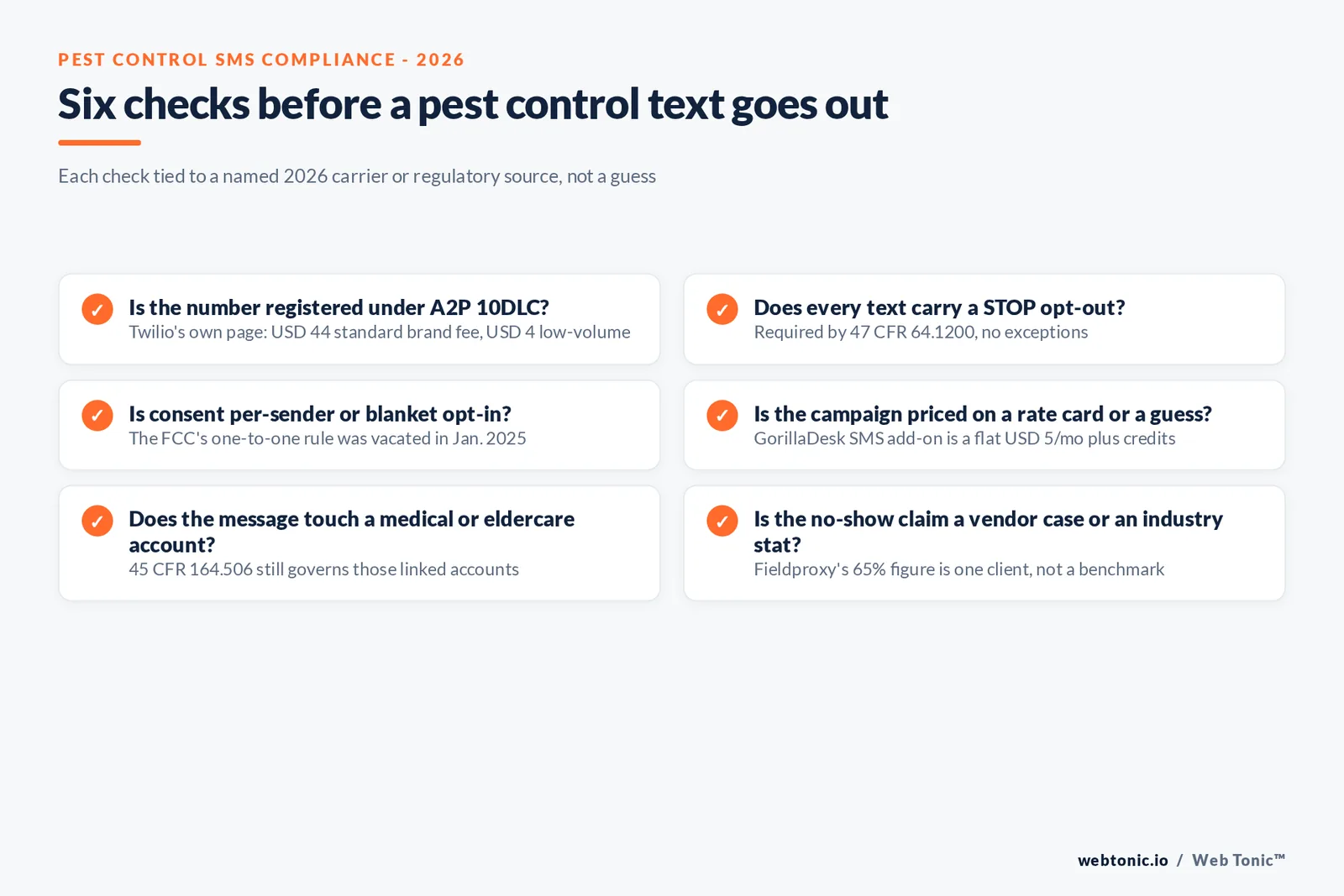
Get this exactly right, because it is easy to get backwards. The FCC's 2023 order would have required a consumer to give "prior express consent" separately to each individual sender rather than one checkbox covering a list of marketing partners - the so-called one-to-one consent rule. In Insurance Marketing Coalition v. FCC, decided January 24, 2025, the 11th Circuit Court of Appeals ruled the FCC exceeded its statutory authority under the TCPA and vacated Part III.D of the 2023 order. As of 2026 that rule is not in force - do not tell a client they need per-sender checkboxes because of it.
What is unaffected: the underlying consent requirement itself. 47 U.S.C. Section 227 still restricts autodialed and prerecorded-voice messages absent prior express consent, and 47 CFR 64.1200 still requires every text notification to carry a working opt-out - the regulation names replying STOP as the mechanism a business must honor as the recipient's exclusive way to unsubscribe. CTIA's own Messaging Principles and Best Practices is the wireless industry's voluntary standard layered on top, distinguishing consumer messaging from application-to-person business messaging and setting the practical bar most 10DLC campaigns are vetted against before a carrier will deliver them at volume.
Where HIPAA fits for pest control operators serving medical or eldercare accounts
Pest control is not a HIPAA-covered service on its own, but operators servicing medical facilities, senior living or dental accounts under a business associate relationship should know the reminder rule that governs those accounts' own patient texting: 45 CFR Part 164 Subpart E permits appointment reminders as a treatment communication without separate patient authorization, subject to the minimum-necessary standard and the patient's right to request an alternative contact method. That rule sets the ceiling for how much detail belongs in a linked account's reminder text - never a service address, treatment detail, or account balance beyond what confirming a visit requires.
How to budget the SMS line without guessing
Price the platform plan first against the message volume a route actually needs - most single-location pest control operators fit inside an entry-tier plan from EZ Texting, SimpleTexting or a field-service add-on rather than a reputation-platform bundle built for a multi-location brand. Add the one-time 10DLC brand fee and the monthly campaign fee on top; both are fixed costs regardless of send volume. Then write the opt-in and STOP-handling language into the contract before the first campaign sends, since that is the one part of the stack that generates real legal exposure. Our data and analytics practice can model the reminder-to-revenue math before a platform is chosen, our growth marketing practice can map the wider workflow around it, and our team can walk through the compliance checklist above.
Frequently Asked Questions
How much does a pest control appointment reminder text actually cost to send?
At the carrier level, Twilio's own U.S. pricing page lists outbound SMS on a long code at USD 0.0083 per segment - under a cent - before any A2P 10DLC registration fees. Most pest control operators do not buy raw carrier access, though; they buy it bundled inside a field-service or texting platform. GorillaDesk's own SMS add-on charges a flat USD 5 a month for a local number plus a bulk credit pack billed at one credit per 160 characters. Purpose-built texting platforms price the whole package: SimpleTexting's own pricing page lists 500 credits at USD 29 a month with overage at 5.5 cents each, and EZ Texting's own page starts at USD 25 a month for 500 monthly credits with overage from USD 0.03 to USD 0.04.
Is the FCC's one-to-one consent rule something a pest control texting program has to follow in 2026?
No - it was vacated. The FCC's 2023 order would have required a consumer to consent separately to each individual sender rather than checking one box for a list of partners, but the 11th Circuit Court of Appeals granted the Insurance Marketing Coalition's petition for review in January 2025 and vacated that part of the order, ruling the FCC exceeded its statutory authority under the TCPA. Do not describe one-to-one consent as current law; the underlying TCPA consent requirement for autodialed and prerecorded messages, at 47 U.S.C. Section 227, is still in force regardless.
What registration does a pest control company need before sending bulk texts?
US carriers require A2P 10DLC registration for any business sending application-to-person texts at scale. Twilio's own 10DLC page lists a standard registration at a USD 44 one-time brand fee plus USD 15 per campaign for vetting and USD 1.50 to USD 10 per campaign per month; low-volume standard registration drops the brand fee to USD 4. The Campaign Registry's own published fee schedule separately lists brand registration from USD 4 to USD 4.50 depending on entity type and campaign fees from USD 1.50 to USD 30 a month by use case. Podium's own pricing page separately lists a USD 5-a-month 10DLC fee bundled into its plans.
Do pest control customers actually respond better to a text than a phone call?
There is no independently audited industry study proving a specific pest control response rate, and this page will not repeat the unsourced '98% open rate' or '45% response rate' figures that circulate without a named study behind them. What is documented is operational: one field-service vendor's own case study reports a client pest control company cut a 22% no-show rate - an estimated USD 45,000 a month in lost revenue - after switching from manual day-before phone calls to automated reminders, without stating a text-specific response percentage. Treat that as a single vendor-reported case, not a benchmark.
What compliance rules apply to a dispatch or reminder text beyond consent?
Quiet hours and opt-out mechanics are set at 47 CFR 64.1200: any text notification must let the recipient opt out by replying STOP, and that reply must be the exclusive, honored opt-out mechanism. CTIA's own Messaging Principles and Best Practices, the wireless industry's voluntary standard that carriers use to police unwanted messages, separately distinguishes consumer-to-consumer messaging from application-to-person business messaging and sets the practical bar most 10DLC campaigns are vetted against.
Sources
National Pest Management Association / Harris Poll - 2026 homeowner survey
Twilio - U.S. SMS pricing
Twilio - A2P 10DLC registration pricing
The Campaign Registry - Fees and pricing
GorillaDesk - SMS text messaging add-on
SimpleTexting - Pricing
EZ Texting - Pricing
Podium - Pricing
11th Circuit Court of Appeals - Insurance Marketing Coalition v. FCC, Jan. 2025
Cornell LII - 47 U.S. Code Section 227 (TCPA)
eCFR - 47 CFR 64.1200, delivery restrictions
CTIA - Messaging Principles and Best Practices
eCFR - 45 CFR Part 164 Subpart E (HIPAA privacy)
Fieldproxy - Pest control client case study on automated reminders