Table of contents

Webflow now runs 2.8% of all websites and passes mobile Core Web Vitals on 68.9% of origins against WordPress’s 49.3%. Personal injury firm websites still convert 2.8% of visitors. Both numbers are true, and the gap between them is the story.
Key Takeaways
- Webflow powers 2.8% of all websites and 4.2% of identifiable-CMS sites in 2026, up from 0.6% in 2022.
- That is 4.7x growth in four years, the fastest percentage gain of any CMS measured.
- Webflow takes 9.4% of new site launches, up from 3.2% in 2022.
- WordPress still leads at 42.4% of all sites and 64.2% of identifiable-CMS sites, down 4.6 points since 2022.
- WordPress holds 71.4% of SME service-business sites — the segment most law firms sit in.
- 2,840 WordPress-to-Webflow migrations were recorded in 24 months, the second-largest migration path measured.
- Webflow passes all three mobile Core Web Vitals on 68.9% of origins versus 49.3% for WordPress.
- Good mobile TTFB: Webflow 55.5%, WordPress 24.8%, Squarespace 80.8%.
- Wix leads mobile CWV pass rate at 80.7%, ahead of Squarespace (70.2%) and Webflow.
- Webflow has the lightest combined mobile payload of the four majors: 918 KB JS plus 855 KB images.
- Median Webflow LCP is 1.8s against 2.8s on WordPress and 4.2s on Magento.
- Landing-page conversion by platform: Webflow 6.42%, WordPress 4.62%, Magento 3.84%.
- Platform choice explains roughly 30% of site speed; implementation explains the other 70%.
- PI firm websites average 2.8% visitor-to-lead conversion; top performers reach 18%.
- Mobile conversion runs 40–50% below desktop while 70%+ of legal traffic is mobile.
- Cutting an intake form from 11 fields to 4 produced a 120% conversion lift.
- Adding video to a landing page lifted conversions 86%.
- Leads contacted within one minute convert 391% better, yet 39% get no response at all.
Webflow’s Share Is Small and Growing Fast
Scope matters when quoting CMS share, so quote both. Across a Q1 2026 crawl of one million domains, Webflow reached 2.8% of all websites and 4.2% of identifiable-CMS sites, up from 0.6% in 2022, while WordPress fell 4.6 percentage points to 42.4%.
| Platform | % of all websites (2026) | % of identifiable CMS | 2022 share | Change |
|---|---|---|---|---|
| WordPress | 42.4% | 64.2% | 47.0% | -4.6pp |
| Shopify | 8.4% | 14.2% | 4.8% | +3.6pp |
| Custom / framework | 6.4% | 9.8% | 5.4% | +1.0pp |
| Wix | 3.8% | 5.8% | 3.0% | +0.8pp |
| Headless CMS | 3.2% | 4.8% | 0.8% | +2.4pp |
| Webflow | 2.8% | 4.2% | 0.6% | +2.2pp |
| Squarespace | 2.6% | 3.9% | 2.6% | 0.0pp |
The leading indicator is stronger than the installed base. Webflow took 9.4% of sites first detected in the trailing twelve months against 3.2% in 2022, and 2,840 WordPress-to-Webflow migrations were recorded over 24 months — the second-largest migration path in the dataset after Magento to Shopify. Adoption is concentrated in agencies (24.6%), designer portfolios (22.4%) and B2B SaaS (18.4%).
Law firms are not in that list. WordPress holds 71.4% of SME service-business sites and 68.4% of local and regional business sites, which is where a personal injury practice sits. A firm choosing Webflow in 2026 is making a deliberate, minority choice — so the performance case has to carry it.
The Field Performance Case
Real-user data from the May 2026 CrUX dataset via HTTP Archive is the fairest test, because it measures deployed sites rather than demo builds. Webflow passes all three Core Web Vitals on mobile for 68.9% of origins against 49.3% for WordPress, with good TTFB on 55.5% versus 24.8%.
| Platform | Mobile CWV pass (all 3) | Good TTFB | Median mobile JS | Median mobile images |
|---|---|---|---|---|
| Wix | 80.7% | 66.9% | 1,707 KB | 185 KB |
| Squarespace | 70.2% | 80.8% | 1,571 KB | 1,111 KB |
| Webflow | 68.9% | 55.5% | 918 KB | 855 KB |
| WordPress (defaults) | 49.3% | 24.8% | 692 KB | 1,029 KB |
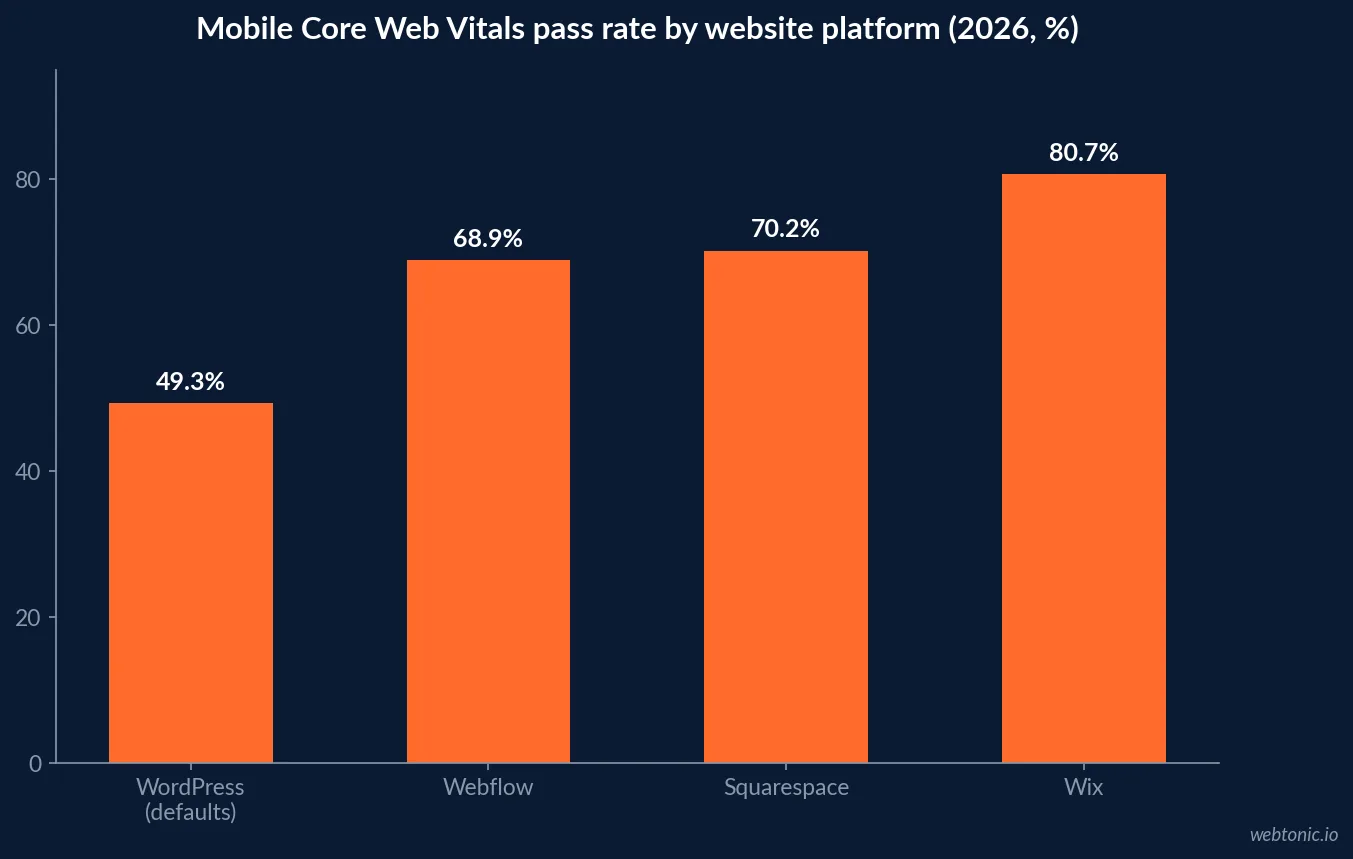
Two nuances stop this being a clean win. Webflow is third on pass rate, behind Wix and Squarespace, and much of WordPress’s deficit is a hosting-mix artefact — WordPress runs on everything from $3 shared plans to enterprise clusters, while Webflow is 100% managed hosting. What Webflow genuinely wins is payload discipline: the lightest combined JS plus image weight of the four majors, at 918 KB and 855 KB respectively.
The blunt conclusion from the same analysis: platform selection accounts for roughly 30% of a site’s speed outcome, and the remaining 70% comes from template choice, integration count, image handling and third-party script management. A lean WordPress site on premium managed hosting will beat a bloated Webflow build with excessive custom code, every time.
Speed, Conversion and the Median Law Firm Site
Median LCP by platform tracks landing-page conversion rate closely enough to be useful: custom/Next.js at 1.6s and 6.84%, Webflow at 1.8s and 6.42%, WordPress at 2.8s and 4.62%, Magento at 4.2s and 3.84%. Correlation, not proof of causation — the same teams that buy Webflow tend to buy better design and better copy.
| Platform | Median LCP | Median INP | Landing-page CVR | All-good CWV share |
|---|---|---|---|---|
| Custom Next.js / Astro | 1.6s | 124ms | 6.84% | 84.6% |
| Webflow | 1.8s | 142ms | 6.42% | 78.4% |
| Headless CMS | 1.9s | 136ms | 6.18% | 76.4% |
| Squarespace | 2.6s | 184ms | 4.94% | 52.4% |
| WordPress (default themes) | 2.8s | 218ms | 4.62% | 42.6% |
| Wix | 3.4s | 264ms | 4.42% | 32.4% |
| Magento | 4.2s | 312ms | 3.84% | 22.6% |
Now overlay the legal numbers. PI firm websites average 2.8% visitor-to-lead conversion while top performers reach 18% — a spread far larger than any platform-level difference. Pages loading in zero to two seconds convert at roughly 3x the rate of five-second pages, and most PI firm sites load in three to five seconds on mobile, so speed is worth real money. It is simply not worth the whole gap.
Where the Conversion Money Actually Is
The published lifts on law firm sites dwarf the platform delta, and none of them require a replatform.
| Fix | Documented impact | Platform dependent? |
|---|---|---|
| Cut intake form from 11 fields to 4 | +120% conversion | No |
| Add attorney video above the fold | +86% conversion | No |
| Sub-two-second page load | ~3x versus five seconds | Partly (~30%) |
| Practice-area landing pages, not homepage | Top-performer characteristic | No |
| Social proof above the fold | Top-performer characteristic | No |
| Live chat or AI intake | 51% of legal consumers accept chatbots | No |
| Contact every lead inside one minute | +391% conversion | No |
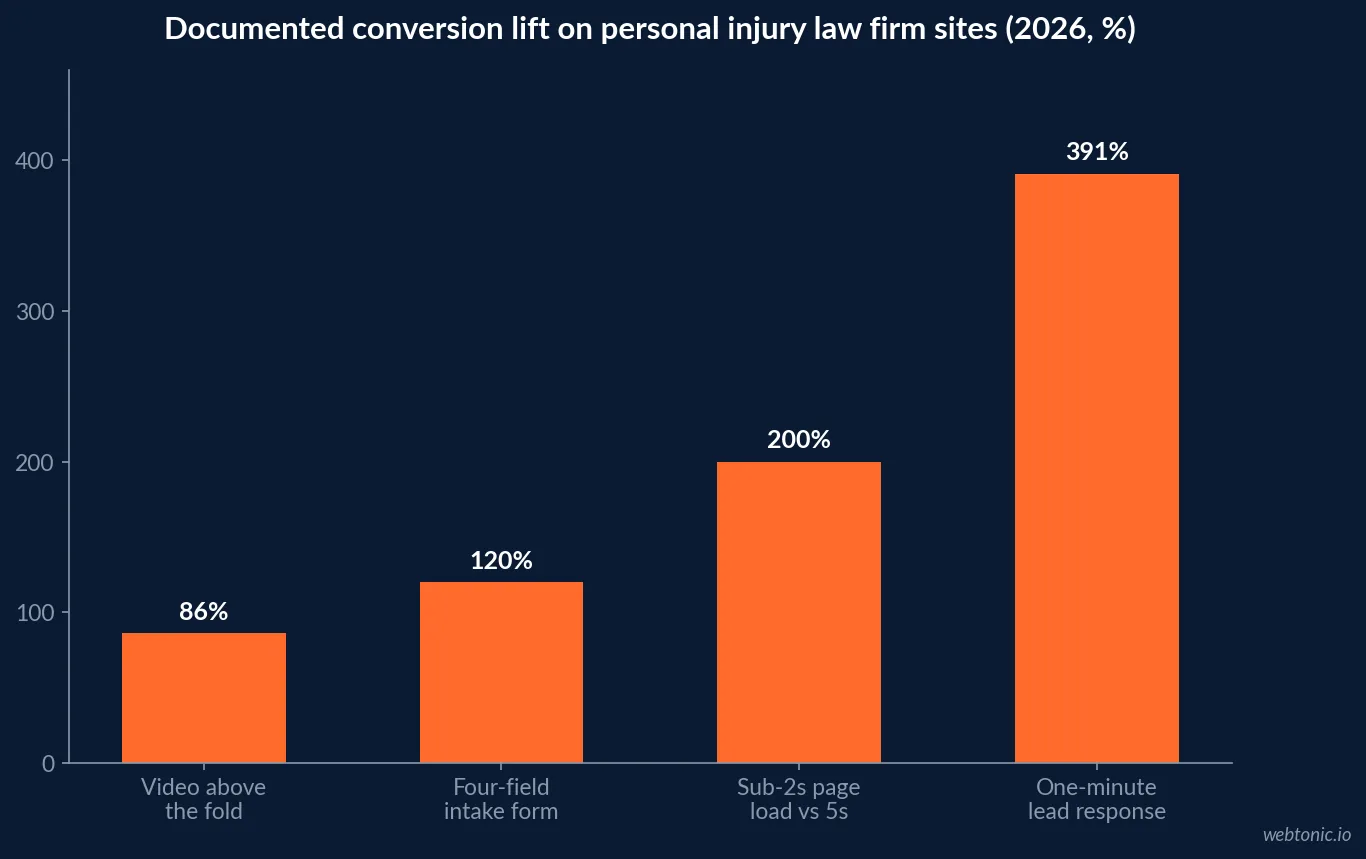
The response-time data is the most uncomfortable. 79% of legal consumers hire the first attorney who responds, leads contacted within one minute convert 391% better — and 39% of leads receive no response at all, with a further 5% answered only after two hours. A firm with a 18%-converting site and two-hour response times signs fewer cases than a firm converting 6% and calling back in sixty seconds. No CMS fixes that.
Mobile is the second gap. Over 70% of legal website visitors arrive on a phone, and mobile conversion runs 40–50% below desktop at 1.5–2.5% against a 4–8% top-performer range. Since Webflow’s measurable advantage is specifically mobile payload and mobile CWV, this is where the platform argument is strongest — provided the build stays lean.
The Migration Question, Costed
Replatforming is not a design decision, it is a cash-flow decision with a risk profile. The migration data shows 2,840 WordPress-to-Webflow moves in 24 months plus 940 from Wix and 720 from Squarespace, so the direction of travel is real — but that is a few thousand sites against the tens of millions running WordPress.
| Consideration | What the data says | Decision rule |
|---|---|---|
| Current mobile CWV status | WordPress passes on 49.3% of origins | Measure first — you may already pass |
| Hosting quality | Only 24.8% of WP origins hit good TTFB | Upgrade hosting before replatforming |
| Existing conversion rate | PI average 2.8%, top 18% | Below 3% is a funnel problem, not a CMS problem |
| Page count | Webflow strong to ~500 pages | 1,000+ pages favours WordPress |
| Redirect and ranking risk | Every URL must be mapped | Never migrate mid-campaign |
| In-house capability | Webflow removes dev dependency | No developer on call favours Webflow |
The sequence that protects rankings is unglamorous: benchmark current field CWV and conversion, fix hosting and images on the existing stack, rebuild templates only if the design itself is the constraint, then map every URL one-to-one before launch. Firms that skip the benchmark step have no way to tell whether the post-migration lift came from the platform, the new copy, or the new intake form.
One under-discussed advantage of managed platforms for law firms is variance reduction rather than peak speed. Webflow origins post good mobile TTFB 55.5% of the time against 24.8% on WordPress, and that gap exists mostly because WordPress performance is delegated to whoever bought the hosting. For a practice where marketing is a part-time responsibility, removing plugin conflicts, update cycles and security patching from the workload is worth more than the 1.0s median LCP difference.
Practical Fit: Webflow for a PI Practice
Scale is rarely the constraint. Webflow CMS handles 100–500 pages comfortably, which covers practice-area × city page programmes for almost every multi-location firm; past roughly 1,000 pages, WordPress’s database handling and bulk editorial tooling win. Webflow is 100% managed hosting, which removes the single largest source of WordPress performance variance and, for a small firm without a developer on call, is a genuine operational argument.
| Requirement | Webflow | WordPress |
|---|---|---|
| Sub-2s mobile LCP on defaults | Strong — 1.8s median | Hosting dependent — 2.8s median |
| 100–500 page location programme | Strong — native CMS collections | Strong |
| 1,000+ page content library | Weaker | Strong |
| Plugin and integration depth | Narrow third-party ecosystem | 30,000+ public plugins |
| Ongoing developer dependency | Low — visual editing | Moderate — updates and security |
| Hosting variance risk | None — fully managed | High — $3 to enterprise |
| Intake, call tracking, chat integrations | Embeds work; fewer native options | Widest plugin coverage |
The honest recommendation from the data: replatforming to Webflow is a reasonable decision for a firm that is already rebuilding, wants managed hosting and runs a template-driven location programme. It is a poor use of budget for a firm whose real problem is a 3.5% conversion rate, an 11-field form and an unanswered phone. Fix the funnel first, then decide what it should be built on. Our personal injury law technical SEO statistics quantify the crawl and indexation side, the attribution statistics cover measuring what the site produces, the marketing dashboards statistics cover reporting it, and data intelligence is how we instrument all of it.
Frequently Asked Questions
How much of the web runs on Webflow in 2026?
A 1,000,000-domain crawl puts Webflow at 2.8% of all websites and 4.2% of sites running an identifiable CMS, up from 0.6% in 2022 — a 4.7x four-year gain. It also takes 9.4% of new site launches in the trailing twelve months, versus WordPress at 38.4%.
Is Webflow actually faster than WordPress for a law firm site?
In the field, yes, on defaults. May 2026 CrUX data shows Webflow passing all three Core Web Vitals on mobile for 68.9% of origins against 49.3% for WordPress, with good TTFB on 55.5% versus 24.8%. Most of that gap is hosting uniformity, not templating magic — a lean WordPress site on premium managed hosting beats a bloated Webflow build.
Does a faster site fix a law firm's conversion rate?
Partly. PI firm sites average 2.8% visitor-to-lead conversion while top performers reach 18%, and pages loading in under two seconds convert at roughly 3x the rate of five-second pages. But intake speed dominates: leads contacted inside one minute convert 391% better, and 39% of leads get no response at all.
Can Webflow CMS handle a large law firm site with many location pages?
Comfortably for 100–500 pages, which covers almost every multi-location PI practice. Beyond roughly 1,000 pages, database handling and bulk editorial tooling favour WordPress. Webflow CMS collections are the standard way to run practice-area × city pages from one template.
What does the platform decision actually change?
Roughly 30% of a site's speed outcome, according to platform comparison analysis — the other 70% comes from template choice, plugin or embed count, image handling and third-party scripts. The bigger levers for a PI firm are a four-field intake form (120% lift), video above the fold (86% lift) and mobile-first design for the 70%+ of legal traffic that arrives on a phone.
Sources
CMS market share 2026: 1M domain crawl
WordPress vs Webflow vs Squarespace: speed compared 2026
Personal injury website conversion benchmarks
Law firm conversion rate optimization: complete guide
W3Techs: usage statistics of Webflow
Webflow pricing explained (2026)
Google Search Central: page experience