



Table of contents
In the personal injury legal vertical — one of the most competitive search niches online — backlink authority is the primary differentiator between page-one firms and everyone else. A Rankings.io data science study of 112,000 personal injury law SERPs found that referring domain count and domain authority are among the strongest correlates of top organic positions, while older domains gain roughly one ranking position per six additional years of domain age.
Key Takeaways
- Backlinks remain one of Google's top 3 ranking factors, and in PI law they are often the final differentiator between page 1 and page 2 rankings.
- 4+ editorial backlinks per month sustained over 12–18 months builds a backlink profile that is extraordinarily difficult for competitors to overcome.
- Legal directories (Avvo, Justia, FindLaw, Super Lawyers) provide foundational citation authority — every PI firm should have complete profiles on these platforms.
- PI lawyer keywords carry CPCs of $100–$300+, meaning organic rankings earned through link building deliver significant cost savings over paid search.
- Older domains rank higher in PI law — each six years of domain age correlates with roughly one additional ranking position in SERPs.
- SEO-sourced leads cost $183 per lead vs $442 for Google Ads, and convert to signed cases at 15–20% (vs 5–15% for paid), making link-driven organic traffic the most profitable PI acquisition channel.
- Guest posting on genuine legal publications is the most scalable high-quality link building strategy for law firms, outperforming directory submissions and paid link tactics.
Link Building Benchmarks for Personal Injury Law Firms
The following table summarizes the key backlink and authority benchmarks from the most authoritative 2025–2026 studies of the personal injury legal vertical.
| Metric | Benchmark | Source |
|---|---|---|
| Referring domains for page-1 PI rankings | 50–200+ unique domains | Rankings.io (112K SERPs) |
| Domain age advantage | +1 rank position per 6 years | Rankings.io |
| Editorial backlinks for competitive edge | 4+ per month, sustained 12–18 months | Inoriseo |
| Directory profiles (foundational authority) | Avvo, Justia, FindLaw, Super Lawyers, Martindale | Inoriseo / Semrush |
| Avg DR of page-1 PI firms | 40–65 DR (Ahrefs scale) | AuthoritySpecialist |
| Cost of quality guest post link | $200–$1,500+ per placement | Industry estimates |
| Organic SEO CPL (link-building ROI proxy) | $183 per lead | LEXGRO |
| Time to measurable ranking improvement | 4–8 months from sustained link building | The HOTH / Inoriseo |
Why Backlinks Matter More in PI Law Than Almost Any Other Niche
According to Semrush's State of Search research, backlinks from high-authority domains remain one of the strongest correlates of page-one rankings across competitive verticals, including legal services. WordStream data confirms that legal terms — "lawyer," "attorney," and specific practice area keywords — consistently rank among the highest-cost keywords in paid search, making organic visibility through link building exceptionally valuable.
For PI-specific keywords, the on-page fundamentals (keyword optimization, content quality, technical performance) are relatively similar across the top 10 competing firms in any major market. Every firm targeting "personal injury lawyer Chicago" has optimized their title tags, written comprehensive practice area content, and built a mobile-friendly website. The gap that separates page 1 from page 2 is almost always backlink authority.
This is why investing in growth marketing strategies that prioritize link building alongside content creation delivers compound returns — each quality backlink makes future content more likely to rank.
What 112,000 PI Law SERPs Reveal About Ranking Factors
Rankings.io conducted one of the largest data science studies ever focused on personal injury law SEO, analyzing 112,000 SERPs across PI-related queries. Their key findings provide a data-driven foundation for link building strategy:
- Legal directories dominate — platforms like FindLaw, SuperLawyers, and Justia maintain a distinct advantage over the vast majority of individual law firm websites in organic rankings.
- Older domains rank higher — SERP listings gain an average of one position per six years of domain age, giving established firms an inherent advantage that newer firms must overcome with more aggressive link building.
- Referring domain count correlates with rank — while the exact number varies by metro and keyword difficulty, firms with 50–200+ referring domains consistently outrank those with fewer backlink sources.
- GBP listings with robust organic SEO rank higher in the local pack — backlink authority to the main website directly influences Google Business Profile visibility, connecting link building to local lead generation.
These findings underscore that link building for PI firms is not optional — it is a fundamental competitive requirement, especially when competing against well-funded national directories that hold thousands of high-authority backlinks.
Link Building Strategies That Work for PI Law Firms
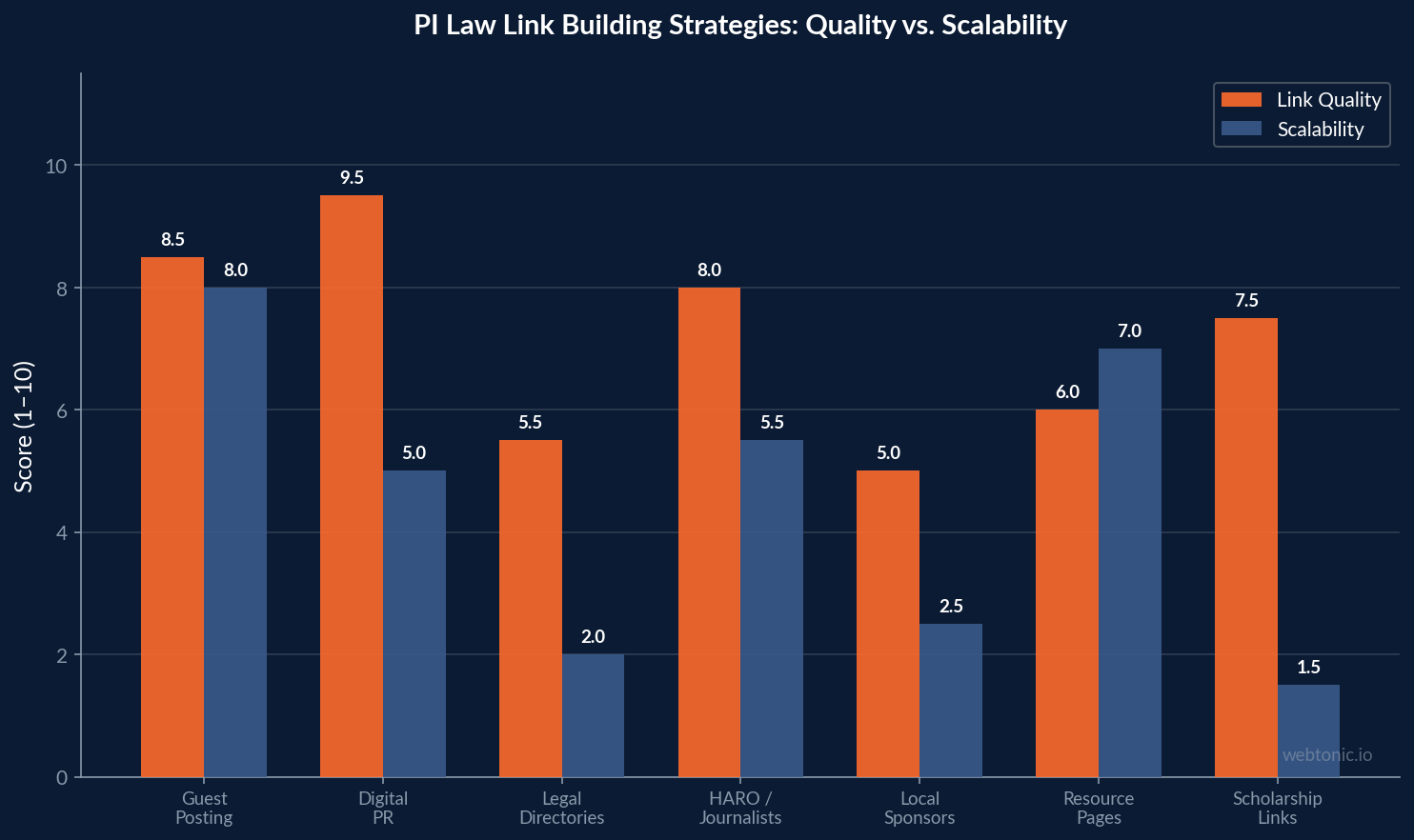
Not all link building tactics deliver equal results. Based on the data and case studies reviewed, these strategies produce the highest-quality backlinks for personal injury attorneys:
| Strategy | Link Quality | Scalability | Time to Impact |
|---|---|---|---|
| Guest posting (legal publications) | High — editorial, contextual | High — 4–8 posts/month achievable | 4–6 months |
| Legal directory profiles | Medium — citation authority | Low — one-time setup | 1–3 months |
| Digital PR / data-driven content | Very High — earned media | Medium — requires newsworthy data | 2–4 months |
| Local sponsorships and events | Medium — local relevance | Low — limited opportunities | 3–6 months |
| Legal scholarship programs | High — .edu backlinks | Low — seasonal, annual | 6–12 months |
| HARO / journalist responses | High — earned editorial | Medium — time-intensive | 1–3 months |
| Resource page link building | Medium — contextual | High — systematic outreach | 3–6 months |
Guest posting on genuine legal publications is the most scalable high-quality strategy because it combines editorial context, topical relevance, and referral traffic. Firms sustaining 4+ editorial backlinks per month for 12–18 months build authority profiles that are extraordinarily difficult for competitors to replicate. For firms looking to accelerate their organic presence, professional search marketing agencies typically combine link building with content and technical SEO for compound growth.
Case Study: 1,000% Traffic Increase Through Legal Link Building
The HOTH documented a case study where a law firm achieved a 1,000%+ increase in organic traffic through a sustained SEO and link building campaign. The results included:
- Rankings for 2,500+ legal keywords — from minimal organic visibility to broad keyword coverage across practice areas.
- $1,400 monthly traffic value — the estimated cost to buy the same traffic through paid search, demonstrating the ROI of organic rankings earned through link building.
- Compound growth pattern — initial months showed gradual improvement, followed by an inflection point where accumulated authority triggered rapid ranking gains across multiple keyword clusters simultaneously.
This pattern is typical of link building campaigns: slow initial progress followed by exponential gains as domain authority crosses competitive thresholds. Most PI firms abandon link building efforts in months 3–6, before the compound effect materializes — which is precisely why sustained campaigns create durable competitive advantages.
Link Building ROI: Organic vs. Paid Acquisition Economics
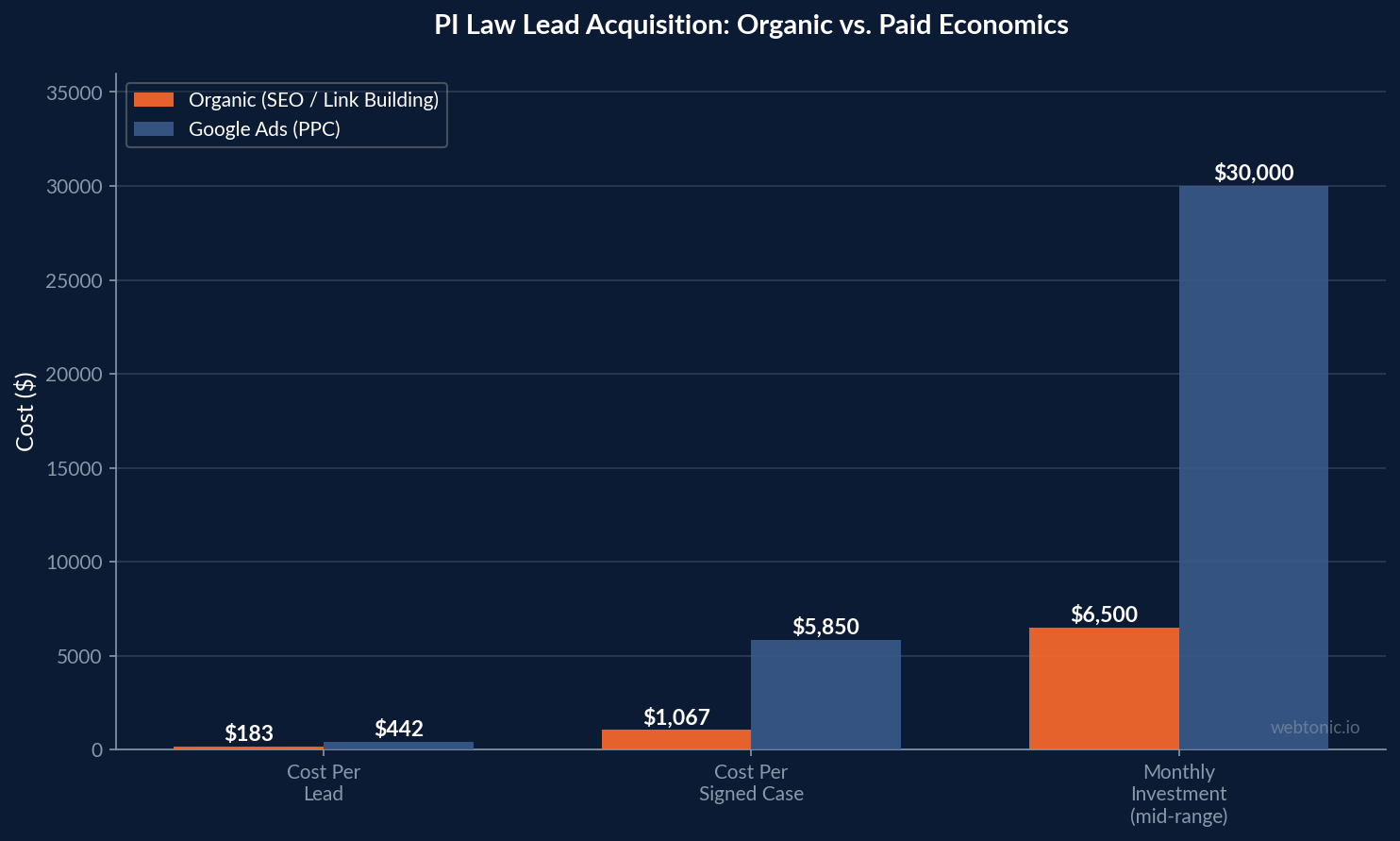
The financial case for link building in PI law becomes clear when comparing the full-funnel economics of organic versus paid lead acquisition.
| Metric | Organic (SEO/Link Building) | Google Ads (PPC) |
|---|---|---|
| Avg cost per lead | $183 | $442 |
| Lead-to-signed conversion | 15%–20% | 5%–15% |
| Cost per signed case | $915–$1,220 | $2,900–$8,800 |
| Monthly investment range | $3,000–$10,000 | $10,000–$50,000+ |
| Time to first results | 4–8 months | Immediate |
| Compound growth effect | Yes — rankings persist | No — stops when budget stops |
| Competitive moat | High — hard to replicate | Low — anyone can bid |
At $183 per lead with 15–20% conversion to signed cases, organic traffic delivers a cost per signed case of $915–$1,220 — roughly 3–7× cheaper than Google Ads. The compound advantage is even more significant: once a PI firm builds sufficient authority to rank on page 1, those rankings persist even during months of reduced investment, unlike paid search campaigns that stop generating leads the moment you pause spending.
Link Building Risks: What to Avoid in PI Law SEO
Not all backlinks help — some actively harm rankings. PI firms should avoid these common pitfalls:
- Private blog networks (PBNs) — Google identifies and penalizes PBN links, which can trigger months of recovery work and significant ranking losses.
- Paid link schemes — buying links from link farms or low-quality blogs violates Google's guidelines and puts the firm's entire organic presence at risk.
- Over-optimized anchor text — using exact-match keyword anchors (e.g., "personal injury lawyer Chicago") for more than 5–10% of total backlinks triggers algorithmic penalties. Natural anchor profiles include brand name, URL, and generic anchors alongside keyword variations.
- Irrelevant link sources — backlinks from unrelated industries carry minimal SEO value and can signal manipulative intent to Google's spam algorithms.
- Neglecting link profile audits — firms should audit their backlink profile quarterly using tools like data intelligence platforms to identify and disavow toxic links before they accumulate.
Legal Directory Backlinks: The Foundation of PI Firm Authority
Legal directories serve a dual purpose: they provide foundational citation authority and generate direct referral traffic from potential clients browsing attorney listings. The Rankings.io study confirmed that directory platforms like FindLaw, SuperLawyers, and Justia maintain a distinct ranking advantage over the majority of individual law firm websites — which means having a presence ON these platforms sends authority signals back to your domain.
Every PI firm should maintain complete, optimized profiles on these platforms:
- Avvo — high domain authority, lawyer rating system, client review integration.
- Justia — free and paid listings, strong topical relevance for legal queries.
- FindLaw — one of the oldest legal directories, carries significant historical authority.
- Super Lawyers — editorial selection process adds credibility beyond standard directory listings.
- Martindale-Hubbell — peer-review rating system trusted by the legal profession for over a century.
These directory profiles constitute the minimum viable backlink profile for any PI firm. They are not sufficient to compete in major metros, but without them, a firm starts from a significant authority deficit.
Related reading
- Personal Injury Law Webflow Statistics: Platform & Performance Data for 2026
- What Personal Injury Lawyers Should Budget for Generative Engine Optimization
- 2026 SEO Stats for Personal Injury Law: Benchmarks That Matter
- Link Building Services services at Web Tonic
FAQ
How many backlinks does a personal injury law firm need to rank on page 1?
There is no universal number, but the Rankings.io study of 112,000 PI SERPs shows that firms with 50–200+ unique referring domains consistently outrank those with fewer. In competitive metros like Los Angeles or Chicago, the threshold is higher. Sustaining 4+ quality editorial backlinks per month for 12–18 months builds an authority profile that creates durable page-1 rankings.
What is the ROI of link building for personal injury lawyers?
Organic leads cost $183 per lead compared to $442 for Google Ads, and convert to signed cases at 15–20% vs 5–15%. This means a cost per signed case of $915–$1,220 via SEO compared to $2,900–$8,800 via PPC. Additionally, organic rankings persist even during reduced investment, unlike paid campaigns that stop generating leads when spending stops.
How long does link building take to improve PI law firm rankings?
Most firms see measurable ranking improvements within 4–8 months of sustained link building. The typical pattern shows slow initial progress followed by an inflection point where accumulated authority triggers rapid gains across multiple keywords. Firms that abandon link building before month 6 rarely experience the compound growth effect that makes the investment worthwhile.
Are paid links safe for personal injury law firm SEO?
No. Buying links from PBNs, link farms, or low-quality blogs violates Google's guidelines and can trigger penalties requiring months of recovery. The safest approach combines editorial guest posts, digital PR, and legal directory profiles — all methods that produce links Google recognizes as legitimately earned. Firms should also audit their backlink profiles quarterly to identify and disavow any toxic links.
What types of content generate the best backlinks for PI law firms?
Data-driven content — such as ROI analysis reports, original legal statistics, settlement data compilations, and state-specific legal guides — attracts the most editorial backlinks. Content that journalists and legal bloggers can cite as a source earns links naturally, while self-promotional content (case results, attorney bios) rarely generates external backlinks.
Sources
Rankings.io — SEO Data Science: A Study of 112K PI Law Firms
Inoriseo — Link Building for Law Firms: Complete Guide
The HOTH — Legal SEO: 1,000% Traffic Increase Case Study
LEXGRO — PI Cost Per Lead Benchmarks
Authority Specialist — PI Lawyer SEO Benchmarks 2026
Boominghype — Personal Injury SEO Keywords 2026
Revenue Memo — Law Firm Marketing Statistics 2026


