Table of contents

Personal injury carries the highest average cost per lead of any industry WordStream tracks in Google Ads - USD 131.63 - and yet Clio's own client data shows referrals, not paid search, remain the single largest source of new clients for the average firm. This page maps both halves of that funnel with sourced figures, rather than treating either channel as the whole answer.
Key Takeaways
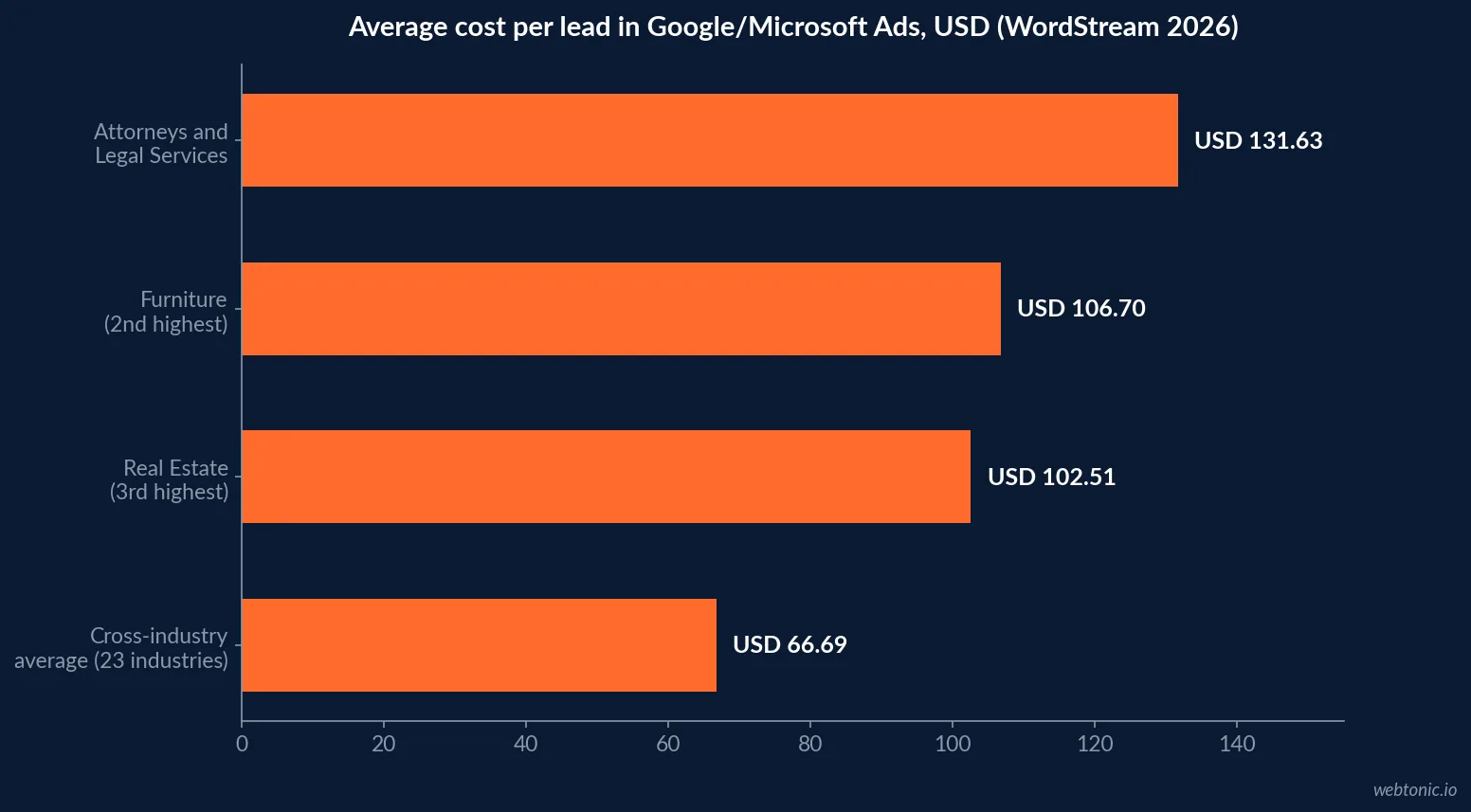
- USD 131.63 average cost per lead for Attorneys and Legal Services in Google and Microsoft Ads, the highest of 23 industries tracked (WordStream 2026).
- USD 9.87 average cost per click for the same category, also the highest tracked.
- USD 66.69 is the cross-industry average cost per lead across all 23 industries - personal injury runs roughly double that.
- 35% of law firms say referrals from other legal professionals generate their most leads (Clio 2024 Legal Trends Report).
- Referrals and firm websites lead all other client sources, per the same Clio report.
- Only 13% of potential clients received a referral to another firm or colleague when the first firm couldn't help.
- Median online lead response time is 13 minutes (Hennessey Digital, 2025 study).
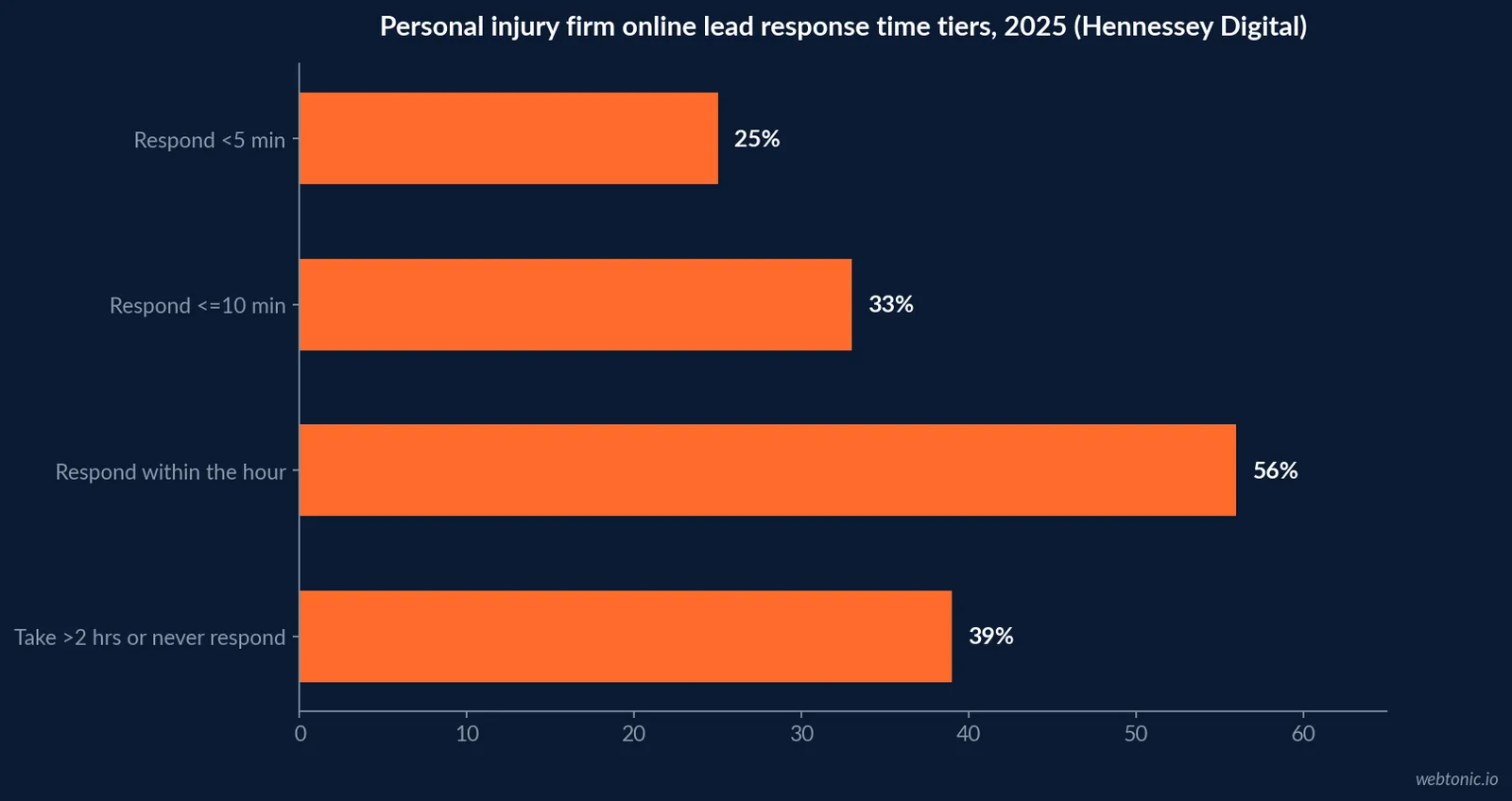
- 25% of firms respond in under 5 minutes, up from 13% four years earlier.
- 39% of firms take over 2 hours to respond, or never respond, to an online lead.
- 74% of firms responded within 7 days in 2025, up from 59% in 2021.
- Personal injury's flat-fee median case value is USD 2,678 (Clio 2024).
- Median personal injury hourly billing rate is USD 271 at the firm level (Clio 2024).
- Marketing budgets average 9.0% of revenue across industries (The CMO Survey 2026, cross-industry benchmark, not law-firm specific).
- Overall marketing spend grew just 1.7% year on year in the same report.
- 70% of cases at some firms flow through Local Services Ads, per Whitespark contributor data, once a firm ranks well in both organic and local results.
| Metric (2026 unless noted) | Personal injury / legal | Cross-industry benchmark | Source |
|---|---|---|---|
| Average cost per click | USD 9.87 (highest of 23 industries) | USD 5.42 | WordStream 2026 |
| Average cost per lead | USD 131.63 (highest of 23 industries) | USD 66.69 | WordStream 2026 |
| Top reported lead source | Referrals, 35% cite legal-professional referrals | n/a - category specific | Clio 2024 Legal Trends Report |
| Referral follow-through rate | 13% of declined clients get referred elsewhere | n/a | Clio 2024 Legal Trends Report |
| Median lead response time | 13 minutes | n/a - legal-specific study | Hennessey Digital 2025 |
| Marketing budget as % of revenue | No PI-specific figure published | 9.0% (all industries) | The CMO Survey 2026 |
Why this is the most expensive category to buy a click in
WordStream's 2026 Search Advertising Benchmarks report, built from over 13,000 LocaliQ customer campaigns running between April 2025 and March 2026, puts Attorneys and Legal Services at the top of every cost metric it tracks across 23 industries: USD 9.87 average cost per click against a USD 5.42 cross-industry average, and USD 131.63 average cost per lead against a USD 66.69 cross-industry average. No other industry in the report comes close on either metric - the next-highest cost per lead, Furniture, sits at USD 106.70.
Referrals still outrank the channel that costs the most
Clio's 2024 Legal Trends Report states it directly: "despite spending a significant portion of their expenses on marketing, referrals are the greatest source of potential clients, followed closely by company websites." Digging further, 35% of law firms report that referrals from other legal professionals generate their single largest share of new-client leads, ahead of any paid channel named in the survey.
That referral engine has a leak, though. The same report finds only 13% of potential clients who approached a firm that couldn't help them actually received a referral to a different firm or colleague. Firms are relying on a channel they are not systematically feeding - which is the gap paid search, at USD 131.63 a lead, is being asked to close.
| Client-facing factor | What Clio's 2024 survey found | Demand-gen implication |
|---|---|---|
| Top reported lead source | Referrals + company website lead all sources | Website and intake experience double as a referral landing page |
| Firm-to-firm referral generation | 35% cite legal-professional referrals as top source | Referral relationships are a channel, not a side effect |
| Referral follow-through when a firm declines a case | Only 13% of clients get referred onward | Most declined leads simply disappear rather than convert elsewhere |
| What clients weigh when hiring | Experience with similar cases, firm reputation, positive reviews | Reviews and case-specific proof outrank fee structure |
| Flat-fee median case value, personal injury | USD 2,678 | Sets the revenue ceiling paid CPL has to clear per case |
Speed to lead: the metric that decides which channel's spend was wasted
Hennessey Digital's 2025 Lead Form Response Time Study, built from actual online lead-form submissions tracked over a five-year window, found the median response time to online leads holds at 13 minutes, with 25% of firms responding in under 5 minutes - up from just 13% four years earlier. 33% respond within 10 minutes and 56% within the hour. The other end of the distribution is the part that matters for paid spend: 39% of firms take more than 2 hours to respond, or don't respond at all, to a lead they may have paid over USD 130 to generate.
Over a longer window, 74% of firms responded to leads within 7 days in 2025, against 59% in 2021 - real improvement, but still a full week for over a quarter of firms on a lead type where the buyer is actively comparing several firms in the same day.
Demand capture, not demand creation, is the honest framing here
Google's own Demand Gen campaign documentation describes the format's job as creating "new demand" through YouTube, Discover, Gmail and Display placements ahead of a search - a model built for categories where interest can be built before a purchase decision starts. Personal injury does not fit that model well: the buying trigger is an accident, an event with no lead time and no browsing phase. The category's spend is almost entirely demand capture - search ads and organic visibility positioned to be found the moment someone searches "car accident lawyer near me" - which is also why Whitespark's local search contributors report personal injury clients driving up to 70% of their cases through Local Services Ads even when they already rank well organically: the channel exists at the exact capture point, not upstream of it.
| Funnel stage | What it looks like for personal injury | Channel doing the work |
|---|---|---|
| Trigger event | An accident - unplanned, no lead time | None - not a marketable moment |
| Immediate search | "[injury type] lawyer near me" | Search ads + Local Services Ads + organic pack |
| Comparison window | Hours, not days - reviews and speed decide | Reviews, response time, Business Profile |
| Decision | Retainer signed, often same day | Whichever channel answered fastest |
| Post-case referral loop | Only 13% of declined leads get referred on | Firm-to-firm relationships, rarely systematized |
What the marketing budget backdrop looks like
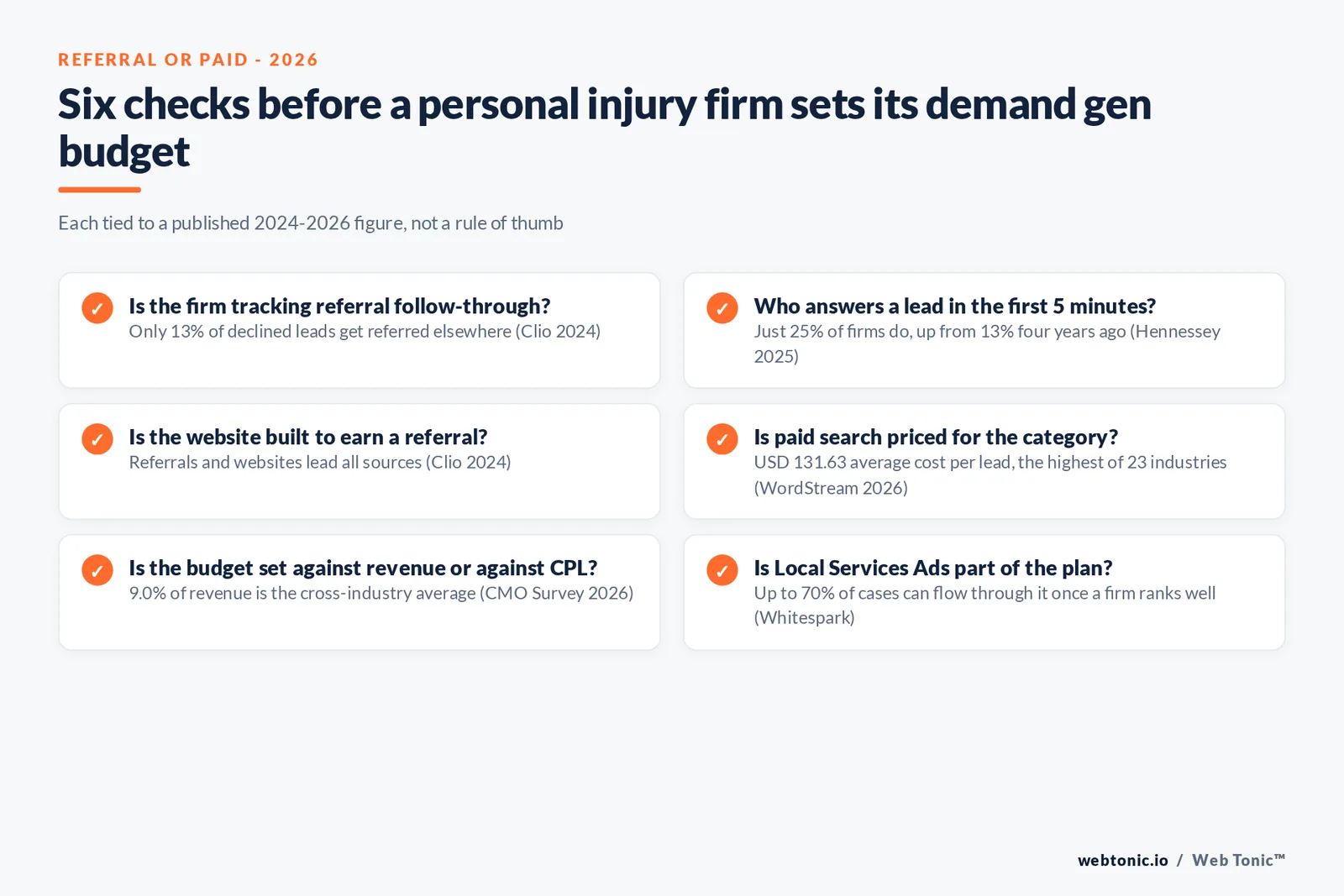
No study prices a personal-injury-specific marketing budget as a share of revenue, so the honest comparison is the cross-industry figure: The CMO Survey 2026 reports marketing budgets averaging 9.0% of company revenue, with overall marketing spend growing just 1.7% year on year - the smallest increase the survey has recorded since 2021. Applied to a category with a USD 131.63 average cost per lead, that flat budget share buys meaningfully fewer leads here than in a lower-CPL category running the identical percentage.
The practical read: a fixed percentage-of-revenue budget rule works poorly in the highest-CPL category in the WordStream dataset. Firms that treat referral cultivation, response-time discipline and paid spend as three levers on the same funnel - rather than three separate line items - are the ones whose budget share actually buys proportionate lead volume.
Where this leaves the channel mix
Referrals remain the largest single source Clio's own data documents, but they are inconsistent by nature - only 13% of declined leads get passed along, and a firm cannot budget a marketing plan around a channel it does not control. Paid search fills the gap at the highest cost per lead of any tracked industry, which makes response speed and review strength - both free to improve - the actual multipliers on that spend. Our growth marketing team builds that kind of blended plan rather than optimizing one channel in isolation; our Google Ads pricing guide breaks down how cost-per-click budgets translate into cost-per-lead targets in high-CPC categories like this one, and our cost-per-lead benchmarks by industry place this category against the rest of the field it leads.
Frequently Asked Questions
What does a personal injury lead cost through Google Ads?
USD 131.63 on average, according to WordStream's 2026 Search Advertising Benchmarks report, which pulled data from over 13,000 LocaliQ customer campaigns across 23 industries. That makes Attorneys and Legal Services the single most expensive category in the report - more than double Furniture at USD 106.70 and nearly double the USD 66.69 cross-industry average. Cost per click for the category runs USD 9.87, also the highest of the 23 industries tracked.
Do referrals really beat paid search for personal injury leads?
Clio's 2024 Legal Trends Report states plainly that referrals are the greatest source of potential clients across the legal industry, with 35% of law firms naming referrals from other legal professionals as their top lead source, followed closely by the firm's own website. But the same report finds only 13% of potential clients who couldn't be helped by a firm actually received a referral elsewhere, meaning the referral engine that firms rely on most is also the least reliably reciprocated - which is why paid search fills the gap referrals leave.
How fast do personal injury firms need to respond to a new lead?
Faster than most currently do, but the trend is improving. Hennessey Digital's 2025 Lead Form Response Time Study - built from actual lead-form submissions over a five-year window - puts the median response time to online leads at 13 minutes, with 25% of firms responding in under 5 minutes, up from 13% four years earlier. Still, 39% of firms take more than 2 hours to respond, or never respond at all, to an online lead - in a category where the injured party is likely calling two or three firms in the same hour.
Is demand generation or demand capture the bigger opportunity for personal injury?
Demand capture, structurally. Google's own Demand Gen campaign documentation describes demand generation as creating new interest through video, Discover and Gmail placements before a search happens - a model that fits categories where the buying trigger builds over time. A personal injury case starts at the moment of an accident, an event no campaign can predict, so the category is built almost entirely around demand capture: being found the moment someone searches, not creating the intent to search in the first place.
What share of a marketing budget should a personal injury firm expect to spend?
There's no personal-injury-specific benchmark, so treat this as the cross-industry number it is: The CMO Survey 2026 puts marketing budgets at 9.0% of company revenue on average across industries, with overall marketing spend growth of just 1.7% year on year. Given the category's USD 131.63 average cost per lead, a firm running that 9.0% figure against local revenue will convert it into meaningfully fewer leads than a lower-CPL category running the same budget share.
Sources
WordStream/LocaliQ - 2026 Google Ads Benchmarks by industry
Clio - 2024 Legal Trends Report
Hennessey Digital - 2025 Lead Form Response Time Study
Google Ads Help - About Demand Gen campaigns
Whitespark - 2026 Local Search Ranking Factors report
The CMO Survey - Highlights and Insights Report 2026