Table of contents

A med spa's Google Business Profile carries a category-conflict risk most local businesses never encounter - a medical spa entity and a supervising practitioner at the same address - layered on top of an industry where AmSpa reports 73% of visits are repeat patients. This page weighs the published cost of managing that profile against the published cost of getting the category structure wrong.
Key Takeaways
- The medical aesthetics industry has passed USD 17 billion and is growing more than USD 1 billion a year (AmSpa State of the Industry).
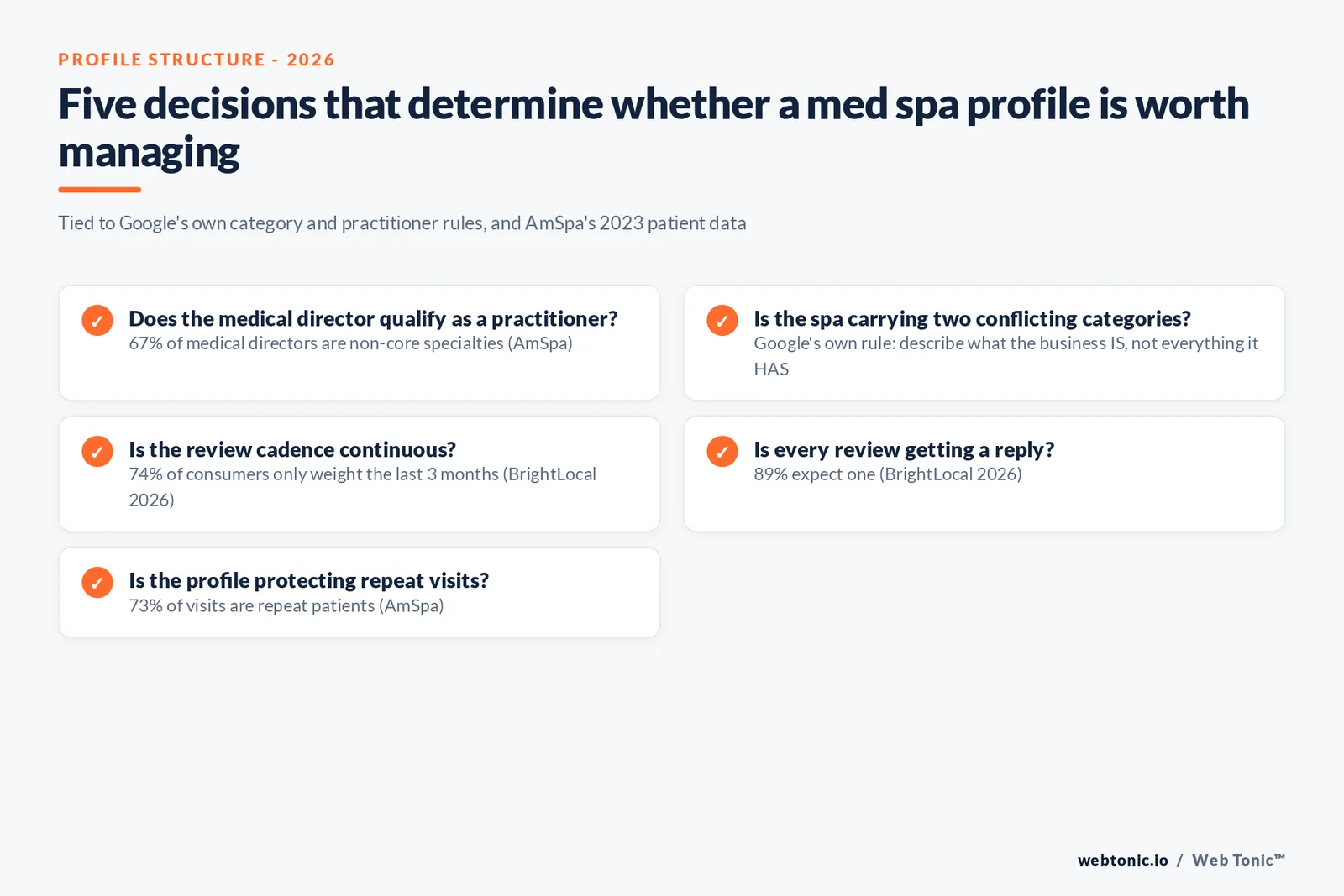
- 73% of aesthetic patient visits are repeat patients, per AmSpa's 2023 industry data.
- Average spend per patient per visit is USD 245 (AmSpa).
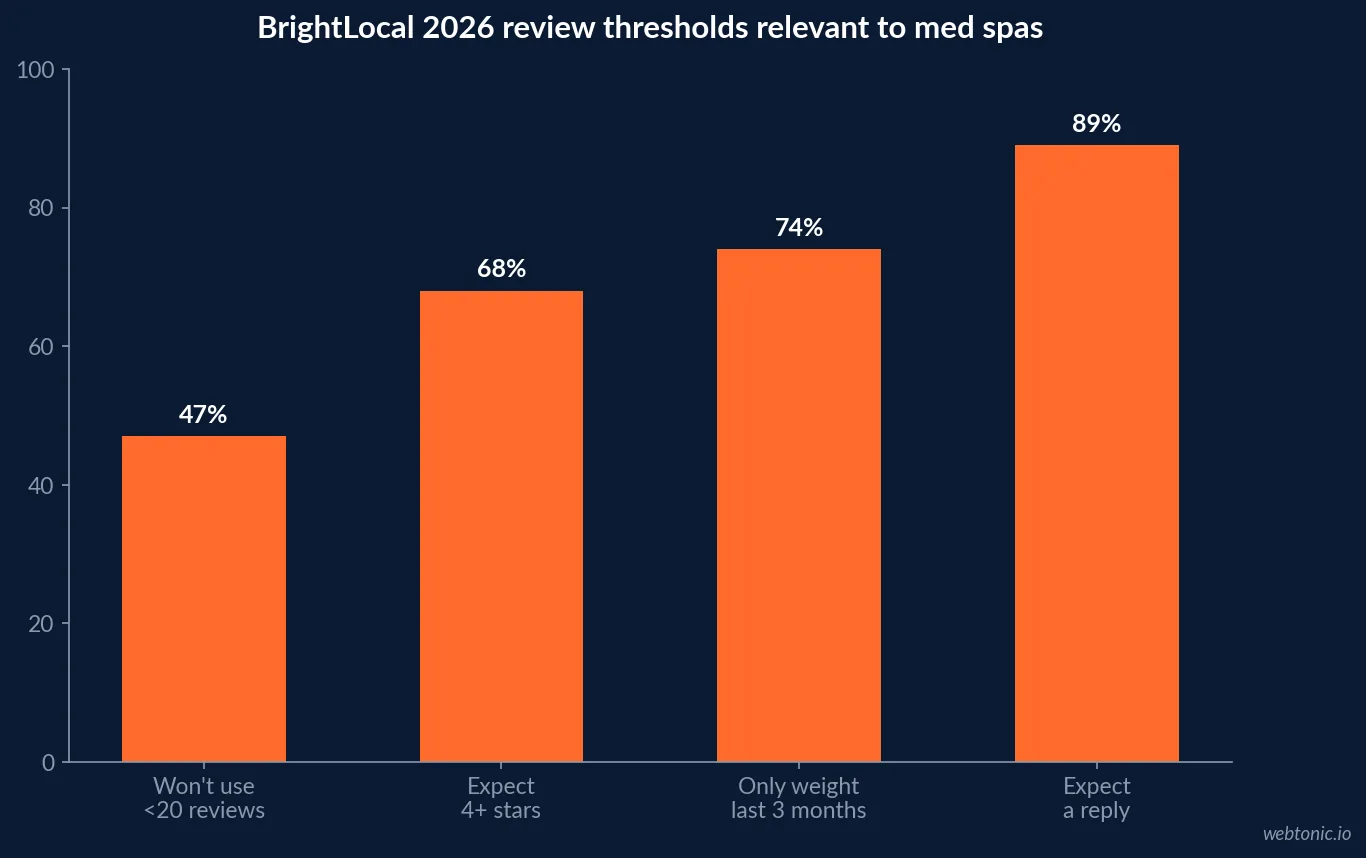
- 47% of consumers won't use a business with fewer than 20 reviews (BrightLocal LCRS 2026).
- 68% expect at least a 4-star average (BrightLocal LCRS 2026).
- 74% only weight reviews from the last 3 months (BrightLocal LCRS 2026).
- 89% expect a business to reply to its reviews (BrightLocal LCRS 2026).
- Google's own category guidelines require choosing the most specific "this business IS" category, not a list of everything a location offers or contains.
- Individual practitioners must be public-facing with their own client base to qualify for a dedicated profile, per Google's guidelines.
- Support staff and non-public-facing roles are not eligible for their own Business Profile under the same rule.
- 67% of medical directors at med spas are non-core specialties, and 74% of med spas are owned by non-MDs/surgeons (AmSpa).
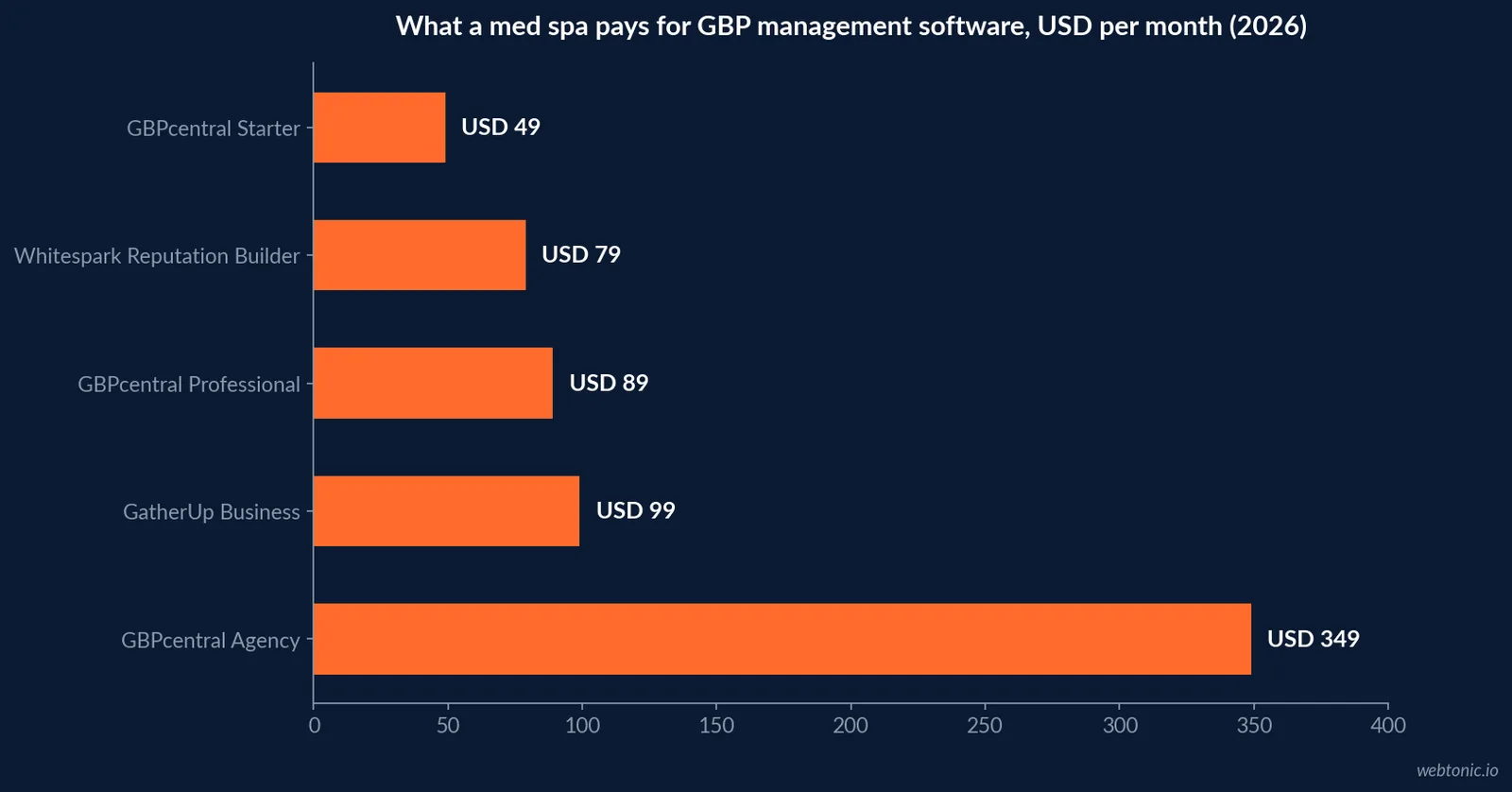
- Published GBP tool tiers run USD 49 to 349 a month across GBPcentral, Whitespark and GatherUp.
- 48% of med spas hired a medical director in the last year (AmSpa).
| Signal (year noted) | Figure | Source | Relevance to the profile |
|---|---|---|---|
| Industry size | USD 17B+, growing USD 1B+/year | AmSpa State of the Industry | A large, still-consolidating category |
| Repeat-visit share | 73% of aesthetic visits | AmSpa (2023 data) | One bad review outlasts one visit |
| Average spend per visit | USD 245 | AmSpa (2023 data) | Sets the value of one converted profile view |
| Review floor to be considered | 47% won't use <20 reviews | BrightLocal LCRS 2026 | A thin review count is a visible handicap |
| Reply expectation | 89% expect a reply | BrightLocal LCRS 2026 | Unanswered reviews read as unmanaged |
| Published GBP tool cost range | USD 49-349/month | GBPcentral, Whitespark, GatherUp pricing pages | The software floor before any specialist labor |
The category-conflict risk that is specific to this business type
Google's own guidelines for representing your business instruct owners to "use as few categories as possible," choose categories that "complete the statement 'This business IS a' rather than 'this business HAS a,'" and specifically warn against categories that "pertain to other businesses that are nearby or related, such as a business physically contained within your business or an entity that contains your business." A med spa sits exactly on that line: the location is a medical spa business, but it is also, in many states, operating under a supervising physician or medical director who may be a separate legal entity. Structuring the profile as one business with the wrong second category, or as two competing profiles at one address, is the mechanism behind most category-conflict issues in this space - not a random enforcement action.
Whose name goes on the profile: the practitioner rule applied to medical directors
The same Google guidelines classify doctors as individual practitioners: public-facing professionals with their own client base, eligible for a dedicated profile that can include a title or degree certification. The qualifying test is specific - a practitioner "can be contacted directly at the verified location during stated hours," and "support staff should not create their own Business Profiles." AmSpa's own industry data shows why this matters for med spas specifically: 67% of medical directors are non-core specialties relative to aesthetics, and 74% of med spas are owned by non-MDs or surgeons. A medical director in a purely supervisory role, without direct patient contact at that location, does not meet Google's public-facing test and should not have a dedicated profile competing with the med spa's own listing.
| Role at the med spa | Google Business Profile eligibility | Common mistake |
|---|---|---|
| Injector or aesthetician seeing patients directly | Can qualify as an individual practitioner | No profile at all, folded into the brand listing |
| Medical director, supervisory only, no direct patient contact | Does not meet the public-facing test | Given a dedicated profile that competes with the med spa's own listing |
| Medical director who also treats patients on-site | Can share a profile per the solo-practitioner branded format | Two separate profiles for the same address |
| Front-desk / intake staff | Not eligible for their own profile | Issued a listing to try to rank a staff name |
| The med spa business itself | One profile, most specific single category | Categories stacked to cover every service offered |
What the review requirement actually costs to satisfy
BrightLocal's 2026 Local Consumer Review Survey sets the bar most med spas underestimate: 47% of consumers won't use a business with fewer than 20 reviews, 68% expect at least a 4-star average, and - the part that punishes inconsistent review requests - 74% only weight reviews written in the last three months. Add 89% expecting a reply to reviews left, and the requirement is not "collect reviews" but "collect them continuously and answer every one," which is a recurring task, not a one-time project.
Weighing the cost against the size of the mistake
AmSpa's data frames the stakes: the industry has passed USD 17 billion and is still growing more than USD 1 billion a year, average spend runs USD 245 per patient visit, and 73% of visits are repeat patients rather than one-time buyers. A med spa that gets its category structure wrong, lets reviews go stale, or assigns the wrong person a competing profile is not just losing new-patient searches - it is undermining the trust signal that a large, repeat-visit patient base is built on.
Against that, published software tiers of USD 49 to 349 a month (GBPcentral, Whitespark's Reputation Builder at USD 79 per location, GatherUp at USD 99) cover the recurring review and posting workload. None of them make the category-structure decision above, which is the part that actually determines whether the profile stays live.
| What needs doing | Software tier alone | Specialist review |
|---|---|---|
| Review requests + reply cadence | Covered | Not required if cadence is consistent |
| Rank tracking, posting | Covered | Not required |
| Category structure (spa vs practitioner) | Not covered | One-time audit, ongoing monitoring |
| Medical director profile eligibility | Not covered | Judgment call against Google's own test |
| Response to a category or policy flag | Not covered | Requires reading Google's guidelines directly |
What the photos and posts policy allows before and after treatment content goes up
Google's own Business Profile photos, videos and posts content policy makes owners "responsible for making sure that your posted content complies with all applicable laws and regulations," a rule that carries real weight for a category where before-and-after imagery is standard marketing material and state-level medical advertising rules vary widely. Google's guidelines don't publish a med-spa-specific exception list, which means the compliance judgment call sits with the practice, not with the platform - a policy gap that a specialist reviewing content before it posts is better positioned to catch than a scheduling tool that only checks image dimensions.
The same policy applies to Business Profile posts, which Google frames as a channel for "sales, specials, events, news and offers" - useful for driving repeat visits among the 73% of patients AmSpa reports are already returning, but only if the posting cadence stays current enough to satisfy the same recency expectations reviews carry.
| Content type | Google's stated requirement | Med-spa-specific risk |
|---|---|---|
| Before/after treatment photos | Must comply with all applicable laws and regulations | State medical-advertising rules aren't covered by Google's own policy |
| Posts (offers, events, news) | Owner-submitted, subject to prohibited/restricted content rules | Stale posts undercut the recency signal reviews already require |
| Patient testimonials in posts | Same content-policy standard as photos | Overlaps with medical-marketing disclosure rules in some states |
| Medical director credentials | Practitioner titles allowed (Dr., MD, etc.) | Must match the licensing name Google can cross-check |
So, is it worth it?
The published data does not support treating a med spa's profile as a set-and-forget asset, nor does it justify an expensive specialist retainer for a single-location business with a clean category structure. The honest answer sits in between: the recurring review and posting work is worth the published USD 49 to 349 a month it costs to run through software, and the one-time and ongoing category-structure and content-compliance decisions are worth getting a second, informed opinion on, because AmSpa's own data shows how much repeat-visit revenue is riding on the profile staying visible. Our growth marketing practice reviews that category structure as part of a broader local visibility engagement for aesthetics clients, and our paid social ROI research covers the same before/after content question for platforms with stricter ad-review rules than a Business Profile. For the budget side of this decision, our team can walk through what a realistic marketing plan costs against AmSpa's own spend data.
Frequently Asked Questions
Is a Google Business Profile actually worth managing for a med spa?
The published evidence says the downside of neglecting it is larger than the cost of managing it. BrightLocal's 2026 Local Consumer Review Survey finds 47% of consumers won't use a business with fewer than 20 reviews and 74% only weight reviews from the last 3 months - both requirements a med spa cannot meet passively. Weighed against published software tiers of USD 49 to 349 a month, an unmanaged profile risks losing access to an industry where AmSpa reports 73% of visits are repeat patients, meaning a bad first impression online has a long tail.
Why do med spas have a higher Google Business Profile category-conflict risk than most businesses?
Because a single location often has to represent two different entities: a medical spa business and a supervising physician or medical director who may also qualify as an individual practitioner under Google's own guidelines. Google's category rules say a profile should describe what a business IS, not everything it HAS, and should avoid categories for a different, related entity at the same address. A med spa carrying both a 'Medical Spa' category and a practitioner-style category for its medical director at the same address is exactly the kind of two-entity structure those rules are written to prevent.
Should the medical director have a separate Business Profile from the med spa?
Only if they are public-facing with their own client base, per Google's individual practitioner guidelines - the same rule applied to doctors, dentists and other licensed professionals. Many medical directors at med spas hold a supervisory role rather than a direct-treatment one, in which case they don't meet the public-facing test and shouldn't have a dedicated profile at all. Getting this wrong in either direction is one of the more common category-structure mistakes in the category.
How many reviews does a med spa need before it shows up as a credible option?
BrightLocal's 2026 Local Consumer Review Survey puts the floor at 20 reviews - 47% of consumers say they won't consider a business below that - with 68% expecting at least a 4-star average and 89% expecting a reply to reviews left. For a purchase this personal, a profile with a handful of stale reviews reads as a bigger red flag than it would for a lower-consideration category.
What does it cost to manage a med spa's profile against what a software tool covers?
Published GBP management tools run USD 49 to 349 a month across GBPcentral, Whitespark's Reputation Builder (USD 79 per location) and GatherUp (USD 99). None of them structure the category split above or catch a policy violation before Google does - that judgment call is the part a med spa is actually paying for when it brings in specialist help rather than running software alone.
Sources
Google Business Profile Help - Guidelines for representing your business, categories and practitioners
Google Business Profile Help - Photos, videos and posts content policy
Google Business Profile Help - Create and manage posts
BrightLocal - Local Consumer Review Survey 2026
American Med Spa Association - Medical Spa State of the Industry Report
GBPcentral - GBP management software pricing
Whitespark - Reputation Builder pricing
GatherUp - Pricing