Table of contents

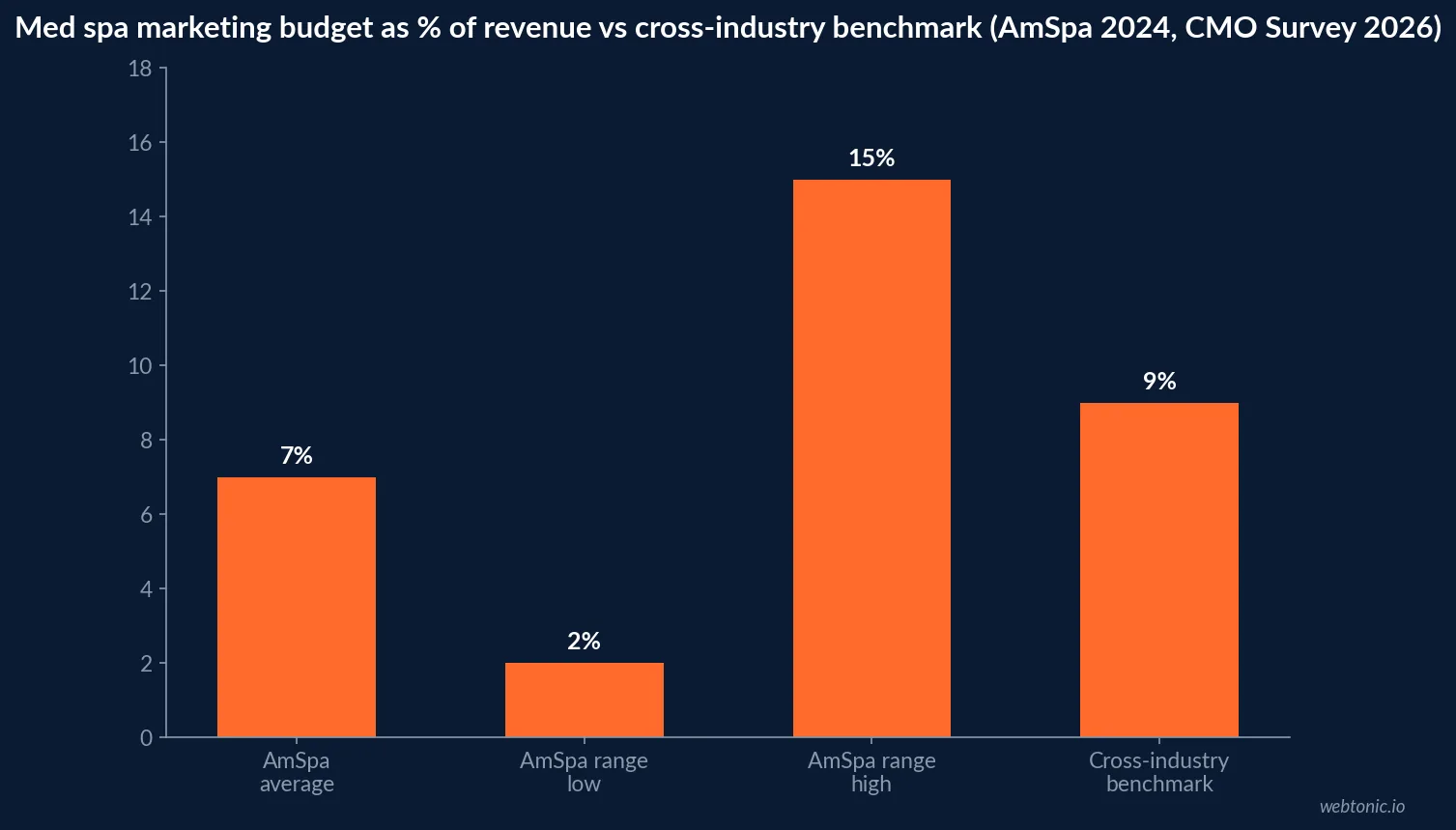
AmSpa's own survey puts the average med spa marketing budget at 7% of revenue, spanning a documented range of 2% to 15%, in an industry that has passed USD 17 billion and is still growing more than USD 1 billion a year. This page sets that budget range against the closest published ad-cost proxy and the repeat-visit economics that decide where the money should actually go.
Key Takeaways
- Average med spa marketing budget is 7% of revenue, per AmSpa's own survey data.
- Budgets range from 2% to 15% of revenue across the aesthetic industry (AmSpa).
- AmSpa's own experts recommend 7% to 10% for steady growth, and up to 12% for spas actively chasing new-patient growth.
- The cross-industry marketing budget benchmark is 9.0% of revenue (The CMO Survey 2026, all industries, not aesthetics-specific).
- Overall marketing spend grew just 1.7% year on year across that same cross-industry survey.
- The medical aesthetics industry has passed USD 17 billion and grows more than USD 1 billion a year (AmSpa).
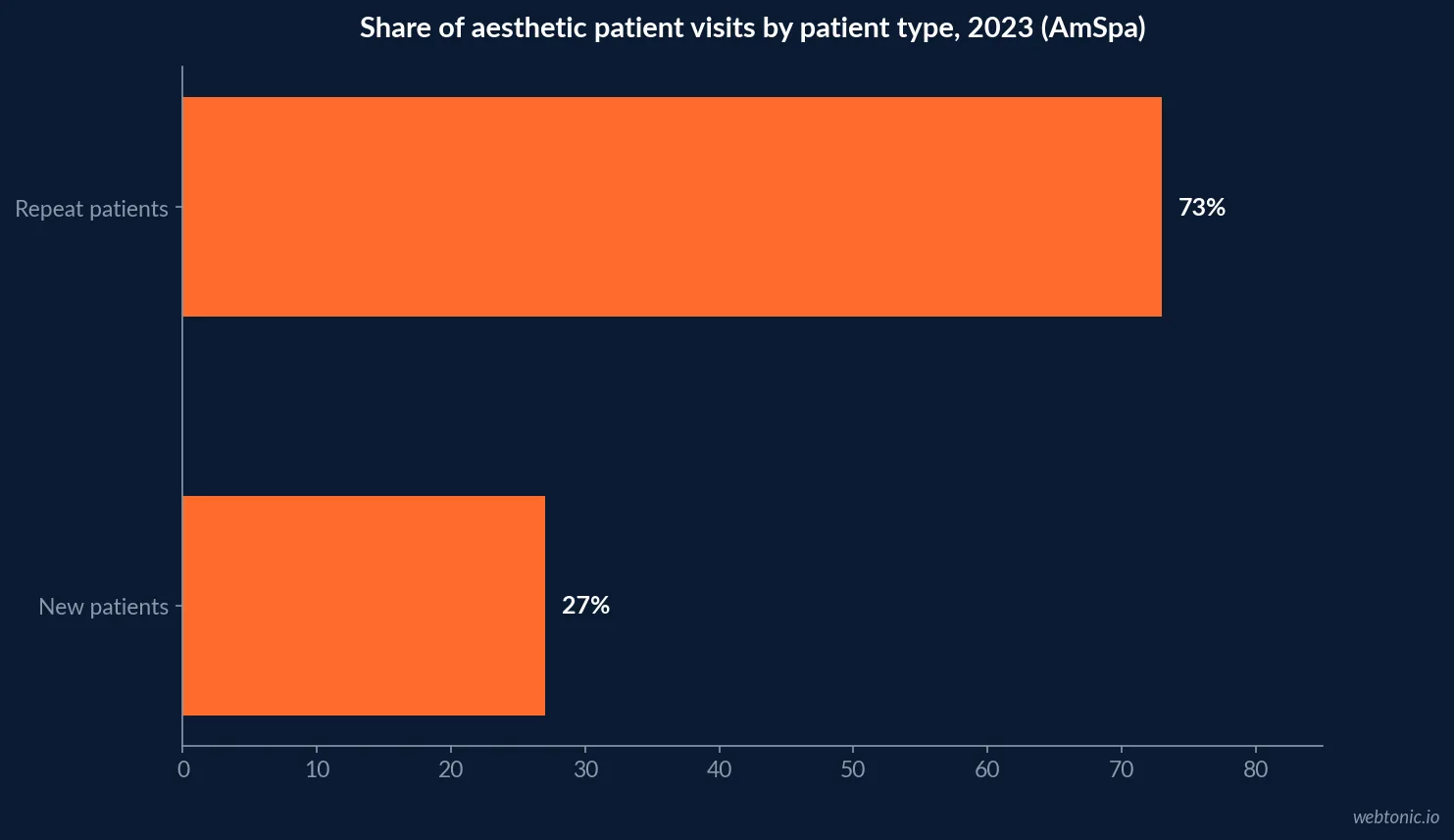
- 73% of aesthetic patient visits are repeat patients (AmSpa).
- Average spend per patient per visit is USD 245 (AmSpa).
- Beauty and Personal Care cost per lead fell 34.95% year over year in Google and Microsoft Ads (WordStream 2026).
- Beauty and Personal Care click-through rate rose 18.21% year over year (WordStream 2026).
- Beauty and Personal Care conversion rate rose 32.34% year over year - the largest CVR gain of any industry tracked (WordStream 2026).
- The average conversion rate across all 23 industries is 8.18% (WordStream 2026, cross-industry benchmark).
- 48% of med spas hired a medical director in the last year (AmSpa), a cost line that competes with the same budget.
| Budget benchmark (year noted) | Figure | Source | How specific is it |
|---|---|---|---|
| Average med spa marketing budget | 7% of revenue | AmSpa 2024 State of the Industry survey | Aesthetics-specific |
| Range across the industry | 2% to 15% of revenue | AmSpa 2024 survey | Aesthetics-specific |
| Recommended range for steady growth | 7% to 10% of revenue | AmSpa industry experts | Aesthetics-specific, advisory |
| Cross-industry marketing budget benchmark | 9.0% of revenue | The CMO Survey 2026 | All industries - not aesthetics-specific |
| Repeat-visit share of volume | 73% of visits | AmSpa (2023 data) | Aesthetics-specific |
| Average spend per visit | USD 245 | AmSpa (2023 data) | Aesthetics-specific |
What AmSpa's own survey says to actually budget
AmSpa's own reporting on its 2024 State of the Industry survey states that, on average, a medical spa invests about 7% of its revenue in marketing, with the range running 2% to 15% depending on business size, competitive intensity and growth ambitions. AmSpa's own industry experts frame the practical range as 7% to 10% of revenue to maintain steady growth, with spas actively pursuing new-patient growth pushing toward 8% to 12%.
Set against The CMO Survey 2026's cross-industry average of 9.0% of revenue, the typical med spa is budgeting slightly below the general benchmark - which tracks with AmSpa's own experts pushing spas toward the top of their documented range rather than the average.
The closest published ad-cost proxy, labelled honestly
No major benchmark report tracks a "med spa" or "medical aesthetics" line item specifically. The closest published proxy is WordStream's 2026 Search Advertising Benchmarks Beauty and Personal Care category, built from over 13,000 LocaliQ customer campaigns. In the 2026 edition, that category posted the largest year-over-year cost-per-lead decrease of any of the 23 industries tracked, at 34.95%, alongside an 18.21% increase in click-through rate and the largest conversion rate gain of any industry, at 32.34%. Treat this as a beauty-category signal, not a med-spa-specific number - injectables and energy-device treatments carry a materially higher average ticket than most advertisers inside that broader category.
| Metric (2026, YoY change) | Beauty and Personal Care | Cross-industry context | Source |
|---|---|---|---|
| Cost per lead | Down 34.95% (largest decrease of 23 industries) | USD 66.69 average CPL across industries | WordStream 2026 |
| Click-through rate | Up 18.21% | 6.64% average CTR across industries | WordStream 2026 |
| Conversion rate | Up 32.34% (largest gain of 23 industries) | 8.18% average CVR across industries | WordStream 2026 |
| Average cost per click | Not separately broken out in the public report | USD 5.42 average CPC across industries | WordStream 2026 |
Why retention deserves a bigger line than most budgets give it
AmSpa's own patient data reframes where the money should go: 73% of aesthetic patient visits are repeat patients, at an average spend of USD 245 per visit. A med spa's existing patient base already accounts for the majority of visit volume before a single acquisition dollar gets spent on a new-patient channel. A budget split entirely toward Beauty and Personal Care-style paid acquisition, with nothing reserved for the recall and rebooking systems that keep repeat patients coming back, is optimizing for the smaller half of the business.
Building the split: acquisition, retention and the medical-director cost line
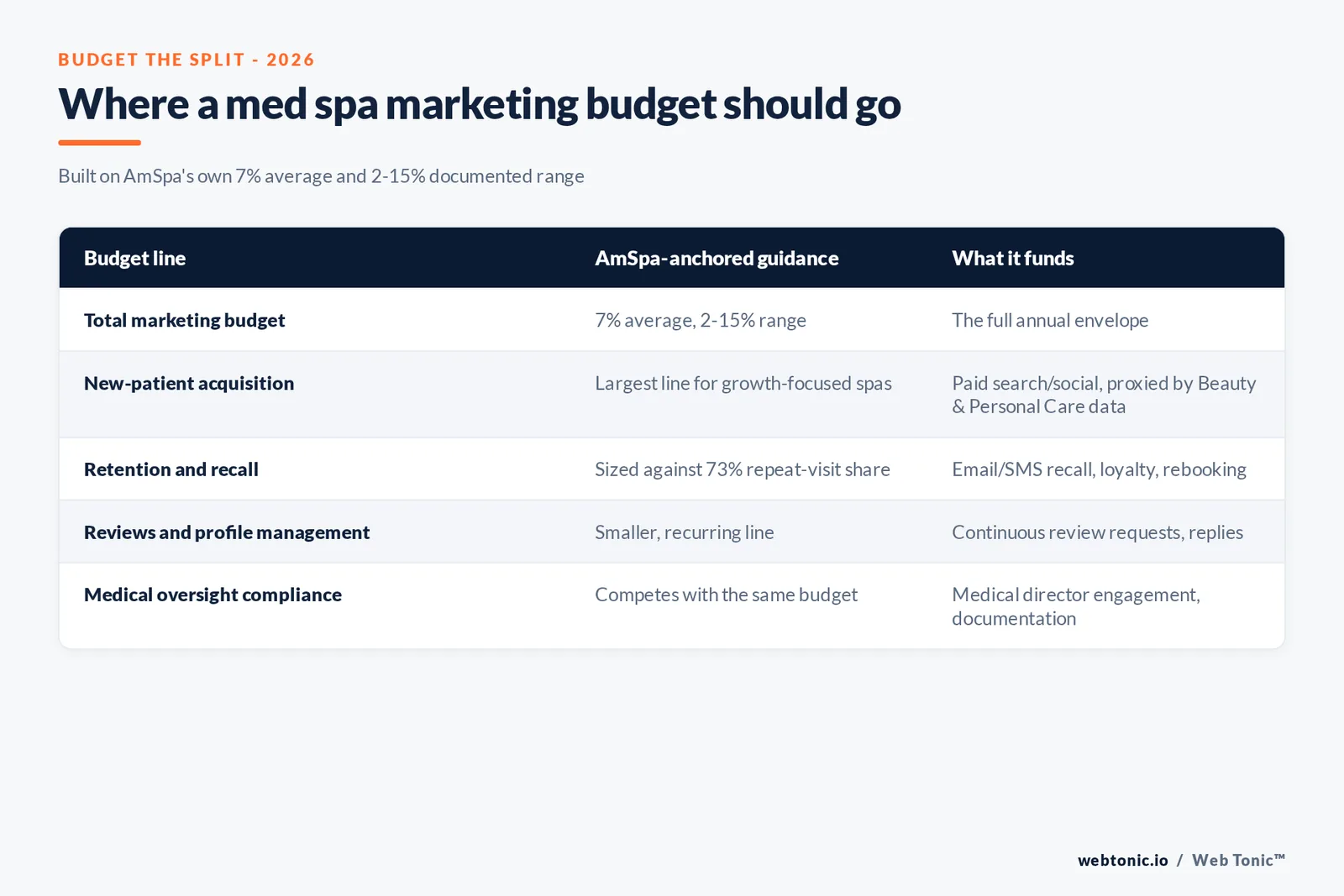
A realistic annual plan inside AmSpa's own 7% to 12% range has to cover three things at once: new-patient acquisition (the Beauty and Personal Care proxy above), retention systems for the 73% of visits that are repeat business, and the operational cost of compliant medical oversight - AmSpa reports 48% of med spas hired a medical director in the last year, a cost that competes with the same budget line in smaller practices.
| Budget line | AmSpa-anchored guidance | What it has to fund |
|---|---|---|
| Total marketing budget | 7% average, 2-15% range, 7-10% for steady growth | The full annual envelope |
| New-patient acquisition | Largest single line for growth-focused spas | Paid search/social, proxied by Beauty and Personal Care benchmarks |
| Retention and recall systems | Sized against 73% repeat-visit share | Email/SMS recall, loyalty, rebooking automation |
| Reviews and profile management | Smaller, recurring line | Continuous review requests, response cadence |
| Medical oversight compliance cost | Competes with the same budget in smaller spas | Medical director engagement, documentation |
Why demand held up even when discretionary spending didn't
The category's resilience is documented outside AmSpa's own survey too. The American Society of Plastic Surgeons' 2024 Procedural Statistics report found total cosmetic surgery and minimally invasive treatment volume held roughly steady through economic headwinds, posting 1% and 1.5% year-over-year increases respectively. Neuromodulator injections alone - Botox and its category peers - reached 9,883,711 procedures in 2024, more than double the volume of the next-largest minimally invasive treatment category. That kind of demand stability is exactly what supports AmSpa's documented budget range holding steady rather than needing a defensive cut in a softer year.
The practical read for a marketing calendar: procedure volume this concentrated in a handful of recurring, repeatable treatments (injectables, fillers, skin resurfacing) means a med spa's demand generation plan can lean on scheduled recall campaigns tied to typical treatment intervals, rather than guessing at seasonality the way a one-time-purchase category has to.
| Procedure category (2024) | US volume | YoY change | Source |
|---|---|---|---|
| Neuromodulator injections (Botox and peers) | 9,883,711 | +4% | ASPS 2024 Procedural Statistics |
| HA fillers | 5,331,426 | +1% | ASPS 2024 Procedural Statistics |
| Skin resurfacing | 3,703,305 | +6% | ASPS 2024 Procedural Statistics |
| Total minimally invasive procedures | Over 28.5 million | +1.5% | ASPS 2024 Procedural Statistics |
Where the cross-industry budget is actually moving in 2026
A cross-industry benchmark worth naming clearly as such: HubSpot's 2026 State of Marketing report, surveying over 1,500 global marketers, found 79.2% of marketing teams expect at least a slight budget increase in 2026, with paid social media (37.4%) and video marketing (37.1%) among the top areas marketers plan to increase investment in - both formats that map directly onto how aesthetic treatments are typically marketed and shown. The same report found 73% of marketers say their budget receives more scrutiny than in the past, which reinforces why AmSpa's own documented 2% to 15% range, not a single flat number, is the more useful planning anchor for a med spa's own budget conversation.
Is it still worth the spend?
The published data supports continued investment, with a caveat on discipline. WordStream's Beauty and Personal Care category posted the largest conversion rate improvement of any tracked industry in 2026, and AmSpa's own industry size data shows the category is still expanding rather than saturating. The risk is not overspending; AmSpa's documented range shows most spas already sit at or below the cross-industry 9.0% benchmark, meaning under-resourcing - not overspending - is the more common way spas leave growth on the table. Our growth marketing team builds acquisition-and-retention plans against exactly this kind of blended budget rather than a single channel's cost per lead, our conversion rate benchmarks give the cross-industry context for the CVR gain above, and our Facebook Ads budgeting guide covers the paid-social side of an aesthetics acquisition plan in more depth.
Frequently Asked Questions
What percentage of revenue should a med spa budget for marketing?
AmSpa's own 2024 State of the Industry survey puts the average at 7% of revenue, with a documented range of 2% to 15% depending on business size, competitive intensity and growth ambitions. AmSpa's own industry experts recommend 7% to 10% for steady growth and up to 12% for a med spa actively chasing new-patient growth rather than maintaining its current base.
How does that compare to the cross-industry marketing budget benchmark?
It runs below the general benchmark. The CMO Survey 2026 reports marketing budgets averaging 9.0% of revenue across all industries surveyed - a cross-industry figure, not aesthetics-specific. A med spa budgeting the AmSpa average of 7% is running slightly lean against that broader marker, which may explain why AmSpa's own experts push toward 8% to 12% for spas prioritizing growth.
What does a click or a lead cost in the closest tracked ad category?
There's no med-spa-specific line in the major ad benchmark reports, so the closest published proxy is WordStream's Beauty and Personal Care category, which saw a 34.95% year-over-year decrease in cost per lead, an 18.21% increase in click-through rate and a 32.34% increase in conversion rate in the 2026 report - the largest CVR gain of any of the 23 industries tracked. Treat this as a beauty-category proxy, not a med-spa-specific number: injectables and energy-device services carry a materially higher average transaction value than most Beauty and Personal Care advertisers in that dataset.
Is new-patient acquisition or retention the better use of a med spa's budget?
The math favors weighting retention more than most new-patient-focused plans do. AmSpa reports 73% of aesthetic patient visits come from repeat patients, at an average spend of USD 245 per visit - meaning the existing patient base is already the majority of visit volume before a single acquisition dollar is spent. A budget split entirely toward new-patient channels is optimizing for the smaller side of the business.
Is med spa demand generation still worth the spend given rising competition?
The published data says yes, conditionally: WordStream's Beauty and Personal Care category posted the largest year-over-year conversion rate improvement of any industry it tracks in 2026, and AmSpa's own industry size - over USD 17 billion and still growing more than USD 1 billion a year - shows the category is expanding, not saturating. The condition is budget discipline: AmSpa's own range spans 2% to 15% of revenue, meaning under-resourcing marketing at the low end of that range is a common way spas leave growth on the table without knowing it.
Sources
American Med Spa Association - How much should a med spa spend on marketing
American Med Spa Association - Medical Spa State of the Industry Report
WordStream/LocaliQ - 2026 Google Ads Benchmarks by industry
The CMO Survey - Highlights and Insights Report 2026
American Society of Plastic Surgeons - 2024 Procedural Statistics report
HubSpot - 2026 State of Marketing report